
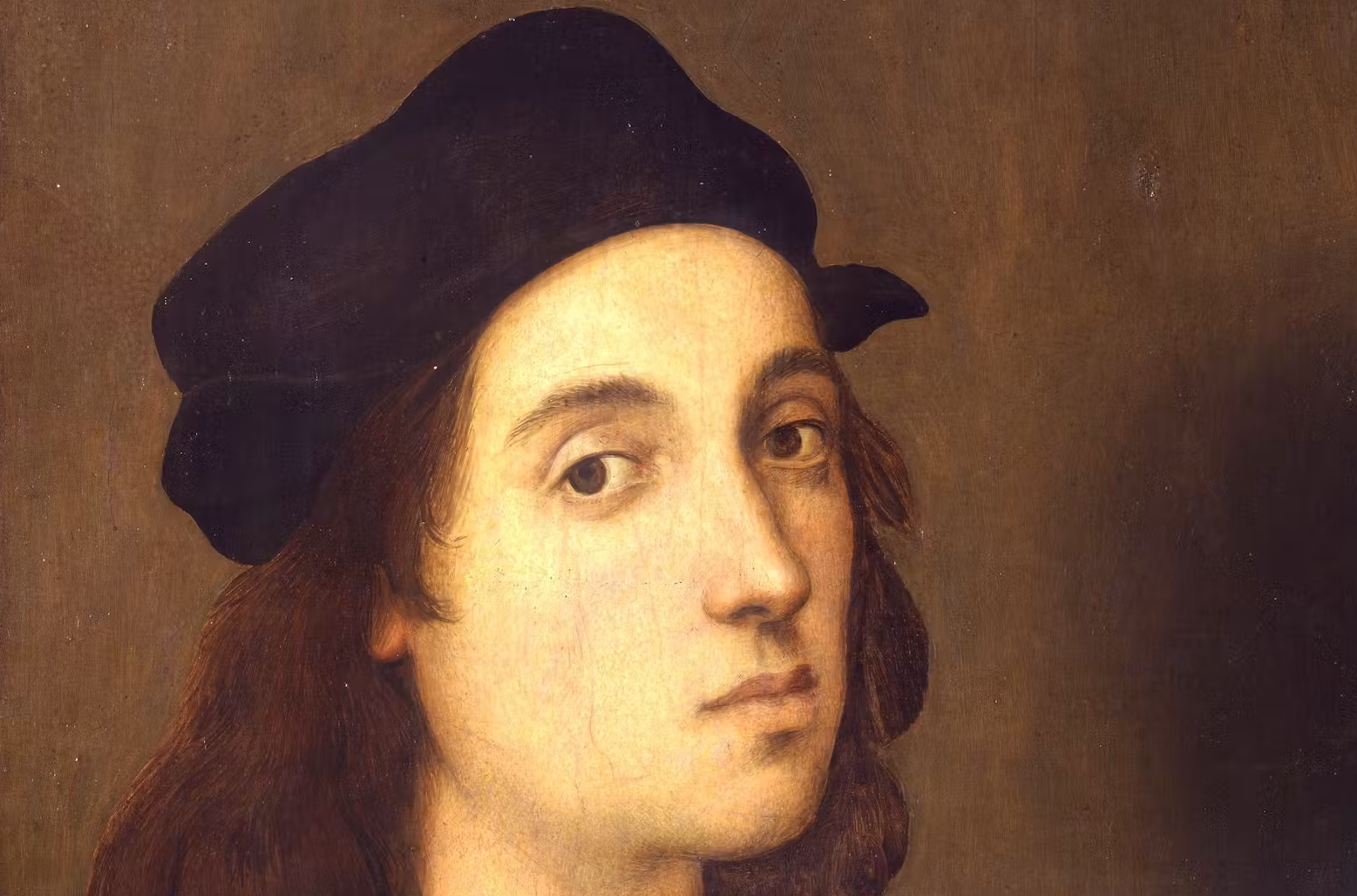
 Raphael—known in Italian as Raffaello Sanzio or Raffaello Santi—was one of the defining artists of the High Renaissance. In little more than two decades of professional activity, he created paintings and frescoes admired for their balance, clarity, graceful figures and ability to transform complex ideas into harmonious compositions.
Born in Urbino in 1483, Raphael absorbed the lessons of Perugino, Leonardo da Vinci, Michelangelo and classical antiquity without becoming an imitator. He developed a distinctive visual language that combined emotional warmth with ideal beauty. His Madonnas established new standards for religious painting, his portraits revealed personality beneath courtly appearances, and his Vatican frescoes became some of the most influential images in Western art.
Raphael was also an architect, archaeological surveyor, designer of tapestries and director of one of Renaissance Rome’s largest artistic workshops. His death in 1520, at only 37, ended a remarkably productive career that helped define what later generations understood as classical perfection.
Raphael’s Childhood in Urbino
Raphael was born in Urbino, in Italy’s present-day Marche region, on either March 28 or April 6, 1483. The second date is traditionally favored because the artist and biographer Giorgio Vasari wrote that Raphael was born and died on Good Friday, exactly 37 years apart.
Urbino was small, but its ducal court was one of Renaissance Italy’s most sophisticated cultural centers. The city brought together painters, architects, poets, mathematicians and humanist scholars under the patronage of the Montefeltro family. Raphael therefore encountered courtly culture and intellectual life from childhood.
His father, Giovanni Santi, was a painter and poet employed at the court of Federico da Montefeltro and his successors. Giovanni probably gave Raphael his earliest instruction and introduced him to the practical operation of an artist’s workshop. More importantly, he taught his son how an artist could move comfortably among aristocratic patrons, writers and diplomats.
Raphael’s mother, Magia di Battista Ciarla, died in 1491. Giovanni died three years later, leaving Raphael orphaned at approximately eleven years old. Although the details of his subsequent training remain uncertain, the young artist maintained connections with his father’s workshop and Urbino’s courtly circles.
Visitors can explore this formative environment at the Palazzo Ducale and National Gallery of the Marche in Urbino. The traditionally identified Casa Natale di Raffaello, or Raphael’s birthplace, is also preserved in the city.
Training and the Influence of Perugino
Raphael is closely associated with Pietro Perugino, the leading Umbrian painter of the period. Vasari described him as Perugino’s pupil, although surviving documentation does not establish the precise nature or duration of their relationship.
The connection is unmistakable in Raphael’s early work. From Perugino he learned to organize figures within spacious landscapes, use clear perspective and create serene religious scenes with graceful gestures. For a time, their styles were so similar that some works were difficult to attribute with certainty.
By 1500, when Raphael was still a teenager, a contract described him as a “master.” He began receiving independent commissions in Città di Castello, including altarpieces for local churches. These early projects demonstrate how quickly he moved beyond apprenticeship.
One of his first major achievements was the Marriage of the Virgin, completed in 1504 and now in Milan’s Pinacoteca di Brera. The figures and subject recall Perugino, but Raphael created a more unified relationship between the people, the geometric pavement and the centrally planned temple in the background. The painting already reveals his extraordinary instinct for architectural space and compositional order.
Raphael’s Umbrian period also produced the Mond Crucifixion, the Coronation of the Virgin and the Colonna Altarpiece. These works retain Perugino’s lyrical calm while showing a growing interest in movement, individual expression and structural clarity.
Florence and the Lessons of Leonardo and Michelangelo
Raphael arrived in Florence around 1504, when the city was experiencing a remarkable concentration of artistic talent. Leonardo da Vinci and Michelangelo were both active there, and their designs for competing battle murals attracted widespread attention.
Rather than following either artist completely, Raphael studied what each could teach him. From Leonardo he absorbed pyramidal composition, atmospheric landscape, subtle emotional relationships and the delicate transitions of light and shadow known as sfumato. Michelangelo offered a different model: powerful anatomy, twisting movement and bodies that expressed both physical and psychological energy.
Raphael transformed these influences in a series of celebrated paintings of the Virgin and Child. Works such as the Madonna of the Goldfinch, Madonna of the Meadow and La Belle Jardinière arrange Mary, Jesus and the young Saint John the Baptist in stable triangular groups. Their gestures and exchanged glances create affection without theatrical sentimentality.
The figures feel natural, yet every movement contributes to a carefully controlled design. This combination of human tenderness and formal discipline became one of Raphael’s greatest strengths.
The portraits of the Florentine merchant Agnolo Doni and his wife, Maddalena Strozzi, reveal his close study of Leonardo’s portraiture. At the same time, the clarity of their faces, fabrics and jewelry demonstrates Raphael’s increasingly independent style. The Uffizi Galleries’ account of the Doni portraits explains their commission and unusual painted reverse panels.
Raphael’s Florentine years were not an isolated phase of study. He continued accepting commissions elsewhere and maintained connections across central Italy. His ability to learn rapidly, adapt and cultivate patrons prepared him for the opportunity that transformed his career.
Readers interested in this wider artistic context can continue with ItaliaMia’s guide to the Italian Renaissance and its overview of the principal Italian art movements and periods.
Raphael in Rome
Raphael moved to Rome in 1508, probably with the support of the architect Donato Bramante, who may have been a distant relative or family associate. Pope Julius II was transforming the Vatican and rebuilding Saint Peter’s Basilica as visible expressions of papal authority. Raphael entered an environment in which art, architecture, theology and politics were inseparable.
Julius commissioned him to decorate rooms in the papal apartments. The project ultimately included four interconnected spaces now called the Stanze di Raffaello, or Raphael Rooms. Raphael and his workshop continued working on them under Julius II and his successor, Pope Leo X.
The first room, the Stanza della Segnatura, contains Raphael’s most famous frescoes. Its program presents theology, philosophy, poetry and justice as complementary paths toward knowledge.
The Disputation of the Holy Sacrament represents Christian theology. Parnassus celebrates poetry under the protection of Apollo and the Muses. The Cardinal and Theological Virtues address justice. Facing the Disputation is Raphael’s most celebrated fresco, The School of Athens.
The School of Athens
The School of Athens brings the philosophers of antiquity together inside a monumental classical building. Plato and Aristotle occupy the center, surrounded by thinkers engaged in teaching, argument, calculation and contemplation.
Plato points upward, suggesting eternal forms and truths beyond the material world. Aristotle extends his hand horizontally, directing attention toward observable reality. Their opposing but balanced gestures summarize a fundamental philosophical debate while anchoring the entire composition.
Raphael used linear perspective to guide the viewer toward the two central figures. The building’s arches, coffering and massive piers create an idealized vision of classical architecture related to Bramante’s designs for the new Saint Peter’s Basilica.
Several ancient thinkers may carry the features of Raphael’s contemporaries. Plato is often associated with Leonardo da Vinci, while the brooding Heraclitus in the foreground is traditionally interpreted as a tribute to Michelangelo. Raphael also inserted his own face at the right edge of the gathering, quietly identifying himself with this community of intellectual achievement.
The fresco is not merely an assembly of famous philosophers. It is an image of knowledge as an active social process. People read, teach, listen, calculate and disagree, yet every group belongs within a larger harmonious order. The official Vatican Museums guide to the Room of the Segnatura provides a closer introduction to the fresco cycle.
The Other Raphael Rooms
Raphael’s later Vatican frescoes became more dramatic. In the Stanza di Eliodoro, scenes such as The Expulsion of Heliodorus from the Temple and The Liberation of Saint Peter use stronger contrasts of light, more forceful movement and increasingly complex spatial effects.
The Mass at Bolsena presents a medieval Eucharistic miracle as though it were unfolding before the papal court. Julius II appears kneeling at the right, turning a religious narrative into an affirmation of contemporary papal authority.
The Fire in the Borgo, produced with substantial participation from Raphael’s workshop, depicts Pope Leo IV miraculously stopping a fire by making the sign of the cross. The event also served as a reference to the reigning Leo X. Such imagery shows how Raphael could unite historical narrative, theology and political symbolism.
The Hall of Constantine was largely executed by Raphael’s assistants after his death, using his workshop’s designs and visual principles. Together, the four rooms reveal the transition from Raphael’s personal fresco style to the collaborative production of a large and highly organized studio.
The Vatican Museums’ official overview of the Raphael Rooms explains the original function of these papal apartments. Advance planning is essential when visiting the Vatican Museums because admission demand is consistently high.
Raphael’s Madonnas
Although his monumental Vatican frescoes established his public reputation, Raphael’s Madonnas became equally important to his legacy. He repeatedly returned to the Virgin and Child, finding new emotional and compositional possibilities within a familiar religious theme.
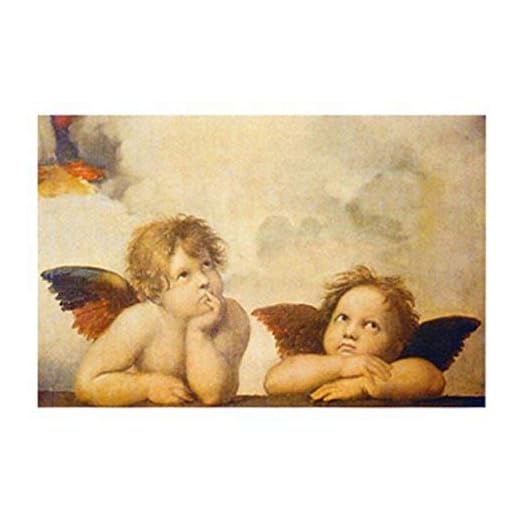
The Sistine Madonna, now in Dresden, presents Mary moving forward through parted curtains while carrying Christ. Saints Sixtus and Barbara kneel below, and two small angels rest at the bottom of the composition. Those angels have become famous independently through reproductions, often detached from the solemn altarpiece to which they belong.
The Madonna della Seggiola, preserved in Florence’s Palazzo Pitti, places Mary, Jesus and Saint John within a circular format. Mary wraps both arms around the child while turning toward the viewer. The compressed arrangement creates an unusually intimate sense of protection and affection.
The Madonna del Granduca is quieter and more restrained. Mary emerges from a dark background holding the child close to her body. Technical examination has shown that the dark setting was added over an earlier architectural interior. More information is available from the Uffizi Galleries’ official Madonna del Granduca page.
Raphael’s religious figures became models for generations of artists because they appear ideal without losing their humanity. Their beauty comes not only from facial features but also from posture, rhythm and the emotional relationship between bodies.
Raphael as a Portrait Painter
Raphael was among the Renaissance’s most perceptive portraitists. He could communicate rank and authority while allowing hints of fatigue, intelligence, reserve or vulnerability to emerge.
His Portrait of Pope Julius II was revolutionary in its intimacy. Rather than showing the pope as a distant ceremonial figure, Raphael presented an aging man seated in thought. The lowered gaze and tense hands suggest the burden of office as much as its power.
The Portrait of Baldassare Castiglione depicts the diplomat and author of The Book of the Courtier. Its restricted palette, soft textures and direct gaze convey the cultivated self-control prized in Renaissance court society. Raphael and Castiglione were friends, which may help explain the portrait’s unusual combination of dignity and warmth.
In the Portrait of Pope Leo X with Cardinals Giulio de’ Medici and Luigi de’ Rossi, the richly illuminated manuscript, bell and magnifying glass create a setting of learning and luxury. Yet the figures’ glances do not entirely connect, generating an atmosphere of calculation beneath the sumptuous surface.
La Velata, or Woman with a Veil, is frequently connected with Margherita Luti, traditionally identified as Raphael’s lover and the model for several works. The identification remains debated, as does the romantic mythology surrounding the artist’s private life.
Raphael’s portraits can be seen in collections including the Uffizi, Palazzo Pitti, the Louvre, the National Gallery in London and the Prado. The National Gallery’s Raphael collection provides an accessible overview of his development and influence.
The Triumph of Galatea and Villa Farnesina
Raphael also created important mythological works for private patrons. At the Villa Farnesina in Rome, the banker Agostino Chigi commissioned him to paint the Triumph of Galatea.
The fresco depicts the sea nymph Galatea riding across the water in a shell-shaped chariot. Dolphins, sea creatures and twisting figures surround her in a composition filled with circular movement. Galatea turns upward toward a group of cupids, maintaining a calm center amid the activity.
The work demonstrates Raphael’s ability to treat classical mythology with the visual grandeur usually reserved for religious subjects. It also reflects the humanist culture of Renaissance Rome, where wealthy patrons used ancient stories to display learning, taste and social status.
Raphael and his workshop later decorated the villa’s Loggia of Cupid and Psyche. Much of the execution was entrusted to assistants, but the unified conception demonstrates the studio’s ability to translate Raphael’s drawings into an extensive decorative program.
The Raphael Cartoons and Sistine Chapel Tapestries
Pope Leo X commissioned Raphael to design a series of tapestries illustrating episodes from the lives of Saints Peter and Paul. The tapestries were intended for the lower walls of the Sistine Chapel, beneath frescoes painted by an earlier generation of Renaissance artists and in direct proximity to Michelangelo’s ceiling.
Raphael created full-scale painted designs known as cartoons. They were sent to Pieter van Aelst’s renowned workshop in Brussels, where highly skilled weavers translated them into wool, silk and precious metal thread.
Because tapestry weaving reverses the design, the completed textiles face in the opposite direction from the surviving cartoons. Seven cartoons are now held by the Victoria and Albert Museum and displayed on long-term loan at the Victoria and Albert Museum from the Royal Collection.
Scenes such as The Miraculous Draught of Fishes and The Healing of the Lame Man show Raphael adapting his balanced compositions to a monumental narrative format. The figures communicate through decisive gestures that remain legible even across a large chapel.
Raphael the Architect
Raphael’s accomplishments extended well beyond painting. After Bramante died in 1514, Pope Leo X appointed Raphael to a leading role in the construction of Saint Peter’s Basilica.
Much of his proposed work was later altered or replaced, making his architectural contribution difficult to reconstruct. Nevertheless, surviving drawings and records demonstrate his serious engagement with the building’s plan.
Raphael also worked on the Chigi Chapel in Santa Maria del Popolo, Palazzo Branconio dell’Aquila and Villa Madama. These projects show his interest in classical proportion, decorative richness and the integration of architecture with painting and sculpture.
Villa Madama, designed for Cardinal Giulio de’ Medici, was conceived as a Roman suburban villa inspired by descriptions of ancient residences. Although it remained unfinished, its combination of architecture, gardens, stucco and painted decoration became influential throughout Europe.
Antiquities and the Preservation of Ancient Rome
Raphael’s relationship with antiquity was not limited to borrowing classical forms. In 1515 he was appointed to oversee ancient marble and archaeological remains associated with papal building projects.
Working with Baldassare Castiglione, he prepared a celebrated letter to Pope Leo X calling attention to the continuing destruction of ancient Roman monuments. The document proposed a systematic survey of the city’s remains and argued for their protection.
Raphael and his collaborators developed methods for recording ancient buildings through plans, elevations and sections. This work places him among the early figures in the history of architectural preservation and archaeological documentation.
The classical balance visible in his paintings therefore emerged from direct and disciplined study. Ancient Rome was not simply a collection of decorative motifs for Raphael; it was a cultural inheritance that could be measured, understood and reinterpreted.
Raphael’s Workshop and Collaborators
Raphael managed one of the largest artistic workshops in Renaissance Rome. Its leading members included Giulio Romano, Gianfrancesco Penni, Perino del Vaga and Giovanni da Udine.
A large studio was necessary because Raphael received simultaneous commissions for frescoes, panel paintings, portraits, tapestries, architecture and decorative schemes. He often created the overall design and detailed drawings while assistants carried out portions of the finished work.
This collaborative process has produced continuing attribution debates. Some late paintings were conceived by Raphael but executed partly—or even largely—by workshop members. Differences in quality do not necessarily indicate deception or failure; collaborative production was a normal feature of major Renaissance workshops.
Raphael’s organizational model also amplified his influence. Drawings, engravings and workshop replicas carried his compositions far beyond Rome. Marcantonio Raimondi’s prints were especially important in making Raphael’s inventions available to artists and collectors throughout Europe.
The Transfiguration
The Transfiguration was Raphael’s final major painting. Cardinal Giulio de’ Medici commissioned it for Narbonne Cathedral, although it remained in Rome after the artist’s death and is now in the Vatican Pinacoteca.
The upper half shows the transfigured Christ floating above Mount Tabor, accompanied by Moses and Elijah. Below, the apostles struggle unsuccessfully to cure a distressed boy. The contrast between divine revelation and earthly confusion gives the painting unusual emotional and visual intensity.
Raphael linked the two episodes through gestures, light and a strong diagonal movement from the desperate crowd toward Christ. The lower section’s dramatic expressions and deep shadows differ from the calm balance of his earlier work, suggesting that Raphael was exploring a more emotionally charged artistic direction.
According to Vasari, the painting was displayed near Raphael’s body during his funeral. Whether every part was completed entirely by Raphael remains debated, but the work served as a powerful conclusion to his career.
Raphael’s Death and Burial in the Pantheon
Raphael died in Rome on April 6, 1520. Vasari’s dramatic account connected the death with the artist’s romantic life, but modern historians treat that explanation cautiously. A severe illness, possibly worsened by inappropriate medical treatment, is more plausible, although the precise cause cannot be established.
His death produced widespread grief in Rome. Raphael had been admired not only for his talent but also for his courtesy, generosity and ability to coordinate large groups of assistants and patrons.
He was buried in the Pantheon, the ancient Roman building he had studied and revered. His tomb bears an epitaph attributed to the humanist Pietro Bembo: while Raphael lived, Nature feared that he might surpass her; when he died, she feared that she too would die.
The burial place was especially appropriate. Raphael had devoted his final years to recovering the architectural knowledge of ancient Rome, and the Pantheon embodied the classical harmony that informed his art.
Raphael’s Influence and Legacy
Raphael’s influence spread rapidly through his students, engravings and the circulation of workshop designs. Giulio Romano carried aspects of his style to Mantua, while other assistants helped shape Mannerist painting in Rome and beyond.
For centuries, European academies treated Raphael as the supreme model of composition and ideal beauty. Artists studied his figures, copied his Madonnas and used the Vatican frescoes as lessons in organizing complex narratives. The National Gallery notes that his classical example dominated European academic painting until well into the 19th century.
Later artists sometimes rebelled against that authority. The Pre-Raphaelite Brotherhood in 19th-century Britain argued that academic art had become formulaic after Raphael. Even their name, however, confirms his position as a dividing point in Western art history.
Raphael should not be reduced to an artist of effortless sweetness. His apparent ease was the result of relentless observation, drawing, revision and coordination. He learned from other artists without surrendering his identity and managed ambitious commissions without losing sight of human expression.
His greatest works balance qualities that often seem opposed: ideal beauty and individual personality, intellectual structure and emotional warmth, archaeological knowledge and creative invention. That balance is why Raphael remains central to any understanding of the most famous Italian artists and the development of Renaissance art.
Where to See Raphael’s Art in Italy
The richest concentration of Raphael’s work is found in Rome and Florence, but Urbino, Milan and other Italian cities preserve important examples.
Vatican Museums, Rome
The Vatican Museums contain the Raphael Rooms, the Transfiguration, the Oddi Altarpiece, the Madonna of Foligno and other major works. The Stanza della Segnatura alone makes the Vatican essential for understanding Raphael’s achievement.
Villa Farnesina, Rome
The villa preserves the Triumph of Galatea and the workshop decoration of the Loggia of Cupid and Psyche. It offers a different perspective on Raphael’s art outside the official environment of the Vatican.
Pantheon, Rome
Raphael’s tomb can be visited inside the Pantheon. The setting connects his memory with the ancient architecture he studied and sought to preserve.
Galleria Borghese, Rome
Raphael’s Deposition, also known as the Borghese Entombment, is one of the gallery’s Renaissance masterpieces. It demonstrates his growing interest in muscular movement and emotional drama before his move to Rome.
Uffizi Gallery, Florence
The Uffizi displays Raphael’s self-portrait, the portraits of Agnolo and Maddalena Doni, Pope Leo X with Cardinals and other important works. The museum’s official page on Raphael’s self-portrait connects the image with his appearance in The School of Athens.
Reserve Uffizi Gallery admission through Weekend in Italy before visiting, particularly during the busiest travel periods.
Palazzo Pitti, Florence
The Palatine Gallery holds the world’s largest concentration of Raphael paintings, including the Madonna della Seggiola, Madonna del Granduca, La Velata and portraits of Agnolo Doni and Cardinal Bibbiena. The official Palatine Gallery guide provides visitor and collection information.
Pinacoteca di Brera, Milan
Raphael’s Marriage of the Virgin is one of the museum’s defining masterpieces. Its architectural perspective and balanced arrangement mark his transition from Perugino’s influence toward an independent style.
Urbino
Raphael’s native city provides essential context even though relatively few of his paintings remain there. Visitors can see his reputed birthplace and explore the court culture of the Palazzo Ducale, which shaped his early development.
For a broader itinerary, see ItaliaMia’s guide to Italy’s greatest art cities and its selection of places to see Italy’s finest artworks.
Books About Raphael
Readers who want to explore Raphael’s paintings, drawings, architecture and influence can browse Raphael art books on Amazon.com. Museum catalogues and illustrated monographs are especially useful for examining details that are difficult to appreciate in general art-history surveys.
External Sources
Vatican Museums: Raphael’s Rooms
Vatican Museums: Room of the Segnatura
Uffizi Galleries: Raphael’s Self-Portrait
Uffizi Galleries: Madonna del Granduca
National Gallery, London: Raphael
National Gallery: Raphael from Urbino to Rome
Museo Nacional del Prado: Raphael
Metropolitan Museum of Art: Raphael