
Introduction to Italian Cinema
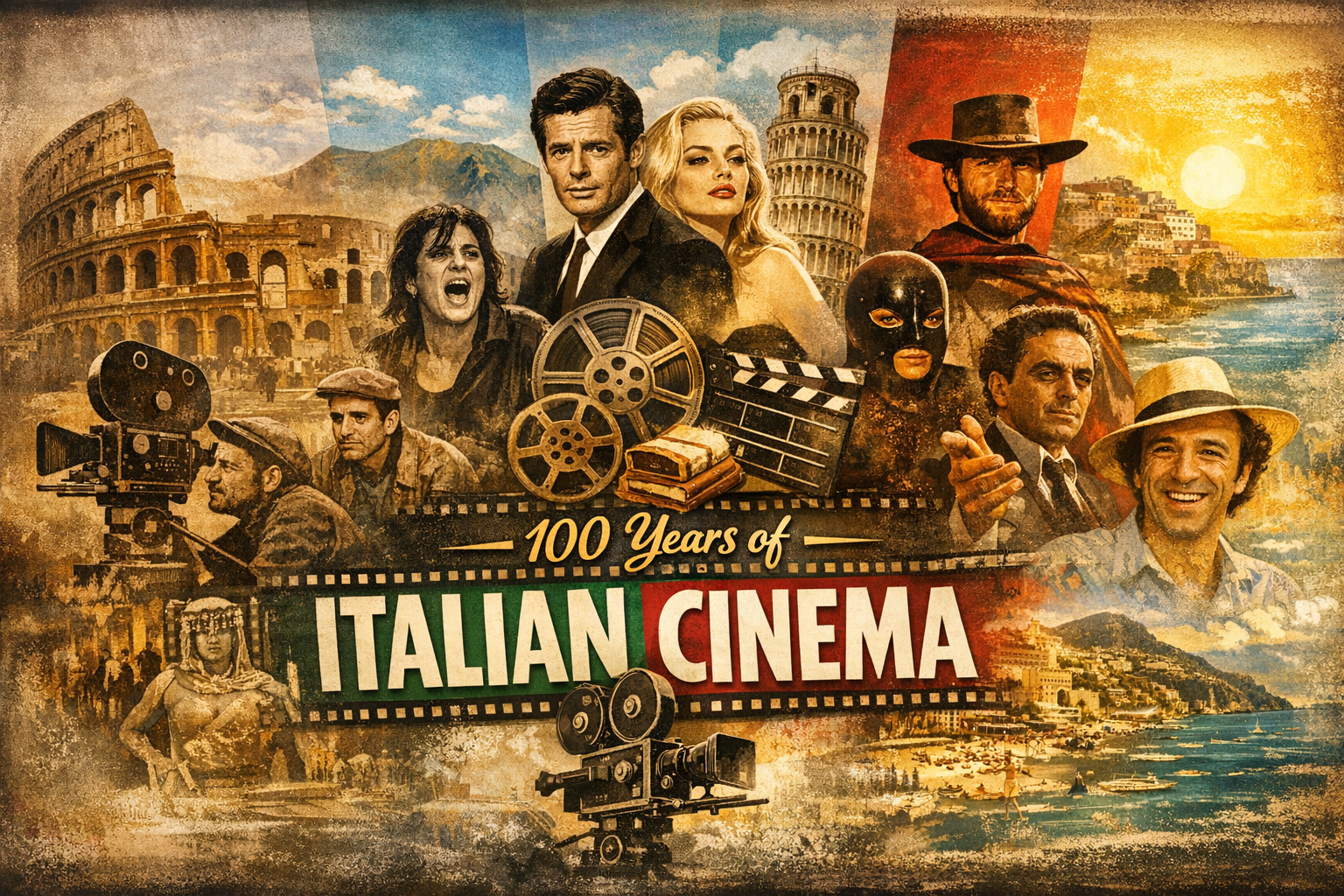
Italian cinema stands as one of the most influential national film traditions in the history of world cinema. Over the past century, Italy has produced films that not only reflected its social, political, and cultural transformations but also redefined the language of cinema itself. From the realism born out of postwar hardship to the poetic introspection of auteur cinema and the global impact of genre films like spaghetti westerns and giallo, Italian filmmakers have consistently pushed artistic boundaries.
Directors such as Roberto Rossellini, Vittorio De Sica, Federico Fellini, Michelangelo Antonioni, Luchino Visconti, Pier Paolo Pasolini, Sergio Leone, Bernardo Bertolucci, and Paolo Sorrentino shaped global film movements and inspired generations of filmmakers worldwide. Italian cinema’s strength lies in its ability to merge artistry with popular appeal, realism with fantasy, and personal vision with universal themes.
What follows is a decade-by-decade journey through 100 essential Italian films, offering a panoramic view of Italy’s cinematic legacy from the 1920s to the 2020s.
🎞️ 1920s – Silent Foundations and Epic Spectacle
Decade overview:
Italian cinema in the 1920s was dominated by silent films, historical epics, and literary adaptations. These films laid the technical and visual foundations for later innovation.
- Cabiria (1924) – Dir. Giovanni Pastrone – Italia Almirante
Epic silent spectacle set during the Punic Wars. - Quo Vadis? (1925) – Dir. Gabriellino D’Annunzio – Emil Jannings
Lavish Roman historical drama. - The Last Days of Pompeii (1926) – Dir. Carmine Gallone – Victor Varconi
Tragic tale set before the volcanic eruption. - Maciste in Hell (1925) – Dir. Guido Brignone – Bartolomeo Pagano
Mythological fantasy featuring Italy’s first film hero. - Assunta Spina (1929 reissue) – Dir. Gustavo Serena – Francesca Bertini
Emotional melodrama centered on jealousy and honor.
🎤 1930s – Early Sound and National Identity
Decade overview:
The arrival of sound cinema coincided with state influence, studio systems, and polished storytelling.
- La Canzone dell’Amore (1930) – Dir. Gennaro Righelli – Dria Paola
Italy’s first sound film. - 1860 (1934) – Dir. Alessandro Blasetti – Aida Bellia
Risorgimento-era patriotic drama. - The White Ship (1941) – Dir. Roberto Rossellini – Non-professional cast
Naval drama hinting at neorealism. - Luciano Serra, Pilot (1938) – Dir. Goffredo Alessandrini – Amedeo Nazzari
Aviation melodrama. - Il Signor Max (1937) – Dir. Mario Camerini – Vittorio De Sica
Light romantic comedy.
🌍 1940s – Neorealism Is Born
Decade overview:
Postwar devastation gave rise to Italian Neorealism, focusing on ordinary people and real locations.
- Rome, Open City (1945) – Dir. Roberto Rossellini – Anna Magnani
Resistance drama under Nazi occupation. - Paisà (1946) – Dir. Roberto Rossellini – Ensemble cast
Episodic liberation stories. - Shoeshine (1946) – Dir. Vittorio De Sica – Franco Interlenghi
Tragic tale of street children. - Germany, Year Zero (1948) – Dir. Roberto Rossellini – Edmund Moeschke
Ruined postwar Berlin through a child’s eyes. - Bicycle Thieves (1948) – Dir. Vittorio De Sica – Lamberto Maggiorani
A father’s desperate search for survival.
👥 1950s – Neorealism Evolves
Decade overview:
Neorealism matured, blending social realism with emotion, humor, and style.
- Umberto D. (1952) – Dir. Vittorio De Sica – Carlo Battisti
Loneliness in old age. - I Vitelloni (1953) – Dir. Federico Fellini – Alberto Sordi
Youth and stagnation in a small town. - La Strada (1954) – Dir. Federico Fellini – Giulietta Masina
Poetic road tragedy. - Senso (1954) – Dir. Luchino Visconti – Alida Valli
Passion and betrayal during war. - Nights of Cabiria (1957) – Dir. Federico Fellini – Giulietta Masina
Hope and heartbreak in Rome.
🌟 1960s – The Golden Age
Decade overview:
Auteur cinema flourished, redefining film language and influencing global cinema.
- La Dolce Vita (1960) – Dir. Federico Fellini – Marcello Mastroianni
Decadence and existential drift. - L’Avventura (1960) – Dir. Michelangelo Antonioni – Monica Vitti
Alienation and mystery. - Divorce Italian Style (1961) – Dir. Pietro Germi – Marcello Mastroianni
Satirical social critique. - 8½ (1963) – Dir. Federico Fellini – Marcello Mastroianni
Surreal self-reflection. - The Leopard (1963) – Dir. Luchino Visconti – Burt Lancaster
Aristocracy in decline.
🤠 1970s – Genre and Political Cinema
Decade overview:
Spaghetti westerns, political thrillers, and bold experimentation dominated.
- The Good, the Bad and the Ugly (1966) – Dir. Sergio Leone – Clint Eastwood
Iconic western epic. - Investigation of a Citizen Above Suspicion (1970) – Dir. Elio Petri – Gian Maria Volonté
Power and paranoia. - The Conformist (1970) – Dir. Bernardo Bertolucci – Jean-Louis Trintignant
Fascism and identity. - Deep Red (1975) – Dir. Dario Argento – David Hemmings
Stylish horror mystery. - Amarcord (1973) – Dir. Federico Fellini – Magali Noël
Nostalgic memory portrait.
🧠 1980s – Memory and Intimacy
Decade overview:
Italian cinema turned inward, focusing on memory, family, and history.
- Cinema Paradiso (1988) – Dir. Giuseppe Tornatore – Philippe Noiret
Love letter to cinema. - The Night of the Shooting Stars (1982) – Dir. Taviani Brothers
Childhood and war. - La Famiglia (1986) – Dir. Ettore Scola – Vittorio Gassman
Generational saga. - Kaos (1984) – Dir. Taviani Brothers
Literary adaptation. - Bianca (1984) – Dir. Nanni Moretti – Nanni Moretti
Neurotic comedy-drama.
🌍 1990s – International Recognition
Decade overview:
Italian films regained global success and awards recognition.
- Life Is Beautiful (1997) – Dir. Roberto Benigni – Roberto Benigni
Holocaust tragicomedy. - Il Postino (1994) – Dir. Michael Radford – Massimo Troisi
Poetry and friendship. - Mediterraneo (1991) – Dir. Gabriele Salvatores
War and escapism. - Johnny Stecchino (1991) – Dir. Roberto Benigni
Comic crime farce. - Lamerica (1994) – Dir. Gianni Amelio
Post-Cold War realism.
🎥 2000s – Revival and Experimentation
Decade overview:
New voices and bold storytelling reenergized Italian cinema.
- The Best of Youth (2003) – Dir. Marco Tullio Giordana
Forty years of Italian history. - I’m Not Scared (2003) – Dir. Gabriele Salvatores
Childhood thriller. - The Consequences of Love (2004) – Dir. Paolo Sorrentino
Stylized crime drama. - Gomorrah (2008) – Dir. Matteo Garrone
Brutal crime realism. - Il Divo (2008) – Dir. Paolo Sorrentino
Political portrait.
🌐 2010s – Global Prestige
Decade overview:
Italian cinema embraced international co-productions and auteur prestige.
- The Great Beauty (2013) – Dir. Paolo Sorrentino
Modern decadence. - Call Me by Your Name (2017) – Dir. Luca Guadagnino
Coming-of-age romance. - Dogman (2018) – Dir. Matteo Garrone
Crime and cruelty. - Perfect Strangers (2016) – Dir. Paolo Genovese
Social satire. - Happy as Lazzaro (2018) – Dir. Alice Rohrwacher
Magical realism.
🎬 2020s – A New Generation
Decade overview:
Contemporary Italian cinema blends realism, fantasy, and global themes.
- The Hand of God (2021) – Dir. Paolo Sorrentino
Autobiographical drama. - Io Capitano (2023) – Dir. Matteo Garrone
Migration epic. - Freaks Out (2021) – Dir. Gabriele Mainetti
Genre spectacle. - Le Otto Montagne (2022) – Dir. Van Groeningen & Vandermeersch
Friendship and nature. - A Chiara (2021) – Dir. Jonas Carpignano
Crime and adolescence.
Conclusion
Across a century of artistic evolution, Italian cinema has remained a cornerstone of global film culture. Whether through neorealist truth, auteur introspection, or genre reinvention, these 100 films collectively tell the story of Italy—and of cinema itself.