
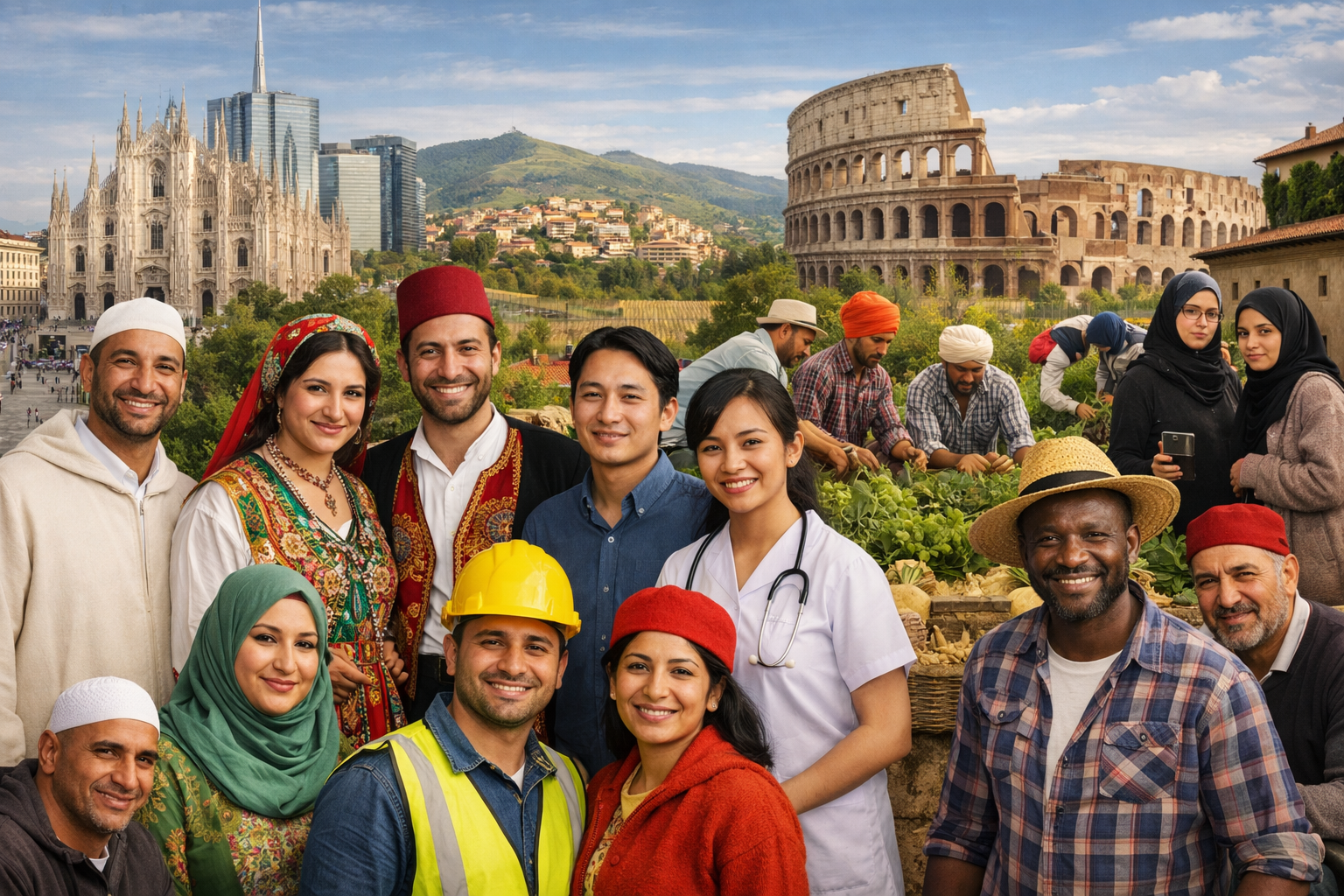
Italy has transformed over the last few decades into a country shaped by immigration and long-standing minorities. While ethnic Italians remain the majority, non-Italian ethnic groups now play a vital social, cultural, and economic role. These communities are concentrated in specific regions and cities, maintain strong cultural identities, and integrate into Italian life at different speeds and levels.
Moroccan Community
Location and Cities
Moroccans are Italy’s largest Extra-EU ethnic group. They are concentrated in Lombardy, Emilia-Romagna, Veneto, and Piedmont, with strong populations in Milan, Turin, Bologna, Brescia, and Modena. Seasonal workers are also present in rural agricultural zones.
Culture
Moroccan culture in Italy is shaped by Islamic traditions, extended family structures, and North African cuisine. Mosques, halal shops, and cultural associations are central to community life. Religious holidays such as Ramadan are widely observed.
Integration
Moroccans are among the most established migrant groups. Many second-generation Moroccans speak Italian as their first language and attend Italian universities. Integration is strong in employment and education, though cultural and religious differences can still create social barriers.
Albanian Community
Location and Cities
Albanians are widely distributed across central and southern Italy, especially in Apulia, Calabria, Sicily, Tuscany, and Lazio. Cities such as Bari, Rome, Florence, and Milan host large populations.
Culture
Albanian culture emphasizes family loyalty, hospitality, and resilience. The historic Arbëreshë communities preserve Albanian language, traditional clothing, and Eastern Christian rites.
Integration
Albanians are often cited as a successful integration model. Cultural similarities, intermarriage, and language proximity have accelerated social inclusion. Many Albanians are Italian citizens today.
Chinese Community
Location and Cities
The Chinese population is concentrated in Prato, which hosts one of Europe’s largest Chinese districts. Other hubs include Milan, Rome, Florence, and Naples.
Culture
Chinese communities are organized around family networks, entrepreneurship, and regional identity (often from Zhejiang province). Cultural life centers on business associations, language schools, and traditional festivals such as Lunar New Year.
Integration
Economic integration is strong due to business ownership, especially in textiles and retail. Social integration is slower, largely due to language barriers and inward-focused community structures. Second-generation Chinese Italians increasingly bridge both cultures.
Romanian Community
Location and Cities
Romanians are widespread across Italy, especially in Lazio, Lombardy, Veneto, and Piedmont, with large populations in Rome, Milan, Turin, and Verona.
Culture
Romanian culture blends Eastern European traditions, Orthodox Christianity, and strong family ties. Churches and cultural centers are key social spaces.
Integration
Integration is generally high. Romanians work across construction, care work, logistics, and services. Linguistic similarities with Italian aid social mobility, and many families settle permanently.
Filipino Community
Location and Cities
Filipinos are mainly urban, with strong concentrations in Rome, Milan, Genoa, Bologna, and Florence.
Culture
Community life revolves around Catholic faith, mutual aid networks, and family support. Cultural events, choirs, and church gatherings are central.
Integration
Filipinos are among the most positively perceived migrant groups. Italian language proficiency is high, and social integration is strong, particularly in healthcare and domestic care sectors.
Indian and South Asian Communities
Location and Cities
Indian, Pakistani, and Bangladeshi communities are concentrated in Lombardy, Emilia-Romagna, Veneto, and Lazio, with notable populations in Brescia, Milan, Reggio Emilia, and Rome.
Culture
Cultural life varies by religion, including Sikhism, Islam, Hinduism, and Christianity. Sikh temples in northern Italy serve as religious and social hubs.
Integration
Economic integration is strong, particularly in agriculture, logistics, and manufacturing. Cultural visibility has increased, though social inclusion depends heavily on local attitudes.
Egyptian and North African Communities
Location and Cities
Egyptians are concentrated in Milan, Rome, and northern industrial cities. Tunisians are prominent in Sicily and coastal regions.
Culture
Arabic language, Islamic traditions, and strong kinship networks shape community life. Small businesses and trade play a major role.
Integration
First-generation integration is moderate, while second-generation youth show higher educational attainment and cultural fluency.
Sub-Saharan African Communities
Location and Cities
Communities from Nigeria, Senegal, Ghana, and Ivory Coast are found in Rome, Milan, Naples, Turin, and agricultural regions in the south.
Culture
Music, religion (Christian and Muslim), and community associations are central. Informal economies and cultural festivals maintain identity.
Integration
Integration varies widely. Some groups face systemic discrimination, while others achieve upward mobility through education and entrepreneurship.
Middle Eastern Communities
Location and Cities
Syrian, Iraqi, Lebanese, and Palestinian communities are smaller but present in Rome, Milan, and Bologna.
Culture
Strong emphasis on family, religion, and education. Cultural associations support refugees and professionals alike.
Integration
Highly dependent on migration pathway. Refugees face challenges, while skilled migrants integrate more quickly.
Latin American Communities
Location and Cities
Peruvians, Ecuadorians, and Colombians are concentrated in Milan, Rome, Genoa, and Turin.
Culture
Spanish language, Catholic traditions, and vibrant music and dance scenes characterize these communities.
Integration
Integration is relatively smooth due to cultural and religious similarities. Many work in services and care sectors.
Refugees and Asylum-Seeking Groups
Location and Cities
Refugees from Eritrea, Somalia, Afghanistan, and Syria are distributed through national reception systems, often in smaller towns.
Culture
Cultural preservation is challenged by displacement, yet community solidarity remains strong.
Integration
Integration depends heavily on policy support, language training, and employment access. Outcomes vary significantly by region.
Overall Integration Patterns
Across non-Italian ethnic groups in Italy, economic integration often outpaces social and political inclusion. Schools, workplaces, and mixed neighborhoods are the primary engines of integration. Second-generation migrants increasingly identify as Italian while maintaining dual cultural identities.
Conclusion
Excluding native Italians, Italy’s ethnic landscape is shaped by Extra-EU communities, long-standing minorities, and new migration flows. These groups are not peripheral. They sustain industries, reshape cities, enrich culture, and influence Italy’s future. Understanding where they live, how they maintain culture, and how they integrate is essential to understanding modern Italy.