For anyone tracing an Italian family, civil records are among the most valuable documents you can find. A single Italian birth, marriage or death record may reveal not only a date and place, but also parents’ names, occupations, addresses, spouses, witnesses and clues leading to an earlier generation.
The challenge is understanding where those records were created and where they can be found today.
Italy did not develop as a single unified country until the nineteenth century. Before unification, different kingdoms, duchies and foreign governments maintained their own administrative systems. As a result, the availability and format of Italian civil records vary considerably from one region—and sometimes one town—to another.
Today, however, researching these documents is far easier than it once was. Millions of records have been digitized, and many can be viewed free online through Italy’s official archives.
If you are starting a family-history project rather than looking for one particular certificate, begin with Italia Mia’s guide to researching your Italian ancestors. It explains how to identify an ancestral town, work backward through generations and combine civil, parish, immigration and other records.
What Are Italian Civil Records?
Italian civil registration is called stato civile. It is the government system used to record major events in a person’s life.
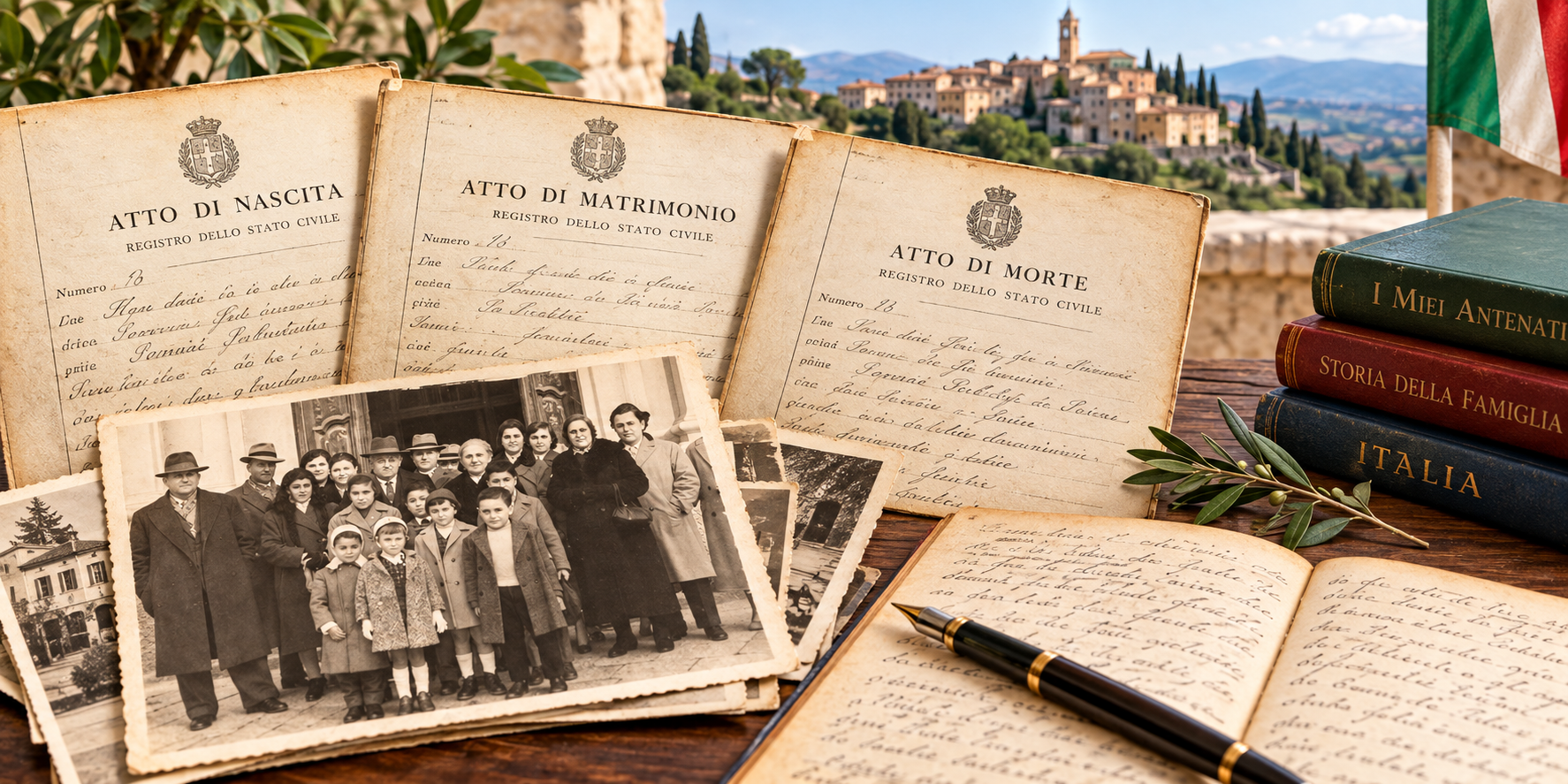
The principal records genealogists encounter are:
Atto di nascita — Birth record
Records the birth of a child and commonly identifies the parents.
Atto di matrimonio — Marriage record
Records a civil marriage and can contain valuable information about both spouses and their families.
Atto di morte — Death record
Records a death and may identify a spouse, parents, occupation, birthplace and residence.
You may also encounter pubblicazioni di matrimonio, or marriage banns, and supporting marriage documents known as allegati or processetti.
These additional marriage documents can be genealogical treasures because they were assembled to demonstrate that a couple was legally free to marry. Depending on the period and locality, they can contain copies or extracts of birth, baptism and death records involving several members of the family.
When Did Civil Registration Begin in Italy?
There is no single starting date that works for every part of Italy.
Following Italian unification, civil registration became standardized throughout the Kingdom of Italy, with records generally available from around 1866 onward.
But researchers should not assume that Italian civil records begin in 1866.
In many areas, especially those affected by Napoleonic administration, civil registration began decades earlier. Parts of southern Italy have extensive nineteenth-century collections beginning in the early 1800s.
Other regions followed different systems.
This means that the political history of your ancestor’s town matters. If civil records suddenly stop as you work backward, it does not necessarily mean that earlier information does not exist. The records may have been created under a different government, preserved in a different archive or recorded by a parish instead.
That regional complexity is one reason why identifying the exact comune, rather than simply knowing the province or region, is so important.
First Find Your Ancestor’s Comune
Before searching Italian civil records, establish your ancestor’s town of origin as precisely as possible.
Knowing that someone came from “Sicily,” “Calabria” or “Naples” is usually not enough.
Italian civil records were created locally. The crucial location is normally the comune, the municipality responsible for registering births, marriages and deaths.
An immigrant who told American officials that he came from Naples, for example, may actually have been born in a smaller municipality elsewhere in the Province of Naples or even in another part of Campania.
Look for the ancestral town in:
- Passenger manifests
- Naturalization petitions
- Marriage certificates
- Death certificates
- Military registrations
- Passports
- Obituaries
- Cemetery records
- Family letters
- Church records
- Records belonging to siblings and other relatives
Do not rely on one document alone. Place names and surnames were frequently misspelled after immigration.
Once you know the comune, Italian research becomes dramatically more focused.
Italian Birth Records — Atto di Nascita
A nineteenth-century Italian atto di nascita can contain considerably more information than researchers expect.
Depending on the period and locality, a birth record may include:
- Child’s full name
- Date of birth
- Time of birth
- Place or street where the birth occurred
- Father’s full name
- Father’s age
- Father’s occupation
- Mother’s full maiden name
- Mother’s age
- Parents’ residence
- Name of the person declaring the birth
- Names and occupations of witnesses
One particularly important feature is the use of a woman’s birth surname. Italian records generally identify women by their maiden names, including married women. This makes tracing maternal lines considerably easier.
Always examine the margins of a birth record as well.
Officials sometimes added annotations years later recording a marriage, death or other event. A small handwritten note beside a birth entry can therefore point you toward another record created decades later.
Also distinguish between the date the event occurred and the date it was reported or registered. They are not necessarily the same.
Italian Marriage Records — Atto di Matrimonio
Marriage records are often the most productive documents in Italian genealogy.
An atto di matrimonio may identify:
- Bride and groom
- Their ages
- Occupations
- Birthplaces
- Residences
- Fathers’ names
- Mothers’ maiden names
- Whether parents were living or deceased
- Previous marital status
- Witnesses
This allows one document to connect two families simultaneously.
But the marriage record itself may be only the beginning.
Marriage Banns and Processetti
Before a marriage could take place, various legal requirements had to be satisfied. This generated additional paperwork.
Researchers may encounter pubblicazioni, the formal publication of an intended marriage, and collections known as allegati or processetti.
A surviving marriage packet might contain supporting documents relating to the bride, groom, parents or even grandparents.
For that reason, if you find an ancestor’s marriage act, always investigate whether the associated marriage attachments survive.
They can sometimes move a family tree backward another generation without requiring a separate search.
Italian Death Records — Atto di Morte
An Italian atto di morte may contain:
- Name of the deceased
- Age
- Occupation
- Residence
- Birthplace
- Name of spouse
- Names of parents
- Date and place of death
- Names of people reporting the death
Death records are extremely useful, but they require more caution than birth records.
The deceased obviously did not provide the information personally. Details came from relatives, neighbors, hospital personnel or other informants.
An elderly person’s age or parents’ names may therefore be incorrect.
If a death certificate says that your ancestor was born in 1825 but a birth record indicates 1823, give greater evidentiary weight to the record created close to the birth.
Use death records as evidence and as a source of clues, but confirm important relationships with other documents whenever possible.
Search the Official Portale Antenati
The most important online resource for Italian civil genealogy is the Italian government’s Portale Antenati.
The portal is operated through Italy’s archival administration and provides free access to genealogically important material preserved by Italian State Archives. Available material includes birth, marriage and death records as well as some military records.
No paid subscription is required to consult the available collections.
There are two basic ways to research the portal.
Search by Name
Some collections have been indexed, allowing you to search for a person by name.
This is convenient, but never assume that a failed name search means that the record does not exist.
Only part of the enormous archival collection has been indexed.
Names can also be mistranscribed.
Browse the Registers
For serious Italian genealogy research, learning to browse the original registers is essential.
Start with:
- The appropriate State Archive.
- The ancestor’s comune.
- The record type.
- The approximate year.
- The relevant register.
Many registers contain an alphabetical index, usually near the beginning or end of the volume.
Once you locate the person in the index, note the numero dell’atto, or record number, and use it to find the full entry.
The official Portale Antenati is free and is now one of the first places anyone researching an Italian family should check.
Using FamilySearch for Italian Records
FamilySearch remains another major resource for Italian genealogy.
Its Italian collections include civil registration and Catholic Church records from numerous areas, although coverage differs by locality and period.
FamilySearch itself recommends beginning Italian research by identifying the ancestral town, then using civil registration and Catholic Church records.
This town-first approach is important. Searching repeatedly for a common surname across all of Italy can produce hundreds or thousands of irrelevant results.
FamilySearch and the Portale Antenati should therefore be viewed as complementary research tools rather than as guarantees that every Italian record will be searchable by name.
When the Record Is Not Online
Digitization has transformed Italian genealogy, but not everything is online.
If you know the town and approximate date, you may need to contact the Ufficio dello Stato Civile of the appropriate comune.
Provide as much precise information as possible:
- Full name
- Date or approximate year
- Type of event
- Comune
- Parents’ names, if known
- Spouse’s name, if relevant
- Reason for requesting the document
Do not ask a municipal office to “find everything about the Rossi family.”
A narrow request for a specific birth, marriage or death is much more likely to receive attention.
Depending on your purpose, you may need an estratto per riassunto dell’atto, an official extract containing essential information, or a copia integrale dell’atto, a complete copy of the record.
Requirements can differ according to the record, its age, privacy restrictions and the purpose for which it is requested.
Civil Records Before Italian Unification
The further back you go, the more complicated Italian research becomes.
Before the creation of modern Italy, the peninsula consisted of separate states and territories, including the Kingdom of the Two Sicilies, the Papal States, the Kingdom of Sardinia, the Grand Duchy of Tuscany and territories controlled at various times by France and Austria.
Record-keeping systems consequently varied.
Napoleonic administration introduced civil-registration systems in many areas during the early nineteenth century. These records are particularly important to genealogists because they frequently provide detailed information about individuals and their parents.
However, Napoleonic records do not exist uniformly throughout Italy, and the years covered vary.
Never apply one region’s chronology automatically to another.
Why Southern Italian Records Can Be Especially Rich
Many areas of southern Italy developed extensive civil-registration collections during the early nineteenth century.
This is particularly valuable to descendants of the millions of southern Italians who later emigrated abroad.
Families from Sicily, Campania, Calabria, Basilicata, Puglia and other southern regions can sometimes be followed through successive civil records for several generations before researchers need to rely primarily on parish registers.
The process works best by linking documents systematically:
Death → Marriage → Birth → Parents’ Marriage → Parents’ Births
Rather than simply collecting people with the same surname, prove each relationship before moving backward.
What Happens When Civil Records Run Out?
Eventually, most Italian family researchers reach a period before civil registration.
At that point, church records become essential.
Catholic parishes recorded baptisms, marriages and burials long before the modern Italian state existed.
Depending on survival and accessibility, parish registers may extend a family line into the eighteenth, seventeenth or even sixteenth century.
Useful church records include:
Battesimo — baptism
Matrimonio — marriage
Morte or sepoltura — death or burial
Stato delle anime — parish census or “state of souls”
A stato delle anime can be particularly useful because it may list an entire household together, helping researchers distinguish between families sharing the same surname.
The availability and quality of church records vary enormously. Some remain in local parishes, while others have been transferred to diocesan archives or digitized.
Understanding Italian Surnames in Civil Records
Do not reject a document simply because the surname is spelled differently.
Before standardized identification systems, spelling could vary between record keepers. Dialect pronunciation, handwriting and later transcription also created variations.
After immigration, names might be further modified.
For example, researchers may encounter variations involving:
- De Luca / Deluca
- Di Pietro / Dipietro
- D’Angelo / Dangelo
- Lo Presti / Lopresti
- De Angelis / DeAngelis
The names, dates, parents, spouses and comune are usually more important than a minor spelling difference.
For more background, see Italia Mia’s guide to Italian surnames, their origins, meanings and regional clues.
Essential Italian Words for Reading Records
You do not need to speak fluent Italian to begin reading civil records, but learning a few recurring terms makes research much easier.
nato / nata — born
nascita — birth
figlio / figlia — son / daughter
padre — father
madre — mother
marito — husband
moglie — wife
coniuge — spouse
matrimonio — marriage
morte — death
vedovo / vedova — widower / widow
celibe — unmarried man
nubile — unmarried woman
defunto / defunta — deceased
fu — indicates that a named person was deceased
anni — years
comune — municipality
frazione — village or subdivision of a comune
testimone — witness
professione — occupation
Older church records may be written partly or entirely in Latin. Names can consequently appear in Latinized forms: Giovanni may become Joannes, for example, and Giuseppe may appear as Josephus.
Never Ignore Witnesses, Occupations and Addresses
Beginning genealogists naturally focus on names and dates.
That can mean overlooking some of the most useful evidence in a document.
Witnesses may be brothers, cousins, neighbors or work colleagues. Repeated occupations can distinguish between two men with the same name. Street addresses can show that two families lived in the same household or neighborhood.
If several men named Giuseppe Rossi lived in the same comune, a combination of occupation, wife, parents and address may be the only reliable way to determine which Giuseppe belongs to your family.
Genealogy is therefore not simply name matching. It is the reconstruction of relationships from multiple pieces of evidence.
Keep Copies of the Entire Record
When you locate an ancestor, save the entire page rather than cropping only the person’s name.
Record:
- Archive
- Comune
- Record type
- Year
- Volume or register
- Act number
- Page or image number
- URL, when available
- Date you accessed it
Also transcribe the record before drawing conclusions from it.
Keeping this information becomes increasingly important as your research expands. After several generations, dozens of people may share similar names.
Italian Civil Records and Citizenship by Descent
Genealogy and citizenship research frequently overlap, but they are not the same process.
A digital image found in an archive can be excellent evidence for establishing your family tree. It does not automatically mean that the image satisfies the documentary requirements of an Italian citizenship procedure.
Citizenship applications may require officially issued documents, apostilles, translations and correction or explanation of discrepancies between records.
More importantly, Italy substantially changed its rules governing citizenship by descent in 2025. Having an Italian great-grandparent or another distant Italian ancestor no longer automatically means that a new applicant qualifies under the rules now in force.
Before ordering numerous certificates specifically for citizenship purposes, read Italia Mia’s updated guide to Italian citizenship by descent and the rules that changed in 2025.
Common Mistakes When Researching Italian Civil Records
One of the biggest mistakes is searching for a surname throughout Italy without first finding the ancestral comune.
Other common problems include:
- Treating an online family tree as proof.
- Assuming everyone with the same surname is related.
- Ignoring women’s maiden names.
- Trusting an automated index without checking the original record.
- Confusing a province with a comune.
- Assuming an immigrant was born in the city from which a ship departed.
- Ignoring marginal annotations.
- Treating ages on death records as exact.
- Overlooking marriage attachments.
- Rejecting documents because of minor spelling variations.
- Moving to an earlier generation before proving the current relationship.
A well-researched family tree is built one documented relationship at a time.
Building Your Italian Family History
Italian civil records can transform a vague family story into a documented history.
A name remembered by a grandparent may lead to a passenger manifest. That document may reveal a village. A birth record from that village can identify two parents. Their marriage record may identify four grandparents, and the process begins again.
For descendants of Italian emigrants, these documents can reconnect a family with a specific town and with the people who lived there generations earlier.
Italia Mia’s broader Italian Genealogy section brings together resources for tracing those connections, while our article on Italians in the World explores the wider history and continuing identity of Italian communities abroad.
The most important rule is simple: start with what you know, identify the correct comune, and work backward one verified generation at a time.
Frequently Asked Questions
Where can I find Italian birth records online?
Start with the official Portale Antenati and FamilySearch. Both provide substantial collections of Italian civil records, but availability and indexing vary by location and period.
When did Italy begin keeping birth, marriage and death records?
Nationwide civil registration became standardized after Italian unification, generally from around 1866, but many areas have earlier civil records dating from the Napoleonic or pre-unification periods.
Are Italian civil records free to search?
The official Portale Antenati is free to use and does not require registration to consult its available archival material.
Why can’t I find my ancestor by name?
The register may not have been indexed. Try browsing by State Archive, comune, record type and year. Also search surname variations.
What if I don’t know my ancestor’s Italian town?
Work backward through records created in the country of immigration. Naturalization files, passenger lists, marriages, obituaries and records belonging to siblings can reveal the precise Italian birthplace.
Are death records reliable?
They are useful but should be corroborated. Information was supplied by an informant rather than by the deceased, so ages, birthplaces and parents’ names can be incorrect.
What is the best Italian record for genealogy?
Marriage records and their supporting allegati or processetti can be particularly valuable because they often connect multiple generations. Birth records are generally stronger evidence for a person’s birth date and parents.
Can I use an online Italian birth record for citizenship?
It can help identify the correct ancestor and record, but citizenship procedures may require an officially issued version and other formalities. Check the current citizenship requirements before ordering documents.
External Sources
Portale Antenati — Official Italian Ancestors Portal
Italian Ministry of Culture — Antenati Project
FamilySearch — Italy Genealogy Research
FamilySearch — Italian Historical Record Collections