
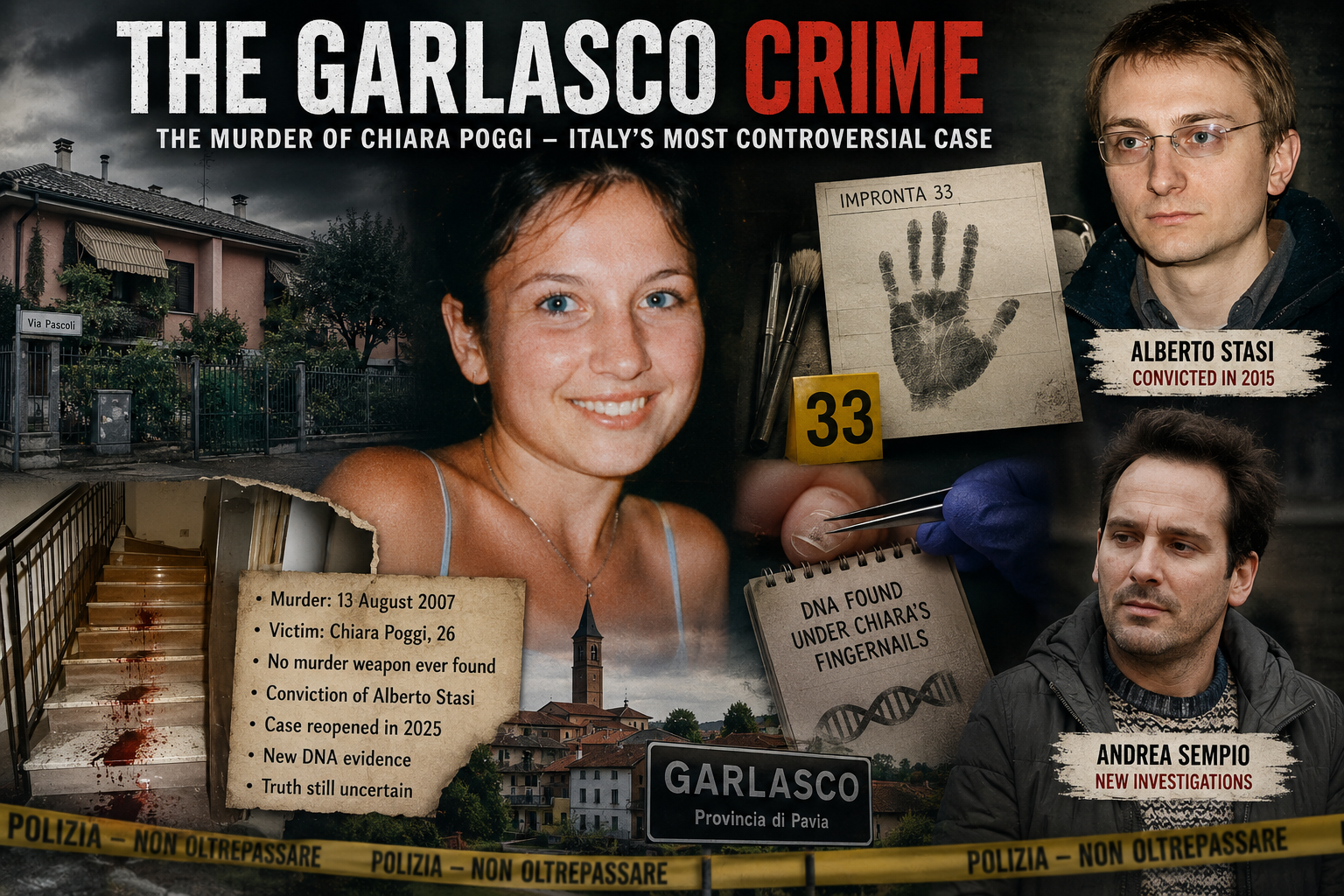
 The murder of Chiara Poggi remains one of the most debated criminal investigations in modern Italian history. What began as the killing of a 26-year-old woman in the quiet Lombardy town of Garlasco became a national obsession involving disputed forensic evidence, endless appeals, media sensationalism, and new suspects almost twenty years later.
Even today, Italians remain divided over a central question: was Alberto Stasi truly guilty, or did the justice system convict the wrong man?
The case has evolved far beyond a traditional murder investigation. It became a symbol of Italy’s struggles with forensic science, televised justice, and public opinion shaping criminal trials.
The Quiet Town of Garlasco Before the Murder
Before August 2007, Garlasco was known as a peaceful provincial town in the Pavia area of northern Italy. Violent crime was rare. Residents described it as calm, family-oriented, and uneventful.
That changed forever on 13 August 2007.
The murder quickly transformed Garlasco into one of the most recognized towns in Italy. Reporters flooded the streets. Television vans parked outside homes. Every small detail became national news.
The phrase “Delitto di Garlasco” entered Italian popular culture almost immediately.
Who Was Chiara Poggi?
Chiara Poggi was 26 years old when she was killed. Friends and relatives described her as intelligent, reserved, and methodical. She had graduated in economics and worked in communications.
She lived with her family in a villa on Via Pascoli in Garlasco.
At the time of her death, her parents and younger brother were on vacation. Chiara stayed behind because of work commitments. She was alone in the house on the morning she died.
Her boyfriend, Alberto Stasi, was a student at Milan’s Bocconi University.
The Morning of 13 August 2007
According to investigators, Chiara was alive sometime after 9:00 a.m. on 13 August 2007. Prosecutors later reconstructed a timeline suggesting she was attacked between approximately 9:12 and 9:35 a.m.
Alberto Stasi’s Emergency Call
At around 1:50 p.m., Alberto Stasi called emergency services, saying he had discovered Chiara’s body inside her home.
His call immediately drew attention because of his calm demeanor and the strange details he provided. Some listeners felt he sounded detached; others argued people react differently under trauma.
That debate continues today.
Discovery of the Body
Chiara’s body was found near the staircase leading to the basement. She had suffered multiple blows from a blunt object. The weapon was never recovered.
The brutality shocked Italy. The image of the staircase became one of the defining visuals of the entire case.
The Crime Scene and Early Forensic Evidence
From the beginning, investigators focused heavily on forensic reconstruction.
Blood Patterns and the Staircase
Blood traces suggested Chiara was attacked on the ground floor before falling or being dragged toward the stairs.
Experts debated whether the killer pushed her downstairs after the fatal attack or whether she collapsed there during the struggle.
The Missing Murder Weapon
One of the greatest mysteries remains the weapon itself.
Investigators never found the object used to kill Chiara. Over the years, theories included a hammer, fireplace tool, metal object, or construction instrument.
The absence of the murder weapon became a major argument for critics of the conviction.
The Infamous Shoe Prints
Police identified shoe prints inside the house that prosecutors later associated with Alberto Stasi.
But the forensic interpretation became highly controversial. Defense experts argued contamination and investigative mistakes may have compromised the evidence.
The lack of blood on Stasi’s shoes was especially debated. Prosecutors considered his explanation implausible. Supporters of Stasi argued it proved he was not the killer.
Alberto Stasi: Boyfriend, Witness, Suspect
Almost immediately, investigators focused on Stasi.
His Statements to Police
Stasi claimed he arrived at Chiara’s home, entered, and discovered her body. He insisted he panicked and called authorities.
However, police identified inconsistencies in his timeline and descriptions of the scene.
Those inconsistencies became central to later prosecutions.
The Computer and Internet Evidence
Investigators examined Stasi’s computer activity extensively. Prosecutors questioned whether he was truly working on his thesis during the time of the murder.
The case also generated controversy around sexually explicit images found on his computer. Some media outlets sensationalized the material, suggesting hidden psychological motives.
Years later, new digital analyses revisited these computer records again.
Why Investigators Became Suspicious
Several factors increased suspicion:
- His calm behavior
- The timing inconsistencies
- The shoe print evidence
- Questions about his alibi
- The absence of visible panic
- His account of entering the bloody crime scene without contamination
Supporters of Stasi countered that the prosecution never established a convincing motive.
The Long Judicial Battle
The Garlasco case became infamous because of its endless judicial reversals.
First Acquittal
In 2009, Stasi was acquitted.
Judges argued the evidence was insufficient for conviction.
Second Acquittal
A second acquittal followed in 2011, reinforcing the perception that the prosecution’s case was weak.
Cassation Intervention
Italy’s Supreme Court of Cassation later annulled the acquittal and ordered a retrial. The court argued earlier judges had improperly evaluated certain forensic elements.
Final Conviction in 2015
In 2015, Stasi was definitively convicted and sentenced to 16 years in prison.
Even after conviction, debate never stopped.
Some Italians saw him as unquestionably guilty. Others viewed him as the victim of circumstantial evidence and media pressure.
Why the Garlasco Case Divided Italy
The case split public opinion more deeply than almost any Italian criminal proceeding of the 2000s.
Unlike many murder cases, there was:
- No confession
- No murder weapon
- No eyewitness
- No clear motive
The conviction depended largely on forensic interpretation and behavioral analysis.
That ambiguity created decades of arguments across newspapers, television studios, internet forums, and courtrooms.
The Media Circus and Public Obsession
Italian television transformed the murder into nonstop national entertainment.
Television Specials and Crime Shows
Programs reconstructed the crime scene repeatedly. Experts debated blood stains live on television. Psychologists analyzed facial expressions. Journalists chased witnesses and relatives.
The coverage became so intense that many critics accused the media of turning tragedy into spectacle.
Comparisons to Meredith Kercher
The case was frequently compared to the murder of Meredith Kercher because both cases:
- Happened in 2007
- Relied heavily on disputed forensic evidence
- Generated international media frenzy
- Divided public opinion about guilt and innocence
Andrea Sempio and the Reopening of the Case
In 2025, the story changed dramatically.
Investigators reopened aspects of the case focusing on Andrea Sempio, a friend of Chiara’s brother.
DNA Under Chiara’s Fingernails
New forensic analysis reportedly linked male DNA under Chiara’s fingernails to Sempio. Earlier investigations had considered the sample too degraded for reliable identification.
This development reignited public controversy instantly.
The “Impronta 33” Palm Print
Another debated element involved a palm print known as “Impronta 33,” found near the basement stairs.
Investigators later claimed the print might be compatible with Sempio. Critics argued the print quality and preservation were problematic.
The Parking Ticket Alibi
One controversial detail involved a parking ticket Sempio allegedly preserved from the day of the murder, supporting an alibi placing him elsewhere.
Skeptics considered the preserved receipt suspicious. Supporters argued it simply reflected someone trying to protect himself after becoming a person of interest.
Theories, Speculation, and Rumors
Few Italian crimes have generated as many theories as the Garlasco murder.
Multiple Attackers Theory
Some investigators explored whether more than one attacker may have participated.
This theory emerged partly from forensic uncertainties and conflicting timelines.
Family and Friends Under Suspicion
At different moments, speculation involved:
- Friends
- Cousins
- Unknown intruders
- Multiple accomplices
Most of these theories lacked definitive evidence but spread widely through tabloids and television debates.
Internet Conspiracy Narratives
Online communities became deeply invested in the case.
Reddit discussions and Italian forums regularly debate:
- Police contamination
- Judicial bias
- False convictions
- Hidden accomplices
- Corrupted investigations
Some theories are evidence-based; others drift into sensationalism.
The Role of Forensic Science
The Garlasco case is now studied partly as a lesson in forensic limitations.
Experts have questioned:
- DNA contamination risks
- Trace interpretation
- Footwear analysis
- Timeline reconstruction
- Preservation of evidence
The case highlighted how scientific evidence can appear objective while still being interpreted differently by opposing experts.
Errors, Controversies, and Alleged Investigative Failures
Critics of the investigation argue authorities:
- Mishandled evidence
- Failed to preserve traces properly
- Focused too quickly on one suspect
- Allowed media leaks to shape perception
Supporters of the conviction argue the courts repeatedly reviewed the evidence and still found Stasi guilty beyond reasonable doubt.
In 2025, the European Court of Human Rights rejected an appeal by Stasi claiming unfair trial violations, stating the proceedings remained fundamentally fair.
Yet the reopening of investigations in 2025–2026 revived doubts once again.
The Human Cost of the Garlasco Crime
Behind the legal debates lies a devastating human tragedy.
Chiara Poggi lost her life at 26.
Her family spent nearly two decades under relentless media attention.
Alberto Stasi spent years imprisoned while continuing to proclaim innocence.
Andrea Sempio later became the focus of renewed suspicion and public scrutiny.
The case permanently altered multiple lives.
Latest Developments in 2025–2026
The newest phase of the investigation has become one of the most explosive.
Reports in 2025 and 2026 revealed:
- New DNA analysis
- Renewed forensic reviews
- Reexamination of timelines
- Additional questioning of witnesses
- Fresh scrutiny of old evidence
Some prosecutors reportedly explored whether Stasi’s conviction could represent a miscarriage of justice.
Others insist the original verdict remains valid.
As of 2026, the legal situation remains fluid, and no final judicial reversal has occurred.
Frequently Asked Questions
Who killed Chiara Poggi?
Italian courts definitively convicted Alberto Stasi in 2015. However, renewed investigations involving Andrea Sempio reopened public debate.
Why is the Garlasco case controversial?
Because the conviction relied heavily on circumstantial and forensic evidence despite no confession, murder weapon, or clear motive.
What evidence linked Alberto Stasi to the murder?
Key elements included shoe prints, inconsistencies in his statements, forensic traces, and disputed timeline reconstruction.
Why was Andrea Sempio investigated?
New DNA analysis reportedly connected him to biological traces under Chiara’s fingernails.
Was the murder weapon ever found?
No. The weapon has never been recovered.
Is Alberto Stasi still in prison?
He received a 16-year sentence and later entered work-release and semi-liberty programs while maintaining innocence.
Conclusion
The Garlasco crime remains unresolved in the minds of many Italians, even after convictions and years of court proceedings.
It is a story about far more than a single murder. It reflects the uneasy relationship between justice, media pressure, forensic science, and public opinion in modern Italy.
Nearly twenty years later, the central mystery still haunts the country:
Did the courts convict the right person, or has the true story of Chiara Poggi’s death still not been fully uncovered?
For further background coverage, see Reuters’ investigation into the reopened Garlasco case and Wikipedia’s case summary.