

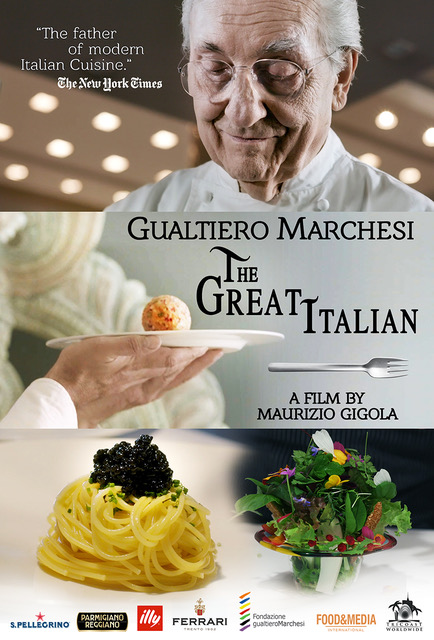
Gualtiero Marchesi did more than create celebrated dishes. He changed how Italian chefs thought about ingredients, presentation, creativity and their own cultural identity.
Before Marchesi, Italy was already home to one of the world’s richest culinary traditions, but its finest cooking was often interpreted internationally through a French lens. Marchesi demonstrated that Italian cuisine could be modern, intellectually ambitious and visually arresting without losing its connection to regional ingredients and familiar flavors.
He became the first chef in Italy to lead a restaurant awarded three Michelin stars, but his importance cannot be measured by awards alone. His restaurants became laboratories for a new Italian cuisine, while his kitchens trained an extraordinary generation of chefs. Carlo Cracco, Davide Oldani, Enrico Crippa, Andrea Berton, Pietro Leemann, Ernst Knam and Paolo Lopriore are among the prominent figures influenced by his teaching.
Marchesi was a chef, restaurateur, educator, musician and cultural thinker. Through all those roles, he helped establish the language of contemporary Italian fine dining.
Growing Up in a Milanese Restaurant
Gualtiero Marchesi was born in Milan on March 19, 1930. Food and hospitality were part of his life from childhood. His parents operated the Albergo del Mercato, a hotel and restaurant on Via Bezzecca, where he observed the rhythms of professional service and took his first steps in the kitchen.
This early environment taught him the foundations of traditional Lombard cooking. He learned that good cuisine begins with discipline: ingredients must be respected, techniques mastered and preparations repeated until they become reliable.
Marchesi was also deeply interested in music. He studied piano and remained passionate about classical music throughout his life. This was not a hobby disconnected from his culinary career. Music influenced how he understood rhythm, proportion, silence and composition—all ideas that would later become central to his cooking.
After gaining experience in Switzerland, including a period in St. Moritz and studies in Lucerne, Marchesi continued his education in France. Encounters with the French restaurant world introduced him to new techniques and to the emerging principles that would become associated with nouvelle cuisine.
Rather than simply copying French cooking, however, he eventually used those lessons to reconsider Italian cuisine. He wanted to remove heaviness and unnecessary decoration while preserving the identity of the ingredients.
The Restaurant on Via Bonvesin de la Riva
In 1977, Marchesi opened his landmark restaurant on Via Bonvesin de la Riva in Milan. It was here that his ideas became a complete culinary statement.
The restaurant received its first Michelin star soon after opening and a second the following year. In 1985, it was awarded three Michelin stars, making Marchesi the first chef in Italy to reach the guide’s highest level.
The achievement had significance beyond one restaurant. It demonstrated that modern Italian cuisine could command the same international critical respect long associated with France’s greatest dining rooms.
At Bonvesin de la Riva, Marchesi presented Italian ingredients with an unusual degree of refinement and restraint. Plates were carefully composed, portions were controlled and sauces were used with precision. He rejected the idea that luxury depended on excess.
His cooking was sophisticated, but it was rarely complicated merely for show. Behind the elegant presentation was a desire to make every flavor recognizable.
From Milan to L’Albereta in Franciacorta
In 1993, Marchesi moved the center of his culinary work from Milan to L’Albereta in Erbusco, in the Franciacorta countryside.
The setting allowed him to develop a restaurant experience closely connected to landscape, hospitality and contemplation. At L’Albereta, food was not treated as an isolated performance. It was part of a broader encounter with place, wine, architecture and service.
The move also gave Marchesi room to continue training young chefs. Working in one of his kitchens meant learning techniques, but it also meant learning how to think. Students were expected to question habits, observe ingredients carefully and understand why every element appeared on the plate.
Marchesi subsequently developed or advised other restaurants in Italy and abroad. These included ventures in Milan, Rome, Paris and London.
In 2008, he returned prominently to central Milan with Il Marchesino, later known as Marchesi alla Scala, beside the Teatro alla Scala. The location united several of his lifelong passions: cuisine, music, art and Milanese culture.
His association with the Grand Hotel Tremezzo on Lake Como created another important part of his legacy. La Terrazza Gualtiero Marchesi was entrusted with preserving and presenting a selection of his signature dishes, allowing later diners to encounter his culinary vocabulary.
The Philosophy Behind Marchesi’s Cooking
Marchesi is frequently described as the founder of modern Italian cuisine, but “modern” did not mean rejecting the past.
He believed tradition should be understood before it was transformed. A chef needed to know ingredients and established techniques thoroughly, but was not required to reproduce the same preparations forever. Tradition could provide a point of departure for creativity.
Several principles defined his work.
Simplicity Through Subtraction
Marchesi removed ingredients that did not contribute something essential. His plates often appeared simple because he had eliminated repetition, heaviness and unnecessary garnish.
This simplicity demanded precision. When a plate contains only a few elements, poor ingredients or technical errors have nowhere to hide.
The Ingredient Must Remain Recognizable
Marchesi wanted diners to perceive the individual character of rice, fish, pasta, vegetables and meat. Sauces and seasonings were meant to support the principal ingredient rather than overwhelm it.
This approach helped distinguish his cuisine from both old-fashioned banquet cooking and overly elaborate versions of French haute cuisine.
Cooking as an Art Form
Marchesi regarded cuisine as a form of cultural expression. His dishes drew inspiration from painting, sculpture, design and music. Yet he did not believe appearance alone made a plate artistic. Beauty had to be joined by flavor, technique and meaning.
His plating was often highly structured. Empty space mattered as much as the food, just as silence can be essential in music.
The Chef as Composer
His musical background gave him a distinctive way of thinking about a meal. A dish could contain contrast, repetition, tempo and harmony. A menu could progress like a musical composition, with moments of intensity followed by quieter passages.
Marchesi approached creativity as an editor as well as an inventor. The chef’s task was to decide what belonged—and what should be removed.
His Most Famous Dishes
Marchesi created several dishes that became symbols of modern Italian gastronomy.
Riso, Oro e Zafferano
His best-known creation is Riso, Oro e Zafferano: a saffron risotto finished with an edible sheet of gold leaf.
The dish transforms a recognizable Milanese preparation into something ceremonial. Its force comes from the contrast between the restrained plate, the brilliant yellow rice and the geometric square of gold.
Gold provides visual drama but does not alter the essential flavor. The dish therefore expresses a central Marchesi idea: presentation can change how food is perceived without disguising what it is.
Raviolo Aperto
The Raviolo Aperto, or open raviolo, dismantled the conventional form of filled pasta. Rather than enclosing the filling, Marchesi placed ingredients between visible sheets of pasta, often using a parsley leaf embedded in one sheet as a decorative element.
The result made the structure of the dish visible. It was both recognizable and surprising—pasta interpreted through transparency, geometry and color.
Seppia al Nero
In Marchesi’s treatment of cuttlefish and its ink, black became both an ingredient and a visual field. The composition showed how a restrained palette could create a powerful plate while preserving the marine character of the principal ingredient.
Dripping di Pesce
Inspired by the action paintings of Jackson Pollock, Dripping di Pesce used colorful sauces distributed across the plate in an apparently spontaneous pattern.
The presentation looked playful and free, but the arrangement was controlled. It illustrated Marchesi’s continuing conversation between food and modern art.
Quattro Paste
Another emblematic composition brought together four forms or preparations of pasta on one plate. Instead of treating pasta merely as a carrier for sauce, Marchesi presented it as a subject worthy of study, comparison and contemplation.
These dishes were never simply exercises in decoration. Each one questioned an established culinary form: risotto, ravioli, seafood or pasta. Marchesi preserved the identity of the food while changing the way diners saw it.
Michelin Stars—and His Rejection of Ratings
Marchesi’s three Michelin stars established a historic benchmark for Italian restaurants. Yet later in life, his relationship with restaurant rankings changed.
In 2008, he asked not to have his restaurants evaluated through the conventional star system. He believed that chefs, especially younger ones, were becoming too focused on pleasing guides and maintaining scores. In his view, this pressure could discourage creativity and turn cooking into a competition.
The decision was controversial because Marchesi’s reputation had benefited from Michelin recognition. It was also consistent with his insistence that a chef should develop an independent identity.
Marchesi was not arguing that standards were unimportant. His own kitchens were known for discipline and precision. His objection concerned allowing ratings to become the primary purpose of a restaurant.
For him, judgment ultimately had to begin with the food, the chef’s cultural knowledge and the experience offered to the guest.
The Maestro and His Students
Perhaps Marchesi’s greatest legacy is the number of influential chefs who passed through his kitchens.
He became known as Il Maestro not simply because he was famous, but because teaching was central to his work. He did not try to produce chefs who copied his plates. He wanted them to master a method and then develop their own culinary language.
Carlo Cracco carried Marchesi’s combination of Italian ingredients and avant-garde technique into some of Milan’s best-known restaurants. His later television career also helped bring the figure of the contemporary Italian chef to a much wider public.
Davide Oldani developed what he calls cucina pop, applying precision and creative contrasts to relatively humble ingredients. His philosophy differs from Marchesi’s fine-dining model, but the attention to balance, clarity and thoughtful composition reveals the Maestro’s influence.
Enrico Crippa became known for intensely visual, vegetable-driven cooking at Piazza Duomo in Alba. His plates demonstrate how Marchesi’s dialogue between art, nature and cuisine could lead a student toward an entirely personal style.
Andrea Berton developed an identity centered on clean flavors, careful construction and broths. Pietro Leemann pursued a vegetarian path at Joia in Milan, connecting gastronomy with ethics, spirituality and nature.
Pastry chef Ernst Knam brought rigorous technique and artistic presentation to chocolate and desserts. Paolo Lopriore became admired for one of the most individual and intellectually demanding approaches in contemporary Italian cooking.
Other notable chefs associated with Marchesi’s kitchens include Daniel Canzian, Fabrizio Molteni, Pietro D’Agostino and many professionals who later transmitted his methods to their own teams.
The remarkable diversity of these chefs is evidence of the quality of Marchesi’s teaching. His strongest students did not cook alike. What they shared was an insistence on thought, technique and personal expression.
ALMA and the Education of Italian Chefs
Marchesi’s influence extended beyond his restaurant kitchens through ALMA, the International School of Italian Cuisine in Colorno, near Parma.
He served as the school’s rector from 2003 until his death in 2017. ALMA’s mission—to combine technique with knowledge of Italian gastronomic history, products and regional traditions—closely reflected his beliefs.
Marchesi understood that Italian chefs needed more than practical kitchen ability. They needed cultural education. A professional representing Italian cuisine should understand agriculture, art, music, history, design and the country’s extraordinary regional differences.
By lending his authority to culinary education, Marchesi helped elevate cooking from a trade learned primarily through repetition to a profession supported by structured study and cultural awareness.
The Gualtiero Marchesi Foundation
In 2010, Marchesi and Enrico Dandolo established the Fondazione Gualtiero Marchesi. Its mission reaches beyond the preservation of recipes.
The foundation promotes cuisine as one of the arts and encourages dialogue among gastronomy, music, painting, sculpture and other forms of cultural expression. It also works to preserve and communicate Marchesi’s ideas to future generations.
This interdisciplinary mission reflects the man himself. Marchesi never viewed a chef as an isolated technician. He believed cuisine belonged within the wider culture of a country.
Marchesi: The Great Italian
Marchesi’s life and ideas were documented in Maurizio Gigola’s film Marchesi: The Great Italian. The documentary combines culinary images with testimony from chefs, artists and people who knew him.
Rather than functioning only as a record of famous dishes, the film examines the relationship between Marchesi’s cooking and his interests in beauty, music and the visual arts.
Readers interested in the film can visit Italia Mia’s separate article about Marchesi: The Great Italian.
A Lasting Influence on Italian Cuisine
Gualtiero Marchesi died in Milan on December 26, 2017, at the age of 87. By then, the transformation he had begun was visible throughout Italy.
Contemporary Italian fine dining now confidently draws upon regional traditions while using modern techniques and presentation. Italian chefs are internationally recognized not only as guardians of inherited recipes but also as independent creative figures.
Marchesi helped make that transition possible.
His legacy survives in iconic dishes, in the institutions he supported and in the many chefs he trained. It also survives in a broader idea: Italian cuisine does not have to choose between memory and invention.
To appreciate Marchesi fully, it helps to understand the regional traditions from which Italian chefs draw their inspiration. Our guide to what to eat in all 20 Italian regions explores that extraordinary diversity, while Traditional Italian Food That Is Rarely Found Abroad looks beyond the dishes most familiar to international visitors.
Marchesi respected that heritage, but he refused to treat it as untouchable. He showed that tradition remains alive only when each generation studies it carefully enough to reinterpret it with intelligence.
That may be his most important lesson. A great chef does not erase the past or imitate it. He understands it, removes what is unnecessary and gives it a new form.