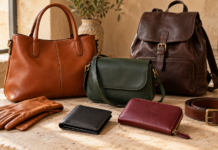
What makes Italian leather goods worth the price? The answer lies in the leather, construction, finishing, repairability and craftsmanship. A good Italian leather bag should earn its price every time you use it: when the strap sits comfortably, the zip opens cleanly, and the leather develops character without the construction falling apart.
The strongest reasons to pay more are the quality of the hide, the care taken in making the object, and the possibility of repairing it. Design and brand recognition also influence the price. Understanding those different costs makes it easier to choose well, whether your budget is €80 or €3,000.
Affiliate disclosure: This article contains affiliate links. We may earn a commission from qualifying purchases through these links at no additional cost to you. As an Amazon Associate, we earn from qualifying purchases.
Italian Leather Quality: Full-Grain, Calfskin and Tanning
“Leather” describes a material, not a single level of quality. The animal, the part of the hide, the tanning process, and the surface treatment all affect how a finished item feels and wears.
Full-grain leather retains its original grain surface. It can show small natural variations and develop an attractive patina. That makes it appealing for a wallet or everyday satchel, but the term alone cannot tell you whether the stitching, lining, or hardware will last.
Descriptions such as “top-grain,” “calfskin,” and “genuine leather” answer different questions. Calfskin identifies the animal’s age category; it does not establish the leather’s finish or construction quality. “Genuine leather” alone supplies too little information to justify a premium.
Vegetable tanning uses plant-derived tannins. It is often associated with the firm, warm-toned cowhide found in traditional Tuscan accessories. Chrome tanning can produce soft, flexible leather suited to lightweight bags and clothing. Either process can yield excellent material; vegetable tanning is not a universal quality guarantee. [1]
Il Bisonte provides a useful example of specific information: its Archivio wallet is described as vegetable-tanned cowhide, handmade in Tuscany, with brass hardware. Those details tell a buyer considerably more than “premium Italian leather.” [2]
Also separate the origin of the leather from the origin of the finished object. A product advertised as using Italian leather is not necessarily manufactured in Italy. Check the individual item’s country-of-manufacture information.
Construction: Stitching, Structure and Everyday Durability
A beautiful hide cannot rescue a badly assembled bag.
Look at the points that carry weight: handle bases, strap attachments, corners, and the area around the zip. Stitching should be secure and consistent, without loose loops, missed sections, or holes crowded so tightly that they weaken the material.
Open the item. A wallet should fold naturally without an awkward ridge of bulk. Card slots should hold cards securely without requiring a struggle. In a bag, the lining should sit neatly and allow access to pockets without pulling against the outer shell.
Skiving—the controlled thinning of leather around folds and joins—helps explain why one wallet feels refined while another feels clumsy. Good work balances a slim profile with enough material where strength is needed.
Machine stitching can be excellent. Hand stitching has value when the technique and execution benefit the object. A “handmade” description becomes useful when the maker explains which operations are performed by hand.
Leather Finishing: Edges, Surface Treatments and Hardware
Run a fingertip along the edges of a strap or wallet. Depending on the design, the edge may be burnished, folded, or painted. Each can be appropriate. What matters is whether it has been executed cleanly.
Burnished edges should feel smooth. Folded edges should sit neatly around curves. Painted edges should look even, without obvious bubbling, sticky patches, or cracking at a new fold.
Surface finishes involve a tradeoff too. Aniline leather leaves the natural grain visible; semi-aniline introduces some pigment while preserving the visible grain. Pigmented finishes provide greater coverage. A natural-looking surface can be appealing, while a more protective finish may suit frequent handling better. [3]
Inspect the hardware with the same attention. Open the zip several times. Check that clasps engage positively and strap adjusters hold their position. Weight and shine alone do not establish quality.
Repairability: Can Your Leather Bag or Wallet Be Restored?
A bag becomes a better long-term purchase when worn parts can be replaced.
Ask whether the maker can repair stitching, replace a strap, renew an edge finish, or assess a damaged lining. Find out how repairs are arranged and whether replacement hardware is available.
Accessible construction and replaceable components can make a repair more practical. A proprietary clasp may require the brand’s help; a badly damaged coating may be difficult to restore convincingly. A skilled repairer should assess the actual item before promising a result.
Bottega Veneta offers aftercare and repair services and a Certificate of Craft programme for selected products. Eligibility and terms matter: do not assume every bag, purchase channel, or type of wear receives complimentary treatment. Confirm coverage before buying, especially through a third-party retailer. [4]
Italian Leather Goods Across Different Price Levels
These examples illustrate different purchases rather than a direct comparison between equivalent products. Prices are reference points checked in October 2026; currencies, regional pricing, stock, and promotions vary.
| Price level | Example | What to evaluate |
|---|---|---|
| Around €80–€100 | Tony Perotti Vegetale 336 wallet, listed at €82.50 on its Italian shop | Material disclosure, neat folds, useful capacity, and secure stitching. At this level, a simple accessory lets the budget go further. |
| Around €150–€250 | Il Bisonte Archivio wallet, listed at €195 | Its specified vegetable-tanned cowhide, Tuscan manufacture, brass hardware, and whether you enjoy leather that changes with use. |
| Around €300–€400 | The Bridge Lisa leather shopper, listed at €375 | Handle comfort, weight, access, lining, and reinforcement become especially important in a larger everyday object. |
| Around $2,000 and above | Bottega Veneta Intrecciato shoulder bags; an Italist listing showed a black version at $2,093 | Handwoven construction and distinctive design, alongside the substantial contribution of luxury positioning to the price. |
Sources: Tony Perotti [5], Il Bisonte [2], The Bridge [6], and Italist [7].
Where to Shop for Italian Leather Goods
For an accessible starting point, search Tony Perotti leather wallets on Amazon.com or Amazon.it. These are search links, not promises of availability for the exact model above. Check the seller, materials, manufacturing origin, and return terms on the individual listing.
For designer options, browse Bottega Veneta on Italist or explore Italist’s current selection. Compare the exact model, dimensions, leather, delivered price, and return costs.
Italian Craftsmanship: What Is Worth Paying For?
Bottega Veneta’s Intrecciato offers a concrete example: the house describes the interweaving of leather strips as work performed entirely by hand. That is an identifiable craft process contributing to the finished object. It does not mean a woven luxury bag will outlast every simpler bag. [8]
Equally, craftsmanship can appear in an unshowy wallet: balanced thickness, accurately cut pockets, clean edges, and a fold that works comfortably. These qualities may be easier to appreciate after months of use than under shop lighting.
The most convincing Italian leather goods combine suitable leather, careful assembly, thoughtful finishing, and realistic aftercare. Pay for improvements you can identify and will enjoy using. A modest wallet can meet that standard, and a costly handbag should be held to it.
Sources
- Leather Naturally: leather FAQs
- Il Bisonte: wallets and Archivio specifications
- Leather Working Group: definitions of leather finishes
- Bottega Veneta: services and Certificate of Craft
- Tony Perotti: Italian shop
- The Bridge: official shop
- Italist: Bottega Veneta selection
- Bottega Veneta: Craft is Our Language