
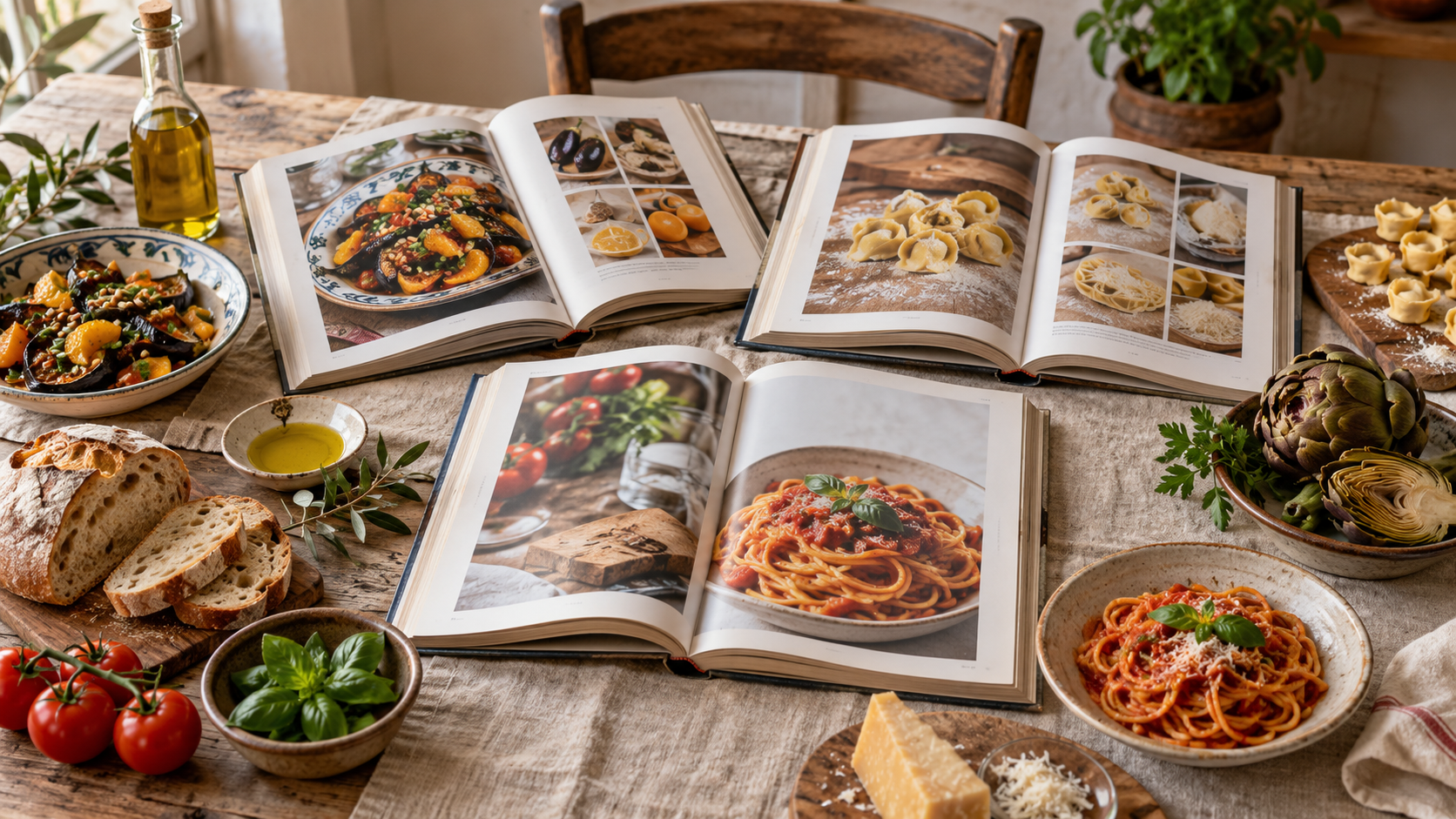
 Italian cooking is not one single cuisine. The food of Sicily is shaped by the Mediterranean, North Africa and centuries of cultural exchange; Tuscan cooking is built around seasonal produce, bread, beans and careful simplicity; Naples and Campania are celebrated for pizza, pasta, vegetables, seafood and festive dishes; Emilia-Romagna is the home of many of Italy’s most famous fresh pastas, cheeses and cured meats; and Rome has its own unmistakable repertoire of pastas, offal, fried foods and Jewish-Roman specialties.
That is why a regional cookbook often teaches more about real Italian food than a general collection of familiar recipes. The best books explain not only how a dish is prepared, but where it comes from, how it varies from town to town and why local ingredients matter.
The recommendations below include both classic references and approachable modern books. Amazon prices and availability can change, and some older titles may be offered by third-party or used-book sellers. Readers looking for more Italian titles can also visit Italia Mia’s Italian Books collection.
Best Sicilian Cookbooks
Sicilian food combines Greek, Arab, Norman, Spanish and wider Mediterranean influences. Its cooking moves easily between frugal dishes and elaborate pastries, with recurring ingredients such as citrus, eggplant, tomatoes, almonds, pistachios, capers, anchovies, swordfish, raisins and breadcrumbs.
Made in Sicily by Giorgio Locatelli
Best overall Sicilian cookbook
Giorgio Locatelli’s large, richly illustrated book is part cookbook, part culinary journey. It explores the people, ingredients and traditions behind Sicilian food while offering recipes for caponata, pasta, couscous, seafood, vegetables and desserts. Locatelli explains how Sicily’s layered history appears on the plate, making this an especially good choice for readers who want cultural context as well as recipes.
The book is substantial and inspiring, although it may suit an experienced or enthusiastic cook better than someone seeking only quick weekday meals.
View Made in Sicily on Amazon.com
Sicilia by Ben Tish
Best for contemporary presentation and entertaining
Sicilia presents the island through vivid photography and recipes that feel rooted in tradition but inviting to the modern home cook. Ben Tish gives particular attention to Sicily’s contrasting character: simple country cooking on one side and colorful, celebratory food on the other.
It is a fine choice for cooks attracted to grilled foods, vegetables, seafood, citrus, sweets and generous dishes made for sharing. Readers seeking a strictly historical or encyclopedic reference may prefer Locatelli, but this is arguably the more immediately approachable book.
View Sicilia by Ben Tish on Amazon.com
Coming Home to Sicily by Fabrizia Lanza
Best for seasonal Sicilian home cooking
Fabrizia Lanza writes from the perspective of a Sicilian cook deeply connected to the land, agricultural seasons and the food traditions of Case Vecchie. The book is organized around the year and shows how recipes grow naturally from harvests, celebrations and daily life.
Choose this book if you are interested in the relationship between Sicilian food, farming and seasonality rather than a restaurant-style collection alone.
View Coming Home to Sicily on Amazon.com
Best Tuscan Cookbooks
Tuscan cuisine is famous for restraint. Bread, beans, greens, olive oil, seasonal vegetables, grilled meat and slow-cooked dishes are treated with respect rather than hidden beneath elaborate sauces. Many of the region’s most satisfying recipes emerged from cucina povera—the resourceful cooking of ordinary households.
Cucina Povera by Giulia Scarpaleggia
Best for traditional Tuscan home cooking
Tuscan-born food writer Giulia Scarpaleggia explores the art of transforming inexpensive, seasonal ingredients into deeply satisfying food. Recipes include soups, bread-based dishes, vegetables, handmade pasta, meat and desserts, with an emphasis on thrift, reducing waste and using what is available.
Although the book reaches beyond Tuscany in places, its spirit is strongly Tuscan. It is one of the most useful choices for cooks who want practical food rather than an idealized picture of villa life.
View Cucina Povera on Amazon.com
From the Markets of Tuscany by Giulia Scarpaleggia
Best for market-driven Tuscan cooking
This book takes readers through Tuscan markets and builds recipes around the produce, meats, cheeses and pantry ingredients found there. It communicates an essential principle of Italian cooking: decide what to cook after seeing what is fresh and in season.
The book is especially appealing to travelers, gardeners and cooks who enjoy understanding ingredients and their local context.
View From the Markets of Tuscany on Amazon.com
The Tuscan Sun Cookbook by Frances Mayes and Edward Mayes
Best for beginners and lovers of Tuscan atmosphere
Frances and Edward Mayes combine approachable recipes with stories and photography that evoke life around their Tuscan home. The cooking is accessible, warmly presented and well suited to relaxed meals with family and friends.
This is not the most scholarly guide to regional food, but it makes a welcoming gift and a comfortable entry point for someone who loves Tuscany and wants recipes that do not feel intimidating.
View The Tuscan Sun Cookbook on Amazon.com
Best Naples and Campania Cookbooks
Naples has given the world far more than pizza. The cooking of Campania includes dried pasta, tomatoes, leafy vegetables, legumes, seafood, mozzarella, eggplant, elaborate holiday dishes and memorable pastries. Many foods considered Italian-American classics have roots in this region, although they often changed after arriving in the United States.
Naples at Table by Arthur Schwartz
Best complete English-language guide to Neapolitan cooking
Arthur Schwartz’s Naples at Table: Cooking in Campania remains a landmark study of the region. It covers Naples as well as the wider provinces and islands of Campania, combining recipes with history, personal observations and explanations of local food culture.
The book is particularly valuable for readers interested in the relationship between Campanian food and Italian-American cooking. Because it is an older title, new copies may be limited, but a good used copy deserves a place in a serious Italian cookbook collection.
View Naples at Table on Amazon.com
Cucina Napoletana by Arturo Lengo
Best compact collection of classic Neapolitan recipes
Arturo Lengo’s collection is a more focused route into the food of Naples. It includes recognizable classics alongside dishes that are less familiar outside Campania. The format is useful for cooks who want recipes first and do not need the breadth of cultural commentary found in Naples at Table.
Availability can vary, so compare new and used editions before ordering.
View Cucina Napoletana by Arturo Lengo on Amazon.com
Food of the Italian South by Katie Parla
Best modern companion for southern Italian cooking
This is not exclusively a Naples cookbook: Katie Parla travels across the Italian South. Campania nevertheless plays an important part, and the book helps place Neapolitan cuisine within the broader food traditions of southern Italy.
It is a strong companion to Naples at Table for readers who want contemporary photography, travel context and dishes from areas that receive less international attention.
View Food of the Italian South on Amazon.com
Best Emilia-Romagna Cookbooks
Emilia-Romagna is one of Italy’s great food regions. Parmigiano Reggiano, Prosciutto di Parma, traditional balsamic vinegar, mortadella, ragù, tortellini, cappelletti, lasagne and an extraordinary variety of fresh pasta all belong to its culinary world. It is also a region where technique matters, especially when making dough, rolling pasta and preparing fillings.
The Splendid Table by Lynne Rossetto Kasper
Best comprehensive cookbook for Emilia-Romagna
The Splendid Table: Recipes from Emilia-Romagna, the Heartland of Northern Italian Food is the essential English-language reference for the region. Lynne Rossetto Kasper combines detailed recipes with history, folklore and explanations of local traditions from Bologna, Parma, Modena, Ferrara, Ravenna and beyond.
This is the book to choose if you want to understand the region rather than merely reproduce a few famous dishes. It is detailed and sometimes demanding, but the depth is precisely what makes it valuable.
View The Splendid Table on Amazon.com
American Sfoglino by Evan Funke with Katie Parla
Best for learning handmade pasta technique
Evan Funke’s book concentrates on the craft of pasta made with a rolling pin in the tradition of Bologna’s sfogline. Step-by-step photography and detailed instruction help cooks learn how dough should feel, how to roll a large sheet and how to shape classic forms.
The author is American, and the book is not a complete survey of Emilia-Romagna. Its value lies in technique. Pair it with The Splendid Table for an excellent combination of regional knowledge and hands-on pasta instruction.
View American Sfoglino on Amazon.com
Science in the Kitchen and the Art of Eating Well by Pellegrino Artusi
Best historical classic with roots in Emilia-Romagna and Tuscany
Pellegrino Artusi’s nineteenth-century work helped establish a shared vocabulary for Italian home cooking after unification. Artusi was born in Romagna and later lived in Florence, so the collection is broader than Emilia-Romagna alone. Still, it is indispensable for readers interested in the development of Italian cooking and in dishes such as cappelletti in the Romagna tradition.
Modern cooks should expect an absorbing historical text rather than the precise, highly visual instructions of a contemporary cookbook.
View Science in the Kitchen and the Art of Eating Well on Amazon.com
Best Roman Cookbooks
Roman cooking is direct, savory and intensely local. Its best-known pasta dishes—carbonara, cacio e pepe, amatriciana and gricia—use few ingredients, which means technique and timing cannot be disguised. The city’s cuisine also includes artichokes, puntarelle, fried foods, quinto quarto offal dishes and the important traditions of the Roman Jewish community.
Tasting Rome by Katie Parla and Kristina Gill
Best overall introduction to Roman food
Tasting Rome balances classic dishes with bakery food, street food, drinks and the changing contemporary food culture of the capital. The writing provides historical and neighborhood context, while Kristina Gill’s photography makes the book attractive enough to give as a present.
This is the best starting point for most English-speaking readers because it presents Rome as a living food city rather than a museum of four pasta dishes.
View Tasting Rome on Amazon.com
My Kitchen in Rome by Rachel Roddy
Best for the rhythms of everyday Roman cooking
Rachel Roddy writes with the intimacy of someone learning, shopping and cooking within a Roman neighborhood. The recipes are woven together with observations about markets, ingredients, seasons and domestic life.
Choose this book if you enjoy narrative food writing and want to understand how Roman meals fit into everyday routines. It is more personal than encyclopedic, which is part of its charm.
View My Kitchen in Rome on Amazon.com
Cooking the Roman Way by David Downie
Best traditional alternative
David Downie gathers recipes inspired by Roman homes and trattorias, covering pasta, vegetables, meat, offal and other foundations of the city’s cuisine. It offers a more traditional counterpoint to newer, more visually polished books.
As with several older regional titles, shoppers may find the best value among used copies.
View Cooking the Roman Way on Amazon.com
Best General Italian Cookbooks
A regional collection becomes even more useful when paired with one authoritative general reference. These books help readers compare techniques, understand how similar dishes change across Italy and build a dependable foundation before specializing in one region.
Essentials of Classic Italian Cooking by Marcella Hazan
Best single-volume introduction to Italian cooking
Marcella Hazan taught generations of English-speaking home cooks to approach Italian ingredients and techniques with clarity and discipline. The book explains fundamentals—sauces, risotto, pasta, vegetables, meat and fish—without unnecessary complication.
It does not attempt to document every region equally, but it remains the most practical first purchase for someone building an Italian cookbook library.
View Essentials of Classic Italian Cooking on Amazon.com
La Cucina: The Regional Cooking of Italy by the Italian Academy of Cuisine
Best encyclopedic regional reference
La Cucina gathers recipes documented across Italy by the Italian Academy of Cuisine. Its great strength is range: readers can move beyond the best-known cities and compare food from northern, central, southern and island regions.
The number of recipes makes it an exceptional reference, although its concise style offers less step-by-step guidance and photography than many modern cookbooks. It is best for confident cooks and readers interested in culinary documentation.
View La Cucina: The Regional Cooking of Italy on Amazon.com
The Silver Spoon
Best large household reference
The Silver Spoon is the English-language edition of a famous Italian kitchen reference. Its enormous range makes it useful when you have an ingredient and need ideas, or when you want a broad overview of Italian dishes in one substantial volume.
Because the collection is so large, individual recipes may be shorter and less explanatory than those in a book devoted to one region. Treat it as a dependable reference rather than a guided course in regional cooking.
View The Silver Spoon on Amazon.com
The Regional Italian Cookbook: Recipes from The Silver Spoon
Best visually accessible tour of all 20 regions
This more focused Silver Spoon volume is designed specifically around Italy’s regional differences. It is easier to navigate as a culinary journey than the much larger general reference and is a particularly attractive option for readers who want an overview before buying books devoted to individual regions.
View The Regional Italian Cookbook on Amazon.com
Which Italian Cookbook Should You Buy First?
If you want one general book, begin with Essentials of Classic Italian Cooking. If your main interest is understanding regional diversity, choose La Cucina or The Regional Italian Cookbook. For a single region, the strongest starting points are Made in Sicily, Cucina Povera, Naples at Table, The Splendid Table and Tasting Rome.
A particularly useful small collection would contain one broad reference, one regional book connected to your family history or favorite destination, and one technique-focused volume. For example, Essentials of Classic Italian Cooking, The Splendid Table and American Sfoglino would give a cook both a strong foundation and serious pasta-making instruction.
The most important lesson these books share is that authentic Italian cooking is local. There is no single correct Italian pantry, sauce or Sunday meal. The recipes change with geography, climate, agriculture, history and family tradition—and that variety is precisely what makes Italian food endlessly rewarding.
External Sources
- Bloomsbury: Sicilia by Ben Tish
- Hachette Book Group: Cucina Povera by Giulia Scarpaleggia
- Penguin Random House: The Tuscan Sun Cookbook
- Google Books: Naples at Table
- Google Books: The Splendid Table
- Penguin Random House: Tasting Rome