
Authentic Murano Glass Products
Visit Muranonet to buy authentic Murano glass
Sculptures | Vases and Plates | Home Decor | Tableware | Jewellery | Lighting | Collectibles | Gift Ideas
Few Italian crafts have achieved the international reputation of Murano glass. For centuries, the small island of Murano, in the Venetian Lagoon, has been synonymous with exceptional glassmaking, combining highly developed technical skills with artistic experimentation, color, transparency and extraordinary forms.
Today, Murano glass can be found everywhere from major museums and international auction houses to antique markets, design galleries and Venetian souvenir shops. The enormous range of quality, however, can make buying Murano glass confusing. A small decorative object may cost €30, while an important twentieth-century work by a celebrated designer can sell for tens of thousands of euros. Exceptional pieces have reached hundreds of thousands.
Understanding the difference requires more than looking for a sticker saying “Murano.” The designer, foundry, period, technique, condition, provenance and rarity can all dramatically affect the value.
The history of Murano’s glass industry stretches back centuries, and the Museo del Vetro di Murano, founded in 1861, houses a chronological collection ranging from ancient examples to twentieth-century masterpieces.
Why Murano became famous
The history of Venetian glassmaking is closely connected with Murano. Glass production was transferred from Venice to the island in the late thirteenth century, where the concentration of furnaces helped create a specialized community of glassmakers.
The isolation of the industry also helped protect technical knowledge. Glassmakers developed methods that were closely guarded within families and workshops, passing skills from master to apprentice.
Over the centuries Murano became famous for techniques including millefiori, murrine, filigrana, latticino, aventurine, sommerso, incalmo, pulegoso, battuto and corroso.
Some techniques produce extraordinary color effects; others depend on precision and the ability of the master to manipulate molten glass almost instantaneously.
The island experienced serious difficulties during the nineteenth century, particularly following the fall of the Venetian Republic. Artistic glass production declined dramatically before experiencing a revival during the second half of the century. Fratelli Toso was founded in 1854, while Antonio Salviati established a blown-glass furnace in 1866.
That nineteenth-century revival laid the foundations for the extraordinary explosion of creativity that followed during the twentieth century.
The golden age of twentieth-century Murano glass
Although Murano glass has a much older history, collectors often concentrate particularly heavily on pieces produced between approximately the 1920s and the 1970s.
This was the period when Murano’s traditional craftsmen began working closely with architects, painters and designers.
The relationship between artist and furnace transformed Murano glass from an essentially traditional craft into an important form of modern decorative art.
A particularly important development occurred in 1921, when Cappellin & Venini created the position of artistic director and appointed Vittorio Zecchin. Other companies subsequently adopted similar approaches.
The result was a remarkable collaboration between master glassmakers and internationally influential designers.
The most important Murano designers
Carlo Scarpa
Carlo Scarpa is one of the most important names in twentieth-century Italian design and architecture.
His relationship with Venini between 1932 and 1947 produced some of the most sophisticated examples of modern Murano glass.
Scarpa experimented with transparency, layered colors, murrine, battuto, corroso and geometric structures. His pieces often look deceptively simple, but their construction can be extremely complex.
Original Scarpa designs are highly desirable among collectors, particularly when accompanied by strong provenance and documentation.
The Museo del Vetro identifies Scarpa’s period as one of the defining chapters of twentieth-century Murano design.
Fulvio Bianconi
Fulvio Bianconi is another essential name for anyone interested in collectible Murano glass.
His work for Venini during the 1950s produced some of the most recognizable pieces in the history of the company.
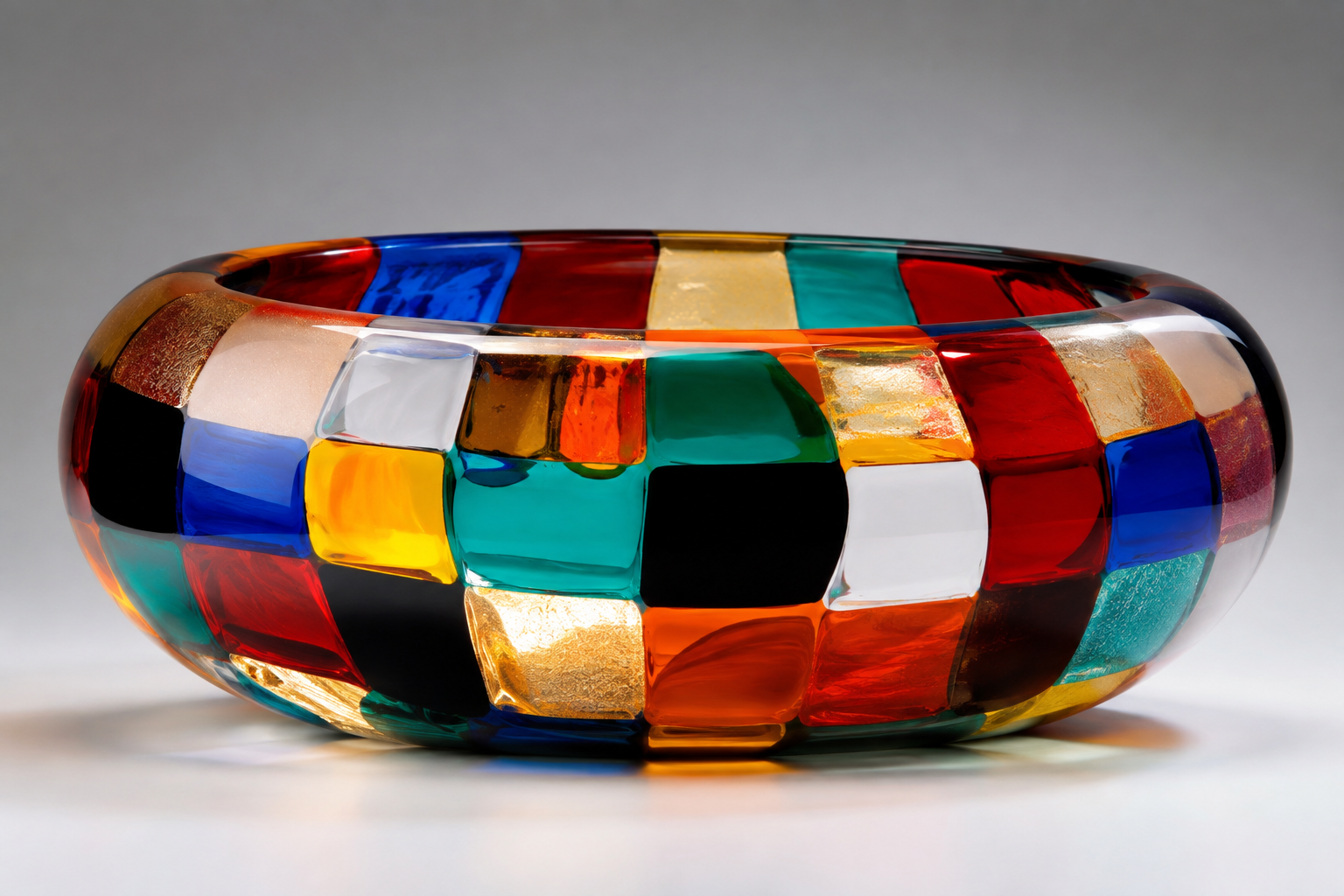
His Pezzato designs, with their geometric blocks of contrasting colors, are particularly famous. His anthropomorphic figures and other sculptural objects are also highly collected.
Bianconi’s work demonstrates why attribution is so important. A piece of Murano glass may be beautiful, but a comparable object designed by Bianconi for Venini can have a completely different market value.
Recent auction results illustrate this difference. A Fulvio Bianconi vase made for Venini around 1950 sold for €17,600 at a Cambi auction, while another Bianconi piece from 1992 reached €15,100.
Ercole Barovier
Ercole Barovier was one of the great innovators of twentieth-century Venetian glass.
His experiments produced remarkable combinations of color, texture and structure, including the Oriente, Pezzato, Intarsio and Barbarico families of work.
Barovier’s importance is enhanced by the extraordinary history of the Barovier glassmaking family, whose documented roots on Murano reach back to 1295. The modern Barovier&Toso company traces its history through more than seven centuries of Venetian glassmaking.
Vintage pieces associated with Ercole Barovier can command substantial prices, particularly when the design, date and provenance are securely established.
Napoleone Martinuzzi
Martinuzzi worked with Venini and is strongly associated with the development of pulegoso glass.
Pulegoso glass contains numerous intentionally trapped air bubbles, creating an opaque, almost volcanic appearance.
Martinuzzi’s work is particularly interesting because it demonstrates how Murano designers could transform what might traditionally have been considered an imperfection—air bubbles—into the principal aesthetic feature of an object.
The Museo del Vetro notes that Martinuzzi’s period at Venini included the development of this thick, opaque glass filled with bubbles.
Flavio Poli
Flavio Poli is closely associated with Seguso Vetri d’Arte and with the development of sophisticated sommerso glass.
Sommerso involves creating multiple layers of differently colored transparent glass, producing dramatic color transitions without painting the surface.
A particularly good sommerso object can have remarkable depth and luminosity.
Poli’s designs from the 1950s and 1960s remain popular with collectors and are among the most recognizable forms of postwar Murano design. The Museo del Vetro specifically identifies Poli’s development of layered “sommerso” glass for Seguso as an important postwar achievement.
Dino Martens
Dino Martens became famous for his highly colorful, experimental designs for Aureliano Toso.
His Eldorado series is particularly recognizable for its exuberant combinations of color, metallic inclusions and irregular geometric patterns.
Martens is a good example of why collectors should not assume that the most valuable Murano glass is necessarily minimalist. Some of the most sought-after pieces are spectacularly colorful and visually extravagant.
A rare Eldorado vase by Martens for Aureliano Toso sold for €26,350 at a recent Cambi auction.
Vittorio Zecchin
Zecchin was a crucial figure in the transition from traditional Murano production to modern artistic glass.
His work combined Venetian glassmaking with influences from Art Nouveau, Symbolism and the Viennese Secession.
His association with Cappellin & Venini and later independent work helped establish the importance of the artist-designer in Murano production.
Archimede Seguso
Archimede Seguso was one of Murano’s most accomplished twentieth-century glassmakers.
Rather than simply being a designer who commissioned production, Seguso was a master craftsman deeply involved in the technical possibilities of the material.
He became particularly associated with sophisticated filigrana techniques and delicate thread glass.
The Museo del Vetro highlights his experiments with filigree and his ability to create vertical-thread vessels in a single blow without additional applications.
The most important Murano glass foundries
The name on a piece can be just as important as the object itself.
Among the most important historical and collectible Murano companies are:
- Venini
- Barovier & Toso
- Seguso Vetri d’Arte
- Archimede Seguso
- Fratelli Toso
- A.Ve.M.
- Aureliano Toso
- Salviati
- Cenedese
- Carlo Moretti
- Alfredo Barbini
- Vetreria Artistica Vistosi
- Cappellin & C.
- Artisti Barovier
- S.A.L.I.R.
- Galliano Ferro
The Museo del Vetro’s twentieth-century collections document the work of many of these companies and their collaborations with artists and designers.
Venini: perhaps the most famous name in collectible Murano glass
Among collectors, Venini occupies a special position.
Founded in 1921, Venini established an extraordinary tradition of collaboration with artists and designers, including Carlo Scarpa, Fulvio Bianconi, Napoleone Martinuzzi and numerous international designers.
The company remains active today, and its historical archive contains tens of thousands of drawings, photographs and works.
Venini’s importance is reflected in auction prices.
The record for a Murano glass artwork is held by Thomas Stearns’ La Sentinella di Venezia, created for Venini in 1962. It sold at Wright Auction in Chicago in 2018 for $737,000, establishing a world auction record for Murano glass.
This is an extraordinary price, of course, and should not be interpreted as representative of ordinary Venini objects. The market ranges from relatively affordable twentieth-century pieces to museum-quality works.
Barovier & Toso
Barovier & Toso is another legendary name.
Its history reaches back to 1295, making it one of the world’s oldest continuously operating glassmaking traditions. The company remains based on Murano.
The twentieth-century work of Ercole Barovier is especially important to collectors.
When buying vintage Barovier glass, it is essential to determine the precise period and production line. “Barovier” by itself does not automatically indicate a high-value piece.
A mid-century Ercole Barovier design with documented attribution can be worth thousands, while an ordinary later decorative object may have considerably less value.
Seguso Vetri d’Arte
Seguso Vetri d’Arte became one of the defining names of postwar Murano glass.
Its association with Flavio Poli is particularly important, especially for sommerso glass.
The company’s work illustrates one of the central characteristics of Murano collecting: the same factory can produce pieces with very different values depending on designer, technique, size, rarity and period.
Fratelli Toso
Founded in 1854, Fratelli Toso became one of the major Murano glass companies of the nineteenth and twentieth centuries.
The firm is particularly interesting to collectors of historical and early twentieth-century glass, including pieces incorporating murrine and other decorative techniques.
Older Fratelli Toso pieces should not automatically be dismissed because they lack a modern-looking signature. Dating and attribution can require specialist knowledge.
Aureliano Toso
Aureliano Toso is especially interesting for collectors attracted to colorful mid-century Italian design.
The company’s association with Dino Martens produced some of the most exuberant Murano glass of the postwar period.
The Eldorado series is a particularly good example of the combination of artistic experimentation and technical craftsmanship that makes mid-century Murano so collectible.
Cenedese
Cenedese produced a wide range of twentieth-century Murano glass and collaborated with important designers and artists.
Collectors may encounter everything from sculptural pieces to colorful aquarium-style compositions.
Cenedese is a useful name to remember when searching antique markets because its work can sometimes be overlooked in comparison with the better-known Venini and Barovier names.
Carlo Moretti
Carlo Moretti became famous for elegant twentieth-century glass objects, particularly tableware and decorative pieces.
The Museo del Vetro notes the company’s contribution to tableware and furnishings and its combination of elegance with unusually bold designs.
For buyers interested in modern Italian interiors, Carlo Moretti pieces can offer an interesting entry into collectible Murano without necessarily reaching the prices of the rarest Venini masterpieces.
What are the most expensive Murano glass objects?
There is a huge difference between expensive Murano glass and the most expensive Murano glass ever sold.
The undisputed benchmark is Thomas Stearns’ La Sentinella di Venezia, which reached $737,000 at auction.
Other important auction results demonstrate the strength of the market.
A large Tomaso Buzzi vase in the Turchese e Nero series, produced by Venini around 1932, sold for €62,500 against an estimate of €20,000–€25,000.
A Dino Martens Eldorado vase made for Aureliano Toso around 1950 reached €26,350.
Several Bianconi works for Venini reached five-figure prices, while Ercole Barovier pieces also achieved prices significantly above their estimates.
These results demonstrate a fundamental rule of collecting:
The value of Murano glass is determined by the individual object, not simply by the fact that it is “Murano.”
What makes a Murano glass object valuable?
Several factors can dramatically affect price.
Designer
The name of the designer can transform the value.
A Fulvio Bianconi, Carlo Scarpa, Ercole Barovier, Flavio Poli, Dino Martens or Thomas Stearns piece is potentially much more valuable than an anonymous decorative object.
Foundry
Venini, Barovier & Toso, Seguso, Aureliano Toso, Fratelli Toso and other historic companies have established collector markets.
Age
Older does not automatically mean better.
A beautiful eighteenth-century object may be extremely valuable, but a spectacular and rare 1950s Venini piece can be worth far more than a generic nineteenth-century object.
Rarity
Limited production, experimental pieces, prototypes and unusual colors can be especially desirable.
Condition
Condition is crucial.
Chips, cracks, repaired handles, polished edges and restorations can dramatically reduce value.
Provenance
A documented history of ownership can make a major difference, particularly for expensive works.
Original invoices, catalogues, exhibition records, certificates and photographs can all help establish provenance.
Technique
Complex techniques such as murrine, filigrana, incalmo, sommerso, battuto and certain forms of aventurine can increase desirability.
Size
Large sculptures and vases often attract higher prices, but size alone does not determine value.
Real Murano glass versus fake or misleading Murano glass
This is one of the most difficult subjects for new collectors.
The first thing to understand is that “fake Murano” can mean several different things.
A piece may be:
- genuinely made on Murano but inexpensive tourist production;
- made in Italy but not on Murano;
- made elsewhere and marketed as Murano;
- an authentic vintage piece with a fraudulent label;
- a genuine piece that has been incorrectly attributed to a famous designer;
- a genuine piece that has been restored or altered.
These distinctions matter enormously.
A sticker saying “Murano Glass” does not automatically prove that you have found an important collectible.
How to identify authentic Murano glass
Exploring Murano means discovering the island, its glassmaking traditions and the skill behind its workshops. For a closer look at individual artists, documented designs and identifying marks, see our guide to Murano glass designers and signatures.
Look at the bottom
Turn the object over.
The base can provide valuable information about how it was made.
Look for:
- labels;
- engraved signatures;
- acid-etched marks;
- factory names;
- model numbers;
- remnants of old labels;
- polished or rough pontil areas;
- evidence of grinding or finishing.
However, the absence of a signature does not automatically mean that an object is fake.
Many labels have disappeared over decades, and many genuine pieces were never prominently signed.
Do not trust a generic sticker
A label saying simply:
“Murano Glass Made in Italy”
is not equivalent to a documented Venini, Seguso or Barovier & Toso attribution.
The more important question is:
Who designed it, who produced it, when was it made and can the attribution be documented?
Examine the workmanship
Authentic high-quality Murano glass generally shows remarkable control of the material.
Look closely at:
- symmetry;
- joins;
- color transitions;
- bubbles;
- murrine alignment;
- thickness;
- handles;
- applied decoration;
- polishing;
- engraving;
- the pontil.
But be careful: bubbles are not proof of authenticity.
Some Murano techniques deliberately incorporate bubbles, while inexpensive glass can also contain accidental bubbles.
Study the colors
Murano glassmakers developed an extraordinary range of colors and combinations.
Certain colors and color combinations can help specialists date or attribute pieces.
However, color alone is not sufficient. Modern manufacturers around the world can reproduce many traditional Murano effects.
Look for the trademark
For contemporary products, buyers should pay attention to the Vetro Artistico® Murano trademark administered through the Consorzio Promovetro Murano.
The mark was established to help identify and protect original artistic glass production from Murano. It is particularly useful when purchasing contemporary work rather than trying to authenticate an unmarked vintage object. The mark is also associated with the organizations promoting original Murano artistic glass.
Ask for documentation
For an expensive purchase, request:
- certificate of authenticity;
- invoice;
- artist/designer attribution;
- foundry information;
- production date;
- catalogue reference;
- provenance;
- restoration history.
A serious dealer should be comfortable explaining why the piece has been attributed to a particular designer or factory.
Can a fake label be attached to genuine glass?
Absolutely.
This is one reason labels should never be considered conclusive evidence.
Vintage labels can be removed from one object and attached to another. Reproduction labels can also be created.
Conversely, a valuable object may have lost its original label entirely.
For this reason, authentication should consider the object itself, not just the sticker.
The combination of shape, technique, dimensions, color, construction and historical documentation is much more reliable.
A useful warning about signatures
A signature can be genuine and still not make the object extremely valuable.
Some artists signed numerous pieces, while other famous designers produced limited numbers of highly collectible works.
There is also the possibility of a signature being added later.
An engraving that appears too deep, too fresh or inconsistent with the age and surface of the glass deserves investigation.
For valuable purchases, professional authentication is advisable.
Where to buy Murano glass in Venice and Murano
The obvious destination is Murano itself.
The island remains the best place to experience the production process and visit established glass companies, galleries and workshops.
A visit to the Museo del Vetro di Murano is particularly useful before making an important purchase. Seeing historical examples helps develop an understanding of techniques, proportions, colors and craftsmanship. The museum’s collection covers the history of Murano glass from the fifteenth through twentieth centuries and includes internationally recognized masterpieces.
For expensive pieces, however, do not buy simply because a salesperson says “this is Murano.”
Ask for the manufacturer’s name, designer, production period and documentation.
Antique markets in Venice
Venice is also an excellent place to search for vintage and antique Murano glass.
The Mercatino dell’Antiquariato di Campo San Maurizio is particularly interesting because it attracts dealers from different regions of Italy and includes vintage and antique glass among its offerings. The market dates back to 1970 and has historically included approximately 60 exhibitors.
The advantage of an antique market is that you may encounter pieces outside the standard tourist-shop environment.
The disadvantage is that attribution is often the buyer’s responsibility.
A €100 object should not necessarily be treated like a €10,000 object. If the price becomes substantial, obtain specialist advice.
Arezzo Antique Fair
For collectors in central Italy, the Fiera Antiquaria di Arezzo is particularly worth watching.
Held on the first Sunday of every month and the preceding Saturday, the fair brings together more than 500 exhibitors and includes glass, furniture, paintings, ceramics, watches and other collectibles.
It is potentially an excellent hunting ground for vintage Italian glass because dealers come from throughout Italy.
This type of fair is particularly interesting for someone searching for an overlooked piece rather than simply wanting to buy directly from a Murano showroom.
Markets and fairs in northern and central Italy
Collectors should also watch antique and vintage markets in major Italian cities.
Milan
Milan is particularly important because of its connection with twentieth-century Italian design.
Look for:
- antiques fairs;
- modernariato markets;
- design auctions;
- specialist design galleries;
- events associated with Milan Design Week and the Salone del Mobile.
Milan is often a better hunting ground for mid-century Italian design than a conventional tourist market.
Florence and Tuscany
Tuscany has a strong network of antique markets.
Besides Arezzo, look for antique and vintage events in Florence and other historic towns.
Because dealers frequently travel between Italian fairs, Murano pieces can turn up hundreds of kilometers from Venice.
Bologna and Emilia-Romagna
Bologna and the surrounding region have an active antiques and collectibles scene.
Vintage Italian glass can occasionally appear alongside furniture, ceramics and twentieth-century design.
Rome and Lazio
Rome’s antiques markets and specialist dealers can also be worthwhile for collectors.
The important point is not to restrict the search to Venice. Historic Murano glass has been collected throughout Italy for generations.
Venice Glass Week
For anyone seriously interested in Murano glass, one of the most important annual events is The Venice Glass Week.
The 2026 edition is scheduled for September 12–20, 2026, with events taking place in Venice, Mestre and Murano. It brings together exhibitions, demonstrations, installations, workshops, galleries, artists and glassmakers.
This is considerably more useful for a serious enthusiast than a conventional tourist shopping trip because it provides an opportunity to see contemporary artistic glass and meet people directly involved in the industry.
The Venice Glass Week official website
Buying Murano glass at regional fairs: what to do
Visit Murano Glass Shop to buy authentic Murano glass
If you discover a promising piece at an antique market, do not immediately buy it.
Take your time.
Ask the seller:
Who made it?
Which furnace produced it?
Who designed it?
Approximately when was it made?
Is the signature original?
Has it been repaired?
Is there documentation?
Then photograph the piece, particularly the bottom.
If the price is significant, research the dimensions and shape against auction catalogues and museum collections.
A seller who cannot identify an object does not necessarily have a fake. Dealers sometimes acquire pieces without knowing exactly what they have.
But uncertainty should be reflected in the price.
What you should avoid
Be cautious when a seller makes claims such as:
“This is definitely a rare Venini piece because it has a Murano sticker.”
or:
“It belonged to a famous designer.”
or:
“This was made by a famous master, but I don’t have any documentation.”
The more valuable the claim, the more evidence should accompany it.
Also be skeptical of extremely low prices for supposedly important designers.
An authentic, rare Carlo Scarpa, Fulvio Bianconi or Thomas Stearns piece is not likely to be casually sold for €50 simply because the seller “doesn’t know what it is.”
Occasionally bargains do happen, but they are exceptional.
How much should you pay?
There is no single price for Murano glass.
You can find attractive contemporary decorative pieces for relatively modest amounts, while collectible vintage objects may cost hundreds or thousands of euros.
Exceptional designer pieces can reach five figures, and the rarest museum-quality works can go much higher.
As recent auction results demonstrate, works by Bianconi, Martens, Barovier, Buzzi and other important designers can reach prices far beyond ordinary Murano production.
The key is to separate decorative value from collectible value.
A beautiful vase costing €150 may be an excellent purchase if you love it.
It does not need to be an investment.
Conversely, an expensive object should have a defensible attribution and provenance if you are buying it as a collectible.
Murano glass as an investment
The strongest market tends to concentrate on recognizable designers, important historical periods and documented pieces.
Venini is particularly prominent, but collectors also pursue Barovier & Toso, Seguso, Aureliano Toso, Fratelli Toso, Cenedese and other historic houses.
Mid-century Murano has attracted particularly strong interest because it sits at the intersection of Italian design, modern art and traditional craftsmanship.
But collecting glass purely as an investment requires specialist knowledge.
Unlike stocks or bonds, a glass object produces no income. It must be stored, insured and protected from damage, and selling it may involve auction fees or dealer commissions.
The best approach is therefore to buy pieces you genuinely appreciate while learning how the market works.
The difference between tourist Murano and collectible Murano
There is nothing inherently wrong with tourist Murano glass.
A colorful glass animal, paperweight, bead necklace or small vase purchased in Venice can be a wonderful souvenir.
The problem arises when a buyer assumes that every piece made on Murano is automatically a valuable antique or collectible.
Murano has always produced objects at many levels of the market.
The distinction is similar to buying a piece of Italian furniture: the fact that it was manufactured in Italy does not automatically make it a rare designer masterpiece.
The same principle applies to Murano.
The best strategy for a first-time collector
If you are starting a collection, do not begin with the most expensive pieces.
Start by learning the major names.
Study Venini, Barovier & Toso, Seguso Vetri d’Arte, Fratelli Toso, Aureliano Toso, Cenedese and Carlo Moretti.
Then learn the designers:
Carlo Scarpa, Fulvio Bianconi, Ercole Barovier, Flavio Poli, Dino Martens, Napoleone Martinuzzi, Vittorio Zecchin and Archimede Seguso.
Visit the Museo del Vetro.
Look at auction catalogues.
Visit antique markets.
Handle pieces whenever possible.
Learn to recognize the difference between sommerso, murrine, filigrana, incalmo, pulegoso and other techniques.
Eventually you will begin to recognize a particular designer’s vocabulary before even seeing the label.
That is when collecting becomes much more interesting.
A simple checklist before buying
Before paying a significant amount for Murano glass, check:
- Foundry: Who made it?
- Designer: Who designed it?
- Period: When was it produced?
- Technique: What glassmaking technique was used?
- Mark: Is there a genuine signature or factory mark?
- Label: Is the label consistent with the period?
- Condition: Are there chips, cracks or repairs?
- Provenance: Is there documentation?
- Rarity: Is the model common or unusual?
- Dimensions: Do they correspond to published examples?
- Price: Does the price make sense compared with auction results?
- Seller: Is the dealer reputable?
- Certificate: Is documentation provided for an important purchase?
For an inexpensive decorative object, this may seem excessive.
For a €5,000 or €10,000 purchase, it is essential.
Murano glass: an Italian tradition that became modern art
The greatest achievement of Murano is not simply the survival of an ancient craft.
It is the ability of Murano glassmakers to repeatedly reinvent that craft.
From Renaissance filigree and murrine to Art Nouveau, Art Deco, modernism and the extraordinary experiments of the 1950s and 1960s, Murano has continually absorbed new artistic influences without abandoning its technical heritage.
That is why names such as Venini, Barovier & Toso, Seguso, Fratelli Toso and Aureliano Toso remain important today.
And it is why designers such as Carlo Scarpa, Fulvio Bianconi, Ercole Barovier, Flavio Poli and Dino Martens have moved beyond the world of glassmaking to become important figures in the history of twentieth-century design.
For the casual visitor, Murano glass is a beautiful souvenir from Venice.
For the collector, it can be something much more: a piece of Italian design history, a demonstration of extraordinary craftsmanship and, in rare cases, a major work of twentieth-century art.
The safest rule when buying is simple: do not buy the label—buy the object, its history and its documented attribution.