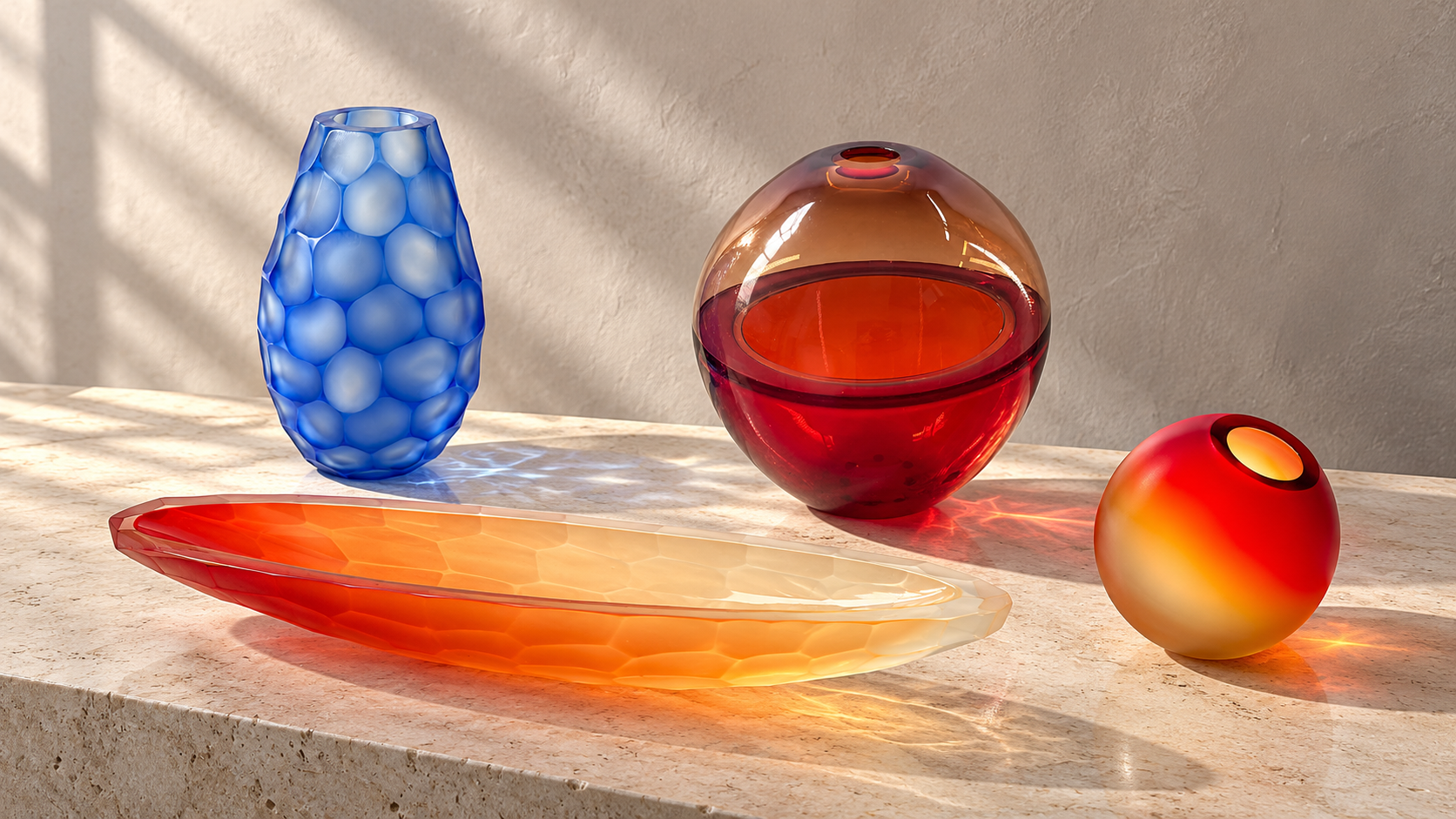
 Murano glass can be as light as a breath or as dense as a polished stone. It can hold a single flower, turn a shaft of sunlight into color, or stand on a pedestal as sculpture. During the twentieth century, the Venetian island’s glassmakers expanded all these possibilities, working with architects, painters and designers who helped bring glass into the history of modern art.
Carlo Scarpa, Paolo Venini, Ercole Barovier and Fulvio Bianconi are central to that story. Yet Murano’s achievement belongs equally to the skilled people at the furnace: the masters who transformed a drawing, an experiment or a conversation into an object.
This guide follows Murano glass from the early 1900s to contemporary design, introduces the names worth knowing, and presents ten selected pieces from Muranonet. For the more personal side of the island, read A Venetian Memory: Venice, Murano and the Magic of Glass.
How Murano glass became modern
The early twentieth century: looking beyond revival styles
Murano entered the twentieth century with a formidable inheritance of blown vessels, ornamental goblets and intricate decoration. The challenge was to give that knowledge a modern direction. Glass increasingly appeared in the Venice Biennale, where its makers could enter a wider conversation about art and design.
Vittorio Zecchin offered one influential answer. His transparent vessels for Cappellin and Venini emphasized proportion, delicate color and a clear outline. Their restraint showed that modernity did not require abandoning the furnace’s traditional skills. It could emerge from removing unnecessary decoration.
In 1921, Paolo Venini and Giacomo Cappellin founded the enterprise from which Venini developed. Venini’s importance lay both in his own design work and in his ability to bring other creative minds into the glassworks. The company became a meeting place for different approaches rather than the expression of one fixed style.
The 1920s and 1930s: texture, substance and experiment
Napoleone Martinuzzi, Venini’s artistic director from 1925 to 1931, brought a sculptor’s interest in volume. His work helped broaden the vocabulary beyond thin, transparent glass. His association with pulegoso, glass filled with bubbles, is particularly important: the material could look dense, textured and almost stone-like.
Carlo Scarpa pushed experimentation further during his work with Venini from 1932 to 1947. He explored the relationship between color, surface and structure through numerous techniques, including sommerso, murrine, incised surfaces and battuto finishing. These were investigations into what glass could become, conducted with the people who understood its behavior in the furnace.
Scarpa’s glass rewards close looking. A vessel may appear simple from across a room, then reveal a complex surface or a carefully organized pattern as you approach. His achievement was to make the material itself carry much of the design.
Beyond Venini, Ercole Barovier developed a distinctive language of texture, color and geometry. Meanwhile, Flavio Poli’s work for Seguso Vetri d’Arte helped make layered sommerso glass one of the defining expressions of mid-century Murano.
The postwar decades: color enters the modern home
After the Second World War, Murano glass became closely associated with the expressive possibilities of Italian design. Fulvio Bianconi brought the eye of an illustrator and graphic artist to Venini. His arrangements of color could feel playful, surprising and deliberately irregular.
The Fazzoletto, credited by Venini to Bianconi and Paolo Venini, captures the folds of a handkerchief in glass. Bianconi’s Pezzati use patches of color to create a different effect: the vessel becomes a composition to look through as well as look at.
This period also makes clear why “Murano style” is too narrow a description. Poli’s substantial layered vessels, Bianconi’s color compositions and the elaborate work of other furnaces could coexist. What united them was a place of production and an exceptional concentration of knowledge, not a single appearance.
From the 1960s onward: international exchange and sculpture
Murano’s partnerships increasingly crossed national boundaries. Finnish designer Tapio Wirkkala worked with Venini from the mid-1960s, combining his approach to form with Venetian color and techniques such as incalmo. American artist Thomas Stearns also contributed an experimental perspective through his work at Venini.
Other designers explored the expressive possibilities of nature, geometry and architecture. Toni Zuccheri’s work included birds and organic forms. Ettore Sottsass later brought bold, sculptural compositions to Venini, where his collaborations began in 1988.
At the same time, artists such as Lino Tagliapietra helped connect Murano’s furnace expertise with the international studio-glass movement. Pino Signoretto demonstrated the sculptural possibilities of hot glass through ambitious figurative work. Glass could now be encountered as an independent artwork, not only as a vessel or furnishing.
Major Murano glass designers and masters to know
These names include designers, artist-makers and creative directors. Their roles overlap, but they are not interchangeable. A design credit and the identity of the master who executed an object can both matter.
| Name | Connections and contribution |
|---|---|
| Vittorio Zecchin | Cappellin and Venini; transparent blown vessels distinguished by elegant proportions and restrained decoration. |
| Paolo Venini | Designer and entrepreneur whose own work and collaborations helped establish Venini as a center of modern glass design. |
| Napoleone Martinuzzi | Venini; sculptural forms and experiments with textured and bubble-filled glass. |
| Carlo Scarpa | Venini; a major innovator in glass surfaces, color, construction and finishing. |
| Ercole Barovier | The Barovier glassworks and Barovier & Toso; experimental surfaces and richly structured geometric decoration. |
| Flavio Poli | Seguso Vetri d’Arte; especially important for layered, colored sommerso vessels. |
| Archimede Seguso | A major Murano master associated with the development of twentieth-century glassmaking and its transmission through skilled furnace work. |
| Dino Martens | Worked with several glassworks, including Aureliano Toso; a key name in expressive twentieth-century Murano design. |
| Fulvio Bianconi | Venini; graphic color compositions, Pezzati and the Fazzoletto, the latter credited jointly with Paolo Venini. |
| Gio Ponti | Venini collaborations form part of his wider contribution to Italian architecture and decorative design. |
| Tapio Wirkkala | Venini; Finnish design sensibility combined with Venetian color, filigrana and incalmo. |
| Toni Zuccheri | Venini; birds, natural forms and a sculptural approach to glass. |
| Thomas Stearns | Venini; an important example of experimental exchange between American art and Murano production. |
| Ettore Sottsass | Venini; strong geometry, contrasting colors and objects with an architectural presence. |
| Lino Tagliapietra | Master glassblower and independent artist whose work connects Murano expertise with international contemporary glass. |
| Pino Signoretto | Master sculptor in glass, especially associated with technically demanding figurative work. |
| Laura de Santillana | Artist from the Venini family whose independent work expanded the conversation between glass, color and contemporary sculpture. |
| Alessandro Diaz de Santillana | Artist whose glass practice extends the family’s creative legacy into an independent contemporary-art language. |
Murano glass today: a living design culture
Contemporary Murano includes historical designs, new work from established furnaces, small workshops and individual artists. It also remains connected to international architecture and design. Venini’s roster of collaborators, for example, includes figures such as Tadao Ando, Ron Arad and Peter Marino.
The independent artistic practices of Laura de Santillana and Alessandro Diaz de Santillana show another direction: glass can operate in a gallery as a medium for exploring color, space and perception. Meanwhile, functional objects continue to offer a more intimate encounter with the material.
A contemporary vase does not need to imitate a 1950s masterpiece to belong to this history. Its connection may lie in a difficult join, a carefully controlled surface or an inventive use of glass canes. The strongest way to look at Murano today is to ask what the maker has done with that inherited knowledge.
Six glassmaking terms that help you understand a piece
- Soffiato: blown glass, shaped by introducing air into the hot material.
- Sommerso: layers of glass that enclose color within another layer, often transparent, creating depth.
- Murrine: cross-sections of patterned glass canes, assembled and fused into decorative compositions.
- Filigrana: fine glass threads incorporated into a vessel, producing linear or more elaborate patterns.
- Incalmo: separately blown sections joined while hot, often creating distinct fields of color.
- Battuto: a cold-worked surface cut with repeated marks that can resemble hammering.
Knowing the term is only a starting point. Look at how the technique serves the shape. Does it sharpen the outline, soften the light or create a pattern that changes as you move around the object?
Ten selected Murano glass pieces from Muranonet
Affiliate disclosure: Italia Mia may earn a commission if you purchase through the Muranonet links below, at no additional cost to you.
The selection prioritizes named glassworks and makers. At the check on October 18, 2026, these ten listings had an orderable option in Muranonet’s catalogue. Orderable does not necessarily mean ready for immediate dispatch: confirm the selected variant and delivery time on the product page. Prices are left to the retailer’s live listings.
Descriptions and attributions below follow Muranonet’s listings. Historical names in the guide above do not imply that every selected object is a vintage work. In particular, Gianni Seguso is identified as the listed maker; the piece is not described as a work by Archimede Seguso or Seguso Vetri d’Arte.

1. Paolo Crepax for Formia — Saturno vase
Two blown elements are joined while hot to create this sculptural vase. The current listing is the red-and-amethyst version, despite the older color wording in its web address. It is an appealing choice for readers drawn to clear geometry and the meeting of separate glass volumes.

2. Gianni Seguso — Intrecciato artistic chalice
This ornamental chalice belongs to the elaborate tipetto tradition. Its separately worked components are assembled hot, showing a different side of Murano from minimalist modern vases. Display it where the silhouette can be appreciated against a quiet background. Muranonet lists the maker as Seguso Gianni.

3. Pino Signoretto — God Plays Dice
A glass hand holds dice above a black base, turning an everyday gesture into a sculptural subject. Muranonet describes the work as signed and unique. Its interest lies in the treatment of anatomy and the tension between the transparent hand and solid-looking support.

4. Pino Signoretto — Aphrodite
An apricot-rose torso from the Aphrodite collection offers a softer treatment of the figure. The seller describes an acid-treated surface and signatures by Pino Signoretto and Carina Cheung. Ask for the production date and documentation if the object is being purchased as a historical collectible.

5. Dino Rosin — Alessandrite Aphrodite
Muranonet attributes this torso to Dino Rosin for the Loredano Rosin Studio. The listing describes calcedonio and alessandrite techniques, with hues changing under different light sources. It also reports a diamond-point signature and original labels. Those details make the supporting documentation especially relevant.

6. Alberto Donà — Ambrosia centerpiece
A red-to-clear color transition meets contrasting glossy and satin surfaces. The listing describes a broad interpretation of battuto finishing. This is a useful piece for understanding how cold working changes the way light travels across glass. A low, uncluttered table would allow the surface to remain visible.

7. Alberto Donà — Blue Pavone vase
The Pavone combines a blown form with battuto surface work. Its blue color gives it a strong presence, while the worked exterior adds detail at closer range. Several heights are listed, so check the chosen size against the shelf or table where it will stand.

8. Oball — Bubble vase
Red submerged within clear glass and enclosed bubbles give this vase visual depth. It provides an accessible illustration of the relationship between color, transparency and mass discussed earlier in the article. Place it where daylight can reveal the inner form without overwhelming nearby objects.

9. Salvadore brothers — Estro tumblers and pitcher
Fine white threads give the Estro collection its filigrana character. Muranonet attributes the pieces to the Salvadore brothers and offers tumblers, a pitcher or a combined set. The retailer notes that color assortments vary and specific combinations cannot be requested. It is the selection’s practical tableware option.

10. Giorgio Barera for Formia — Marte vase
The Marte vase has a rounded silhouette and a satin surface, with color moving through warm orange and red tones. Muranonet credits the design to Giorgio Barera and lists several sizes. It offers a quieter alternative to elaborate figurative sculpture while keeping color central to the object.
How to buy Murano glass with greater confidence
Start with the exact maker, rather than the word “Murano” alone. Ask whether you are buying current production, a later edition of a historical design, or an older collectible. A design’s original date is not automatically the date when the object in front of you was made.
For older glass, request clear photographs of the base, signatures, labels and any damage or restoration. Ask the seller to explain the attribution and provide the available documentation. A familiar shape or a signature by itself should not settle every question about authorship.
For contemporary work, check dimensions, color options and whether the photographs show the exact piece or a representative example. Handmade variations can be attractive, but they should be understood before purchase. For a large sculpture, also confirm its weight, base and delivery arrangements.
The ten pieces above offer several ways into the subject: a Formia vase for an interest in design, an Oball vessel for depth and transparency, a Signoretto sculpture for the human figure, or Salvadore tableware for everyday use. Choose the object you want to live with, then investigate its story.
Why Murano glass continues to matter
Murano’s twentieth-century masters did more than refresh a decorative tradition. They treated glass as a material capable of expressing the changing ideas of their time. Contemporary makers continue that conversation whenever they find a new use for a familiar technique.
That is what makes a good piece worth looking at slowly. Behind its color and outline lies a sequence of decisions: how to gather the material, shape it, join it, cool it and finish its surface. The finished object brings those decisions into the light.
External Sources
- Fondazione Giorgio Cini: Vittorio Zecchin’s transparent glass.
- Le Stanze del Vetro: Napoleone Martinuzzi, Venini 1925–1931.
- Le Stanze del Vetro: Carlo Scarpa, Venini 1932–1947.
- Musée du Verre François Décorchemont: Barovier & Toso and Seguso Vetri d’Arte.
- Le Stanze del Vetro: Fulvio Bianconi at Venini.
- Venini: Fazzoletto design credit.
- Le Stanze del Vetro: Tapio Wirkkala at Venini.
- Le Stanze del Vetro: Thomas Stearns at Venini.
- Fondazione Giorgio Cini: Wirkkala and Toni Zuccheri.
- Venini: Ettore Sottsass.
- Venini: company history and designer collaborations.
- Lino Tagliapietra: artist’s official website.
- Le Stanze del Vetro: I Santillana.
- Le Stanze del Vetro: research on Murano and the Venice Biennale.
- Product descriptions, maker attributions and images: Muranonet product pages linked in the selection above, checked October 18, 2026.