

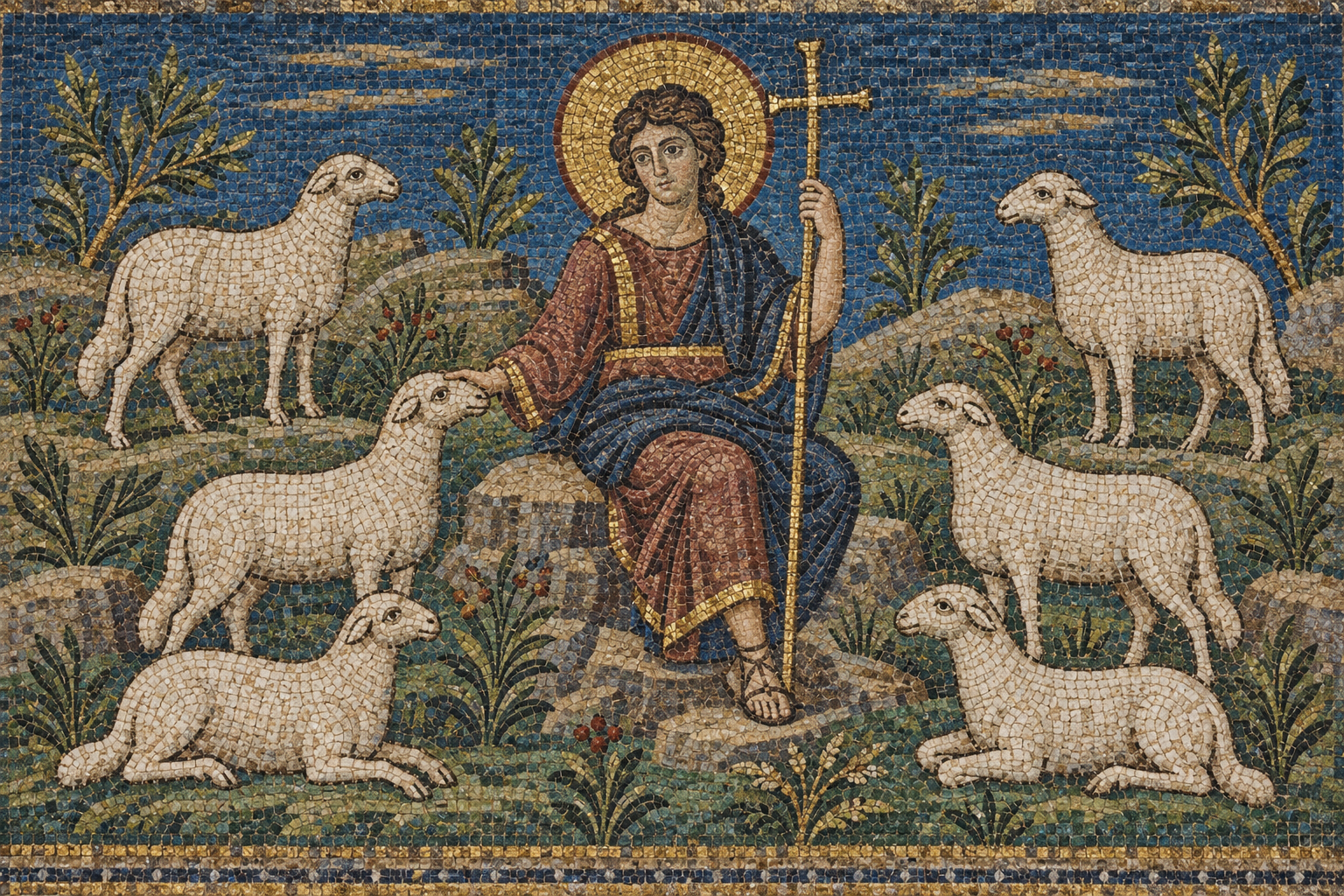
 Few art forms transform light as dramatically as mosaic. A painted surface reflects light, but a mosaic seems to break it apart and rebuild it. Thousands of tiny pieces of glass, marble, stone, ceramic and gold catch the eye from different angles, allowing figures and backgrounds to shimmer as the viewer moves.
Italy preserves an extraordinary record of this art. Roman villas contain floors filled with mythological scenes, animals and glimpses of daily life. Early Christian churches use mosaics to express a new religious language. Byzantine artists turned the interiors of Ravenna into luminous visions of imperial and heavenly power, while medieval Sicily combined Byzantine imagery with Norman architecture and Islamic craftsmanship.
Together, these works form a history spanning more than two thousand years. They also reveal an important truth about Italian art: its greatest achievements often emerged from encounters among different civilizations.
What Is a Mosaic?
A mosaic is an image or pattern created by arranging small individual pieces known as tesserae. These may be cut from marble, colored stone, glass, ceramic or other materials and fixed into mortar.
Roman craftsmen frequently used natural stone for floors because it could withstand constant use. Wall and vault mosaics required lighter materials and brighter colors. Glass tesserae made it possible to create intense blues, greens and reds, while gold tesserae were produced by placing a thin layer of gold leaf between pieces of glass.
The angle of each tessera mattered. Mosaicists did not always create a perfectly smooth surface. Slight variations allowed the pieces to catch light differently, giving robes movement, making water appear to ripple and causing gold backgrounds to glow.
Several techniques developed in the ancient world. Opus tessellatum used relatively regular tesserae and was common on large floors. Opus vermiculatum employed much smaller pieces to create fine details, curved outlines and effects resembling painting. Opus sectile used precisely cut slabs of colored stone or marble fitted together into larger geometric or figurative compositions.
Although these methods can be described separately, historical interiors often combined them.
Roman Mosaics: Mythology, Nature and Everyday Life
Mosaics became an important feature of Roman domestic and public architecture. They appeared in houses, villas, baths, temples and civic buildings throughout the empire.
Black-and-white mosaics were particularly common in central Italy. Their limited palette did not restrict their subjects: dolphins, sea creatures, athletes, gods and decorative borders could all be rendered with remarkable vitality. The ancient port city of Ostia Antica contains some of the best examples, especially in its bath complexes and commercial buildings.
Pompeii preserves more elaborate compositions. The celebrated Alexander Mosaic from the House of the Faun depicts the battle between Alexander the Great and Darius III of Persia. Created from an immense number of tiny tesserae, it achieves the drama, modeling and psychological intensity usually associated with painting. The original is preserved in the National Archaeological Museum of Naples.
Roman mosaics were not merely decorative. They communicated wealth, education, religious belief and social identity. A mythological scene could demonstrate the owner’s familiarity with classical literature, while images of food, hunting or theatrical masks reflected entertainment and domestic life.
The surviving mosaics also record details that written history often overlooks. They show clothing, hairstyles, plants, animals, fishing methods, athletic contests and household objects. In this sense, they are both works of art and documents of Roman society.
Villa Romana del Casale: A Roman World in Pictures
One of Italy’s greatest collections of Roman mosaics survives at the Villa Romana del Casale near Piazza Armerina in Sicily. Constructed during the late Roman imperial period, the enormous villa was the center of a wealthy rural estate.
Its mosaic floors extend through reception rooms, private apartments, corridors and bathing areas. The subjects include mythology, hunting, chariot racing, children at play and scenes of labor.
The most monumental composition is the Great Hunt, which illustrates the capture and transportation of wild animals. Rather than depicting a single aristocratic hunt, the long corridor presents a complex operation involving hunters, officials, ships and animals destined for public spectacles.
Another famous room contains young women participating in athletic activities while wearing garments resembling modern two-piece sportswear. They are sometimes casually called the “bikini girls,” but the scene is more significant than the nickname suggests. It provides valuable evidence of women’s athletic culture in late antiquity.
UNESCO describes the villa’s mosaics as among the finest surviving in place anywhere in the Roman world. Their scale, preservation and narrative variety make Piazza Armerina essential for understanding late Roman art.
Rome: From Imperial Decoration to Christian Art
Rome offers an exceptional opportunity to follow the transformation of mosaic from classical decoration to Christian visual language.
Some of the earliest surviving Christian church mosaics appear in Santa Pudenziana, where Christ is represented enthroned among the apostles. The composition adapts the imagery of imperial authority to express Christian sovereignty.
The Basilica of Santa Maria Maggiore preserves an extensive group of fifth-century mosaics on its nave walls and triumphal arch. The nave panels present scenes from the Old Testament, while the triumphal arch focuses on the childhood of Christ. Their narrative detail and classical architectural settings connect late Roman artistic traditions with the developing imagery of Christianity.
Later Roman churches reveal how the style changed. In the sixth-century apse of Santi Cosma e Damiano, Christ appears against a dramatic field of clouds. The composition feels more symbolic and otherworldly than the earlier narrative scenes.
At Santa Prassede, ninth-century mosaics cover the apse and the small Chapel of Saint Zeno. Blue, green and gold glass transform the chapel into an intimate sacred chamber. These works demonstrate that Rome remained an important mosaic center long after the political collapse of the Western Roman Empire.
Visitors interested in the wider artistic history of the city can continue with ItaliaMia’s coverage of Italian art and its major periods.
Ravenna: Italy’s Capital of Mosaic Art
No Italian city is more closely associated with mosaics than Ravenna. During the fifth and sixth centuries, the city served successively as a capital of the Western Roman Empire, the kingdom of Theodoric the Great and Byzantine Italy.
Eight Early Christian monuments in Ravenna form a UNESCO World Heritage site. Most preserve mosaics of exceptional artistic and historical importance.
The Mausoleum of Galla Placidia creates one of the most atmospheric interiors in Italy. Its modest brick exterior gives little indication of the color within. Deep blue vaults are filled with stars, plants, animals and Christian symbols. Above the crossing, a golden cross appears in a starry sky.
The Neonian Baptistery presents the Baptism of Christ in its central dome, surrounded by a procession of apostles. Architectural motifs below them create the illusion of a richly furnished celestial world.
Sant’Apollinare Nuovo contains long mosaic processions of saints advancing toward Christ and the Virgin. Other panels preserve traces of the church’s complex political and religious history. Portions of the original decoration associated with Theodoric’s court were altered after Ravenna came under Byzantine rule. In several places, fragments of hands and architectural details remain as evidence of the changes.
San Vitale and the Faces of Imperial Power
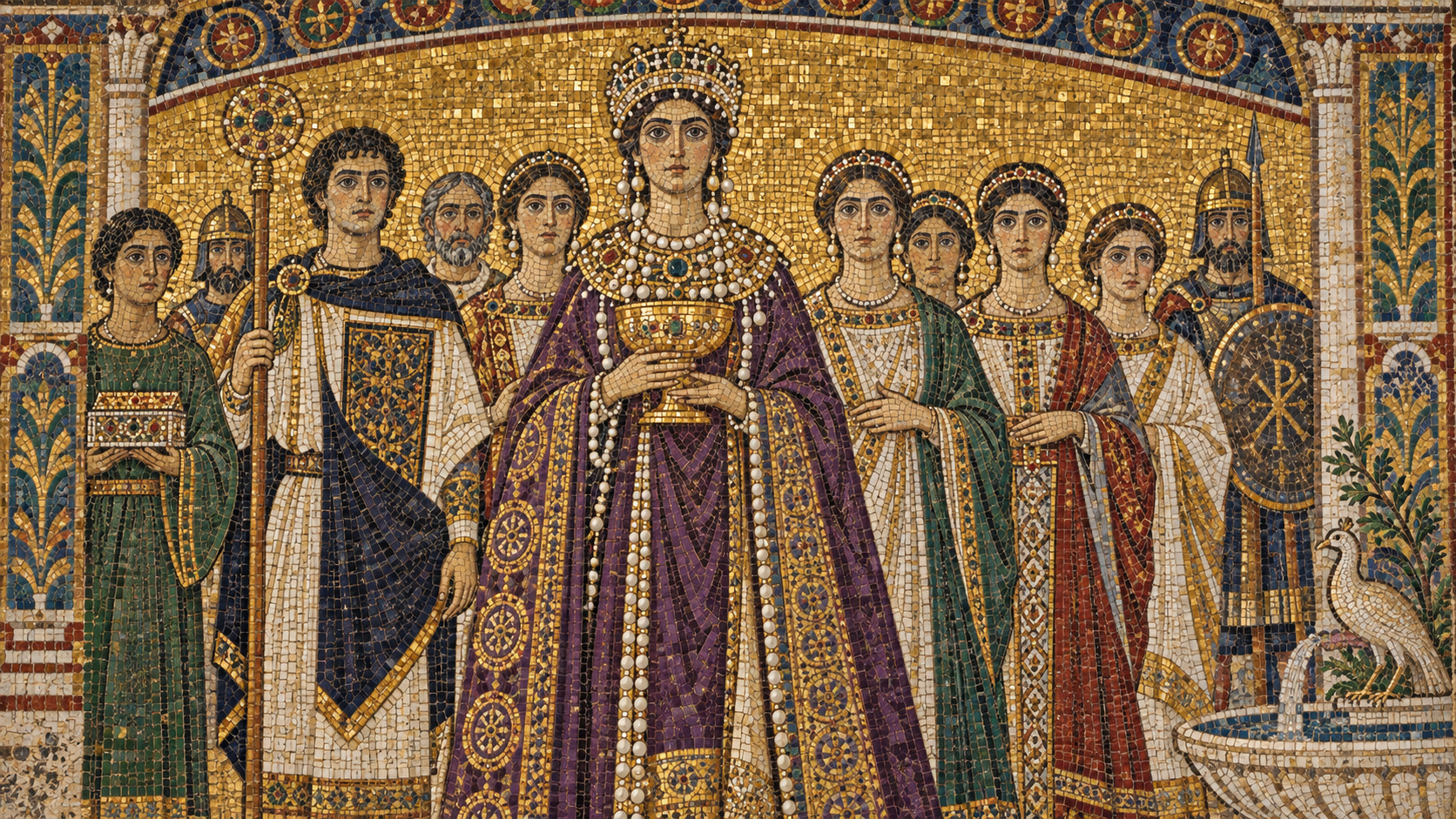
The Basilica of San Vitale contains Ravenna’s most famous mosaics. Its presbytery combines biblical stories, prophets, apostles, decorative foliage and symbolic animals within an elaborate visual program.
Two sixth-century panels are especially celebrated. One depicts Emperor Justinian accompanied by clergy, officials and soldiers. The other presents Empress Theodora with members of her court. Neither ruler is known to have visited Ravenna, yet the portraits establish their symbolic presence inside the church.
The figures appear formal and almost motionless, but the images are filled with political meaning. Justinian occupies a position between military and religious authority. Theodora carries a ceremonial vessel and wears garments decorated with the Three Magi. Gold backgrounds remove the figures from ordinary space and place imperial ceremony within a sacred order.
In the apse, a youthful Christ sits upon a globe and offers a crown to Saint Vitalis. The combination of religious symbolism, court ritual and extraordinary craftsmanship makes San Vitale one of the defining monuments of late antiquity.
A short distance outside Ravenna, Sant’Apollinare in Classe presents a different kind of vision. Its apse is dominated by an idealized green landscape filled with trees, flowers, birds and sheep. Saint Apollinaris stands at its center beneath a jeweled cross set in a starry medallion. Nature, theology and abstraction are merged into a single luminous image.
Sicily: Byzantine Splendor in a Norman Kingdom
The mosaics of medieval Sicily were created in a society shaped by Greek, Arab, Latin and Norman traditions. After conquering the island in the eleventh century, its Norman rulers governed a culturally diverse population and employed artists and craftsmen from across the Mediterranean.
The result was not the expression of a single culture but a deliberate artistic synthesis.
The Palatine Chapel in Palermo is the most concentrated example. Its architecture, carved and painted wooden ceiling, marble decoration and golden mosaics bring together traditions usually associated with different regions and religions.
The mosaics present Christ Pantocrator, biblical narratives, saints and scenes from the lives of Peter and Paul. Their Byzantine style exists alongside an Islamic-influenced muqarnas ceiling and a Latin Christian plan.
Nearby, the Church of Santa Maria dell’Ammiraglio—better known as the Martorana—preserves twelfth-century mosaics of exceptional quality. Among them are images of Christ crowning King Roger II and the Virgin receiving a model of the church from its founder, George of Antioch. The scenes openly connect political authority, religious legitimacy and personal patronage.
Monreale and Cefalù
The Cathedral of Monreale, overlooking Palermo from the slopes of Monte Caputo, contains one of the most extensive medieval mosaic cycles in Europe. Its interior is covered by narratives from the Old and New Testaments, saints, angels and monumental sacred figures.
The enormous image of Christ Pantocrator in the apse dominates the church. Christ’s right hand is raised in blessing, while his left holds an open book. The figure is not intended to be viewed like an ordinary portrait. It fills the architecture and controls the spiritual space around it.
At Cefalù Cathedral, another monumental Pantocrator occupies the apse. The image is accompanied by the Virgin, archangels and apostles arranged in formal rows. The composition is more restrained than the immense narrative program at Monreale, but its setting within the Norman cathedral gives it great visual force.
The monuments of Palermo, Monreale and Cefalù are recognized by UNESCO as evidence of a creative interchange among Western, Islamic and Byzantine cultures. Their mosaics should therefore be understood not simply as imported Byzantine decoration but as part of a specifically Sicilian artistic achievement.
Venice and the Golden Interior of San Marco
Venice developed through commercial and political connections with Constantinople and the eastern Mediterranean. Those relationships are visible throughout the Basilica of San Marco.
The church’s domes, vaults and walls are covered by a vast mosaic program created and modified over several centuries. Scenes from the Bible unfold across a golden architectural landscape, while prophets, saints and angels occupy domes and arches.
As in Ravenna and Sicily, light is essential to the experience. The uneven surfaces of the gold tesserae prevent the background from appearing flat. Natural and artificial light moves across the interior, causing different areas to emerge or retreat.
San Marco also demonstrates that mosaics were living monuments rather than frozen historical objects. Fires, structural changes and changing artistic tastes led to repeated restorations and replacements. Later Venetian painters, including Titian, Tintoretto and Veronese, supplied designs for mosaics, connecting the medieval technique with the artistic language of the Renaissance.
Aquileia, Florence and Other Mosaic Treasures
Beyond the most famous centers, important mosaics appear throughout Italy.
The Patriarchal Basilica of Aquileia in Friuli-Venezia Giulia contains an exceptional early Christian mosaic pavement. Its imagery includes animals, plants, portraits, symbolic scenes and the story of Jonah. The floor allows visitors to see how Christian themes could be integrated with motifs inherited from classical art.
In Florence, the interior of the Baptistery of San Giovanni is crowned by a vast medieval mosaic dome. Its dramatic image of the Last Judgment, dominated by a monumental Christ, was produced by generations of artists during the thirteenth and early fourteenth centuries.
The Cathedral of Orvieto incorporates glittering mosaics into its elaborate façade, although several sections were restored or replaced over time. In Trieste, the Cathedral of San Giusto preserves medieval apse mosaics reflecting the city’s position between the Adriatic, Italy and the Byzantine world.
Mosaics can also be found in Naples, Milan and numerous smaller churches, archaeological museums and Roman sites. The geography of the medium extends far beyond a single route.
How to Read a Historic Mosaic
Mosaics reward close and distant viewing. From across a church, the tesserae merge into coherent figures and fields of color. At close range, the image breaks apart into individual pieces, irregular lines and carefully calculated changes of direction.
Look first at the material. Stone creates a softer, more natural surface; colored glass produces greater intensity; gold responds dramatically to changing light.
Then examine the lines formed by the tesserae. These rows, known as andamenti, help define a face, fold a garment, surround a halo or suggest movement in water and clouds. Skilled mosaicists used the direction of the pieces almost like a painter used brushstrokes.
Context is equally important. A Roman dining-room floor, a baptistery dome and a cathedral apse were created for different audiences and purposes. Understanding where a mosaic was placed can explain as much as studying its subject.
The Mosaic Tradition Today
Mosaic never disappeared from Italy. Churches continued to commission it, archaeological discoveries renewed interest in ancient techniques, and modern artists explored its ability to unite color, texture and architecture.
Spilimbergo in Friuli-Venezia Giulia has become an important center for preserving and developing the craft. The Scuola Mosaicisti del Friuli, founded in 1922, trains mosaicists in Roman, Byzantine and modern methods. Its work demonstrates that mosaic is not limited to copying historical masterpieces. Contemporary artists use traditional tesserae alongside new materials, abstract designs and experimental surfaces.
Restoration has also become a highly specialized discipline. Conservators must address unstable mortar, detached tesserae, moisture, earlier repairs and the effects of pollution or heavy visitor traffic. Their goal is not to make an ancient mosaic appear new, but to stabilize the surviving material while respecting its history.
Planning a Mosaic Journey Through Italy
Ravenna deserves at least two days because its monuments are spread across the city and nearby Classe. San Vitale, the Mausoleum of Galla Placidia, Sant’Apollinare Nuovo and the Neonian Baptistery form an excellent central route, followed by Sant’Apollinare in Classe.
Rome’s mosaics can be explored through several churches, especially Santa Maria Maggiore, Santa Pudenziana, Santi Cosma e Damiano and Santa Prassede.
In Sicily, Palermo can serve as the base for the Palatine Chapel and Martorana, with separate excursions to Monreale and Cefalù. Piazza Armerina lies in the island’s interior and requires additional travel time.
Aquileia and Spilimbergo can be combined on a journey through Friuli-Venezia Giulia, while Venice and Florence each provide major mosaic monuments within cities already rich in art and architecture.
Opening hours, access rules and restoration closures can change, particularly in active churches. Visitors should consult official websites shortly before traveling. Modest clothing may be required, and photography is restricted in some interiors.
A History Made from Fragments
The mosaics of Italy survive because small, durable pieces were assembled into images larger than themselves. That physical construction also provides an appropriate metaphor for Italian history.
Roman patrons, Christian bishops, Byzantine officials, Norman kings, Muslim craftsmen, Venetian merchants and modern conservators all contributed to the tradition. Each period rearranged inherited techniques to express new beliefs, identities and forms of power.
From the starry blue vaults of Ravenna to the imperial gold of Rome, the narrative pavements of Piazza Armerina and the monumental faces of Christ in Sicily, Italian mosaics invite the viewer to slow down. Their beauty does not lie only in the complete image, but in the relationship among thousands of individual fragments—and in the light that continually changes them.
External Sources
UNESCO – Early Christian Monuments of Ravenna
UNESCO – Arab-Norman Palermo and the Cathedral Churches of Cefalù and Monreale
UNESCO – Villa Romana del Casale
UNESCO – Archaeological Area and the Patriarchal Basilica of Aquileia
Ravenna Tourism – UNESCO World Heritage Monuments
Basilica of Santa Maria Maggiore – The Façade Mosaic