

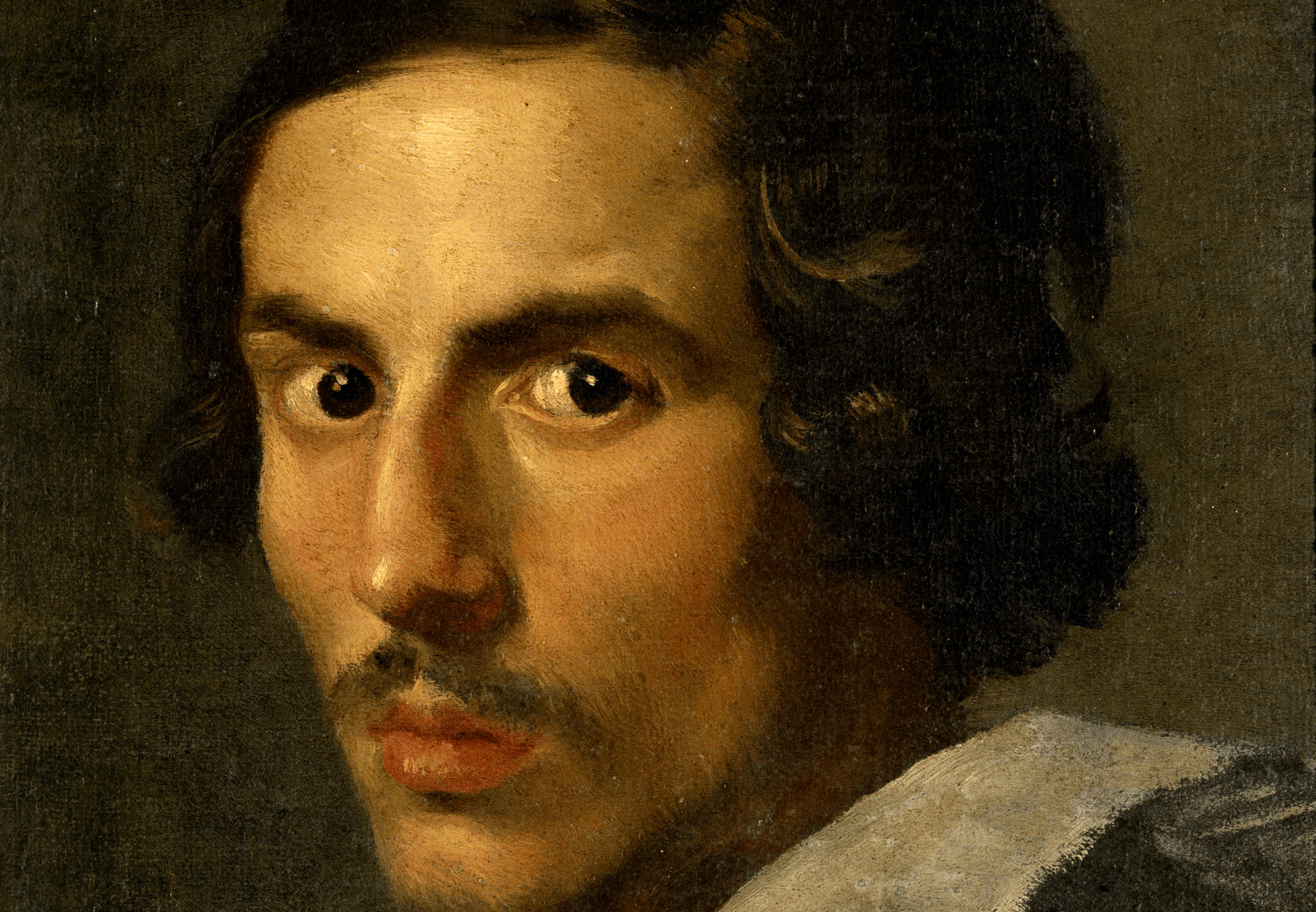
 Gian Lorenzo Bernini transformed seventeenth-century Rome into a theatrical expression of movement, faith and papal power. Sculptor, architect, painter, stage designer and gifted organizer, he created works that seem to breathe, speak and move through space. His statues turn cold marble into soft flesh, windblown fabric and flowing hair, while his churches, fountains and public squares merge architecture, sculpture, light and spectacle.
From the youthful marble groups in the Borghese Gallery to the vast colonnade of St. Peter’s Square, Bernini helped define the Italian Baroque. His influence is so deeply embedded in Rome that it is almost impossible to understand the city without him.
Early Life in Naples and Rome
Gian Lorenzo Bernini was born in Naples on December 7, 1598. His father, Pietro Bernini, was a Florentine sculptor then working in Naples, while his mother, Angelica Galante, was Neapolitan. Pietro belonged to the late Mannerist tradition and possessed the technical experience needed to manage large decorative commissions.
Around 1606, the family moved to Rome, where Pietro contributed to important papal projects. The young Gian Lorenzo entered his father’s workshop, learning how to select marble, use drills and chisels, organize assistants and adapt a design to an architectural setting.
Stories about Bernini’s childhood talent were later embellished by admirers, including his son and biographer Domenico. Nevertheless, surviving early sculptures demonstrate exceptional technical ability. His close observation of ancient statues and Renaissance masters gave him a strong classical foundation, but he soon moved beyond static balance toward a more immediate and dramatic art.
Rome offered an ideal environment for such an ambitious young artist. Popes, cardinals and noble families competed to commission churches, chapels, tombs, fountains and palaces. Art was not merely decoration: it expressed dynastic prestige, religious conviction and political authority.
Cardinal Scipione Borghese and Bernini’s Breakthrough
Bernini’s first great patron was Cardinal Scipione Borghese, the powerful nephew of Pope Paul V. Scipione assembled one of Rome’s most important collections and recognized that the young sculptor could create modern masterpieces capable of competing with antiquity.
Between approximately 1618 and 1625, Bernini produced the extraordinary marble groups now preserved in the Borghese Gallery. These works established his reputation and helped launch the mature Baroque style.
Aeneas, Anchises and Ascanius
Aeneas, Anchises and Ascanius depicts the Trojan hero escaping his burning city while carrying his elderly father and leading his young son. The three generations symbolize the transmission of ancestry, duty and hope.
Although the sculpture still reveals the influence of Pietro Bernini’s workshop, Gian Lorenzo already demonstrates an interest in physical contrast. Aeneas appears strong and muscular, Anchises is fragile and wrinkled, and the child Ascanius has soft, youthful features.
The Rape of Proserpina
Created in 1621–1622, The Rape of Proserpina presents Pluto carrying the struggling Proserpina into the underworld. Bernini selected not a calm conclusion but the most violent instant of the story.
Pluto’s fingers appear to press into Proserpina’s thigh, creating one of the most famous illusions in the history of sculpture. Her tears, twisting body and flying hair intensify the emotional effect. The work turns marble into an astonishing simulation of skin, force and desperate movement.
Apollo and Daphne
Apollo and Daphne, completed between 1622 and 1625, captures the climax of Ovid’s myth. As Apollo reaches Daphne, she escapes him by transforming into a laurel tree. Leaves spring from her fingers, bark grows around her body and her feet become roots.
The sculpture encourages viewers to walk around it. From one angle, Apollo appears to have caught the woman he pursued; from another, Daphne’s transformation becomes visible. Time, movement and narrative unfold through changing viewpoints.
Bernini did not work entirely alone. Giuliano Finelli, one of the most accomplished sculptors in his workshop, contributed to the remarkably delicate leaves and other details. This collaboration foreshadowed Bernini’s later management of large teams.
David
Bernini’s David, carved in 1623–1624, differs sharply from the composed heroes created by Donatello and Michelangelo. Bernini shows David in action, twisting his body as he prepares to release the stone at Goliath.
The figure occupies the viewer’s space rather than remaining enclosed within a calm vertical outline. David’s clenched mouth, tense muscles and concentrated gaze make the invisible presence of Goliath psychologically convincing. According to contemporary accounts, Bernini used his own face as a model for the hero’s expression.
These four sculptures remain among the essential works to see in Rome. Readers planning an art-focused journey can place them within a broader itinerary using Italia Mia’s guide to Italy’s greatest art cities.
Bernini and Pope Urban VIII
Bernini’s career changed decisively when Cardinal Maffeo Barberini became Pope Urban VIII in 1623. Urban reportedly told the artist that Bernini was fortunate to live during his papacy, but that the pope was even more fortunate to have Bernini living during his reign.
The alliance lasted more than two decades. Bernini became the dominant artistic figure of papal Rome, producing portraits, tombs, fountains and architectural projects that glorified both the Catholic Church and the Barberini family.
His most ambitious early Vatican commission was the enormous bronze baldachin above the papal altar in St. Peter’s Basilica. Constructed between 1624 and 1633, the canopy marks the traditional location of St. Peter’s tomb beneath Michelangelo’s dome.
Four colossal twisted columns rise toward an elaborate bronze crown decorated with Barberini bees, laurel branches and papal emblems. The structure combines the forms of architecture, sculpture and ceremonial furniture. Although Bernini directed the project, it required numerous craftsmen and collaborators, including Francesco Borromini.
Bernini was later appointed architect of St. Peter’s Basilica. His interventions helped determine how visitors experience its immense interior. The Cathedra Petri, or Chair of St. Peter, created during the later part of his career, uses sculpture, gilded bronze, colored marble and natural light to produce a vision of divine revelation.
The official St. Peter’s Basilica website provides additional information about Bernini’s baldachin and its religious significance.
Portraits That Seem Alive
Bernini revolutionized the sculpted portrait by abandoning the detached formality common in official busts. His sitters turn, breathe and appear about to speak.
The Bust of Cardinal Scipione Borghese is one of the finest examples. Bernini depicted the cardinal with parted lips and slightly disordered clothing, capturing the impression of a living personality rather than a fixed public mask.
A fracture reportedly appeared in the marble during the sculpture’s completion. Bernini secretly carved a second version in an extraordinarily short period. Both busts are now displayed together in the Borghese Gallery, allowing visitors to compare their subtle differences.
His portrait of Costanza Bonarelli is even more intimate. Costanza was the wife of sculptor Matteo Bonucelli, a member of Bernini’s workshop, and became Bernini’s lover. The marble bust shows her with loose hair, parted lips and an open blouse, creating an unusually private image.
The relationship ended in scandal when Bernini discovered that Costanza was also involved with his brother Luigi. Bernini violently attacked his brother and arranged for Costanza’s face to be slashed. Urban VIII protected his favored artist from the full consequences, while Costanza was imprisoned for adultery. The episode exposes the troubling contrast between Bernini’s artistic genius and his capacity for cruelty, as well as the profound inequalities of gender and power in seventeenth-century Rome.
In 1639, Bernini married Caterina Tezio. They had eleven children, several of whom participated in the artistic and intellectual life surrounding their father.
Architecture, Failure and Rivalry
Bernini approached architecture as a way of directing movement and emotion. Walls, columns, sculpture and light worked together to guide the visitor toward a carefully planned experience.
His church of Sant’Andrea al Quirinale, begun in 1658, is a masterpiece of this method. Its oval interior seems to expand around the visitor, while colored marble, gilding and sculptural figures lead the eye upward toward the dome.
Bernini’s career, however, was not free from failure. Bell towers designed for the façade of St. Peter’s developed structural problems and were eventually dismantled. When Urban VIII died in 1644 and Innocent X became pope, Bernini’s Barberini connections made him politically vulnerable. Francesco Borromini and other rivals gained new opportunities.
Borromini possessed a radically inventive architectural imagination, and his tense relationship with Bernini has become one of the most famous rivalries in Italian art. Their approaches differed, but simple comparisons can be misleading. Both transformed Baroque architecture, and both depended on patrons, workshops and complex building programs.
The Ecstasy of Saint Teresa
During his period of reduced papal favor, Bernini created one of his greatest works: the Cornaro Chapel in the Roman church of Santa Maria della Vittoria.
At its center is The Ecstasy of Saint Teresa, completed in 1652. Bernini represented the Spanish mystic Teresa of Ávila collapsing as an angel prepares to pierce her heart with a golden arrow. Heavy marble folds seem to dissolve into waves, while hidden windows direct natural light onto gilded rays behind the figures.
Members of the Cornaro family appear in sculpted theater boxes along the chapel walls, observing the vision as though attending a performance. Architecture, sculpture, colored marble, lighting and theatrical staging become inseparable.
The scene has sometimes been interpreted mainly in sensual terms. Its physical intensity is undeniable, but Bernini was visualizing Teresa’s own description of an overwhelming spiritual experience. The work should therefore be understood within the Catholic culture of mystical devotion and the Counter-Reformation.
Piazza Navona and the Fountain of the Four Rivers
Bernini regained papal favor during the reign of Innocent X through the Fountain of the Four Rivers in Piazza Navona, completed in 1651.
The fountain represents four great rivers associated with four continents known to seventeenth-century Europeans: the Danube, Ganges, Nile and Río de la Plata. Monumental figures recline around a rocky structure supporting an ancient Egyptian obelisk.
Water, stone, animals, vegetation and human figures combine into a constantly changing spectacle. The apparently hollow rock beneath the obelisk creates a calculated sense of instability and wonder.
A popular legend claims that one river god raises his hand because he fears the façade of Sant’Agnese in Agone, associated with Borromini. The chronology makes this impossible: Bernini’s fountain was designed before the relevant façade. The story survives because it expresses the enduring mythology surrounding the rivalry between the two artists.
Piazza Navona is also an outstanding example of the evolution of the Italian piazza from an ancient urban site into a Baroque public stage.
Alexander VII and St. Peter’s Square
Bernini found another major patron in Pope Alexander VII, elected in 1655. Their collaboration produced the immense colonnade surrounding St. Peter’s Square, constructed from 1656.
The elliptical arms consist of four rows of Tuscan columns topped by statues of saints. Bernini conceived them as the embracing arms of the Church, welcoming pilgrims into the ceremonial space before the basilica.
The colonnade also solved difficult urban and visual problems. It organized the irregular space before St. Peter’s, framed the basilica and created processional routes for enormous crowds. When viewed from designated points in the square, the four rows of columns appear to merge into a single row.
The Vatican’s account of Bernini’s colonnade explains that Alexander VII commissioned the project and that work continued between 1656 and 1667.
The Journey to Paris
By the 1660s, Bernini’s reputation extended throughout Europe. In 1665, Louis XIV invited him to Paris to propose a new design for the Louvre.
Bernini received an elaborate welcome, but his Louvre plans were rejected. His theatrical Roman Baroque did not suit the architectural and political direction developing at the French court. The visit nevertheless produced a remarkable marble bust of Louis XIV, presenting the king as a commanding figure whose cloak seems to move around him.
Bernini’s proposed equestrian monument to Louis XIV was later altered after the king rejected its appearance. The Paris experience demonstrated both the international reach of Bernini’s fame and the limits of exporting Roman papal Baroque into a different court culture.
Final Years and Death
Bernini remained productive into old age. His later works became increasingly spiritual and introspective. The Blessed Ludovica Albertoni in San Francesco a Ripa shows the dying noblewoman in a state suspended between physical suffering and religious ecstasy.
He also created the dramatic tomb of Pope Alexander VII in St. Peter’s Basilica. A gilded skeleton representing Death rises from beneath a marble drapery and holds an hourglass, reminding viewers that even papal authority must yield to time.
Bernini died in Rome on November 28, 1680, at the age of eighty-one. He was buried with relative simplicity in the Basilica of Santa Maria Maggiore, close to the chapel where his father had worked.
Bernini’s Artistic Style and Legacy
Bernini’s central achievement was his ability to unify the arts. Sculpture does not merely decorate his architecture, and architecture does not simply provide a background for sculpture. Every element contributes to a single emotional and spatial experience.
His figures often occupy transitional moments: Daphne becomes a tree, David prepares to throw his stone, Proserpina struggles against Pluto and Teresa receives a divine vision. These subjects allowed Bernini to suggest time, movement and transformation within a stationary material.
He also understood how viewers behave. His works control where people stand, what they see first and how the composition changes as they move. In this sense, Bernini was not only a sculptor or architect but also a director of human experience.
His influence spread through Italy and across Catholic Europe, shaping sculpture, church interiors, fountains, tombs and ceremonial spaces. Later Neoclassical critics sometimes regarded Baroque art as excessive, but modern scholarship has restored Bernini’s position as one of the most inventive artists in European history.
For a broader understanding of his period, readers can continue with Italia Mia’s guide to Italian art movements and periods and its introduction to famous Italian artists.
Where to See Bernini’s Art in Rome
The most important Bernini locations include:
- Borghese Gallery: Apollo and Daphne, David, The Rape of Proserpina, Aeneas, Anchises and Ascanius, and portraits of Scipione Borghese.
- St. Peter’s Basilica: the baldachin, Cathedra Petri, tombs of Urban VIII and Alexander VII, and other sculptures and architectural interventions.
- St. Peter’s Square: Bernini’s monumental colonnade.
- Santa Maria della Vittoria: the Cornaro Chapel and The Ecstasy of Saint Teresa.
- Piazza Navona: the Fountain of the Four Rivers and the Fountain of the Moor.
- Sant’Andrea al Quirinale: one of Bernini’s finest complete architectural designs.
- San Francesco a Ripa: the Blessed Ludovica Albertoni.
- Piazza Barberini: the Triton Fountain.
- Santa Maria sopra Minerva: the Elephant and Obelisk monument.
- Ponte Sant’Angelo: angels designed by Bernini and largely completed by his workshop.
Because admission to the Borghese Gallery is timed and capacity is limited, advance reservations are strongly recommended. Visitors can reserve Borghese Gallery tickets through Weekend in Italy or consult Italia Mia’s broader guide to booking museums and attractions in Italy.
Readers who want to study Bernini in greater depth can also browse books about Gian Lorenzo Bernini on Amazon.com.
Affiliate disclosure: Italia Mia may earn a commission from qualifying reservations or purchases made through selected links, at no additional cost to the reader.
External Sources
- Gian Lorenzo Bernini – The Metropolitan Museum of Art
- Gian Lorenzo Bernini – Enciclopedia Treccani
- Bernini Collection – Galleria Borghese
- David by Bernini – Galleria Borghese
- St. Peter’s Square – Official Basilica of St. Peter
- Bernini’s Colonnade – Vatican