 Giovanni Boccaccio understood that people rarely behave as neatly as moral lessons suggest. They fall in love with the wrong person, chase money, disguise their intentions and sometimes find the courage to act generously. In the Decameron, he turned these contradictions into one of literature’s great collections of stories.
Born in 1313, Boccaccio became one of the “Three Crowns” of Italian literature alongside Dante Alighieri and Francesco Petrarch. His particular achievement was to give prose fiction extraordinary range: a story could be comic, sensual, disturbing and thoughtful, sometimes within a few pages.
His life connected the commercial world of Florence, the courtly culture of Naples and the scholarship that helped shape Renaissance humanism. Yet his most enduring creation begins with catastrophe. Against the devastation of the plague of 1348, the Decameron imagines ten young people who preserve a small community through conversation, shared responsibilities and storytelling.
Boccaccio’s Early Life: Between Florence and Naples
Giovanni Boccaccio was born in Tuscany in 1313, probably in Florence, although Certaldo also appears in accounts of his birthplace. His father, Boccaccio di Chellino, was a merchant associated with the powerful Bardi company. His mother’s identity remains uncertain.
As a teenager, Giovanni went to Naples, where his father’s business connections brought him into contact with the Angevin court. Commercial training and the study of canon law failed to displace his growing interest in literature.
Naples offered an education beyond books. Its court, port and streets exposed him to people whose ambitions and circumstances differed sharply. That breadth of observation would later become central to his fiction.
Boccaccio’s characters often live in a world where money, reputation and quick judgment matter enormously. To understand that setting, read our guide to Medieval Italy and the Rise of the City-States.
Fiammetta and the Beginnings of a Literary Career
The name Fiammetta appears repeatedly in Boccaccio’s writing. Traditionally associated with a Neapolitan love affair, she is also a carefully constructed literary figure. Attempts to identify her confidently with a particular historical woman go beyond what the evidence securely establishes.
In the Elegia di Madonna Fiammetta, Boccaccio gives a woman the central voice as she describes abandonment and emotional suffering. The work reveals an interest that would become essential to the Decameron: how people explain their desires, remember their experiences and try to make sense of disappointment.
Other early works include Filocolo, a prose romance, and the narrative poems Filostrato and Teseida. These experiments with love, adventure and classical material helped him develop his storytelling skills.
He returned to Florence around 1340–41. The imaginative possibilities of Naples remained with him, but Florence would provide the historical setting for his greatest book.
The Plague of 1348 and the Birth of the Decameron
The Black Death provides the Decameron with its unforgettable opening.
Boccaccio describes a Florence in which ordinary obligations are breaking down. Fear separates relatives, illness overwhelms familiar customs, and death makes established distinctions of wealth and status seem suddenly fragile.
This introduction has historical value, but it is also a crafted literary account. It establishes the crisis to which the rest of the book responds.
The Decameron took shape after the epidemic, generally dated to approximately 1349–1353, although Boccaccio continued working on it later.
Its central question is larger than survival alone: how can people maintain a meaningful shared life when the structures around them have failed?
The answer is neither a sermon nor a political program. It is a group of people agreeing to spend time together, listen to one another and tell stories.
What Is the Decameron About?
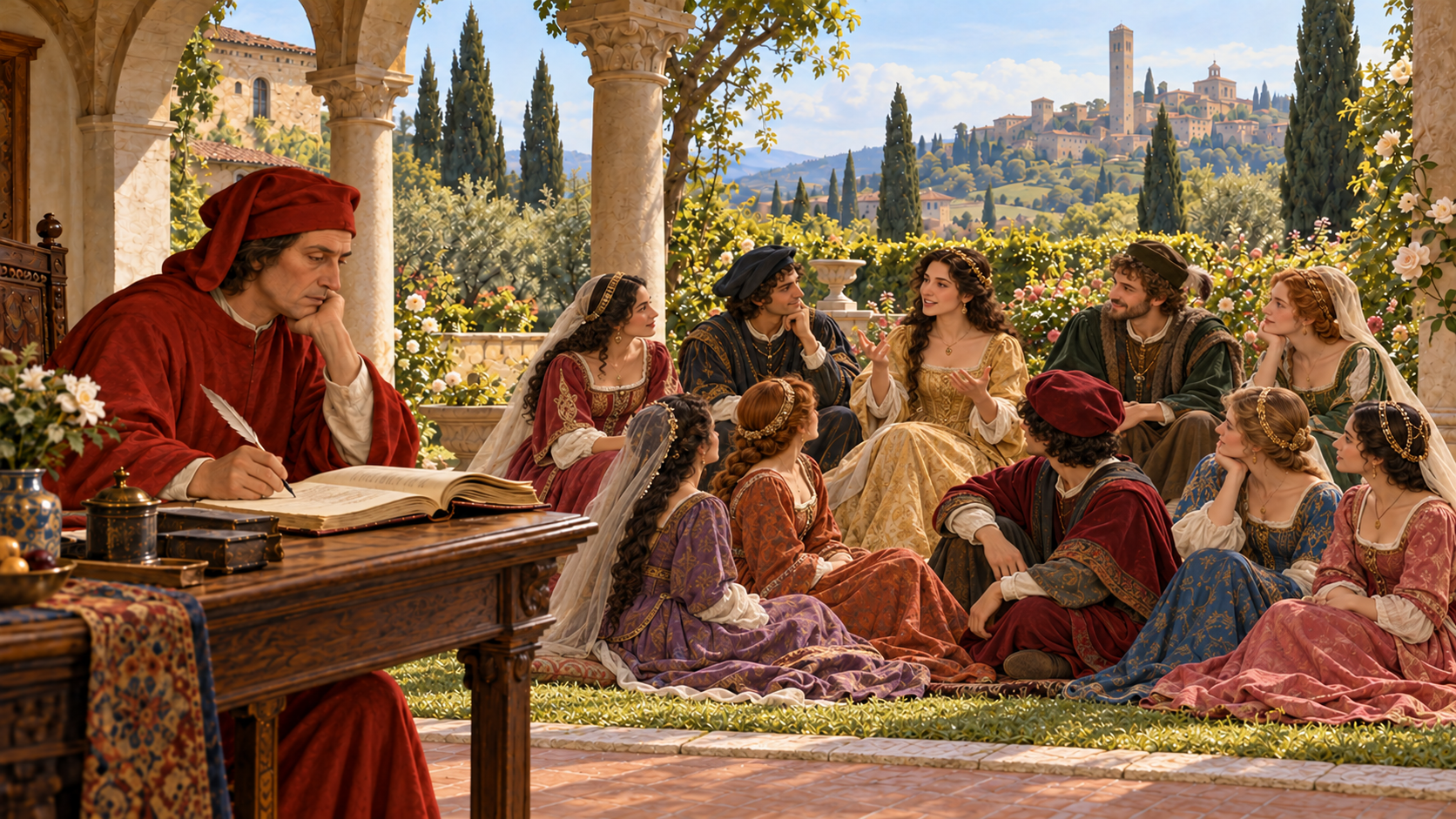
The Decameron contains 100 principal stories told by seven young women and three young men who leave plague-stricken Florence for the countryside.
Their initial gathering takes place in the church of Santa Maria Novella. Pampinea proposes departure, helping establish the women as active participants in the group’s decisions.
The companions are often called the brigata. They organize their retreat with meals, walks, music and storytelling. Each takes a turn as king or queen for a day, directing the company’s activities.
The title refers to ten days of storytelling. Their stay extends over roughly two weeks because they do not tell stories every day.
Most storytelling days have a theme, such as unhappy love, resourcefulness or generosity. The first and ninth days allow broader freedom. Dioneo also receives special permission to depart from the assigned subject.
This structure gives the collection both order and flexibility. Readers encounter an individual tale, the personality of its narrator and the responses of an audience within the book itself.
Love, Fortune and Intelligence in the Decameron
Three forces repeatedly shape Boccaccio’s stories: love, fortune and human ingenuity.
Love can inspire tenderness and loyalty, but it can also produce jealousy, deception and cruelty. Boccaccio does not give every love story the same moral destination. Some end in marriage, others in humiliation or death.
Fortune makes life unstable. Journeys go wrong, wealth disappears, accidents change relationships, and apparently hopeless situations suddenly improve.
Ingenuity is the ability to respond. A character might survive through a well-timed answer, escape danger through an invented explanation or exploit someone else’s expectations.
These qualities make the Decameron unusually alert to practical behavior. Characters must read the circumstances around them. Intelligence matters, but it does not necessarily make someone good.
That distinction keeps the book interesting. A successful trick may be funny while remaining morally uncomfortable. A generous act may be admirable while also being disastrously impractical.
Five Decameron Stories That Reveal Boccaccio’s Range
The following examples include brief plot details.
Ser Ciappelletto — Day One, Story One
The collection opens with a man whose dishonest life becomes the foundation for a reputation for holiness. Through a false confession, Ciappelletto persuades a friar to regard him as exceptionally virtuous.
The story invites readers to question how reputations are made. Who controls the account of a person’s life? How much can an audience really know? Boccaccio begins his collection by making belief itself a problem.
Andreuccio da Perugia — Day Two, Story Five
A young horse dealer arrives in Naples carrying money and possessing far less experience than he imagines. A sequence of fraud, danger and unlikely opportunities follows.
This is an excellent introduction to Boccaccio’s urban storytelling. Naples becomes a place where appearances mislead and survival requires rapid adjustment. Andreuccio’s adventure also complicates the idea that a fortunate ending must reward deserving behavior.
Lisabetta da Messina — Day Four, Story Five
Lisabetta’s brothers murder the man she loves. Her grief becomes bound to a pot of basil in one of the collection’s most haunting stories.
Here Boccaccio moves far from cheerful trickery. Family authority and concern for social standing destroy a relationship, while the emotional consequences fall on the woman whose wishes have been disregarded.
Federigo degli Alberighi — Day Five, Story Nine
Federigo spends his wealth courting a woman who does not return his affection. Later, reduced to modest circumstances, he sacrifices his prized falcon to provide her with a worthy meal, unaware that the bird is the very thing she has come to request.
The story raises questions about generosity, extravagance and the relationship between material worth and personal character. Its power comes from the painful mismatch between good intentions and incomplete knowledge.
Griselda — Day Ten, Story Ten
The final tale concerns a husband who subjects his wife to extreme tests of obedience, including making her believe that their children have been killed.
Griselda’s endurance has prompted sharply different interpretations. Modern readers may find the husband’s conduct appalling, and the narrator’s comments also complicate a straightforward celebration of submission.
The ending refuses to leave the collection in simple moral comfort. After so many stories of clever resistance, readers confront the disturbing limits of patience and power. These summaries and readings draw on the tales themselves.
Women, Desire and the Limits of Freedom
Women are central to the Decameron as both narrators and characters.
In his opening address, Boccaccio presents the book as offering pleasure and consolation to women in love. He acknowledges that their opportunities for distraction and movement are more restricted than those available to men.
Within the stories, women argue, plan, desire, deceive and defend themselves. Their intelligence can expose the weaknesses of husbands, officials and religious figures.
Nevertheless, calling Boccaccio a feminist in the modern sense would flatten the book’s contradictions. Some tales give women remarkable room to act; others reproduce hostile stereotypes or depict violence against them.
A productive reading holds those tensions together. Whose wishes receive sympathy? Who can refuse a demand? When does a clever solution challenge authority, and when does the story restore familiar inequalities?
The women of the brigata also matter because they interpret stories. Their presence makes reading itself a social activity in which no single response is automatically final.
Religion, Hypocrisy and the Power of Words
The Decameron is famous for its irreverent treatment of religious figures. Friars, priests and others who claim spiritual authority may prove as vulnerable to greed and desire as anyone else.
Yet criticism of religious hypocrisy should not automatically be treated as rejection of religious belief.
Boccaccio repeatedly examines the distance between a person’s public role and private behavior. Religious authority makes that distance especially consequential, but merchants, spouses and aristocrats also manipulate appearances.
Words are often the instrument of that manipulation. A speech can conceal a motive, a confession can manufacture a reputation, and a witty answer can overturn an unequal encounter.
Readers therefore face a challenge similar to that of the characters: listen closely, but do not confuse confidence with truth.
Boccaccio, Petrarch and Dante
Boccaccio first met Petrarch in Florence in 1350. Their friendship became an important part of his intellectual life, strengthening his engagement with classical literature and scholarly exchange.
He also devoted considerable attention to Dante. His Trattatello in laude di Dante helped shape the earlier poet’s biography and reputation.
In 1373, Boccaccio began public lectures on Dante’s Comedy in Florence. Ill health forced him to stop before completing the undertaking.
Our biography of Dante Alighieri explores the poet whose achievement Boccaccio worked to preserve.
Together, Dante, Petrarch and Boccaccio helped establish the literary prestige of Tuscan. They did not single-handedly invent modern Italian, but later writers treated their works as major models.
For that wider development, see Italian Literature: Its Origins, Early Writers and the Rise of Dante.
Other Works and Boccaccio’s Final Years
The Decameron can overshadow the breadth of Boccaccio’s career.
His Latin works include Genealogia deorum gentilium, an extensive treatment of classical mythology, and De mulieribus claris, usually known in English as Famous Women. He also wrote De casibus virorum illustrium, examining reversals in the lives of prominent figures.
These works reveal a writer deeply engaged with learning, historical examples and the preservation of ancient culture.
His later career also included religious unease, financial difficulty and worsening health. He died in Certaldo on December 21, 1375.
Boccaccio belongs to both the medieval world and the intellectual changes associated with early humanism. Our guide to Italian Literature in the Early Renaissance places him within that transition.
How Boccaccio Changed Italian Literature
Boccaccio’s importance extends beyond the plots of individual stories. The Decameron demonstrated how prose could accommodate formal speeches, lively exchanges, emotional intensity and carefully paced comedy.
Later writers treated its language as a model. In the sixteenth century, Pietro Bembo promoted Boccaccio’s prose alongside Petrarch’s poetry as an authoritative example for literary Italian.
This was a lasting transformation: a collection filled with merchants, lovers and tricksters became central to debates about how elegant Italian should be written. Read more in Italian Literature of the Renaissance: Bembo, Machiavelli, Ariosto and Tasso.
For readers today, however, linguistic prestige need not be the starting point. The stories remain compelling because people continue to misunderstand one another, defend their pride and improvise under pressure.
How to Start Reading the Decameron
Begin with the opening account of the plague and the formation of the brigata. These passages explain why storytelling matters within the book.
Then read a complete day, or start with a few contrasting tales such as Andreuccio, Lisabetta and Federigo. Notice what changes when a story is tragic rather than comic, or when sympathy shifts from one character to another.
A complete edition with an introduction and notes is especially useful. Medieval customs, place names and religious references can otherwise obscure a joke or an important social detail.
The frame narrative deserves attention too. The conversations surrounding the tales help prevent any single story from becoming the book’s final statement about love, morality or human nature.
External Sources
- Brown University: Decameron Web — A chronology of Boccaccio’s life and works.
- Fondazione Ente Boccaccio — Biographical information and resources from the institution devoted to his legacy.
- Treccani: Giovanni Boccaccio — An Italian reference account of his life and writing.
- Project Gutenberg: The Decameron — The complete work in John Payne’s older English translation.
Boccaccio Books on Amazon
As an Amazon Associate, Italia Mia earns from qualifying purchases. The links below lead to specific English-language editions; formats, prices and delivery availability may vary.
The Decameron — Translated by G. H. McWilliam
This complete Penguin Classics edition includes an introduction and explanatory material, making it a useful choice for readers who want historical context alongside the stories. It is a practical starting point for exploring the collection in depth. View the McWilliam translation on Amazon.
The Decameron — Translated by Wayne A. Rebhorn
Rebhorn’s modern English translation offers another route into the complete collection. Consider this edition if you want to experience Boccaccio through a more recent translation, or compare a sample with McWilliam before choosing the prose style you prefer. View the Rebhorn translation on Amazon.
Decameron — Translated by J. G. Nichols
Nichols provides a further complete English translation, published in this Vintage edition. It is another option for readers approaching Boccaccio for the first time, and a useful comparison for anyone interested in how different translators handle his dialogue and narrative voice. View the Nichols translation on Amazon.