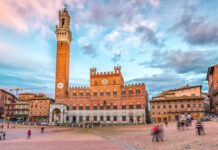
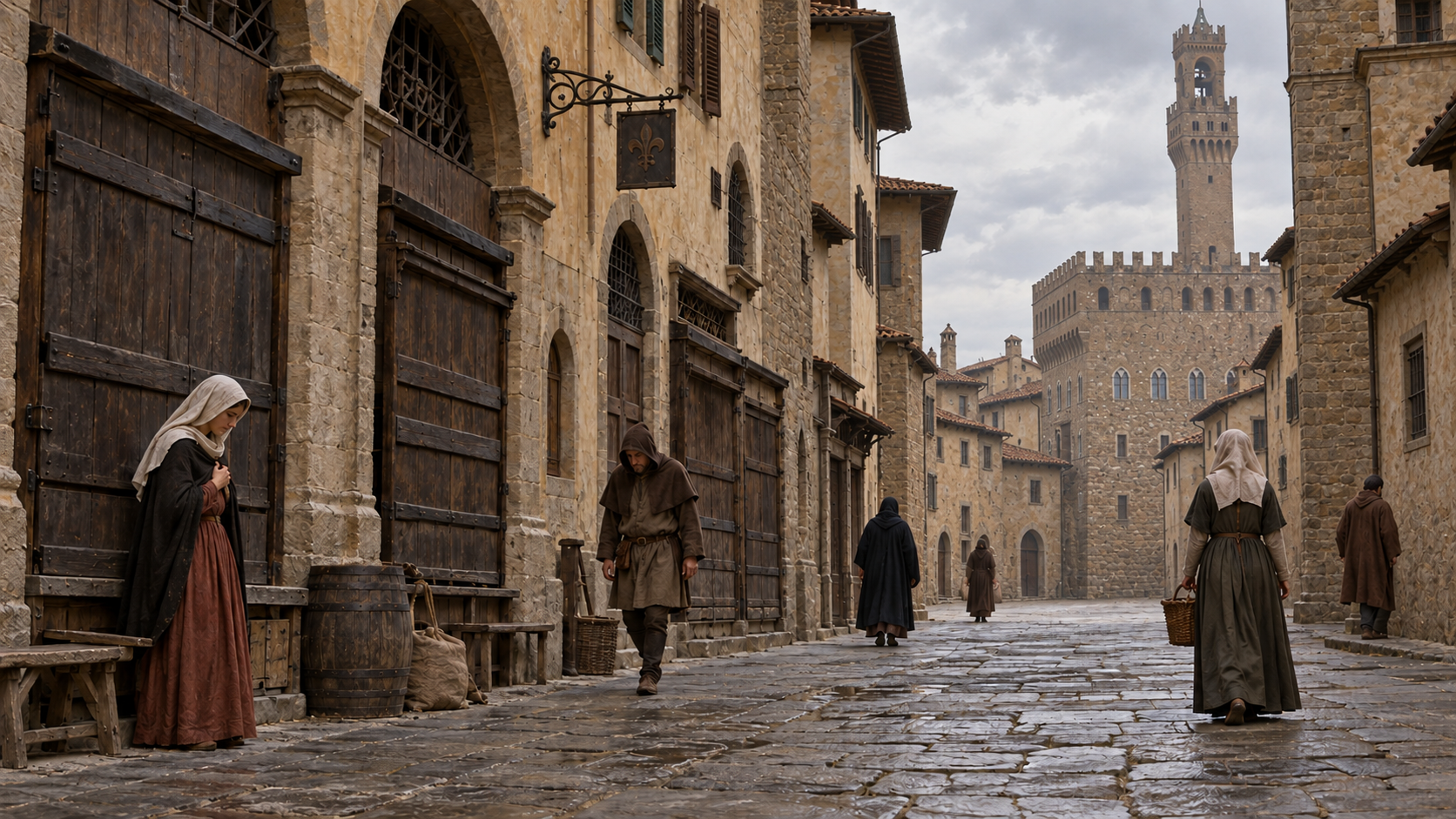
 The Black Death in Italy transformed much more than the size of the population. It disrupted families, emptied workshops, unsettled governments and changed the relationship between workers and employers. In Florence, Siena and Venice, the plague of 1348 exposed the vulnerability of societies built on commerce, crowded urban life and constant movement.
Yet its consequences were neither immediate nor uniform. Some survivors gained property or better wages. Others faced insecurity, tighter controls and repeated bereavement. Cities continued to function, but rebuilding their communities took far longer than surviving the first outbreak.
This story follows directly from Medieval Italy and the Rise of the City-States. The trading connections, civic institutions and economic ambitions that had helped Italian cities prosper now faced an extraordinary test.
How the Black Death Reached Italy
The pandemic reached Sicily in 1347 and spread through much of the Italian peninsula during 1348. Mediterranean shipping connected distant outbreaks with Italian ports, while roads and regional markets carried infection inland. Florence, Siena and Venice became part of a disaster extending far beyond Italy.
Modern genetic research has identified the bacterium Yersinia pestis in victims of the Black Death. However, historians and scientists continue to investigate the relative importance of different transmission routes and the reasons mortality varied between places. The familiar picture of a single rat-infested ship explaining the entire pandemic is too simple.
Medieval people had no knowledge of bacteria. They interpreted illness through combinations of religious belief, medical theory and observation. Boccaccio’s account describes prayers, attempts to clean Florence and measures intended to exclude sick people. These actions show communities trying to respond, even without understanding the disease’s cause.
Florence: A Commercial City Under Extreme Strain
Florence entered the epidemic as a major center of banking, manufacturing and trade. Its prosperity depended on a complex network of merchants, textile workers, servants, transport workers and rural suppliers.
The plague attacked the people who kept that network operating.
Giovanni Boccaccio’s introduction to the Decameron describes the crisis in disturbing detail. Some inhabitants withdrew into private households. Others sought distraction in drinking and entertainment. People with sufficient resources left the city, although the countryside offered no guaranteed protection.
His most powerful observations concern everyday obligations. Caring for relatives, attending funerals and helping neighbors became frightening activities. Burial customs changed under the pressure of mass death, and the shortage of attendants left many sick people without adequate care.
Boccaccio presents a city in which fear strained the relationships that normally held society together. His account is invaluable, but it is also literature: its dramatic contrasts should not be treated as a complete record of every Florentine’s behavior.
Florence survived as a political and economic community. Nevertheless, survival required far more than reopening shops. Households, businesses and institutions had to operate with missing members, disrupted obligations and an uncertain future.
Siena: Personal Tragedy and an Unfinished Cathedral
Siena provides another deeply affecting account of the catastrophe. The chronicler Agnolo di Tura described burying his five children himself. His testimony gives an individual human dimension to a disaster often discussed through population estimates.
The city also lost important artists. Pietro and Ambrogio Lorenzetti are generally believed to have died during the epidemic, which disrupted Siena’s artistic community.
One of the most visible reminders of this troubled period is the unfinished expansion of Siena Cathedral.
Before the plague, the city had pursued an ambitious Duomo Nuovo. The plan would have transformed the existing cathedral into the transept of a much larger church. The surviving walls and enormous unfinished façade, known as the Facciatone, reveal the scale of that ambition.
However, the familiar explanation that the plague alone stopped construction needs qualification. The epidemic disrupted the project, but serious structural weaknesses also contributed to its abandonment. Work did not simply end permanently in 1348; the decisive suspension came in 1357.
The unfinished cathedral therefore records both a demographic catastrophe and the practical limits of a monumental building scheme. Siena’s later history cannot be explained by the plague alone.
Venice: Trade, Vulnerability and the Development of Public Health
Venice depended on maritime connections. Ships brought food, raw materials and commercial wealth into the lagoon. Those same connections also exposed the republic to epidemic disease.
The Black Death struck Venice in 1348 with devastating consequences. Exact mortality estimates remain uncertain, and dramatic figures from older accounts should be treated cautiously.
Venice’s longer response to recurring plague became an important part of its history. Over subsequent generations, the republic developed institutions designed to separate infected people and potentially exposed travelers from the wider population.
The chronology matters. Venice established the plague hospital later known as the Lazzaretto Vecchio in 1423, decades after the first Black Death outbreak. The Lazzaretto Nuovo, established in 1468, served a different role associated with quarantine and the inspection of arrivals and goods.
These institutions should not be projected backward onto Venice in 1348. They emerged through a prolonged process of responding to repeated epidemics.
Their importance lay in making disease prevention an organized public responsibility. Managing movement, isolation and commercial activity became part of governing a trading city.
How Many People Died?
There is no single dependable death total for medieval Italy.
Contemporary writers reported enormous losses, but their figures were not produced through modern censuses. Some numbers may include surrounding territories; others communicate the perceived scale of the disaster more effectively than they measure it.
Boccaccio’s claim of more than 100,000 deaths in Florence, for example, should be identified as his estimate rather than repeated as an established count.
Across Europe, broad summaries often suggest that the Black Death killed around one-third to one-half of the population. However, applying one percentage to every Italian city or rural district creates false precision. Research using environmental evidence alongside historical records emphasizes substantial regional variation.
The demographic consequences also extended beyond the first wave. Plague returned repeatedly during the later fourteenth century and afterward. These renewed outbreaks interrupted recovery and exposed generations born after 1348 to further loss.
The result was a prolonged period of demographic instability, rather than a single catastrophe followed by steady rebuilding.
Labor Shortages Changed the Economic Balance
One of the plague’s most important economic consequences was the changed balance between people and available resources.
With fewer workers, employers could struggle to find labor. Surviving workers sometimes gained opportunities to demand higher pay or seek better conditions elsewhere. Landowners, meanwhile, faced difficulties cultivating estates when tenants and agricultural laborers were scarce.
However, these pressures did not automatically produce freedom or prosperity.
Research on Florence and Siena documents attempts to restrain rural wages after the Black Death. Later policies addressed migration and taxation, helping shape the expansion of mezzadria, the sharecropping system in which cultivators and landowners divided agricultural output.
These arrangements could place substantial obligations on farming households. Urban governments often defended the interests of property owners while trying to maintain production and tax revenue.
The economic consequences therefore involved a struggle over who would benefit from labor scarcity. Workers could gain bargaining power, but employers and governments possessed legal and political tools with which to resist.
Did the Plague Reduce Inequality?
In some places, it did.
Research by Guido Alfani and Francesco Ammannati on communities in the Florentine state identifies a period of declining wealth inequality following the Black Death, lasting approximately a century.
This finding helps explain why a catastrophe could leave some survivors materially better positioned. Death changed the distribution of property and the relationship between wealth and population. Yet a reduction in measured inequality did not mean that poverty disappeared or that everyone shared equally in recovery.
Nor should evidence from parts of Tuscany become a universal rule for Italy. Different institutions, forms of landholding and local conditions produced different outcomes.
The distinction between collective disaster and individual opportunity is essential. A survivor might inherit a house or receive higher wages while also losing relatives, colleagues and the security of a familiar community.
Boccaccio and the Decameron: Storytelling After Disaster
The most enduring literary response to the Black Death in Italy is Boccaccio’s Decameron.
Its framing narrative follows seven young women and three young men who leave plague-stricken Florence. During ten days of storytelling, they tell one hundred tales. The stories explore desire, intelligence, deception, generosity, fortune and the contradictions of human behavior.
The plague supplies more than a dramatic opening. It creates the circumstances in which the group forms a temporary community, establishes routines and shares responsibility for its entertainment.
One influential interpretation sees this carefully organized storytelling as a response to social breakdown. Outside, ordinary relationships have been disrupted; within the group, conversation and agreed rules create a manageable world.
That reading helps explain the work’s emotional range. Humor and pleasure exist alongside the memory of death. Boccaccio allows life to remain complicated even under the shadow of catastrophe.
The Decameron also requires careful reading as historical evidence. Its plague introduction preserves contemporary perceptions, while its fictional framework develops a deliberate artistic response to those experiences.
How the Plague Changed the Italian City-States
The Black Death did not erase the political structures described in our guide to Medieval Italy and the Rise of the City-States. Instead, it subjected those structures to intense pressure.
Cities needed workers, cultivators and taxpayers. Families needed to reorganize property and care. Governments faced demands to maintain production while managing tensions between employers and laborers.
These responses varied. Research on post-plague legislation shows that governments adopted markedly different approaches to wages and prices. There was no single, inevitable political response to population decline.
It is therefore misleading to describe the plague as an event that simply ended medieval society or created the Renaissance. Italian urban culture and artistic experimentation had deep roots before 1348. The epidemic changed the conditions under which those existing developments continued.
Its legacy appears most clearly in specific experiences: Siena’s interrupted building ambitions, Florence’s changing distribution of wealth, Venice’s later public-health institutions and Boccaccio’s effort to imagine social life after catastrophe.
Together, they show a society transformed through loss, negotiation and adaptation over many generations.
External Sources
- Brown University — Boccaccio’s Decameron, First Day Introduction
- Opera della Metropolitana di Siena — Panorama and New Cathedral
- Lazzaretti Veneziani — History of the Lazzaretto Vecchio
- Guido Alfani and Francesco Ammannati — Long-Term Trends in Economic Inequality in the Florentine State
- Davide Cristoferi — Labor Regulations After the Black Death in Florence and Siena
- Nature Ecology & Evolution — Regional Variation in the Black Death’s Demographic Impact