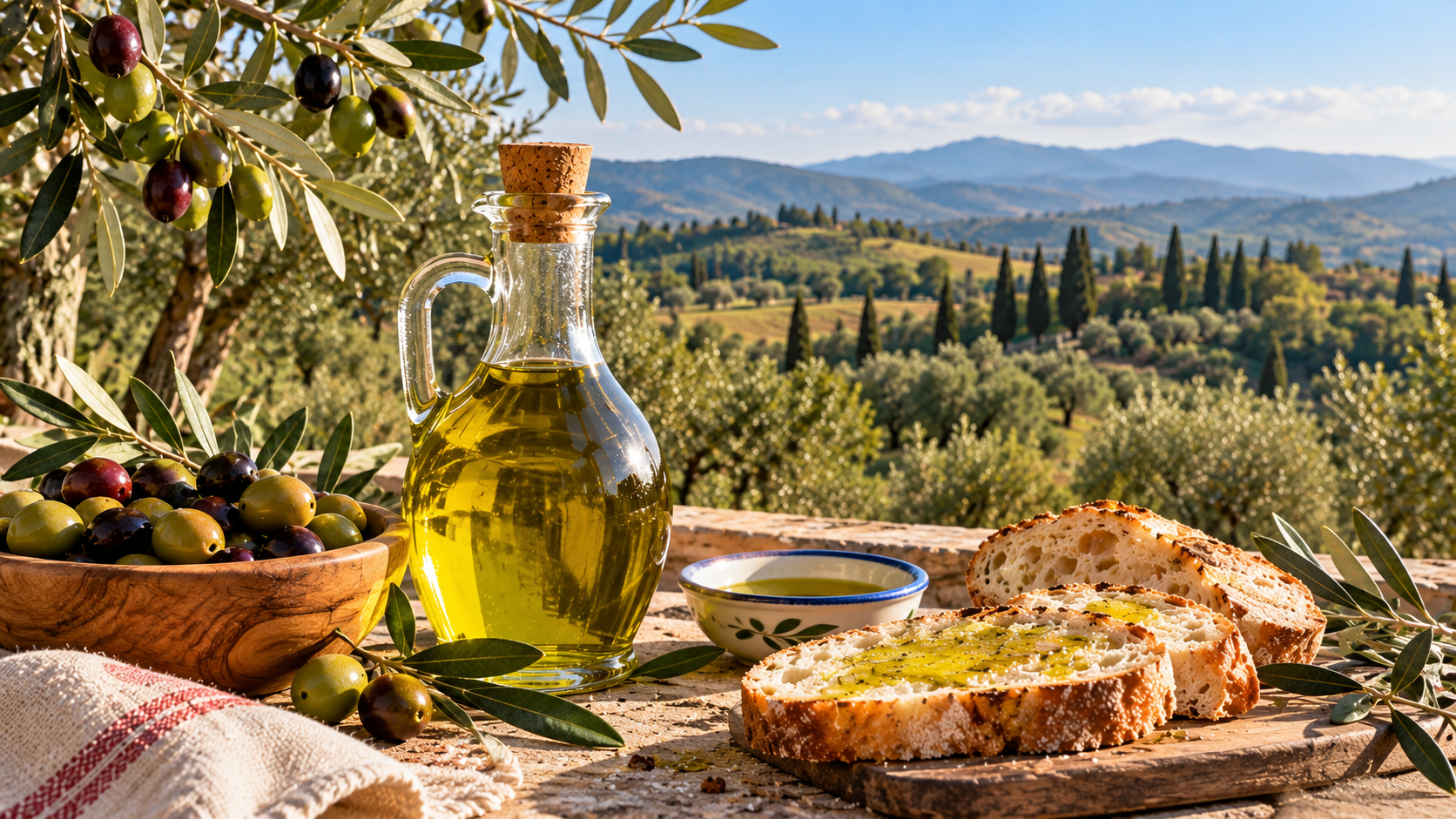
 Olive oil is one of the essential ingredients of Italian cooking. It brings flavor to a slice of toasted bread, adds character to a bowl of pasta, and transforms seasonal vegetables into something memorable.
But Italian olive oil is not a single product with a single taste.
A Tuscan extra virgin olive oil can be intensely grassy and peppery. A Ligurian oil may be delicate and sweet, while a Sicilian oil can carry aromas of tomatoes, herbs, and green almonds. These differences reflect the olive varieties, local landscapes, harvesting methods, and traditions of individual producers.
In Italy, olive oil is more than a cooking ingredient. It is part of the agricultural calendar, a regional identity, and a connection between generations.
Understanding how it is produced, how to recognize quality, and how to use it properly will help you appreciate one of the foundations of traditional Italian cuisine.
The History of Olive Oil in Italy
The history of olive oil in Italy stretches back thousands of years. Olive cultivation developed across the Mediterranean long before the Roman Empire, with Greek settlers helping to establish and expand olive-growing traditions in southern Italy.
The Romans transformed olive oil into a major agricultural and commercial product. It was used for cooking, lighting, personal care, religious activities, and other purposes.
Roman estates produced olive oil, while extensive trade networks brought additional supplies from provinces such as Hispania and North Africa. Archaeological discoveries, including Roman amphorae, reveal how important the oil trade became throughout the Mediterranean.
After the fall of the Western Roman Empire, olive cultivation continued in many parts of the Italian peninsula. Farms, monasteries, and rural communities preserved olive-growing practices through the centuries.
Today, modern technology has largely replaced traditional stone mills and hydraulic presses. Yet the agricultural rhythm remains familiar: the olives ripen, families and workers gather for the harvest, and the first freshly extracted oil becomes a much-anticipated seasonal pleasure.
In many Italian communities, visiting the local frantoio, or olive mill, remains an important autumn tradition.
How Italian Extra Virgin Olive Oil Is Made
Producing excellent extra virgin olive oil begins long before the olives reach the mill. The health of the trees, weather conditions, olive variety, harvest timing, and handling of the fruit all influence the finished product.
Harvesting the Olives
The Italian olive harvest generally takes place in autumn and early winter, although timing varies considerably by region, altitude, weather, and cultivar.
Some producers harvest relatively early, when many olives are still green. This can produce oils with intense aromas, bitterness, and pepperiness, often with a lower oil yield.
Other producers wait until more olives have ripened, seeking a softer and rounder flavor.
Hand harvesting is still practiced, particularly in difficult terrain or smaller groves. Mechanical harvesting equipment is widely used as well.
The objective is to collect healthy fruit without unnecessary damage and deliver it to the mill promptly.
Crushing and Extraction
At the mill, leaves and other debris are removed, and the olives are washed before being crushed into a paste.
The paste is mixed gently in a process called malaxation, allowing small oil droplets to combine. Modern mills typically use centrifuges to separate the oil from water and olive solids.
Traditional hydraulic presses still exist, but the majority of contemporary production uses mechanical extraction systems designed to maintain consistency and cleanliness.
What Cold-Pressed Really Means
The expressions cold-pressed and cold-extracted are frequently associated with premium olive oil, but they have specific meanings.
Under European Union labeling rules, first cold pressing refers to a traditional hydraulic pressing process conducted below 27°C (80.6°F). Cold extraction refers to qualifying processes such as centrifugation or percolation carried out below that temperature.
Cold extraction can help preserve desirable aromatic compounds, although the quality of the fruit and the overall production process remain crucial.
A bottle does not automatically qualify as exceptional simply because its label says cold-extracted.
Filtering and Bottling
After extraction, the oil may be filtered to remove suspended particles and moisture.
Unfiltered olive oil can have a distinctive cloudy appearance, especially when freshly produced. Some consumers enjoy its rustic character.
However, cloudiness does not mean an oil is necessarily fresher or better. Remaining water and sediment can shorten its shelf life.
Good producers protect their oil from oxygen, excessive heat, and light during storage and packaging.
Italian Olive Oil by Region: Six Distinct Traditions
Italy’s diversity is one of its greatest strengths as an olive-growing country. The same basic ingredient can produce dramatically different flavors depending on where and how it is cultivated.
Regional descriptions are useful starting points, but individual olive oils can vary considerably within each region.
Tuscany: Grassy, Peppery and Assertive
Tuscany is internationally recognized for distinctive extra virgin olive oils, often made using Frantoio, Moraiolo, and Leccino olives.
Many Tuscan oils display fresh-cut grass, artichoke, green olive, and peppery sensations.
They are particularly satisfying on toasted bread, white beans, grilled meat, and vegetable soups.
One of the simplest Tuscan preparations is fettunta: toasted rustic bread rubbed with garlic and finished with extra virgin olive oil and a little salt.
A robust Tuscan oil is often an excellent choice when you want the olive oil itself to be noticed.
Umbria: Fresh and Harmonious
Landlocked Umbria has a long olive-growing tradition, especially in the hills surrounding Assisi, Spoleto, and Lake Trasimeno.
Moraiolo, Frantoio, Leccino, and other local cultivars contribute to a broad range of oils.
Many display green aromas, balanced bitterness, and a pleasant peppery finish.
Umbria’s oils work particularly well with lentils, legumes, roasted vegetables, and grilled meats.
A drizzle of Umbrian oil over a warm bowl of beans is a fine example of how cucina povera turns simple ingredients into satisfying food.
Puglia: Bold Southern Character
Puglia, the region forming the heel of Italy’s boot, is one of the country’s principal olive-growing areas.
Its landscape includes extensive olive groves, traditional farmhouses, and centuries-old trees.
Coratina is particularly associated with powerful oils featuring pronounced bitterness, pepperiness, and aromas that may suggest artichokes or green almonds. Ogliarola and other cultivars can produce different, often gentler profiles.
Puglian extra virgin olive oil is delicious with bitter greens, roasted peppers, legumes, grilled bread, and traditional southern vegetable dishes.
Liguria: Delicate and Elegant
Liguria’s terraced hillsides overlook the Mediterranean, creating a distinctive landscape for olive cultivation.
The Taggiasca olive is especially associated with western Liguria.
Oils made from this cultivar often have a gentle, rounded character, sometimes with notes of ripe fruit, almond, and subtle herbs.
They complement seafood, steamed vegetables, delicate sauces, and many dishes in which a stronger oil might dominate the other ingredients.
Liguria is also the home of traditional basil pesto, where the character of the olive oil can help shape the finished sauce.
Sicily: Aromatic and Varied
Sicily’s climate, landscapes, and numerous native cultivars produce a remarkable variety of olive oils.
Nocellara del Belice, Biancolilla, and Cerasuola are among its best-known olive varieties.
Depending on the cultivar and harvest, Sicilian oils may suggest tomato leaf, fresh herbs, almonds, or green fruit.
They pair beautifully with tomatoes, eggplant, grilled fish, chickpeas, and many of the island’s traditional dishes.
Try finishing a plate of roasted eggplant with a fragrant Sicilian extra virgin olive oil, a little salt, and fresh oregano.
Sardinia: Herbal and Distinctive
Sardinia deserves more attention from olive oil enthusiasts.
Its native Bosana cultivar can produce complex oils with grassy, herbal, bitter, and spicy characteristics. Other local varieties contribute additional styles.
The island’s olive-growing traditions reflect its distinctive agricultural history and Mediterranean environment.
Sardinian oils are particularly appealing with grilled vegetables, legumes, fish, and rustic bread.
For a closer look at producers and recommended bottles, visit our separate Best Italian Olive Oil guide.
Understanding the Different Grades of Olive Oil
The expressions extra virgin, virgin, regular, and light are not interchangeable. They describe products with different characteristics or processing histories.
Extra virgin olive oil (EVOO) is the highest official category of virgin olive oil. It is obtained mechanically, without refining, and must meet chemical and sensory standards. Under EU rules, its free acidity must not exceed 0.8%, and it must have no sensory defects as determined by the prescribed assessment.
It is excellent both for dressing food and for everyday cooking.
Virgin olive oil is also produced mechanically without refining. However, the permitted acidity is higher, up to 2%, and minor sensory defects may be present. It can be used in cooking, although extra virgin is generally preferred when fresh aroma and flavor are priorities.
Regular olive oil, commonly marketed simply as olive oil or sometimes as pure olive oil, usually combines refined olive oil with virgin olive oil. Refining reduces distinctive aromas, giving the product a milder flavor.
Light olive oil is a commercial expression often used for refined or predominantly refined olive oils with a lighter taste or color. It does not mean that the oil has significantly fewer calories or less fat.
For most Italian home cooking, a good extra virgin olive oil is the most versatile choice.
How to Recognize Authentic Italian Olive Oil
A beautiful bottle or an Italian-sounding brand name does not necessarily mean that its contents were produced entirely from Italian-grown olives.
When shopping, start with the actual origin information.
Look Beyond the Brand Name
An oil may be packaged in Italy while containing oils originating elsewhere.
This is not automatically evidence of poor quality. Excellent olive oil is produced throughout the Mediterranean.
However, if your objective is to purchase genuinely Italian-origin oil, you should not rely on packaging design or an Italian bottling address alone.
Check the declared origin, producer details, and information about where the olives were harvested and processed.
Understand DOP and IGP
Two important European quality designations appear on some Italian olive oils.
DOP stands for Denominazione di Origine Protetta, or Protected Designation of Origin (PDO). It identifies a protected geographical name whose production requirements are tied closely to a defined area.
IGP stands for Indicazione Geografica Protetta, or Protected Geographical Indication (PGI). This also protects a geographical name, but its rules differ from those of PDO.
Both designations require compliance with a registered product specification and controls.
Examples include Toscano IGP, Terra di Bari DOP, and Riviera Ligure DOP.
These certifications provide useful origin and traceability information. Nevertheless, many excellent olive oils are sold without DOP or IGP certification.
Check the Harvest Date
Olive oil is a fresh food product, even though it is shelf-stable.
Whenever available, check the harvest date rather than relying exclusively on the best-before date.
In Italy, olives are normally harvested toward the end of the calendar year. A bottle from a recent harvest will often provide a more vivid tasting experience than one that has spent years in storage.
As of October 2026, the 2025–26 harvest is the previous production season, while the 2026–27 harvest is beginning in some growing areas. Freshly milled oil from the new harvest will become available as producers complete their extraction and bottling.
Properly stored oil can remain usable beyond its peak flavor period, but freshness matters when you are purchasing an expensive finishing oil.
Choose Protective Packaging
Dark glass and suitable metal tins help protect olive oil from light.
Transparent bottles may look attractive on a kitchen shelf, but prolonged exposure to light can accelerate deterioration.
Look for a container that can be tightly closed and a size that suits your normal consumption.
For additional product comparisons and recommendations, see Best Italian Olive Oil: Top Brands, Regions and Buying Guide.
How to Taste Olive Oil Like an Italian
Tasting olive oil is one of the best ways to understand the differences between varieties.
You do not need professional equipment. A small, clean glass and a little curiosity are enough.
Pour a small amount into the glass and gently warm it in your hand. Cover the opening briefly to concentrate the aromas, then smell the oil.
A fresh extra virgin olive oil may remind you of newly cut grass, artichokes, tomatoes, almonds, herbs, or fresh olives.
Take a small sip and allow the oil to coat your mouth.
Three positive characteristics are especially important in professional olive oil evaluation: fruitiness, bitterness, and pungency.
A slight peppery sensation at the back of the throat is common in many fresh oils. Bitterness and pungency are not automatically defects. They can be desirable qualities associated with the olive cultivar, harvest maturity, and natural compounds in the oil.
Not every excellent oil needs to be intensely peppery. A mild, well-balanced oil can be equally appealing.
What you want to avoid are obvious stale, rancid, musty, or otherwise unpleasant aromas.
For your first comparison, taste a robust Tuscan or Puglian oil alongside a gentler Ligurian oil. The differences can be striking.
Cooking with Italian Extra Virgin Olive Oil
One persistent misconception is that extra virgin olive oil should only be used raw.
In reality, good extra virgin olive oil is suitable for many common cooking methods, including sautéing, roasting, and moderate-temperature frying.
Its performance depends on factors such as quality, freshness, cooking temperature, and how long it is heated.
There is no need to reserve all your extra virgin olive oil exclusively for salads. It is a valuable everyday cooking fat.
For Bruschetta and Toasted Bread
For a simple bruschetta, toast a thick slice of rustic bread, rub it lightly with garlic, and drizzle with fresh extra virgin olive oil.
Add chopped tomatoes and basil if you prefer.
Few dishes demonstrate the importance of olive oil quality so clearly. There is nowhere for a stale or flavorless oil to hide.
Bruschetta is also among the traditional favorites featured in our 20 Iconic Italian Dishes to Try.
For Pasta and Sauces
Olive oil forms the base of countless Italian pasta sauces.
Warm garlic gently in extra virgin olive oil, add chili pepper if desired, and combine with freshly cooked pasta and some reserved pasta water.
Olive oil also brings richness to tomato sauces, vegetable-based pasta dishes, and preparations with seafood.
For an additional burst of aroma, add a small drizzle of fresh oil immediately before serving.
For Vegetables and Legumes
Roasted zucchini, eggplant, potatoes, peppers, and carrots all benefit from extra virgin olive oil.
It also works beautifully with beans, chickpeas, lentils, and vegetable soups.
These combinations are closely connected to the traditional Mediterranean way of eating, where vegetable dishes and legumes have long played an important role.
For Salads and Dressings
A good extra virgin olive oil, a little salt, and the appropriate vinegar or lemon juice are often all you need.
For a classic dressing, combine approximately three parts olive oil with one part vinegar, adjusting the balance to your taste.
If you enjoy regional Italian condiments, explore our guide to Italian Balsamic Vinegar.
For Baking
Olive oil can also replace butter or other fats in suitable cake recipes.
Italian olive oil cakes frequently include ingredients such as citrus zest, yogurt, or almonds.
Choose a milder oil when you want its flavor to remain subtle, or a more aromatic one when olive oil is meant to be part of the cake’s identity.
The Health Benefits of Olive Oil
Extra virgin olive oil is one of the characteristic foods of the Mediterranean diet, a dietary pattern built around vegetables, fruit, legumes, whole grains, nuts, and other minimally processed foods.
Its main dietary fat is oleic acid, a monounsaturated fatty acid. Extra virgin olive oil also contains naturally occurring compounds, including various phenolic substances, whose concentrations differ between oils.
Replacing a portion of saturated fats with unsaturated fats such as those in olive oil can support cardiovascular health.
Research has also examined potential associations between Mediterranean-style eating patterns and better long-term metabolic and cardiovascular outcomes.
However, olive oil is not a medicine. Claims that it independently prevents Alzheimer’s disease, treats inflammation, or cures chronic conditions go beyond what can be confidently promised to individual consumers.
Olive oil also remains calorie-dense, like other cooking oils. The goal is to use it thoughtfully as part of a balanced diet rather than simply adding unlimited quantities to existing meals.
The broader dietary pattern matters more than any single ingredient.
For more about the evolution of this way of eating, read Why the Mediterranean Diet Is Disappearing in Italy.
How to Store Olive Oil and Keep It Fresh
Even an excellent bottle can lose much of its appeal if stored incorrectly.
Heat, light, oxygen, and time are the principal enemies of fresh olive oil.
Keep the bottle tightly closed in a cool, dark cupboard, away from the stove and direct sunlight.
Avoid leaving it permanently beside a sunny window, even if the bottle looks beautiful there.
Purchase quantities that you can realistically use. A large tin may be economical for a household that cooks frequently, but it is less attractive if it remains open for many months.
For oil used only as a finishing condiment, a smaller bottle may be a better investment.
If you buy freshly milled, unfiltered olio nuovo, follow the producer’s storage advice and plan to enjoy it relatively quickly.
A fresh bottle should deliver clean aromas and pleasant flavor. When an oil develops distinctly rancid or stale notes, it has passed its best culinary condition.
Italian Olive Oil as a Gift
A good bottle of Italian extra virgin olive oil makes an appealing and practical gift for anyone who enjoys cooking.
It can also introduce someone to the distinct flavors of a particular Italian region.
For a thoughtful present, consider a small bottle from a recognized producer, preferably with clear origin and harvest information.
Pair it with traditional pasta, a regional specialty, or a carefully chosen Italian cookbook.
You can find additional ideas in our Italian Gourmet Food guide and Italian Pantry Essentials.
The best gift is not necessarily the most expensive bottle. It is an oil that the recipient will enjoy opening, tasting, and using.
Frequently Asked Questions About Italian Olive Oil
Is Italian extra virgin olive oil better than regular olive oil?
Extra virgin olive oil is the highest official grade of virgin olive oil and generally offers more characteristic fruit flavor than refined blends. Whether you prefer a strong or mild oil depends on your taste and intended use.
Can I fry with extra virgin olive oil?
Yes. Quality extra virgin olive oil can be used for many frying and sautéing applications. Avoid overheating oil to the point where it smokes heavily, and use appropriate temperatures for your cooking method.
Does green olive oil mean better quality?
No. Color alone does not establish quality. Olive variety, ripeness, pigments, and processing all influence the color.
Is cloudy olive oil better than filtered olive oil?
Not necessarily. Fresh unfiltered oil can be delicious, but residual moisture and sediment may reduce its storage life.
How long does olive oil last after opening?
That depends on the oil and its storage conditions. For the freshest flavor, aim to use an opened bottle within a few weeks to a few months, protecting it carefully from light, heat, and oxygen.
Does expensive olive oil always taste better?
No. Price reflects many factors, including production costs, harvest yields, certification, packaging, and distribution. A less expensive, well-stored, fresh oil may offer better value than an older premium bottle.
A Taste of Italy Worth Bringing Home
Italian olive oil tells the story of the land where it is produced.
A bold oil from Puglia, a delicate Ligurian Taggiasca, or a fragrant Sicilian extra virgin oil can change the character of an otherwise simple meal.
The real pleasure comes from discovering these differences and using the right oil for the food you enjoy.
Start with a fresh, well-made bottle, taste it on its own, and experiment with the dishes you already prepare.
A little good olive oil, used with care, remains one of the simplest ways to bring authentic Italian flavor into your kitchen.
Shop Italian Olive Oil
Explore the Italian olive oils in our shop selection below. Compare the origin, bottle size, product description, and current offer before purchasing. For the freshest result, check the harvest information and confirm the country of origin on the particular product you select.
Affiliate disclosure: Some links in the product shop below may be affiliate links. Italia Mia may earn a commission from qualifying purchases at no additional cost to you.
External Sources
- European Commission — Olive Oil Categories, Quality and Labeling
- European Commission — Protected Geographical Indications and Designations of Origin
- International Olive Council — Standards and Sensory Assessment
- UC Davis — Olive Oil Quality
- UC Davis — Olive Oil Myths and Facts
- American Heart Association — The Mediterranean Diet