 Original contribution by Gerry Firth
Reviewed and updated September 30, 2026
Italian vegetable markets offer plenty to enjoy beyond the familiar tomato, aubergine and courgette. Artichokes, knobbly topinambur, pale cardoon stalks and colourful bitter greens bring different flavours and textures to the cooler months.
Gerry Firth’s original article, “Please, Do Eat the Daisies!”, drew attention to a botanical connection behind these vegetables: they belong to Asteraceae, the large plant family that includes daisies, sunflowers and thistles. Their family relationship is real, although calling them all “daisies” can obscure how different they are.
Knowing what to buy—and which part to cook—makes this seasonal selection much more approachable.
Italian Artichokes: What Is a Carciofo?
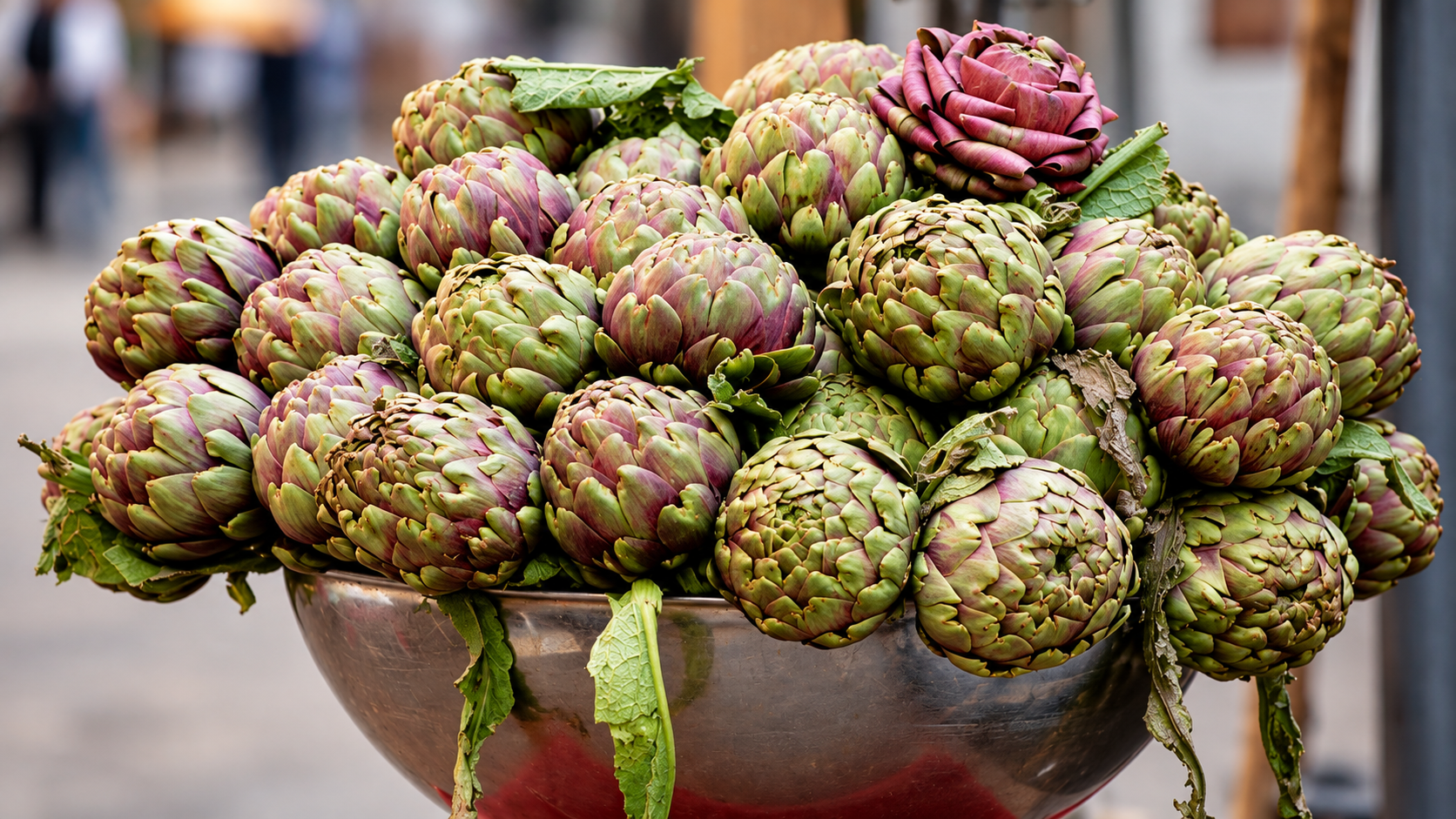
The globe artichoke, carciofo in Italian, is a cultivated thistle. Botanically, it is commonly classified as Cynara cardunculus Scolymus Group; the older name Cynara scolymus also appears in gardening and food references.
The vegetable is an immature flower head, harvested before it opens into a purple bloom. Its edible portions include the fleshy bases of the bracts, often called “leaves” at the table, and the tender heart beneath them. A carefully trimmed stem can also be eaten.
Preparing an artichoke means removing tough outer bracts, trimming any sharp tips and peeling away the fibrous exterior of the stem. Larger or more mature heads may contain a developed, fuzzy choke that needs removing.
Artichokes should not be described as vegetables whose buds universally mature in winter. Harvest timing depends on the variety, climate and growing conditions. In Italy, spring is particularly associated with Roman artichokes and the festivals celebrating them in Lazio.
Two Roman Ways to Eat Artichokes
Carciofi alla romana are gently cooked artichokes seasoned with garlic, parsley and mentuccia, an aromatic herb characteristic of the Roman preparation. Olive oil and slow cooking help produce a tender result.
Breadcrumbs appear in some stuffed-artichoke recipes, but they are not a defining ingredient of the classic Roman dish. Describing it simply as a breadcrumb-stuffed artichoke boiled in water misses its characteristic preparation.
Carciofi alla giudia offer a different experience. This speciality of Roman Jewish cuisine uses frying to create crisp outer bracts around a tender centre. Both dishes show how much the cooking method can change the same vegetable.
Topinambur: The Jerusalem Artichoke
Topinambur is the Italian name for Jerusalem artichoke, also called sunchoke. Despite its English name, it is a different plant from the globe artichoke.
Helianthus tuberosus is a sunflower relative grown for its underground tubers. Above ground, it develops tall stems and yellow flowers; below ground, it produces the irregularly shaped vegetable sold in markets. The tubers are harvested from late autumn through winter.
For a straightforward introduction, scrub the tubers thoroughly, cut them into similar-sized pieces and roast them until tender. They can also be steamed or blended into soup. Their thin skins need not always be removed, although peeling may suit a smoother preparation.
The resemblance to potatoes is mainly useful in the kitchen. Their carbohydrate composition is different, so they should not be presented as nutritionally interchangeable.
Inulin, Digestion and Diabetes
Jerusalem artichokes contain inulin, a fermentable dietary fibre also found in chicory root. Inulin and insulin are entirely different: one is a plant carbohydrate, while the other is a hormone involved in regulating blood glucose.
Inulin reaches the large intestine, where gut bacteria use it. This gives it prebiotic properties, but it can also cause gas, bloating, cramps or diarrhoea in some people. A small serving is a sensible starting point if topinambur is unfamiliar to you.
The presence of inulin does not justify the original article’s blanket claim that these tubers are therefore “tolerated by diabetics.” Diabetes meal planning considers the overall meal, carbohydrate intake and portion sizes. Topinambur should be treated as a food choice, without promises that it treats diabetes or guarantees a particular blood-glucose response.
Cardoons: A Close Relative with a Different Edible Part
Cardoons, known as cardi in Italian, are closely related to globe artichokes. Both belong to Cynara cardunculus, but their cultivated forms are selected for different uses.
With a cardoon, the principal vegetable is the thick leaf stalk rather than the artichoke-like flower head. Growers may blanch the stalks by excluding light during cultivation, making them paler and less bitter. This agricultural process is different from briefly blanching vegetables in boiling water.
In the kitchen, remove tough strings and damaged edges, cut the stalks into manageable lengths and cook until tender. They can then be finished in a gratin or another cooked preparation. Treating the entire leaf as the usual edible portion is misleading.
Chicory, Radicchio, Puntarelle and Escarole
Italian bitter greens can be confusing because everyday names do not map neatly onto a single botanical species.
Cichorium intybus includes cultivated forms such as radicchio and Belgian endive. Cichorium endivia is a separate species that includes curly endive and escarole, known in Italian as scarola. Their similar names and shared genus explain some of the confusion.
Puntarelle are the tender central shoots of a particular type of chicory. In Roman cooking, they are cut into thin strips and commonly dressed with anchovies, garlic, oil and vinegar. They are more accurately described as shoots than simply as split leaf stalks.
For a simple meal, try radicchio in a salad or cooked until softened. Escarole can also be cooked, making it a useful alternative when you want greens with more character than a mild lettuce. Different varieties have different harvesting seasons; year-round shop availability does not mean that every chicory is locally in season throughout the year.
Enjoying Winter Vegetables as Part of a Balanced Diet
Vegetables contribute fibre, vitamins and minerals to a varied diet. Their nutritional value is best discussed as part of the meals in which they appear, rather than through sweeping claims about a single ingredient.
A plate of greens, a fried artichoke and a vegetable gratin offer different eating experiences. Enjoying traditional recipes does not require describing every preparation as equally light or assigning medicinal benefits to it.
At an Italian market, ask the seller what is locally in season and how they prepare it. Start with one unfamiliar vegetable: a Roman artichoke, a small portion of roasted topinambur or a head of escarole. Learning a few preparations opens up a much wider view of Italian cooking.
For more ideas, browse Italia Mia’s Italian cuisine articles.
External Sources
North Carolina State University Extension: Globe Artichokes
North Carolina State University Extension: Cardoons
Royal Horticultural Society: Jerusalem Artichokes
Royal Horticultural Society: Endive and Escarole
Italia.it: Artichokes in Lazio
Cleveland Clinic: Inulin and Digestive Health
American Diabetes Association: Carbohydrates and Diabetes