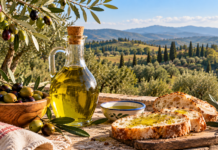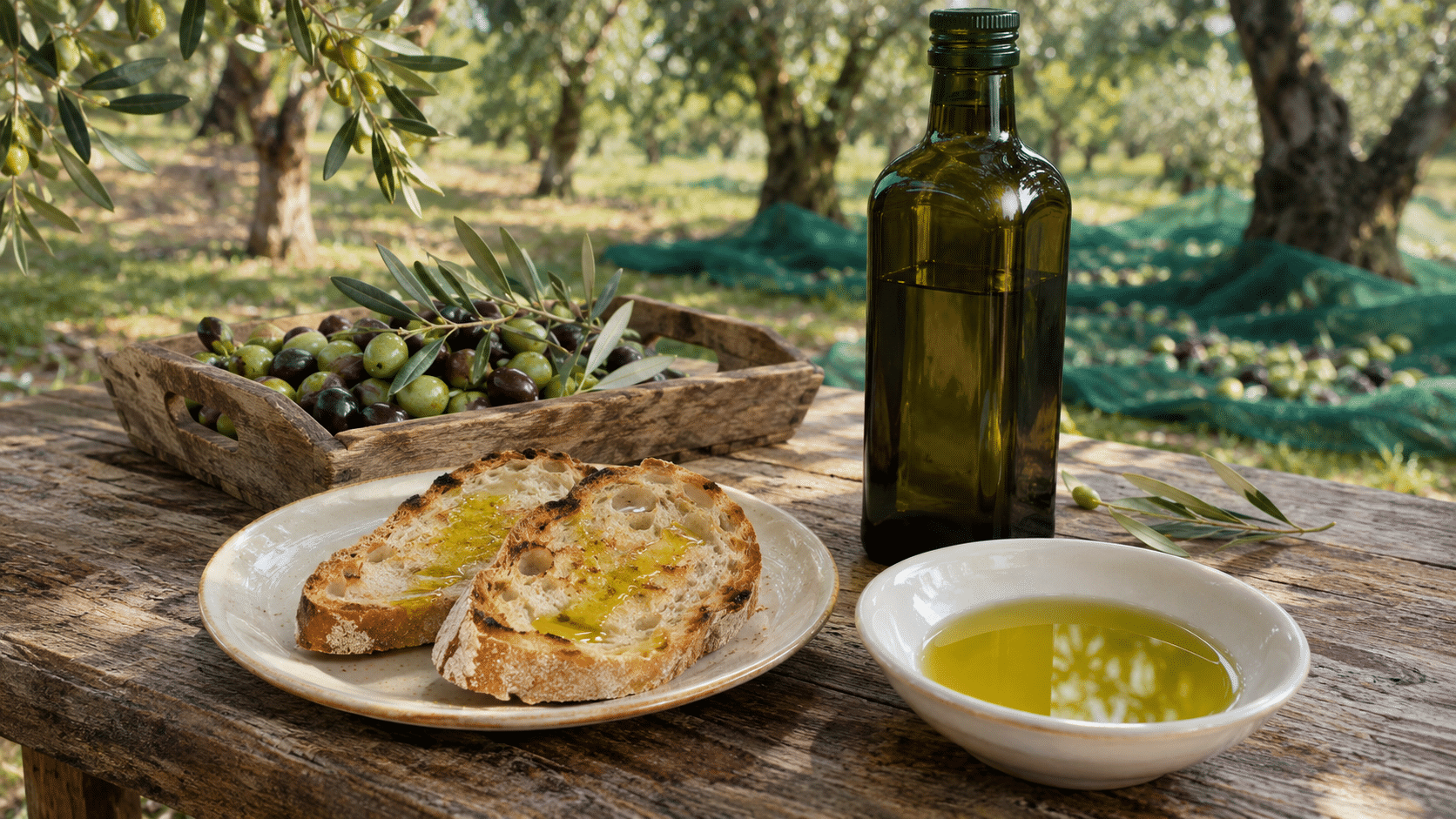
The first taste of the new olive harvest needs very little preparation: warm bread, a little salt and a drizzle of oil. The aroma rises from the toast, followed by a flavour that may be grassy, pleasantly bitter or peppery enough to catch the back of your throat.
This is the appeal of olio nuovo, Italy’s new-season olive oil. It brings an everyday ingredient into sharper focus. Instead of reaching automatically for the bottle beside the cooker, you notice when the olives were picked, where they grew and how the oil tastes today.
Buying it well takes more than choosing the greenest bottle. Harvest information, careful storage and a producer who can explain the oil are more useful than rustic packaging or a promise of “traditional goodness.” Here is how to enjoy the season and bring home an oil you will actually use.
What Does Olio Nuovo Mean?
Olio nuovo means “new oil”: oil from the latest olive harvest. In Tuscany, you may also hear olio novo. The expression celebrates the new season; it is not a separate quality grade above extra virgin.
Keep two questions separate when shopping: Is this extra virgin olive oil? And how recently was it produced? A seasonal description answers neither question completely on its own.
Freshness is part of the attraction, but it cannot compensate for damaged fruit or poor production. A well-made oil should offer clean, appealing aromas, rather than simply an aggressive flavour.
For the broader background on production and regional styles, see our guide to Italian olive oil. At harvest time, the more useful task is finding out what is in the particular bottle in front of you.
When Is the Olive Harvest in Italy?
October and November are useful starting points, particularly for an autumn visit to central Italy. There is no national opening day for the olive harvest, however. Some producers begin earlier, while others continue into December or winter.
Timing depends on location, altitude, olive variety, weather, fruit condition and the style the producer wants to achieve. Two neighbouring farms may choose different picking dates. An earlier harvest is not automatically better for every olive or every purpose.
In Tuscany, the period around late October and early November is closely associated with the arrival of new oil. Elsewhere, ask the farm directly rather than applying a Tuscan calendar to the whole country.
For an autumn purchase, ask which harvest the available bottles actually contain. A shop may be selling the previous season’s stock alongside the new arrival. A website banner announcing the harvest does not necessarily describe every product in its catalogue.
If you want to see milling as well as taste the oil, confirm that production will be taking place during your visit. Our guide to experiencing the olive harvest in Italy explains how to plan that side of the trip.
What Should Fresh Olive Oil Taste Like?
Fresh extra virgin olive oil can have aromas recalling cut grass, herbs, green almond or tomato leaf. Other oils are softer and more reminiscent of ripe fruit. Olive variety and picking conditions help explain why two excellent oils can taste quite different.
Three useful tasting words are fruity, bitter and pungent. Fruity refers to aromas associated with sound olives, rather than a sugary taste. Bitterness is perceived in the mouth; pungency is the peppery sensation that can develop in the throat.
A peppery finish is not the same thing as rancidity. Equally, the strongest sting does not automatically identify the best bottle. Look for freshness and a flavour you enjoy with food.
Colour is an unreliable shortcut. An intensely green oil is not necessarily better than a golden one. Nor can you measure quality by counting how many times a taste makes you cough.
Try a simple comparison at home:
- Pour a small amount of each oil into separate clean glasses.
- Cup a glass gently in your hand, then smell it.
- Take a small sip and notice the aroma, bitterness and finish.
- Taste it again on plain bread or warm potato.
Start without garlic, vinegar or chilli so the oil has room to speak. Then try it with the foods you normally cook. The bottle you prefer on its own may not be the one you prefer on a delicate dish.
Does Olio Nuovo Have to Be Cloudy?
No. New-season oil can be filtered or unfiltered.
Unfiltered oil may look cloudy because it contains suspended particles and tiny amounts of water. That appearance is often associated with freshly milled oil, but cloudiness is not proof of superior quality or recent production.
Filtration removes residual material and can help protect the oil during storage. It does not turn extra virgin olive oil into refined oil. Research also shows that its effects on aroma and flavour depend on the oil and the filtration process; “filtered means flavourless” is an oversimplification.
For a small purchase that you will open immediately, unfiltered oil can be an enjoyable seasonal choice. Ask the producer how quickly to use that particular batch. For bottles you intend to keep longer or give later, filtered oil is often the more practical option.
Avoid buying a large quantity of unfiltered oil simply because it looks more authentic. Think first about how much your household will use.
How to Read the Label
Read the back label as carefully as the front. These details help you compare bottles:
| Label detail | What to check |
|---|---|
| Extra virgin olive oil | The declared quality category; “olio nuovo” does not replace it. |
| Harvest year or campaign | Identifies the crop. Under EU rules, a harvest-year indication requires all the contents to come from that harvest. |
| Best-before date | A durability indication, not the harvest date. |
| Bottling date | Tells you when oil was packed, not when olives were picked. |
| Origin | Look for the stated origin of the oil; an Italian bottler’s address alone is insufficient. |
| Cold extraction | A regulated term for extraction below 27°C by centrifugation or percolation. |
| First cold pressing | Applies to a traditional hydraulic-press method below 27°C; it is not a superior freshness grade. |
| Lot code | Identifies the batch and helps the producer answer questions about your bottle. |
When buying online, request a photograph of the label on the stock being dispatched if the listing is unclear. An attractive product photograph may show an older label. Ask for the harvest information in writing before ordering several bottles.
Buying Directly from a Producer or Frantoio
A frantoio is an olive mill. Some mills produce and sell their own oil; others also process olives for local growers. Buying at a mill is a chance to ask specific questions, but the location alone does not tell you whose olives are in every bottle.
Useful questions include:
- Di quale raccolta è questo olio? — Which harvest is this oil from?
- Quando sono state raccolte e molite le olive? — When were the olives picked and milled?
- Da dove vengono le olive? — Where do the olives come from?
- È filtrato o non filtrato? — Is it filtered or unfiltered?
- Posso assaggiare questo lotto? — Can I taste this batch?
- Come mi consigliate di conservarlo? — How do you recommend storing it?
If you taste an oil and decide to buy it, confirm that the bottle or tin contains the same oil. A producer may offer several varieties, blends or harvest batches.
Ask about the full delivered price, too. A lower price per litre may become less appealing after shipping, especially if it encourages you to buy more than you need. Compare like with like: quantity, harvest, packaging and delivery destination.
Book visits ahead during harvest, when staff may be busy receiving olives and running the mill. Agree whether the appointment includes a tasting, a production visit or simply collection of an order.
How Much Should You Buy?
Start with your own kitchen. If you mainly want a finishing oil for soup and vegetables, a small bottle gives you a chance to enjoy it while it is fresh. If you cook for several people every day, a larger format may make sense.
A useful first purchase is one bottle to open immediately. Taste it over several meals before committing to a case. This also helps you discover whether you prefer a bold oil throughout the week or enjoy alternating it with something gentler.
For a gift, choose a size the recipient can finish comfortably and include the producer’s details. Add a simple suggestion: “Open this with warm bread.” New oil makes more sense as something to enjoy soon than as a decorative bottle saved indefinitely for a special occasion.
How to Store Olio Nuovo at Home
Protect olive oil from light, heat and air. Keep it tightly closed in a dark cupboard away from the hob, oven and sunny windows. The International Olive Council recommends storage between 13°C and 25°C.
Choose containers you can finish within roughly one to three months after opening, following any more specific advice for fresh unfiltered oil. This is practical freshness guidance, not a universal expiry countdown.
Dark glass and suitable food-grade tins offer protection from light. If you buy a large tin, smaller clean, completely dry, food-grade containers can help limit prolonged exposure to air. Seal them carefully.
Avoid continually topping up a table cruet with new oil over old residue. Clean it and allow it to dry fully before refilling.
Simple Ways to Enjoy the New Harvest
Build the meal around ingredients that let you notice the oil. These serving ideas need little preparation:
- Warm toast: drizzle with oil and add a pinch of salt. Try the first piece plain before adding garlic.
- White beans: spoon oil over warm cannellini beans with a little cooking liquid and black pepper.
- Vegetable soup: add a small finishing drizzle after serving, then taste before adding more.
- Boiled potatoes: dress while warm, with salt and chopped parsley.
- Cooked greens: try a bold oil on cavolo nero or chard.
- Fresh ricotta: add a little oil and serve with bread for a simple lunch.
You can use extra virgin olive oil for cooking as well. Using your special new-season bottle at the table is a way to appreciate its aroma, rather than a rule that it must never be heated.
Open it, taste it and make it part of ordinary meals. The pleasure of olio nuovo is noticing what a fresh ingredient can bring to familiar food.
External Links
- International Olive Council: consumer storage guidance
- European Union: olive-oil marketing and labelling standards
- UC Davis: olive-oil myths and facts
- Visit Tuscany: November and new olive oil
- Research review: filtration and extra virgin olive-oil quality