
 Long before Rome became an empire, Italy was already a land of remarkable civilizations.
There were prehistoric communities living in caves, farmers establishing permanent villages, Bronze Age societies building monumental stone structures, and sophisticated peoples trading across the Mediterranean.
The Etruscans created powerful cities in central Italy. Greek settlers established prosperous communities in the south and Sicily. The Samnites, Latins, Sabines, Umbrians, and many other peoples developed their own languages, customs, religious traditions, and political institutions.
Rome would eventually bring much of this world under its control. But Rome did not create Italian civilization from nothing. It grew within a peninsula whose people had already spent thousands of years developing complex societies.
To understand the history of Italy, we must begin before Roman domination.
What Was Italy Like Before Rome?
Ancient Italy was not a unified country. In fact, the idea of a single Italian nation would not become a political reality until 1861.
The peninsula’s geography encouraged cultural diversity.
The Alps formed a formidable northern boundary, although mountain passes allowed people and goods to move between Italy and central Europe.
The Apennines ran down the length of the peninsula, dividing communities into valleys, coastal plains, and mountain territories.
Meanwhile, the Mediterranean connected Italy to Greece, North Africa, the Iberian Peninsula, and the eastern Mediterranean.
These connections brought new technologies, artistic ideas, commercial opportunities, and sometimes conflict.
The result was a mosaic of communities rather than one civilization.
Some groups lived in small agricultural settlements. Others developed organized towns, monumental religious centers, trading ports, and eventually independent city-states.
The term pre-Roman Italy generally refers to these cultures before they came under Roman political control. Many existed alongside Rome for centuries after the city’s traditional foundation date of 753 BCE.
Prehistoric Italy: The First Human Communities
Italy’s human story began hundreds of thousands of years before the emergence of its ancient cities.
Archaeological discoveries show that different human populations occupied the peninsula during the Paleolithic, or Old Stone Age.
Their survival depended on hunting, gathering wild plants, obtaining stone for tools, and adapting to changing environments.
During the Ice Age, the Italian landscape looked very different from the one we recognize today.
Glaciers extended through parts of the Alps. Sea levels were considerably lower during colder periods, exposing coastal areas now underwater. Animals and vegetation shifted as the climate changed.
Neanderthals and Early Modern Humans
One of Italy’s most important prehistoric sites is the Grotta di Fumane, near Verona.
Archaeologists have recovered evidence of both Neanderthals and early Homo sapiens.
The cave preserves traces of stone-tool production, hunting, animal processing, and the use of fire. Its archaeological layers are especially valuable for understanding changes in human behavior between roughly 50,000 and 30,000 years ago.
Other important discoveries have been made in Lazio, Liguria, and southern Italy.
These finds demonstrate that the peninsula was part of a much wider prehistoric European world.
People moved, adapted, exchanged knowledge, and developed increasingly sophisticated ways of using natural resources.
Long before the first Italian cities appeared, the landscape was already shaped by generations of human activity.
The Neolithic Revolution: When Italy Began Farming
A fundamental transformation took place during the sixth millennium BCE, when agriculture and animal husbandry spread through much of the Italian peninsula.
Instead of depending entirely on hunting and gathering, communities increasingly cultivated cereals, raised domesticated animals, and established permanent settlements.
This change did not happen everywhere at the same moment.
Coastal connections with the eastern Mediterranean helped farming practices spread, while inland communities adapted them to local conditions.
Archaeological evidence from Puglia, including the area around the Pulo di Molfetta, reveals farming villages dating to approximately 6000 BCE.
People constructed houses, made pottery, stored food, and organized settlements around agricultural production.
In northern Italy, Neolithic communities gradually developed their own farming traditions.
Permanent settlements created new social relationships. Families needed to manage land, agricultural supplies, livestock, and shared resources.
Pottery became increasingly important for preparing and preserving food. Polished stone tools helped people clear vegetation and work wood.
Burial practices also grew more elaborate, providing evidence of beliefs about death, ancestry, and community identity.
These developments laid foundations for the more complex societies that would emerge during the following millennia.
Copper Age Italy and the Extraordinary Story of Ötzi
One of the most remarkable discoveries in European archaeology came in 1991.
Hikers found a naturally preserved human body in the Alps near the border between modern Italy and Austria.
The man became internationally famous as Ötzi the Iceman.
He had lived more than 5,300 years ago, during the Copper Age.
Unlike many prehistoric human remains, Ötzi was discovered with much of his clothing and equipment.
His belongings included a copper axe, a bow, arrows, tools, and items made from animal skins and plant materials.
The discovery transformed archaeological understanding of everyday life in prehistoric Alpine communities.
Ötzi was not a member of an isolated or technologically primitive society.
His clothing reflected practical knowledge of the mountain environment. His tools demonstrated specialized manufacturing skills. His copper axe showed how metalworking had become part of everyday life.
Scientific research has also provided evidence concerning his health, diet, movements, and violent death.
Today, Ötzi is preserved at the South Tyrol Museum of Archaeology in Bolzano.
His story is a powerful reminder that the inhabitants of prehistoric Italy possessed technical skills and extensive environmental knowledge long before classical civilization.
Bronze Age Italy: Villages, Trade and Monumental Architecture
The Bronze Age brought another major transformation.
Bronze, produced by combining copper with tin, made it possible to manufacture new types of weapons, tools, ornaments, and ceremonial objects.
Metalworking encouraged trade because the necessary materials were not distributed evenly.
Communities developed exchange networks linking the Italian peninsula with the Alps, central Europe, the Balkans, and the Mediterranean.
In the Po Valley, the Terramare culture became an important example of Bronze Age settlement organization.
These communities flourished particularly between approximately 1650 and 1150 BCE.
Their villages were often planned, with wooden houses, defensive structures, and systems for managing water.
Agriculture, livestock breeding, and specialized craftsmanship supported populations whose social organization was becoming more complex.
Yet the most visually extraordinary surviving architecture of Bronze Age Italy developed on the island of Sardinia.
Sardinia and the Nuragic Civilization
Sardinia had a remarkably distinctive prehistoric history.
Long before the construction of its famous towers, Neolithic and Copper Age communities created elaborate burial monuments known as domus de janas, often translated as “fairy houses.”
These tombs were carved into rock between the fifth and third millennia BCE. Their architectural forms and symbolic decorations reveal increasingly complex funeral traditions.
In 2025, a group of these prehistoric funerary sites was added to the UNESCO World Heritage List.
Later, during the Bronze Age, Sardinia developed the civilization now known as Nuragic culture.
The Mysterious Nuraghi
The most recognizable monuments of Nuragic Sardinia are the nuraghi.
These massive structures were constructed from carefully arranged stone blocks, often forming tall, truncated-cone towers with internal chambers.
Thousands of nuraghi survive across the island.
Some are relatively simple towers. Others belong to elaborate complexes with additional towers, defensive walls, courtyards, and surrounding settlements.
Their exact functions varied and remain subjects of archaeological investigation. They may have served defensive, residential, ceremonial, and political purposes.
The most famous example is Su Nuraxi di Barumini, a UNESCO World Heritage Site.
Its imposing central tower and surrounding structures illustrate the remarkable building abilities of the Bronze Age Sardinians.
The Giants of Mont’e Prama
Another exceptional discovery emerged in western Sardinia.
At Mont’e Prama, archaeologists recovered fragments of monumental limestone statues representing warriors, archers, and boxers.
Many of these sculptures date to approximately the ninth and eighth centuries BCE.
They belong to a world of complex local identities, ceremonial traditions, and increasing Mediterranean connections.
The Nuragic civilization was not simply a peripheral prehistoric culture waiting for outside influences.
It developed its own impressive architecture, bronze sculpture, social traditions, and artistic language.
For anyone interested in early Italian history, Sardinia provides some of the strongest evidence that advanced societies existed long before Roman conquest.
The Iron Age and the Emergence of New Peoples
During the transition from the Bronze Age to the Iron Age, roughly around the beginning of the first millennium BCE, many Italian communities experienced significant changes.
Iron tools became increasingly common. Settlements expanded or reorganized, burial customs changed, and regional cultural identities became more recognizable.
The peninsula gradually entered a period in which archaeology and, later, written sources allow historians to identify peoples by names familiar from classical history.
Among them were the Etruscans, Latins, Sabines, Umbrians, Samnites, Picentes, Veneti, and several populations of southern Italy.
These groups were not always clearly separated from one another.
Language, trade, migration, marriage, warfare, and shared religious customs created overlapping identities.
Furthermore, the names used by Greek and Roman writers did not necessarily correspond to how every community understood itself.
One of the most important Iron Age developments occurred in central Italy, where the Villanovan culture helped form the foundations of Etruscan civilization.
The Villanovan Culture: Foundations of Etruscan Italy
The Villanovan culture emerged around the ninth century BCE.
Its archaeological remains have been discovered across areas of central and northern Italy, particularly in territories later associated with the Etruscans.
The culture is especially recognizable through its burial practices.
Many communities cremated their dead and placed the remains in ceramic or bronze urns.
Some urns were shaped like miniature houses, providing clues about the buildings in which people lived.
Villanovan craftspeople produced bronze objects, ornaments, weapons, and distinctive pottery.
Over time, settlements became larger and more socially differentiated.
Increasing contact with the Mediterranean world brought imported goods, new artistic techniques, and opportunities for commercial expansion.
Modern scholarship generally interprets Etruscan civilization as developing substantially from these earlier communities, rather than simply appearing as the result of a sudden invasion by a foreign people.
This was one of the crucial turning points in the history of ancient Italy.
The Etruscans: Italy’s Great Civilization Before Roman Dominance
By the eighth and seventh centuries BCE, Etruscan society was developing into one of the most powerful urban cultures of the western Mediterranean.
Its principal territory, Etruria, corresponded broadly to modern Tuscany, northern Lazio, and parts of Umbria.
Important cities included Tarquinia, Cerveteri, Veii, Vulci, Volterra, Chiusi, and Orvieto.
The Etruscans were accomplished metalworkers, architects, merchants, agricultural producers, and artists.
They developed prosperous urban centers with organized religious institutions and powerful aristocratic families.
Unlike a unified kingdom, Etruria consisted of largely independent city-states.
These cities sometimes cooperated, but they also competed for influence and resources.
A Distinctive Language and Culture
The Etruscan language was not part of the Indo-European language family to which Latin and Greek belong.
Although thousands of Etruscan inscriptions survive, many are brief, and our understanding of the language remains incomplete.
Etruscan writing adapted an alphabet introduced through contact with the Greeks.
The Etruscans also developed distinctive artistic and religious traditions.
Their painted tombs show musicians, dancers, banquets, athletic competitions, and scenes associated with death and the afterlife.
These images are among the most vivid surviving representations of life in ancient Italy.
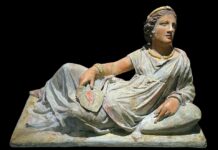
Women appear prominently in several types of Etruscan funerary art, although interpretations of their social position require caution.
How the Etruscans Influenced Rome
Rome developed in close contact with the Etruscan world.
Etruscan traditions influenced aspects of Roman religion, political symbolism, architecture, and public ceremony.
Roman accounts also describe rulers of Etruscan origin during the city’s early history, although the details of the traditional king lists cannot be treated as fully established historical fact.
Eventually, Rome expanded into Etruscan territories and incorporated their cities into its growing state.
The Etruscan legacy, however, survived in Roman institutions, religious practices, and material culture.
For a complete introduction to the archaeological sites, museums, and surviving tombs, read our detailed guide to the Etruscans in Italy.
The Greeks Arrive in Southern Italy
While the Etruscans were developing powerful cities in central Italy, Greek-speaking settlers and traders were establishing communities in the south.
Greek contacts with southern Italy intensified during the ninth and eighth centuries BCE.
Among the earliest important settlements was Pithekoussai, on the island of Ischia, followed by Greek communities such as Cumae on the Campanian mainland.
During the following centuries, new Greek cities developed across southern Italy and Sicily.
This extensive Greek-speaking world became known as Magna Graecia, or Greater Greece.
Its important centers included Taras (modern Taranto), Sybaris, Croton, Metapontum, Poseidonia (Paestum), and Rhegion (Reggio Calabria).
In Sicily, Greek cities included Syracuse, Gela, Selinunte, and Akragas (Agrigento).
These were not merely extensions of the Greek mainland.
They were politically independent communities that developed their own identities while maintaining cultural and commercial relationships with other Greek cities.
Greek Culture Changes Southern Italy
The Greek presence profoundly influenced southern Italy.
Settlers introduced or helped spread forms of urban planning, temple architecture, artistic traditions, coinage, and writing.
Greek cities became centers of philosophy, intellectual debate, mathematics, and artistic production.
However, southern Italy was not empty before Greek settlement.
Indigenous populations already occupied the region.
Contact could involve trade, cooperation, cultural exchange, competition over land, and warfare.
The resulting societies were shaped by both Greek and local traditions.
The Temples of Paestum
One of the most impressive places to experience this ancient world is Paestum, in Campania.
Originally founded as the Greek city of Poseidonia, it preserves three extraordinary Doric temples.
They are among the finest surviving examples of ancient Greek architecture outside Greece.
Visitors sometimes assume that every ancient monument in Italy belongs to Roman civilization.
Paestum offers a striking correction.
Its great temples were built by a Greek community centuries before Rome established control over the region.
Sicily: Indigenous Peoples, Greeks and Phoenicians
Ancient Sicily was another place where different civilizations developed and interacted.
Before the major expansion of Greek settlements, the island was home to populations traditionally identified as the Sicani, Sicels, and Elymians.
Their settlements, languages, and material cultures reflected complex local histories and connections with the wider Mediterranean.
Greek settlers established influential cities along much of the eastern and southern coasts.
Meanwhile, Phoenician communities developed commercial and settlement networks in western Sicily.
Later, Carthage became a major political and military force in the western part of the island.
Sicily therefore became a crossroads of Greek, Phoenician-Punic, and indigenous traditions.
The Greek temples at Agrigento and Selinunte remain among the clearest surviving expressions of this ancient cultural landscape.
The island would eventually play a decisive role in the rivalry between Rome and Carthage.
Yet its history had already been shaped by many centuries of local development and international exchange.
The Italic Peoples: Latins, Sabines, Samnites and Umbrians
The Etruscans and Greeks were not the only influential peoples of ancient Italy.
Much of the peninsula was occupied by communities speaking languages belonging to the Italic branch of the Indo-European family.
These populations included the Latins, Sabines, Umbrians, and Oscan-speaking groups such as the Samnites.
The Latins
The Latins lived principally in Latium, the region surrounding modern Rome.
Their language, Latin, would eventually become the dominant language of Roman Italy and the ancestor of modern Italian.
Before Roman expansion, however, Latin-speaking communities were organized into separate settlements with their own political interests.
Rome was originally one center within this broader Latin world.
The Sabines
The Sabines inhabited parts of central Italy, particularly areas northeast of Rome.
They are prominent in Roman foundation legends, including the famous story of the Sabine women.
Such stories are important evidence of how later Romans imagined their origins, but they should not be confused with verified accounts of historical events.
Archaeological research provides a more complex picture of communities connected through settlement, exchange, and shared cultural practices.
The Samnites
The Samnites occupied mountainous areas of the central and southern Apennines.
They developed strong regional identities and political organizations capable of resisting Roman expansion.
During the fourth and third centuries BCE, the Samnites became formidable opponents of Rome.
The Samnite Wars were major conflicts in the struggle for control of central Italy.
These wars demonstrate that Rome’s eventual victory was neither inevitable nor easily achieved.
The Umbrians and Other Peoples
The Umbrians occupied substantial areas of central Italy, while the Picentes lived along parts of the Adriatic coast.
In the northeast, the ancient Veneti developed their own distinctive culture.
The Ligurians inhabited areas of northwestern Italy, although their historical territories and cultural identities changed over time.
Celtic-speaking groups also became important in the Po Valley, particularly during the first millennium BCE.
Ancient northern Italy was consequently a region of considerable cultural variety.
Puglia Before Rome: The Iapygians, Daunians and Messapians
Puglia offers another important example of pre-Roman diversity.
Ancient Greek writers used the name Iapygians for populations inhabiting much of the region.
Over time, several distinct cultural areas became recognizable.
The Daunians occupied northern Puglia, including much of the territory around modern Foggia.
The Peucetians inhabited central areas, while the Messapians were especially associated with the Salento peninsula.
These peoples developed agricultural economies, fortified settlements, burial traditions, and distinctive craftsmanship.
They also traded and interacted with Greek colonies, particularly Taranto.
Their histories show that the development of southern Italy cannot be explained exclusively through Greek colonization.
Local communities were active participants in shaping the region’s cultural identity.
Trade Connected Italy Long Before Roman Roads
One of the most important forces in ancient Italian history was trade.
The Mediterranean made travel and commerce possible long before Roman engineers constructed their famous road system.
Metals, pottery, textiles, wine, oil, luxury objects, and raw materials circulated between communities.
Etruscan merchants maintained connections with the Greek and Phoenician worlds.
Sardinian communities participated in maritime exchange networks.
Greek settlements traded with inland populations and overseas partners.
The movement of objects also encouraged the movement of ideas.
Writing systems spread through contact. Artistic styles were adapted. Religious symbols crossed cultural boundaries.
These exchanges were rarely one-sided.
Communities selected, changed, and reinterpreted foreign influences according to local needs.
The Italian peninsula was already part of an interconnected Mediterranean world.
How Rome Emerged From This Multicultural Landscape
According to Roman tradition, the city was founded by Romulus in 753 BCE.
This legendary date remains an important reference point, but archaeological evidence tells a more gradual story.
Settlements existed on and around Rome’s hills before the traditional foundation date.
Over time, these communities developed into an increasingly organized urban center.
Rome occupied a strategically valuable position near the Tiber River, where routes linking the coast, inland communities, and central Italy intersected.
Its location encouraged contact with Latins, Sabines, Etruscans, and other peoples.
The city’s early identity developed within this multicultural environment.
By the late sixth century BCE, Rome had undergone significant political changes traditionally associated with the end of monarchy and the beginning of the Republic.
It would then expand through alliances, military campaigns, political integration, and conquest.
The defeat of Veii in the early fourth century BCE marked an important stage in Roman expansion against the Etruscans.
The Samnite Wars brought Rome into prolonged conflict with powerful Italic neighbors.
By 272 BCE, following the defeat of Tarentum, Rome had established dominance over much of peninsular Italy south of the Po Valley.
Roman involvement in Sicily and the wider Mediterranean would expand dramatically during the Punic Wars.
Nevertheless, the earlier civilizations did not simply vanish.
Their populations, customs, technologies, and artistic traditions contributed to the society Rome was creating.
Roman Italy was built through the interaction and gradual incorporation of many different peoples.
Where to Discover Pre-Roman Italy Today
Much of this history can still be experienced directly.
In Veneto, Grotta di Fumane preserves evidence of prehistoric human occupation.
In Bolzano, the South Tyrol Museum of Archaeology tells the extraordinary story of Ötzi.
In Sardinia, Su Nuraxi di Barumini and the archaeological discoveries of Mont’e Prama reveal the achievements of Nuragic civilization.
In Lazio and Tuscany, the Etruscan sites of Tarquinia, Cerveteri, Vulci, and Volterra reveal an ancient world that existed before Roman domination.
In Campania, Paestum preserves magnificent Greek temples.
In Sicily, Agrigento, Selinunte, and Syracuse show the importance of the Greek Mediterranean.
In Puglia, archaeological museums preserve objects created by the indigenous peoples of southern Italy.
These places offer a different perspective on Italian history.
They also connect naturally with Italia Mia’s broader guide to Italian art and its ancient roots, where Etruscan, Greek, and Roman traditions form the foundations of later artistic development.
Ancient Italy Before Rome: A Brief Timeline
The following dates are approximate and describe developments that occurred at different times in different regions.
- Before 40,000 BCE: Neanderthals and other prehistoric human populations inhabit parts of the peninsula.
- Around 40,000–30,000 BCE: Early Homo sapiens communities are established in Italy.
- Around 6000 BCE: Neolithic farming communities spread across parts of the peninsula.
- Fifth–third millennia BCE: Prehistoric Sardinian communities create elaborate rock-cut tombs.
- Around 3300 BCE: Ötzi lives in the Copper Age Alps.
- Around 1600–1200 BCE: Major Bronze Age societies flourish, including the builders of Sardinia’s nuraghi.
- Around 900 BCE: Villanovan culture becomes prominent in parts of central and northern Italy.
- Eighth century BCE: Greek settlements expand in southern Italy and Sicily; Etruscan urban culture develops.
- 753 BCE: Traditional legendary foundation date of Rome.
- Seventh–sixth centuries BCE: Etruscan cities and Greek colonies become major cultural and economic centers.
- 509 BCE: Traditional beginning of the Roman Republic.
- Fourth–third centuries BCE: Rome expands through wars and alliances with Etruscan, Latin, Samnite, and Greek communities.
- 272 BCE: Rome defeats Tarentum, consolidating its dominance over much of peninsular Italy.
Why Ancient Italy Before Rome Still Matters
It is tempting to describe Italian history as a direct progression from ancient Rome to Renaissance Florence and then to modern Italy.
But that approach overlooks the extraordinary diversity of the peninsula’s earliest civilizations.
The Etruscans contributed to the political and religious world in which Rome developed.
Greek communities introduced artistic, intellectual, and architectural traditions that continued to influence Italy for centuries.
The Nuragic civilization created monumental structures whose construction methods and purposes still fascinate archaeologists.
The Italic peoples developed their own languages, political institutions, and regional identities.
And long before any of these civilizations emerged, prehistoric communities had already transformed the Italian landscape through agriculture, technology, and settlement.
Rome eventually became the dominant power, but its success was shaped by the peoples it encountered, conquered, and incorporated.
Understanding ancient Italy before Rome changes how we see the country today.
A Tuscan hill town may stand above an Etruscan settlement. A Greek temple may dominate a southern landscape. A prehistoric stone tower may rise from the Sardinian countryside.
These are not simply isolated archaeological curiosities.
They are reminders that Italy’s history began thousands of years before Rome became an empire.
For the wider historical journey, see our History of Italy overview, which follows the peninsula from Roman civilization through the Middle Ages, Renaissance, unification, and modern Republic.
Our next chapter will explore Roman Italy, beginning with the city’s early development, the Republic, and the conquest of the peninsula.
External Sources and Further Reading
The following archaeological institutions, museums, and reference works provide additional information about the civilizations discussed in this article.
- Grotta di Fumane: Archaeological Research — University of Ferrara research on Neanderthals and early modern humans.
- Ötzi the Iceman — South Tyrol Museum of Archaeology.
- Su Nuraxi di Barumini — UNESCO World Heritage Centre.
- Funerary Tradition in Prehistoric Sardinia — UNESCO World Heritage Centre.
- The Giants of Mont’e Prama — Metropolitan Museum of Art.
- Etruscan Necropolises of Cerveteri and Tarquinia — UNESCO World Heritage Centre.
- Etruscan Art — Metropolitan Museum of Art.
- Ancient Greek Colonization and Trade — Metropolitan Museum of Art.
- Magna Graecia Collection — National Archaeological Museum of Naples.
- The Iapygians, Apulians and Daunians — Treccani, Il Mondo dell’Archeologia.