Good espresso at home begins with a balanced setup: a suitable machine, freshly ground coffee, and a little practice. An expensive espresso machine can still produce disappointing coffee if the grinder cannot make the small adjustments espresso requires.
My advice is to choose equipment around your daily routine. Someone making two morning cappuccinos has different needs from someone who enjoys experimenting with beans, temperatures, and extraction.
This guide explains the main machine types, the features worth paying for, and five espresso machines and five coffee grinders to consider.
Affiliate disclosure: As an Amazon Associate, I earn from qualifying purchases. The shopping links below lead to Amazon searches for the named models. Prices, sellers, specifications, and availability vary.
Choosing the Right Type of Espresso Machine
Semi-automatic machines
With a semi-automatic machine, you grind the beans, fill the portafilter, distribute and tamp the coffee, and control the extraction. The machine supplies the hot water and pressure.
This is the approach I would choose for someone who wants to learn the craft of espresso. It also gives you the freedom to change your grinder independently.
Some machines automatically stop at a programmed shot volume. You still prepare the coffee yourself, but the machine handles the stopping point.
Machines with a built-in grinder
These combine grinding and brewing in one appliance. They simplify the shopping process and can create a tidy coffee station.
However, check how much control the grinder offers. If you later want a different grinder, you may end up adding a separate appliance anyway.
Bean-to-cup machines
Often called super-automatic machines, these grind beans and brew coffee with minimal intervention. Some also prepare milk drinks automatically; others have a manual steam wand.
They suit households that value convenience. You still need to empty the grounds container, clean the brewing system, and maintain any milk components.
Capsule machines
Capsules offer speed, predictable portions, and less preparation. The tradeoffs include ongoing capsule costs, packaging, and restrictions on compatible coffee.
Check the capsule system before buying. Machines from different systems may produce quite different drinks.
Manual lever machines
Lever machines make brewing a more involved process. Depending on the design, you apply pressure directly or operate a spring mechanism.
They can be appealing to enthusiasts, but I would choose one because you enjoy the method, rather than because you expect it to simplify breakfast.
The Features That Matter Most
Pressure: bigger numbers do not mean better espresso
A machine advertised with a 15-bar or 19-bar pump does not necessarily brew better coffee than another model. Pump capacity and pressure during extraction are different measurements.
Many conventional espresso machines brew around 9 bar. Coffee preparation, temperature, and pressure management matter more than the largest number on the box.
Heating system and milk drinks
A single-boiler machine typically switches between brewing and steaming. That is manageable for one or two drinks, but it introduces a pause.
Thermoblock and ThermoJet systems heat water as it moves through the machine. Their warm-up and steaming performance vary by model.
Dual-boiler machines use separate boilers for brewing and steam. They are worth considering if you regularly prepare several milk drinks and want greater control.
A heat-exchanger machine is another option for brewing and steaming, although its temperature management differs from a dual-boiler design.
Temperature control
Consistent brewing temperature helps you repeat a successful recipe. Electronic temperature control can be useful, but check whether the machine also lets you adjust the temperature.
Those are separate features.
Filter baskets
A pressurized basket helps accommodate pre-ground coffee or a less precise grinder. It is a practical starting point for some beginners.
A non-pressurized basket gives you more control, but it requires a grinder capable of producing a fine, consistent grind with small adjustments.
Counter space and maintenance
Measure the complete setup, including the grinder, water-tank access, and clearance beneath cupboards.
Before buying, I would also check replacement parts, local servicing, and the cleaning instructions. A machine should fit your routine after the first week of enthusiasm.
Five Espresso Machines to Consider
These selections cover different needs. They are based on manufacturer specifications and intended use, rather than a hands-on comparison.
Breville / Sage Bambino Plus: for a compact setup with automatic milk texturing
The Bambino Plus combines a compact body, a 54 mm portafilter, and automatic milk texturing. Breville states that its ThermoJet heating system reaches extraction temperature in three seconds.
It is a strong candidate for someone who wants to prepare espresso manually while getting help with cappuccino milk. It requires a separate grinder.
The rapid heating claim concerns the heating system; warming your cup and portafilter still helps. In Italy, look for the Sage version and confirm the local model.
Find the Breville Bambino Plus on Amazon.com
Find the Sage Bambino Plus on Amazon.it
Gaggia Classic E24: for a traditional espresso routine
The Gaggia Classic E24 is designed and made in Italy. It has a 58 mm portafilter, a professional-style steam wand, and straightforward rocker switches.
I would shortlist it for someone who enjoys preparing each shot and wants a traditional machine to learn on. Its single-boiler workflow requires switching between espresso preparation and steaming.
Check the exact generation when ordering. Listings for older Classic models can appear alongside the E24.
Find the Gaggia Classic E24 on Amazon.com
Find the Gaggia Classic E24 on Amazon.it
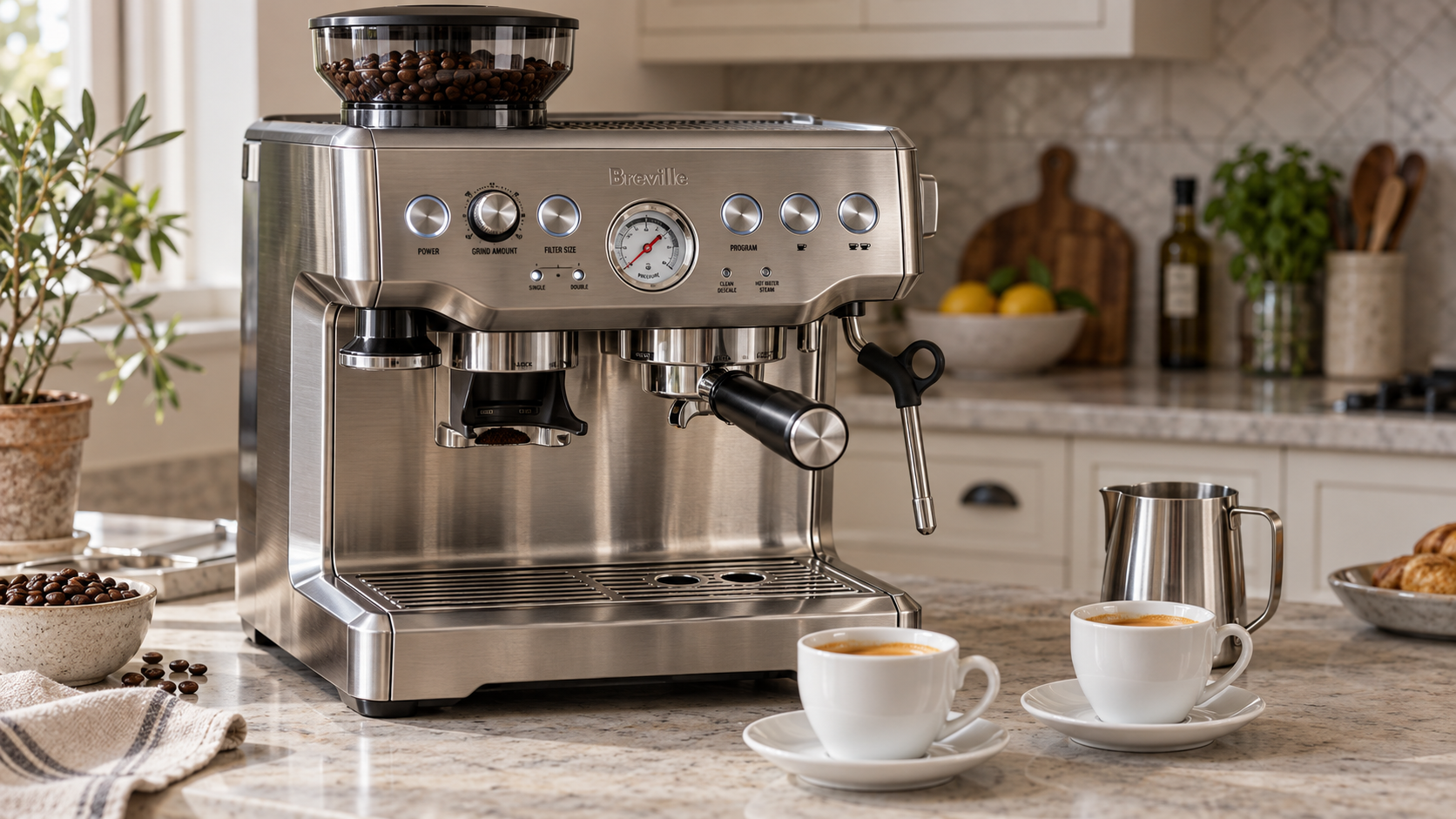
Breville / Sage Barista Express: for an integrated grinder
The Barista Express combines a grinder, espresso brewing, and manual milk texturing in one appliance.
It suits someone who wants to begin with a complete setup. You still need to learn how grind size, dose, and extraction work together.
I would compare its current price with the cost of a separate machine and grinder before deciding. The separate route offers more flexibility when upgrading.
Find the Breville Barista Express on Amazon.com
Find the Sage Barista Express on Amazon.it
De’Longhi Dedica Arte EC885: for a narrow coffee station
The Dedica Arte is a compact option with De’Longhi’s My LatteArt steam wand. It makes sense for a smaller kitchen and someone who wants to practise preparing espresso and milk manually.
Check the model number carefully. The Dedica family includes several versions with different features, and the Arte EC885 should not be confused with every other Dedica listing.
Find the De’Longhi Dedica Arte EC885 on Amazon.com
Find the De’Longhi Dedica Arte EC885 on Amazon.it
De’Longhi Magnifica Evo: for convenient everyday coffee
The Magnifica Evo is a bean-to-cup family with an integrated grinder. Versions equipped with LatteCrema prepare milk drinks automatically, while other versions use a manual frother.
For a household that wants coffee with fewer preparation steps, this is the category I would investigate first. A separate espresso grinder is unnecessary for its normal bean-to-cup operation.
Choose by the full model code and milk system, rather than the Magnifica Evo name alone.
Find the De’Longhi Magnifica Evo on Amazon.com
Find the De’Longhi Magnifica Evo on Amazon.it
Why the Grinder Deserves Its Own Budget
For a traditional espresso setup, I would treat the grinder as an essential purchase.
Espresso depends on controlling how water travels through a compact bed of coffee. A small grind adjustment can change the flow substantially.
A burr grinder crushes beans between grinding surfaces. A blade grinder chops them, producing a less controlled mixture of particle sizes.
However, buying any burr grinder is not enough. Look for a model explicitly designed to handle espresso, with sufficiently fine adjustments.
Stepped grinders use defined adjustment positions. Stepless grinders let you adjust between positions. Both approaches can work, provided the espresso range offers enough control.
Also consider your brewing habits. A grinder that stays set for one espresso blend serves a different routine from one used for espresso, moka, and filter coffee throughout the day.
Five Top Coffee Grinders for Home Espresso
Baratza Encore ESP: an accessible starting point
The Encore ESP is designed with espresso adjustment in mind. It is a sensible candidate for someone building a first setup with a separate machine and grinder.
Its straightforward approach should appeal to buyers who want to learn without adding too many controls at once.
Check that the listing says Encore ESP. The standard Encore is a different model, and Baratza also sells other ESP variants.
Find the Baratza Encore ESP on Amazon.com
Find the Baratza Encore ESP on Amazon.it
Eureka Mignon Specialità: for a dedicated espresso station
The Mignon Specialità has 55 mm flat steel burrs, stepless adjustment, and a touchscreen for programmable timed doses.
I would shortlist it for a coffee station where espresso is the main brewing method. Its adjustment system allows small changes when refining a shot.
Timed dosing controls how long the grinder runs; it does not weigh the coffee. A scale remains useful for checking your dose.
Find the Eureka Mignon Specialità on Amazon.com
Find the Eureka Mignon Specialità on Amazon.it
Baratza Sette 270: for espresso with timed dosing
The Sette 270 combines larger grind adjustments with a stepless micro-adjustment ring. It also offers hands-free, time-based dosing.
This makes it a candidate for someone who wants precise espresso adjustment and a routine built around grinding directly into a portafilter.
Confirm which Sette model you are buying. The 270 and 270Wi have different dosing features.
Find the Baratza Sette 270 on Amazon.com
Find the Baratza Sette 270 on Amazon.it
Fellow Opus 2: for espresso and other brewing methods
The Opus 2 has 48 mm conical burrs and a stepless side adjustment dial. Fellow designs it for espresso as well as coarser brewing methods.
I would consider it for someone who wants one grinder for several coffee routines.
Check the generation before ordering. The original Opus uses a different adjustment system. Fellow’s Ode grinders are intended for brewed coffee and are not espresso grinders.
Find the Fellow Opus 2 on Amazon.com
Find the Fellow Opus 2 on Amazon.it
1Zpresso J-Ultra: for manual espresso grinding
The J-Ultra is a hand grinder designed for espresso. Its external adjustment moves the burr by 8 microns per click, allowing small changes when adjusting extraction.
It offers a compact option without an electric motor. The tradeoff is physical effort, particularly when grinding fine coffee for several drinks.
I would consider it for someone making a small number of espressos who enjoys a manual routine.
Find the 1Zpresso J-Ultra on Amazon.com
Find the 1Zpresso J-Ultra on Amazon.it
How I Would Pair a Machine and Grinder
For a compact first setup, I would compare the Bambino Plus with the Encore ESP. That combination offers assisted milk texturing while keeping grinding separate.
For a more traditional routine, I would consider the Gaggia Classic E24 with the Eureka Mignon Specialità. This pairing suits someone happy to spend time learning preparation and adjustment.
For an integrated setup, the Barista Express already includes a grinder. There is no need to buy another one immediately.
For convenience, a suitable Magnifica Evo handles grinding internally.
These are suggested pairings based on features and workflow. The final decision should include local prices, servicing, and how many drinks you prepare.
A Simple Starting Recipe for Espresso
Once you have the equipment, begin with a repeatable recipe.
For a basket designed to hold an 18-gram dose, try 18 grams of ground coffee and approximately 36 grams of espresso in the cup. That is a 1:2 ratio by weight.
Treat this as a starting point. Smaller baskets need smaller doses, and different coffees may taste better at different ratios.
Use a scale to measure both the coffee and the finished drink. Keep the dose steady while making small grind changes.
If the coffee rushes through and tastes thin, try a finer grind. If it barely flows, try a coarser setting. Distribute the grounds evenly and tamp level before brewing.
Aim for balance in the cup rather than chasing one exact extraction time. Grind size affects both flow and flavor, and the machine’s pre-infusion changes how you interpret timing.
Coffee, Water, and Cleaning
Choose beans you enjoy
An Italian-style medium or medium-dark blend is a practical starting point if you enjoy a rounded espresso with chocolate or nutty notes.
Lighter roasts can be rewarding, but they may require different temperatures and recipes.
Buy manageable quantities and keep the beans sealed away from heat and light. Grind only what you need for the next drink.
Use suitable water
Follow the manufacturer’s water recommendations. Water hardness affects scale buildup and maintenance, so use the supplied hardness test where available.
Do not assume that every bottled water or household filter provides suitable water for espresso equipment.
Clean as part of the routine
Wipe and purge the steam wand after use. Empty and rinse the drip tray, and clean baskets and portafilters regularly.
Follow the manual for descaling, backflushing, and grinder cleaning. Those procedures vary, and backflushing is appropriate only for machines designed for it.
Espresso Machine or Moka Pot?
An espresso machine is useful if you want espresso-based drinks and steamed milk. A moka pot offers a simpler way to prepare concentrated stovetop coffee, although it does not brew with the same pressure as an espresso machine.
If your favorite ritual is a small coffee after lunch, a moka may already meet your needs. Our guide to the stovetop moka and Italian coffee culture explains the alternative.
For more equipment guides, visit Kitchen & Coffee.
My preference is to start with a setup that fits everyday life. For traditional espresso, that means giving the grinder serious attention and choosing a machine whose controls and cleaning routine you will happily use.
Buying in the United States or Italy
Buy equipment intended for your local electrical supply. U.S. and Italian versions may differ in voltage, plugs, model codes, accessories, and warranty support.
A plug adapter does not convert voltage.
Before ordering, check the exact model, seller, included accessories, and local warranty coverage. Amazon search results can include older generations, imported versions, and similarly named products.
External Sources
Breville Bambino Plus specifications
Gaggia Classic E24 specifications
Breville Barista Express specifications
Baratza Encore ESP specifications
Eureka Mignon Specialità specifications
Baratza Sette 270 specifications
1Zpresso J-Ultra specifications