When I think about equipping an Italian kitchen, I start with the food: pasta finished in its sauce, a risotto that needs room for stirring, vegetables sautéed for dinner, and a pot of minestrone.
Each dish asks something different of its cookware. That is why I would choose a few useful pots and pans before buying a large matching set.
Italian cookware also deserves a closer look at its origins. An Italian brand name, an Italian design, and a pan manufactured in Italy are different things. Here is how I would choose cookware that earns its place in the kitchen, with specific collections whose origins manufacturers identify.
Affiliate disclosure: As an Amazon Associate, I earn from qualifying purchases. The shopping links below open searches on Amazon.com and Amazon.it. Check the exact model, seller, manufacturing origin, and specifications before ordering.
Start with the Pots and Pans Your Meals Need
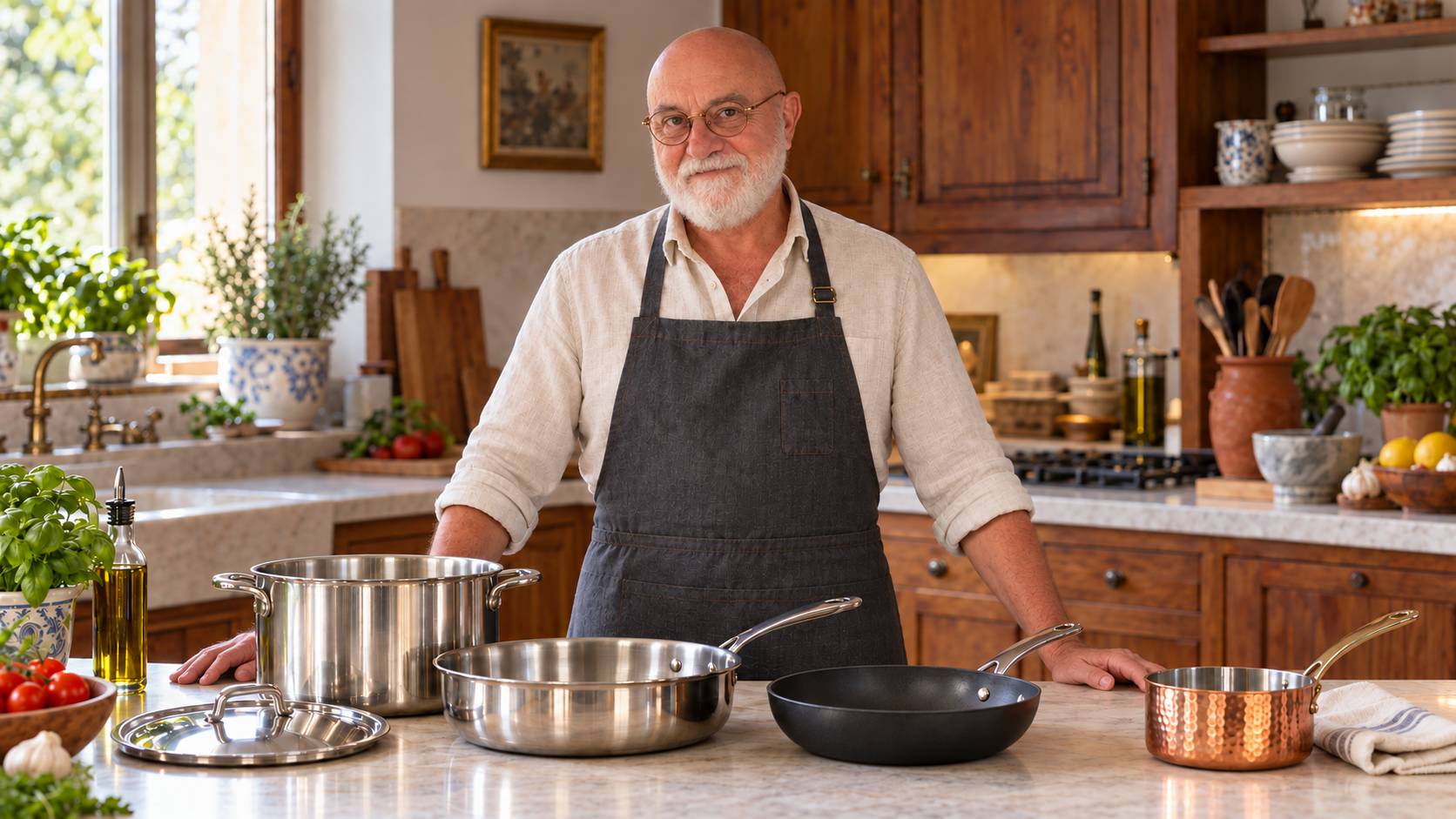
For a small household, I would begin with four pieces.
A medium stainless steel pot handles pasta, soups, and boiled vegetables. Choose a capacity that suits your portions, with enough space to prevent boiling water from spilling over.
A small saucepan is useful for warming milk, making béchamel, and preparing modest quantities of sauce.
A wide sauté pan gives vegetables, chicken, and pasta sauces room to cook. A lid makes it more versatile for dishes that finish with a gentle simmer.
Finally, a nonstick frying pan makes eggs, delicate fish, and quick meals easier.
For many kitchens, a frying pan around 24–28 cm is a practical starting point. However, check the cooking surface as well as the advertised diameter: sloping sides can leave less usable space than you expect.
Before buying, lift the pan if possible. Its weight matters when you are draining pasta or carrying dinner from the stove.
Stainless Steel: My First Choice for Everyday Versatility
Stainless steel would be the foundation of my cookware collection. It suits tomato sauces, soups, boiling, and dishes where browned ingredients leave flavorful juices in the pan.
Construction matters as much as the material name. Stainless steel cookware commonly uses aluminum within a layered base or body to distribute heat. A fully clad pan carries those layers up the sides; a pan with an encapsulated base concentrates them underneath.
Neither description automatically makes a pan the right purchase. I would look for a stable base, comfortable handles, and a shape that suits the dish.
Stainless steel also requires a little patience. For frying, use suitable heat and enough cooking fat. Food may initially stick, particularly if you try to move it before it has browned.
Nonstick: Useful for Specific Jobs
I would keep one nonstick frying pan for eggs, delicate fish, and foods that are awkward to release from an uncoated surface.
Look beyond words such as “stone,” “granite,” or “ceramic.” Those descriptions do not necessarily mean the pan is made from solid stone or ceramic. Check the body material and the actual coating.
My priorities would be a comfortable handle, clear care instructions, and a size I will use regularly.
Follow the manufacturer’s heat limits, avoid overheating an empty pan, and use utensils approved for its coating. Handwashing is a sensible choice when the instructions recommend it.
A coated pan is also a piece I would expect to replace eventually. I would spend accordingly rather than buy an expensive set in which every cooking surface depends on the same coating.
Aluminum: Light and Responsive, with Important Limits
Aluminum cookware appeals to me for its manageable weight and quick response to changes in heat. A flared pan can be particularly useful for finishing pasta with sauce and a little cooking water.
However, bare aluminum, coated aluminum, and aluminum enclosed within stainless steel have different cooking surfaces.
For bare aluminum, follow the exact product instructions. Agnelli’s current professional aluminum pan guidance says to avoid contact with strongly acidic or strongly salty foods. I would therefore choose stainless steel for a long-simmered tomato sauce and use suitable containers for storing leftovers.
Induction compatibility needs checking too. An aluminum body alone does not establish that a pan will work on an induction hob.
Copper and Cast Iron: Buy Them for a Clear Purpose
Copper is attractive, but I would buy it for the cooking experience as well as its appearance. Check whether its interior is lined with tin or stainless steel, since the lining affects how you use and maintain it.
Tin-lined Ruffoni cookware requires care with heat: the manufacturer advises against empty heating and cooking methods that need very high temperatures. Traditional Ruffoni copper cookware also does not work directly on induction.
Cast iron serves a different purpose. Its heat retention makes it useful for browning and slow cooking, although its weight may be a drawback. An enameled casserole can be a worthwhile addition if you often make braised dishes.
Neither material would be my first purchase for a kitchen mainly used for quick pasta, vegetables, and breakfast.
Italian Cookware Collections with Verified Origins
Manufacturing origin should be checked at collection and model level. These are useful starting points, rather than a claim that every product carrying the same brand name has identical origins.
Lagostina Opera: Stainless Steel for Everyday Cooking
Lagostina explicitly identifies its Opera collection as Made in Italy. Its official 26 cm frying pan page describes 18/10 stainless steel, a layered Lagoseal Plus base, and induction compatibility.
I would consider this range when looking for practical stainless steel cookware. Check individual handle and oven limits, rather than assuming every piece can move freely from hob to oven.
The collection name matters here. Lagostina’s Canadian customer service page states that the brand produces cookware in both Italy and China. Its Italian heritage therefore does not establish the origin of every model.
Search for Lagostina Opera on Amazon.com or Amazon.it.
Ballarini Parma: An Italian Nonstick Starting Point
Ballarini is a useful brand to investigate for nonstick cookware. ZWILLING’s official Ballarini Parma frying pan set page identifies that collection as made in Italy.
I would start with one frying pan in a useful size. Check the exact collection carefully: similar names and different generations can have different coatings, handles, and hob compatibility.
Do not assume that a pan described as aluminum nonstick is suitable for induction.
Search for Ballarini Parma on Amazon.com or Amazon.it.
Pentole Agnelli Saltapasta: For Finishing Pasta
Agnelli’s official saltapasta guide describes its aluminum pasta pan as Made in Italy, with high, flared sides suited to tossing and combining ingredients.
This is the kind of specialist pan I would consider if pasta is a frequent dinner. Its value comes from having room to combine the pasta, sauce, and cooking water before serving.
Choose the material carefully. Agnelli offers different constructions, and a bare aluminum version requires different handling from a stainless steel lined or coated pan. Check the product code and hob compatibility.
Search for Agnelli pasta pans on Amazon.com or Amazon.it.
Ruffoni Historia: A Considered Copper Purchase
Ruffoni’s Historia saucepan page identifies Italian manufacture and describes hammered copper with a tin lining.
I would see this as a considered purchase for someone who enjoys cooking and caring for traditional cookware. It also makes an appealing gift, provided the recipient’s hob and cooking habits suit it.
Check the lining, capacity, and care requirements before choosing. A beautiful pan should still have a useful job.
Search for Ruffoni Historia on Amazon.com or Amazon.it.
What I Would Check Before Buying
First, confirm hob compatibility. Look for an explicit induction statement if you need one.
Next, check the oven limits for the pan, handles, and lid. The lowest limit determines how you can use the assembled cookware.
Then consider storage. Long handles, tall lids, and bulky sets can become inconvenient in a small kitchen.
Finally, confirm the exact manufacturing origin if Made in Italy is part of your buying decision. Look for a manufacturer statement tied to the model or collection, supported by packaging or markings on the item.
I would also count the useful cooking vessels in a set. A “ten-piece” collection may include several lids, so the headline number tells you little about how many meals it helps you prepare.
For more ideas to build a practical Italian kitchen, browse our Kitchen & Coffee guides.
My own starting point would be stainless steel for daily cooking, one nonstick frying pan, and a wide pan for finishing pasta. I would add specialist pieces when a dish gives me a reason to use them.
External Sources
Lagostina Opera: official materials, origin, and hob specifications
Lagostina customer service: manufacturing and cookware information
Ballarini: official cookware website
Pentole Agnelli: saltapasta pan guide
Pentole Agnelli: professional aluminum pan instructions
Ruffoni Historia: official copper saucepan specifications
Ruffoni: induction compatibility