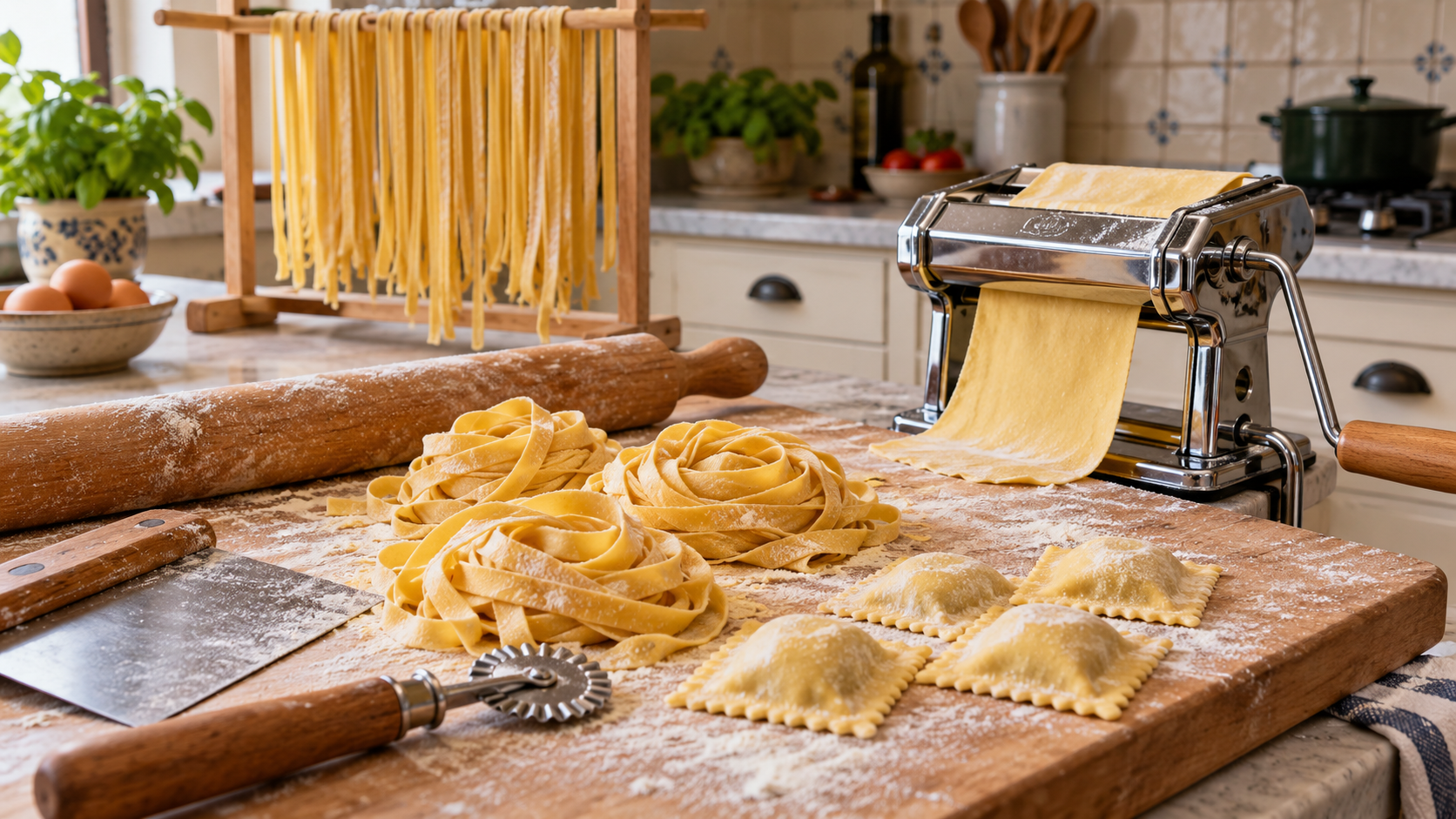
 Making fresh pasta is one of the most satisfying ways to bring Italian cooking into your home. Flour becomes dough, dough becomes a sheet, and suddenly you have tagliatelle ready for Sunday lunch.
My approach to pasta-making tools is simple: start with the equipment that suits what you want to cook. A rolling pin and a knife can take you a long way. A manual machine makes thin, even sheets easier to achieve. Cutters, stamps, and drying racks become useful as you try more shapes.
Here is how I would choose machines, rolling pins, cutters, and other practical tools for an Italian kitchen.
Affiliate disclosure: As an Amazon Associate, I earn from qualifying purchases. This article includes affiliate links to Amazon.com and Amazon.it. Shopping links lead to search results so you can compare models, sellers, and current availability.
Choose Your Tools Around the Pasta You Make
Before buying a machine, think about your favorite dishes.
For tagliatelle, fettuccine, and lasagne, a manual roller is a useful investment. For hand-cut pappardelle, a rolling pin and sharp knife may be enough. Ravioli benefit from a cutter or stamp, while gnocchi need neither a pasta machine nor a drying rack.
I would begin with one way to roll the dough, one way to cut it, and a bench scraper. Add specialized tools when a particular recipe gives you a reason to use them.
Manual Pasta Machines: A Practical Starting Point
A manual pasta machine rolls dough between adjustable rollers. You begin at the widest setting, then reduce the gap gradually until the sheet reaches the thickness your recipe needs.
The main advantage is consistency. Even sheets make it easier to prepare filled pasta and noodles that cook evenly.
Before buying, check your worktop. Many machines attach with a clamp, which needs a suitable edge and enough clearance underneath. Also leave space for the handle to turn.
Marcato Atlas: Check the Exact Version
The Marcato Atlas family is an Italian-made option worth comparing. However, product names and bundles matter.
Marcato’s current Atlas+ includes equipment for lasagna sheets, fettuccine, tagliolini, and spaghetti. Older Atlas 150 listings may include a different selection of cutters. Check the package contents rather than assuming every Atlas machine comes with the same accessories.
I would choose this type of machine for someone who wants to make sheet pasta regularly and gradually try additional cuts.
Compare Marcato Atlas machines on Amazon.com
Compare Marcato Atlas machines on Amazon.it
Imperia iPasta Classic: Another Italian-Made Choice
Imperia’s iPasta Classic is another established option. The manufacturer identifies it as Made in Italy and describes adjustable rollers with six thickness settings, a worktop clamp, and a Duplex cutter. Check the precise model and cutter widths before ordering, since the range includes several configurations.
For me, the decision between these machines would come down to the included accessories, available storage space, and how easily I could obtain compatible parts.
Compare Imperia iPasta machines on Amazon.com
Compare Imperia iPasta machines on Amazon.it
Electric Rollers and Pasta Extruders
An electric roller or compatible motor can free both hands to guide the dough. This can be useful for longer sheets or frequent pasta-making sessions.
Check compatibility carefully. Motors and attachments are not universally interchangeable. For electrical equipment, also confirm that the voltage and plug suit the country where you will use it.
An extruder performs a different job. It pushes dough through shaped dies to produce particular pasta forms. Its dough requirements can differ from those of a roller, so follow the appliance’s recipe rather than using any fresh-pasta dough.
I would start with a manual roller unless convenience or the desire to make extruded shapes justified the additional expense.
Rolling Pins: The Traditional Mattarello
A long wooden rolling pin, or mattarello, is a useful choice for anyone who enjoys working directly with the dough.
Look for a smooth, food-safe surface and a length that fits your workspace. A long, straight pin helps you work across a broad pasta sheet. A shorter pin is easier to store and can suit smaller batches.
Hand rolling takes practice. Turn the dough regularly and aim for an even thickness across the center and edges. Keep portions you are not using covered so they do not dry out.
I would choose a rolling pin for the pleasure of the process as much as the result. It also remains useful when you own a machine.
Shop long wooden pasta rolling pins on Amazon.com
Shop mattarelli per pasta on Amazon.it
Bench Scrapers and Pasta Boards
A bench scraper is one of the first tools I would buy. It divides dough, lifts sticky pieces, and gathers flour from the work surface.
Choose a comfortable handle and a sturdy edge. A metal scraper works well on a suitable board, while a flexible plastic version can help remove dough from a bowl.
A wooden pasta board, often called a spianatoia, provides a dedicated surface for kneading and rolling. Check that it sits securely and that you have somewhere to store it. A clean, suitable worktop can also serve the purpose.
Shop dough scrapers on Amazon.com
Shop tagliapasta raschietti on Amazon.it
Shop wooden pasta boards on Amazon.com
Pasta Cutters, Wheels, and Ravioli Stamps
A sharp kitchen knife can cut pappardelle and other ribbons. A pastry wheel adds convenience when cutting sheets or trimming filled pasta.
A straight wheel makes a clean edge. A fluted wheel creates the familiar decorative border associated with many ravioli shapes. I would prioritize a wheel that turns smoothly and feels secure in the hand.
Ravioli stamps help make individual pieces in consistent shapes. Trays are useful when you want to assemble several at once.
Whichever tool you choose, avoid overfilling. Leave a clear border, remove trapped air, and press the dough together firmly. A decorative cut does not guarantee a good seal.
Shop pasta cutter wheels on Amazon.com
Shop rotelle tagliapasta on Amazon.it
Shop ravioli stamps and trays on Amazon.com
Shop stampi per ravioli on Amazon.it
Drying Racks: Useful for Long Noodles
A drying rack gives freshly cut noodles somewhere to hang while you finish the batch. It also saves counter space.
Look for a stable base, smooth arms, and a design that folds away. Marcato’s Tacapasta has 16 arms and a stated capacity of up to 2 kilograms of pasta. For occasional small batches, a simpler rack may be sufficient.
Ravioli and other filled shapes belong on a suitable tray rather than hanging from a rack.
You do not need to dry fresh pasta completely before cooking it. A rack is useful for handling noodles, but it does not by itself provide a reliable method for making pasta suitable for long-term storage.
Shop Marcato Tacapasta on Amazon.com
Shop Marcato Tacapasta on Amazon.it
Gnocchi Boards and Small Extras
A small ridged gnocchi board is an inexpensive addition if you enjoy making potato gnocchi. A fork can also create ridges, so I would treat the board as a useful extra.
A kitchen scale helps you follow dough recipes consistently. A soft brush is useful for removing flour from equipment where the manufacturer recommends dry cleaning.
These modest tools can be more valuable than an attachment for a pasta shape you rarely make.
Shop gnocchi boards on Amazon.com
Caring for Your Pasta-Making Tools
Read the instructions for each item before cleaning it. A pasta machine, a wooden board, and a removable cutter may require different care.
For the Atlas, Marcato provides guidance on removing the combs and scrapers for cleaning. Follow the instructions for your exact version before taking parts apart.
Avoid soaking wooden tools, and let them dry thoroughly before storing them. Check whether metal cutters and stamps are dishwasher-safe rather than assuming they are.
When shopping, distinguish an Italian brand from a product actually manufactured in Italy. Marcato and Imperia identify the machines discussed above as Italian-made; generic accessories need their own country-of-origin checks.
The Pasta Kit I Would Put Together
For a first pasta kit, I would choose a manual roller or long rolling pin, a bench scraper, and a sharp knife or cutter wheel.
Next, I would add a ravioli stamp if filled pasta became a regular project. A folding rack would follow if I often made long noodles and needed more working space.
For a gift, a few well-chosen tools make a thoughtful combination. Pair them with a cookbook and ingredients selected from our Italian gourmet food guide.
The tools should make it easier to cook the pasta you love. Start there, make a few batches, and let experience guide the next purchase.
External Sources
Marcato Atlas+: official product information
Imperia iPasta Classic: official product information
Marcato Tacapasta: official drying-rack specifications
Marcato Help Center: cleaning the Atlas pasta machine