 Italian cookies range from crunchy almond cantucci to soft ricciarelli and the simple biscuits served with milk or coffee at breakfast. Some are regional pastry specialties; others are familiar supermarket products made for everyday enjoyment.
For me, the most useful way to choose them is by texture and occasion. A cookie intended for dunking offers a different experience from a delicate almond pastry or a small chocolate-filled biscuit.
This guide explains those differences, introduces several recognizable varieties and brands, and offers practical advice for buying Italian cookies online.
Affiliate disclosure: As an Amazon Associate, Italia Mia earns from qualifying purchases. The shopping links below lead to Amazon search results, where sellers, package sizes, prices and availability can vary.
What Does “Biscotti” Mean in Italian?
In Italian, biscotti is the plural of biscotto and means cookies or biscuits generally. In American English, the word usually refers to the elongated, crunchy cookies associated with Italian bakeries and coffee shops.
The name comes from a term meaning “twice cooked,” but that does not mean every Italian cookie goes into the oven twice. Modern Italian usage covers many kinds of cookies, including shortbread-style biscuits and filled varieties.
Cantucci are a good example of the twice-baked style: the dough is baked in logs, sliced and returned to the oven. Other cookies require different methods.
Cantucci: Crunchy Almond Cookies from Tuscany
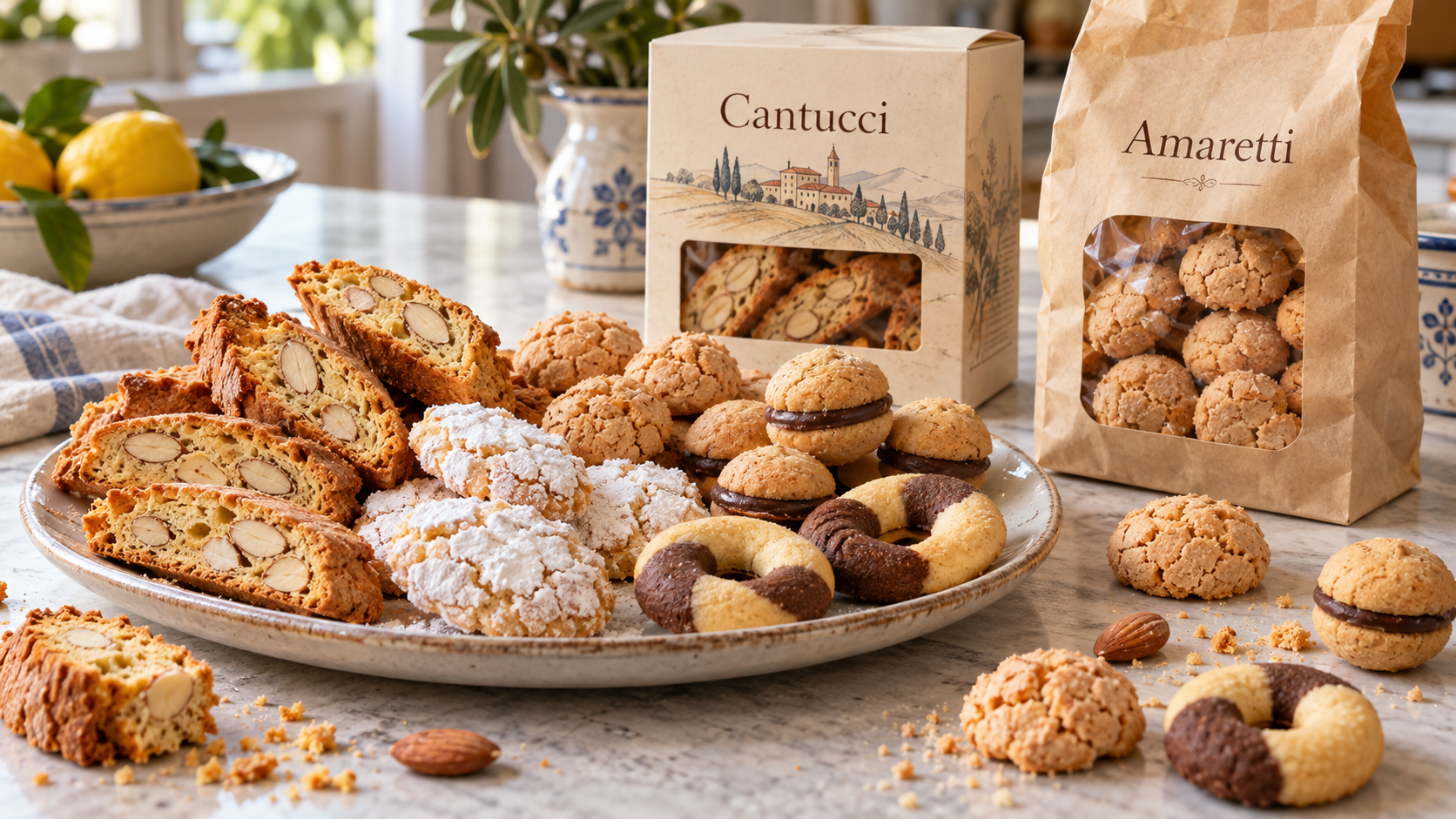
Cantucci, also commonly called cantuccini, are among Tuscany’s best-known sweets. Whole almonds give the sliced cookies their distinctive appearance and bite.
The second baking dries the slices and creates their firm texture. Recipes vary, so do not assume that every package has the same ingredients or sweetness.
The traditional accompaniment is vin santo, a Tuscan dessert wine, although coffee or tea makes an enjoyable alternative. Visit Tuscany describes both the double-baking method and the customary pairing with vin santo.
I would choose cantucci for someone who enjoys a crisp cookie with a hot drink. If you prefer tender pastries, ricciarelli or soft amaretti are a better starting point.
Search for cantucci on Amazon.com or Amazon.it.
Amaretti: Check Whether They Are Crisp or Soft
Amaretti have a distinctive almond-like aroma, but their texture and ingredients differ between recipes.
Crunchy amaretti break into light, crisp pieces. Soft amaretti have a more tender, chewy center. The package should indicate which style you are buying; photographs alone can be misleading.
Another useful correction concerns the ingredients. Amaretti are not universally made only with ground almonds. Chiostro di Saronno’s classic crunchy version, for example, lists sugar, apricot kernels and egg white, while some of its soft versions also contain almonds.
For a first purchase, I would select a package clearly labeled “crunchy” or “soft,” rather than an assortment whose contents are unclear.
Search for amaretti on Amazon.com or Amazon.it.
Ricciarelli: Soft Almond Pastries from Siena
Ricciarelli belong to Siena’s pastry tradition. Their pale, powdered-sugar exterior surrounds a soft almond center, making them quite different from hard cantucci.
They deserve their own description rather than being treated simply as a softer version of amaretti. Visit Tuscany identifies Ricciarelli di Siena IGP as a protected regional specialty with a rounded lozenge shape and an almond-based recipe.
I would choose these for an afternoon coffee tray or a gift for someone who enjoys almond pastries. When shopping, distinguish products carrying the Ricciarelli di Siena IGP designation from other cookies described more generally as ricciarelli.
Search for ricciarelli on Amazon.com or Amazon.it.
For more festive Italian sweets, see our guide to panettone, pandoro, panforte, torrone and ricciarelli.
Baci di Dama: Small Cookies with a Chocolate Center
Baci di dama are sandwich cookies made from two small rounded halves joined with chocolate. Recipes can use hazelnuts or almonds, so check the description if you have a preference.
Their appeal lies in the combination of a crumbly cookie and a chocolate filling. Chiostro di Saronno’s assortment, for example, includes hazelnut baci di dama alongside crunchy amaretti and almond cantuccini.
These would be my choice for a mixed cookie plate when I wanted something with chocolate rather than another almond-only sweet.
Search for baci di dama on Amazon.com or Amazon.it.
Everyday Italian Breakfast Cookies
Regional pastries are only one part of Italy’s cookie selection. Packaged breakfast biscuits offer a simpler option for the kitchen cupboard.
Mulino Bianco’s Abbracci combine cream-flavored and cocoa dough in a two-tone cookie. Macine are ring-shaped biscuits made with fresh cream. Both belong to the frollini family of shortbread-style cookies, rather than the twice-baked cantucci category.
Gentilini offers another recognizable selection. Its classic Osvego contain malt and honey, while classic Novellini are made with milk and honey. Other versions exist, so read the full product name before ordering.
For an everyday purchase, I would start with a modest package rather than a large imported multipack. That gives you a chance to decide whether you like the flavor and texture.
Search for Mulino Bianco cookies on Amazon.com or Amazon.it.
Search for Gentilini cookies on Amazon.com or Amazon.it.
If you are shopping during a trip, our guide to what to buy in an Italian supermarket offers more food ideas to bring home.
How to Choose Italian Cookies Online
Before ordering, check the country of manufacture, package weight, number of packs and seller details. An Italian name or an Italian flag in a listing does not establish where a product was made.
Compare the total cost, including shipping, with the amount of cookies you receive. A small imported box can cost considerably more per ounce than a larger package, while a multipack is only good value if you will use it.
Read the ingredient and allergen information for the exact product. Almond cookies are not automatically suitable for every gluten-free diet, and recipes within the same brand can differ.
For gifts, look for clear descriptions of the contents and protective packaging. An attractive tin is more useful when you know whether it contains crunchy biscuits, soft pastries or a mixture.
Baking and Serving Italian Cookies at Home
If you want to bake cantucci, follow a recipe written specifically for that style. The first bake cooks the logs; the second dries the cut slices. A soft almond pastry needs a different approach, so double baking is not a universal rule for Italian cookies.
Visit Tuscany provides recipes for both cantucci and ricciarelli. For a broader introduction to regional cooking, browse our Italian cookbook guide.
To assemble a varied cookie plate, I would combine crunchy cantucci, soft ricciarelli and chocolate-filled baci di dama. Serve small portions with coffee or tea, and keep the original packaging nearby when guests need to check ingredients.
That variety is what makes Italian cookies interesting: the pleasure comes from finding the texture and flavor you enjoy, rather than expecting every biscotto to taste alike.
External Sources
Treccani: The meaning and origin of biscotto
Visit Tuscany: Cantucci recipe
Visit Tuscany: Tuscany’s protected food specialties
Chiostro di Saronno: Italian pastry assortment and ingredients
Gentilini: Osvego and Novellini assortment
![Mulino Bianco:Assorted Biscuits * Total 61.72 Ounce (1750g) * Pack of 5 [ Italian Import ]](https://m.media-amazon.com/images/I/51NbC6MAkrL._SS520_.jpg)

![Mulino Bianco: "Tarallucci" Biscuits made with fresh eggs 12.3 Oz (350g) - Pack of 4 [ Italian Import ]](https://m.media-amazon.com/images/I/51sJEkgNcuL._SS520_.jpg)


![Mulino Bianco: "Macine" Shortbread cookies Cream - 12.3 Oz (350g) Pack of 3 [ Italian Import ] …](https://m.media-amazon.com/images/I/518asj4fevL._SS520_.jpg)
![Mulino Bianco: "Gran Cereale Classico" Cereals Cookies (Classic Taste), High in Fibers Biscuits 17.63 Ounces (500g) Packages (Pack of 3) [ Italian Import ]](https://m.media-amazon.com/images/I/51MBKgK+nGL._SS520_.jpg)
![Mulino Bianco: "Pan di Stelle" biscuit with cocoa , hazelnuts and many magical starlets of icing - 12.34 Oz (350g) Pack of 4 [ Italian Import ]](https://m.media-amazon.com/images/I/51m5fyqLl+L._SS520_.jpg)

![Mulino Bianco: "Gran Cereale Classico" ("Cereals Cookies", Classic Taste), High in Fibers Biscuits 17.63 Ounces (500g) Package (Pack of 4) [ Italian Import ]](https://m.media-amazon.com/images/I/51icn1LDS3L._SS520_.jpg)
![Mulino Bianco: "Galletti" shortbread with sugar granules - 12.3 Oz (350g) Pack of 4[ Italian Import ]](https://m.media-amazon.com/images/I/51EB3KDWBbL._SS520_.jpg)

![Mulino Bianco: "Campagnole" Shortbread cookies with cream of rice milk and rice flour - 24.69 Oz (700g) [ Italian Import ]](https://m.media-amazon.com/images/I/51NOth7sMML._SS520_.jpg)


![Mulino Bianco: "i Batticuori" shortbread with chocolate - 12.34 Oz (350g) Pack of 4 [ Italian Import ]](https://m.media-amazon.com/images/I/41kwae8hHjL._SS520_.jpg)
![Mulino Bianco: "Girotondi" shortbread with grains of sugar cane - 12.3 Oz (350g) Pack of 4 [ Italian Import ]](https://m.media-amazon.com/images/I/516kpbEcDvL._SS520_.jpg)
![Mulino Bianco: "Chicche" Shortcake filled with cocoa cream - 7.05 Oz (200g) Pack of 2 [ Italian Import ]](https://m.media-amazon.com/images/I/51AT1V-cZiL._SS520_.jpg)
![Mulino Bianco: "Cornetti alla Albicocca" 6 croissants with Apricot jam 10.58 Ounces (300g) - Pack of 2 [ Italian Import ]](https://m.media-amazon.com/images/I/51M-ExEstML._SS520_.jpg)
![Mulino Bianco: "Molinetti" Shortbread cookies with flour buckwheat and brown sugar - 28.21 Oz (800g) [ Italian Import ]](https://m.media-amazon.com/images/I/51apqxCTQ8L._SS520_.jpg)

![Mulino Bianco: "Ritornelli" shortbread with cocoa and almonds - 24.69 Oz (700g) Pack of 2 [ Italian Import ]](https://m.media-amazon.com/images/I/51P91qeT+fL._SS520_.jpg)