A gold bracelet can look like silk, stretch over the hand or fall around the wrist in a loose row of links. Seen in a photograph, all three might be described simply as “Italian gold.” Pick them up and the differences become much clearer. One goldsmith has worked on the way light crosses a surface, another on how a bracelet opens, a third on how two links sit together.
Five Italian cities offer five ways to look at a jewel. Milan gives us the distinctive handwriting of the design house. Florence brings us close to the goldsmith’s bench. Vicenza and Arezzo share a fascination with the chain, though their histories illuminate different aspects of making one. In Valenza, the most revealing detail may be the sliver of metal holding a stone in place.
Milan and the sheen of engraved gold
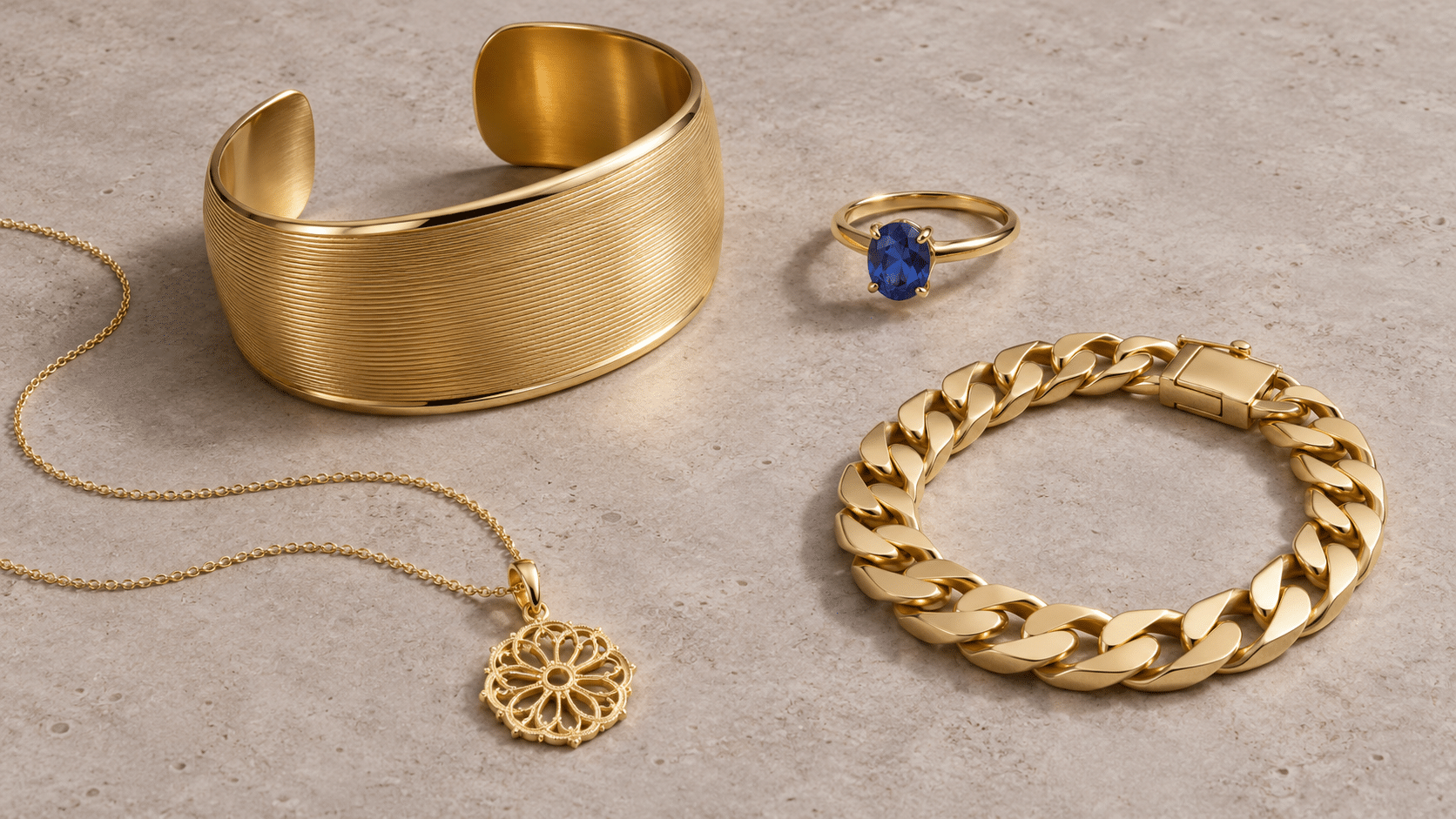
A broad expanse of gold presents a design problem. Polish it to a mirror finish and almost everything around it appears in the reflection. How do you give the gold a character of its own? One Milanese answer comes from Buccellati, founded in the city in 1919. Its rigato engraving takes its name from the fine parallel lines cut into the metal. Across the curved face of a cuff, those lines produce a sheen that recalls silk.
Look first at a photograph of the whole cuff, then enlarge a detail. From a distance the engraved area reads as a single band of soft colour. Up close you can follow the direction of the tool. A polished border catches a brighter line of light, making the difference between the two finishes visible even when both are the same colour.
Buccellati offers one way into Milan’s design culture. A technique available to other goldsmiths becomes so closely associated with a house that a collector can recognise its work across different shapes. For someone encountering Milanese jewellery through fashion, that is a familiar idea. A surface can be as distinctive as the cut of a jacket.
Florence and the goldsmith’s bench
On Florence’s Ponte Vecchio, jewellery fills the shop windows. To understand how an object takes shape, follow the trade beyond the bridge. The city’s artisan itineraries lead into the Oltrarno, on the left bank of the Arno, while the Penko family workshop on Via delle Oche offers another point of reference near the Duomo.
Florentine goldsmith Paolo Penko draws on details that a visitor can also find by looking up at the buildings around him. A curling volute or a repeating frieze changes character when reduced to the scale of a pendant. Two of the workshop’s techniques help explain how. In incisione a bulino, the sharp tip of a graver cuts a line into the metal. In traforo, the maker pierces and saws through the sheet. One line catches light within the gold. The other lets you see through to the skin or cloth beneath it.
If you are choosing a pierced jewel, hold it against two backgrounds. A pendant that appears intricate against black may look much quieter against bare skin. Then turn it over. Seeing where the openings emerge on the reverse makes the work easier to understand than looking at a shop-window display alone.
Vicenza and the bracelet that moves
A chain solves a small mechanical problem many times over. Each link must hold the next one securely while leaving it room to turn. Goldsmiths in Vicenza have been exploring the design possibilities for generations. The city’s Museo del Gioiello points to an early twentieth-century catalogue of Vicentine firms that already showed a striking variety of chains. Changing the profile of a link could change the appearance of an entire necklace.
For a contemporary example, consider FOPE, which traces its Vicenza history to 1929. Its Flex’it bracelets bring elasticity to 18-carat gold jewellery. A bracelet with the substantial look of a gold mesh can expand to pass over the hand, then settle around the wrist. The pleasure of the design is easiest to appreciate in the act of putting it on.
When comparing bracelets, try fastening each one yourself. Rest your wrist on a table, then turn your palm upward. You will learn whether a flat link tends to turn on edge, whether the clasp settles comfortably, and how much freedom you prefer. Those are design qualities a still photograph can barely suggest.
Valenza and the art of setting a stone
In Valenza, in Piedmont, look just beyond the gemstone. An incassatore, or stone setter, prepares the seat where a gem will rest and secures it in its mount. The work affects how much of the stone you see, how high it sits above the finger and how the ring feels against the next finger.
Compare a solitaire held by narrow claws with a stone enclosed by a continuous metal rim, known as a bezel. The claws interrupt the outline at a few distinct points. The bezel draws a second outline around the stone, almost like the frame around a miniature. In a pavé ring the challenge changes again. Many small stones must sit together convincingly, so that the eye can follow a field of light across a curved band.
Valenza’s identity comes into focus through the people trained to make those decisions. Scuola Bulgari, inside the company’s Valenza manufacturing site, teaches stone setting as a dedicated course. Local specialists such as the Orsini Group also work in gem setting and microsetting. A label on a finished jewel may give you the designer’s name. Looking at the mount gives you a glimpse of a second profession behind it.
Arezzo and the making of the everyday gold chain
In Arezzo, start with the most familiar piece in the jewellery box. Lay a plain chain on a table and examine ten consecutive links. A slight variation in wire thickness or the angle of a join would interrupt the rhythm. The achievement is particularly easy to overlook when the necklace is simple enough to wear every day.
The history of UNOAERRE puts a date and two names to the growth of modern jewellery manufacturing here. Carlo Zucchi and Leopoldo Gori founded their company in Arezzo in 1926. In 1934 it received the registered mark 1AR. Read those characters aloud in Italian, uno, a, erre, and you have the name by which the firm became known. Its goldsmithing museum in Arezzo gives the manufacturing side of jewellery a place in the city’s cultural history.
To see what a chain designer can do with a repeated unit, compare an elongated open link with a closely spaced curb link. Open spaces give the first chain a bold outline even when the wire is slender. In the second, the twisted links settle into a flatter ribbon. For a pendant, there is one more practical detail. Check that the chain’s end fitting will pass through the pendant loop. The chain itself can be slim enough while its fitting is a fraction too wide.
Shopping with a goldsmith’s eye
Start with the detail that drew you to the piece. If it was the soft glow of a cuff, ask how the surface was finished. If it was the size of a chain, ask whether its links are solid or hollow and how much the necklace weighs. If it was the colour of a ring, look at the metal around the gem as well as the stone itself. And if a regional connection matters to you, ask who made the piece and where. A shop address tells you where you found it. A maker’s account can tell you how it came into being.
For wearable examples at a range of prices, Italia Mia’s affordable Italian jewellery guide pairs designer accessories with Murano glass. The distinction between material and finish matters especially when shopping online. “Gold-tone brass” describes a brass piece with a golden appearance. “18-carat gold” describes the metal alloy itself.
Italia Mia may earn a commission from purchases made through the following link, at no extra cost to you.
Browse women’s designer jewellery on Italist to compare how contemporary labels use scale, colour and surface. Open the materials description alongside the photograph. Two earrings with a similar golden finish can be made from quite different materials.
External Links
- Richemont — Buccellati’s Milanese history, annual report (PDF)
- FeelFlorence — The Penko family goldsmith workshop
- Museo del Gioiello, Vicenza — The chain in jewellery design
- FOPE — Gold jewellery made in Vicenza
- Scuola Bulgari — Stone setting in Valenza
- UNOAERRE — The origins of the Arezzo maker’s mark
- UNOAERRE — The goldsmithing museum in Arezzo