
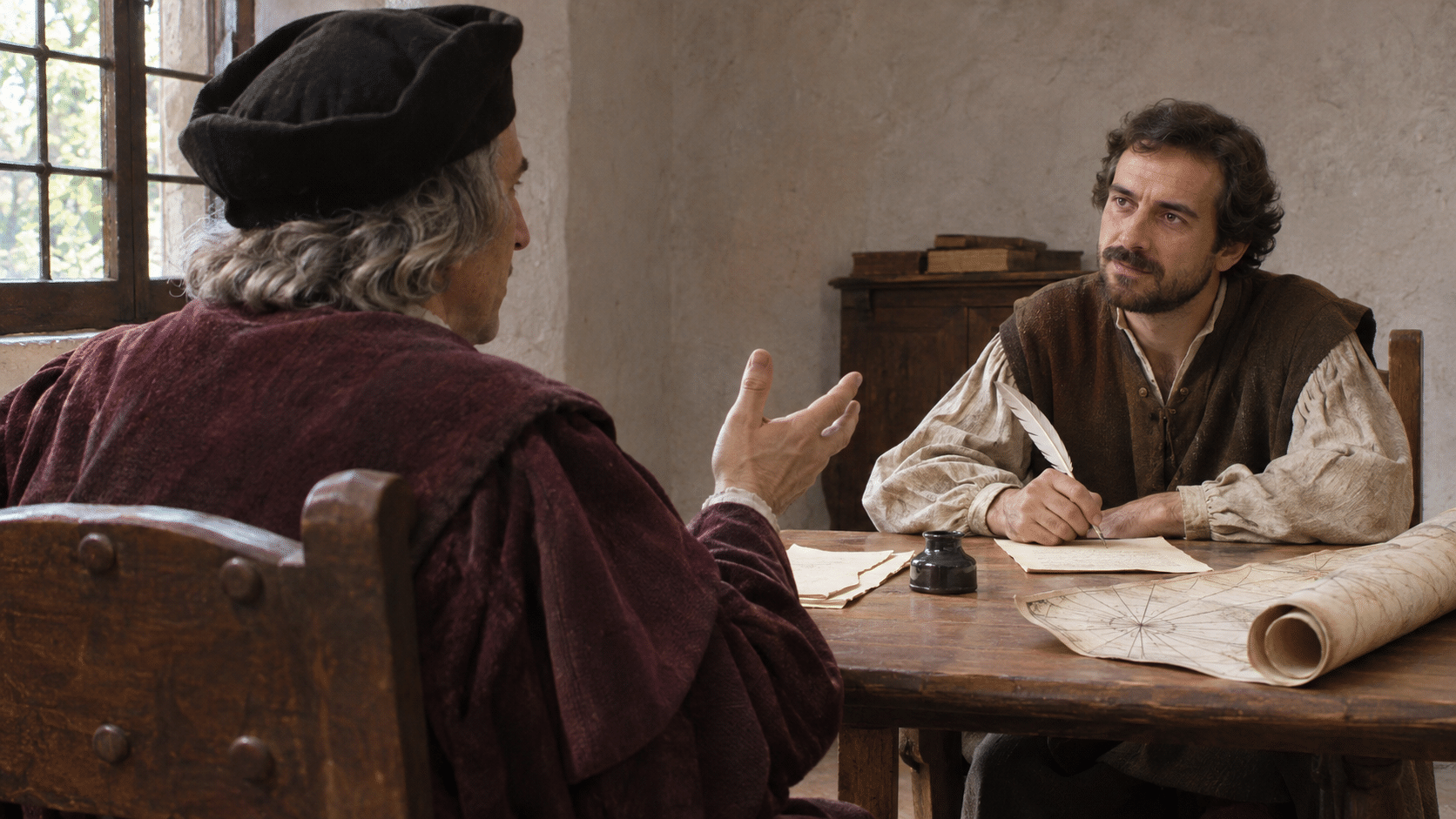
This is an imagined interview, not a historical transcript. Every answer attributed to Columbus is fictional dialogue informed by historical sources, not a quotation or translation. The conversation imagines him looking back near the end of his life. Historical notes distinguish documented events from interpretation and include perspectives his surviving accounts cannot adequately represent.
What would you ask Christopher Columbus if you could sit across a table from him? Whether he was frightened? Why he kept sailing? Or why he believed reaching an inhabited island gave him the right to claim it?
This imagined interview with Christopher Columbus begins with ambition and ends with responsibility. Between those points lies a difficult history: an accomplished navigator pursuing a mistaken geographical idea, a royal enterprise becoming a colonial project, and Caribbean peoples confronting newcomers who wanted far more than directions.
The questions are modern. The reconstructed answers attempt to reflect his outlook without giving him knowledge of later centuries—or inventing a convenient confession.
Before the Atlantic: A Young Man from Genoa
Interviewer: Before you became an admiral, what did you imagine your life would be?
Columbus: A life with more possibilities than those immediately before me. A port teaches you that your own street is not the whole world. Ships arrive carrying goods, news and men who have seen places you know only by name. For someone willing to leave, the sea offers a different measure of distance—and of opportunity.
Interviewer: Should we think of you as an Italian explorer?
Columbus: Think first of a Genoese who sought opportunities beyond Genoa. My enterprise needed a sovereign willing to support it. The ships with which I crossed the ocean sailed under the authority of the Spanish monarchs.
Historical note: The established historical account places Columbus’s birth in Genoa in 1451. Calling him Italian is understandable as geographical shorthand, but there was no unified Italian state. His world was the divided peninsula described in our guide to Renaissance Italy: Power, Society and the Making of a New Age.
The Idea—and the Miscalculation
Interviewer: You did not have to prove that the Earth was round. What, then, were you trying to prove?
Columbus: That the eastern lands could be reached by sailing west across the Ocean Sea, and that the crossing was within our capacity. The question was whether a ship could make the passage, carry sufficient provisions and return with something that justified the expense.
Interviewer: But your estimate of the distance was wrong.
Columbus: I judged the distance from the authorities and calculations I trusted. A voyage begins with an argument about what lies beyond sight. I believed mine strongly enough to ask others to commit ships and money to it.
Historical note: Educated Europeans already knew the Earth was spherical. The central problem was distance: Columbus underestimated the westward voyage to Asia. His plan combined mistaken assumptions about the Earth’s size and Asia’s eastward extent. The Americas were not the intended destination; their presence fundamentally changed what his voyage could achieve.
Finding Someone to Pay
Interviewer: Why was it so difficult to secure support?
Columbus: Confidence costs the man who speaks it very little. Ships cost much more. Those I approached had advisers, competing projects and reasons to doubt me. I had to convince them that a western route could bring advantages worth the uncertainty.
Interviewer: Were you seeking a trade route, a fortune or a place in history?
Columbus: Why should those desires be separate? A successful enterprise would serve the sovereigns and reward the man who proposed it. I wanted authority appropriate to the undertaking, and rights that my sons could inherit.
Historical note: After failing to secure Portuguese backing, Columbus eventually obtained support from Isabella of Castile and Ferdinand of Aragon. His agreements included the title Admiral of the Ocean Sea, governing privileges and a share of specified revenues. These were substantial personal ambitions alongside commercial and religious objectives. His later Book of Privileges preserved documents supporting those claims.
Crossing Without Knowing What Lay Ahead
Interviewer: What does a captain tell men who cannot see an end to the voyage?
Columbus: He gives them work, a course and reasons to continue. Every change becomes something to examine: the wind, the sea, birds overhead. But the same sign can encourage one man and trouble another. A captain must make decisions before certainty arrives.
Interviewer: Were you ever afraid?
Columbus: Fear would not have made a decision for me. Turning back also carried consequences. Men had entrusted themselves to the voyage, and I had made promises to those who sent us. There was no course free of risk.
Historical note: The Niña, Pinta and Santa María left Palos on August 3, 1492, before continuing via the Canary Islands. The expedition reached the Bahamas on October 12. Accounts describe mounting anxiety, but familiar dramatic versions of a fully organized mutiny should not be repeated as unquestioned fact. Nor can this imagined dialogue establish Columbus’s private emotions.
Arrival: A Meeting in Someone Else’s Homeland
Interviewer: What did you see when you arrived?
Columbus: People approaching us, an unfamiliar shore, and the first opportunity to learn where we were. I needed information: the names of islands, the direction of other lands and where gold might be found. Without a shared language, signs had to carry more meaning than they could reliably bear.
Interviewer: Did you understand the people you met?
Columbus: I could observe what they brought and how they responded. Understanding their words and intentions was another matter. We were trying to learn a country through encounters in which even a simple exchange could be misunderstood.
Historical note: The first landfall was on an island its inhabitants called Guanahani, renamed San Salvador by Columbus. Its precise modern identification remains debated. The Lucayan people of the Bahamas belonged to the wider Taíno cultural world. They were encountering Europeans in their own homeland, not waiting for someone to give their island a place in history.
Caribbean communities had agriculture, political leadership, religious traditions and maritime connections. European accounts are evidence about these encounters, but they are also shaped by European expectations. Indigenous people’s actions cannot be reduced to the meanings Columbus assigned them.
Gold, Conversion and Taking Possession
Interviewer: What gave you the right to claim inhabited land?
Columbus: I sailed with royal authority and understood my actions as service to Christian sovereigns. Taking possession declared whose enterprise had reached those shores and under whose authority further settlement would proceed.
Interviewer: That explains your claim. It does not establish the consent of the people living there.
Columbus: Their consent was not the basis on which I understood the commission entrusted to me. I approached those lands through the obligations and authority I believed I carried.
Historical note: This reconstructed answer illustrates an imperial assumption; it does not justify it. European royal grants and papal documents asserted rights over territories without Indigenous agreement. Religious purpose, political control and economic gain could reinforce one another. Describing the enterprise only as exploration leaves out what taking possession meant for those already there.
From Explorer to Governor: Coercion and Enslavement
Interviewer: What happens when the wealth promised to your supporters is difficult to obtain?
Columbus: Expectations do not disappear. Settlers require provisions, the sovereigns expect results, and disagreements become challenges to authority. Those who arrived expecting profit do not become patient simply because the country does not yield what they imagined.
Interviewer: Indigenous people were enslaved and forced to provide wealth. How can an account of your enterprise leave that out?
Columbusr: My own account would speak of government, rebellion, service and the demands of maintaining the settlement. Those were the terms through which I defended my authority and my decisions.
Interviewer: Yet those terms conceal what coercion meant to the people subjected to it.
Historical note: Here the documentary record matters more than an invented response. Columbus’s colonial rule included the enslavement of Indigenous people and demands for tribute. Captives were shipped to Spain. These were actions within his enterprise, not simply developments belonging to a distant later period.
Colonization devastated Caribbean societies through violence, exploitation, disruption of food production and introduced diseases. The timing and effects differed between places, and estimates of pre-contact populations remain disputed. It would be misleading both to assign every subsequent atrocity personally to Columbus and to remove his own responsibility from the story.
Arrest and the Final Voyage
Interviewer: You crossed the Atlantic as an admiral and later returned in chains. What had changed?
Columbus: My authority was challenged, complaints reached the court, and others judged how I had governed. I considered my service and privileges insufficiently respected. What I had undertaken for the Crown remained central to my defense.
Interviewer: Why go back to sea?
Columbus: Because the enterprise was unfinished. A passage still had to be found. The sea offered a task I could pursue even when the authority I had claimed on land was no longer mine to exercise.
Historical note: Francisco de Bobadilla arrested Columbus in Hispaniola in 1500 and sent him to Spain in chains. He was subsequently released, but his governorship was not restored. His fourth and final transatlantic voyage, in 1502–1504, explored stretches of the Central American coast while seeking a passage onward. He died in Valladolid in 1506.
Did You Understand Where You Had Been?
Interviewer: Did finding unfamiliar lands make you abandon your original geographical expectations?
Columbus: An unfamiliar coast does not immediately tell you how the whole world is arranged. I continued looking for connections between what I encountered and the lands I expected to reach. Every voyage supplied more observations, but it did not remove every uncertainty.
Interviewer: What would you want remembered?
Columbusr: That I persuaded others to undertake a crossing they doubted, completed it, and returned across the ocean again. That the promises made to me should be considered alongside the service I believed I had given.
Historical note: Columbus continued interpreting his discoveries within an Asian geographical framework. He did not arrive at the modern understanding of the Americas as continents separating Europe from Asia across two oceans. The consequences of his voyages exceeded—and contradicted—his intentions.
The Legacy He Could Not Foresee
The imagined interview ends here. Columbus cannot answer for centuries he never lived to see, and a fictional conversation should not give him that knowledge.
His voyages helped establish sustained connections across the Atlantic. Those connections brought movements of people, crops, animals and ideas, alongside conquest, enslavement and catastrophic losses for Indigenous societies. Calling him the discoverer of America makes the people already living there disappear from the sentence.
Yet disappearance is also the wrong ending for Taíno history. Despite the devastation of colonization, Indigenous ancestry, practices and identities survived in the Caribbean. Contemporary Taíno communities and cultural movements challenge the once-common claim of complete extinction.
For many Italian Americans, Columbus later became a symbol of belonging and public recognition. That history of identity deserves examination in its own right, but it does not settle the historical questions about his conduct. A community’s attachment to a symbol and the experiences of people harmed by the figure behind it are different kinds of evidence.
An honest interview would therefore leave a final question for the reader: whose account have we heard, and whose account still needs room?
Read More About Columbus and the Atlantic World
Affiliate disclosure: As an Amazon Associate, Italia Mia earns from qualifying purchases. The links below lead to Amazon book searches; check the edition, language and format before ordering.
Columbus — Felipe Fernández-Armesto
A historical biography for readers who want to move beyond the heroic outline and examine Columbus within the world that shaped him. A useful companion to the questions about ambition, reputation and evidence raised here.
Find Columbus by Felipe Fernández-Armesto on Amazon
The Four Voyages — Christopher Columbus, edited and translated by J. M. Cohen
This Penguin Classics collection brings together accounts connected with the voyages. Read it as a collection of historical testimony requiring interpretation, rather than as a neutral description of Indigenous societies or an unmediated record of every event.
Find The Four Voyages on Amazon
The Tainos: Rise and Decline of the People Who Greeted Columbus — Irving Rouse
An archaeological and historical study that shifts attention toward the Caribbean peoples Columbus encountered. Published in the early 1990s, it should be read alongside newer work on Indigenous survival: its older framing of disappearance does not adequately represent contemporary Taíno identity.
Find The Tainos by Irving Rouse on Amazon
External Links
- Library of Congress: Christopher Columbus—Man and Myth
- Library of Congress: Columbus and the Taíno
- NASA educational archive: The Round Earth and Christopher Columbus
- Florida Museum: Christopher Columbus
- Smithsonian Magazine: Who Were the Taíno?
- Smithsonian: Caribbean Indigenous Resistance—¡Taíno Vive!
- HISTORY: Christopher Columbus’s Legend and Italian American Identity