
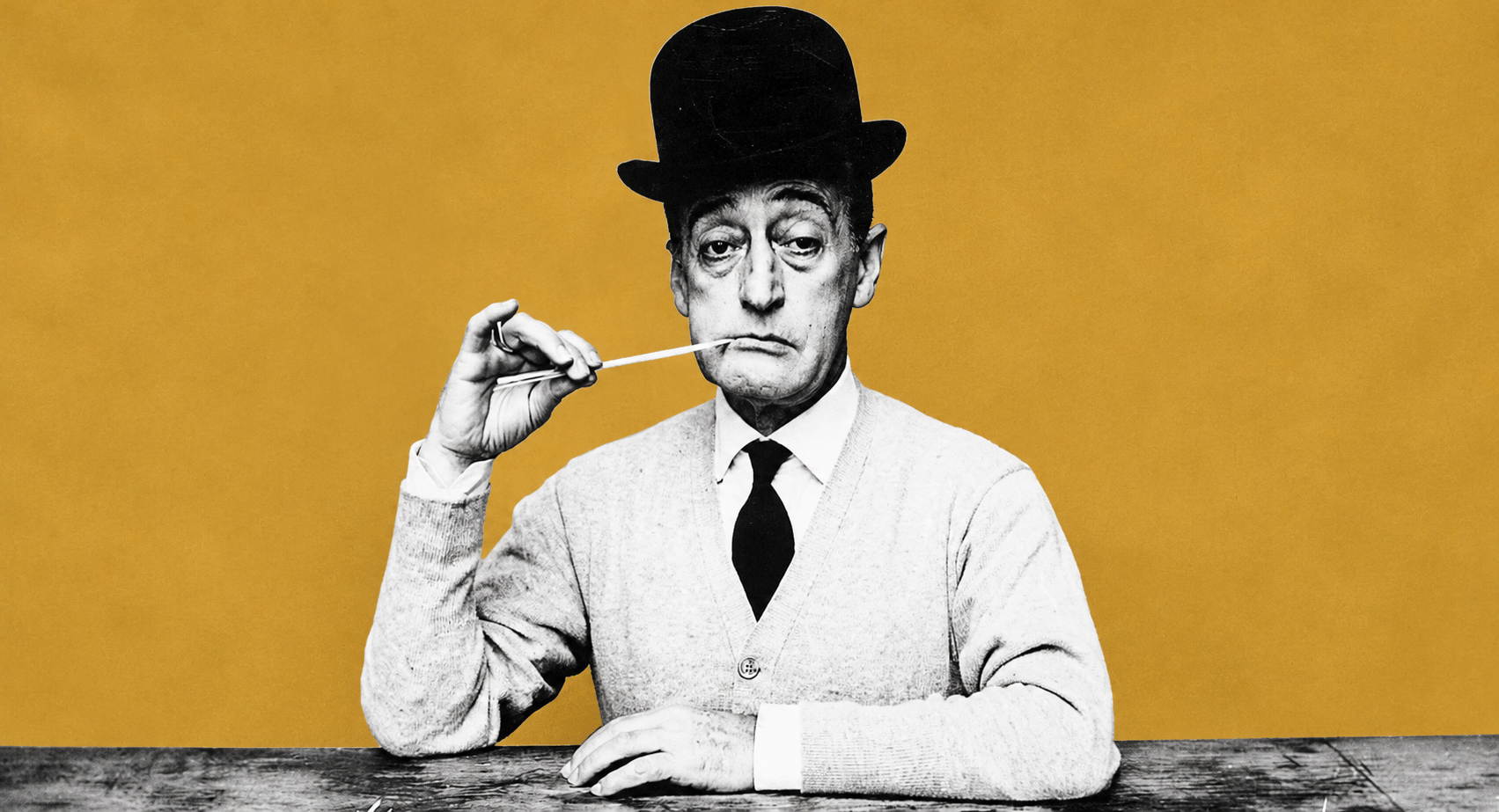
A raised eyebrow, an impossible bend of the neck, a sentence that begins with confidence and ends in glorious confusion: Totò could turn the smallest gesture into an event. His comedy gave frustration a voice and pretension a thoroughly uncomfortable afternoon.
Yet the actor known as the Prince of Laughter also wrote poems about mortality and songs about wounded love. To discover Totò is to encounter several artists at once: a stage performer, a film comedian, a poet and a songwriter whose connection to Naples ran through his language and imagination.
For readers exploring the personalities behind Italian culture, he is an essential figure in Italia Mia’s collection of Italian biographies.
Totò at a Glance
| Detail | Information |
|---|---|
| Name commonly used offstage | Antonio de Curtis |
| Born | February 15, 1898, Naples |
| Died | April 15, 1967, Rome, aged 69 |
| Neapolitan roots | Rione Sanità |
| Principal activities | Actor, comedian, poet and songwriter |
| Film debut | Fermo con le mani! (1937) |
| Essential films | Guardie e ladri; Totò, Peppino e la… malafemmina; I soliti ignoti; Uccellacci e uccellini |
| Best-known poem | ’A livella |
| Best-known song | Malafemmena (1951) |
Growing Up in Naples
Totò was born in the Rione Sanità, a densely inhabited district of Naples. His mother, Anna Clemente, and grandmother raised him in difficult circumstances. He was initially registered with his mother’s surname; Antonio de Curtis became the name by which he was known beyond his stage identity.
His early education was limited, but his interest in performance appeared young. The comic Gustavo De Marco, celebrated for his extraordinary physical flexibility, became an important influence.
Naples supplied more than a birthplace. Its theatrical culture offered a world of imitation, comic types, songs and exchanges with an audience. Totò’s later work makes particular sense when understood as performance built around a living response: a pause held until laughter arrives, a repetition that becomes funnier through insistence, a gesture that contradicts the words being spoken.
The Stage Before the Screen
Totò developed his career through variety entertainment and revue, working in Naples and Rome before becoming a major theatrical attraction. These forms combined sketches, music and comic routines; they rewarded an actor who could establish a character immediately.
His distinctive costume, including a battered bowler and ill-fitting formal clothes, made dignity look precarious before he said a word. During the war years, his stage collaborations included Anna Magnani and the writer Michele Galdieri.
The theatrical background is useful preparation for watching his films. A scene may briefly become a performance within the story, with its own rhythm and escalating absurdity. Watch the hands, the stance and the moment he decides to look at his partner. The joke often starts there.
Becoming a Film Star
His screen debut came in Fermo con le mani! in 1937. The major expansion of his film career followed the war, with I due orfanelli in 1947 and a succession of popular comedies.
The films varied in ambition and quality, but Totò gave audiences a personality they wanted to encounter again. Some roles allowed exuberant nonsense; others made room for weariness, embarrassment or compassion. His career belongs to the wider history of Italian cinema, while retaining the rhythms of an older entertainment world.
For a first viewing, it helps to choose films that show different aspects of his work.
Totò Films: Where to Begin
Guardie e ladri (1951)
Directed by Steno and Mario Monicelli, Guardie e ladri pairs Totò with Aldo Fabrizi as a thief and a policeman. The pursuit brings their circumstances into contact, allowing comedy to develop into a story about ordinary pressures and mutual recognition.
It is a strong introduction for viewers who want character and emotion alongside comic performance. Notice how neither actor needs to make his character entirely admirable to make him understandable.
Totò a colori (1952)
Steno’s Totò a colori offers an especially vivid encounter with the performer’s physical and verbal invention. It includes the famous sleeping-car routine, in which proximity to a self-important fellow passenger becomes a source of mounting disruption.
Watch how insistence changes a scene: a gesture repeated once is an irritation; repeated with perfect timing, it becomes an attack on the other person’s composure.
Totò, Peppino e la… malafemmina (1956)
Camillo Mastrocinque’s comedy brings Totò together with Peppino De Filippo as two uncles alarmed by their nephew’s relationship with a variety performer. Their attempt to intervene produces some of the partnership’s most celebrated exchanges.
The letter-writing scene is the ideal introduction to their chemistry. Dictation and transcription become a collaborative disaster, with each participant apparently convinced that the real problem is the other man.
Peppino is essential to the effect. His hesitations and objections give Totò’s certainty something to collide with. Watch both faces, including the one belonging to the actor who is listening.
I soliti ignoti (1958)
Mario Monicelli’s I soliti ignoti, widely known in English as Big Deal on Madonna Street, gives Totò a supporting role as a safecracking expert advising a group of would-be thieves.
This is an ensemble film rather than a Totò vehicle. His appearance is a lesson in concentrated comic authority: the apparent professional explains a craft to men whose confidence exceeds their competence.
Uccellacci e uccellini (1966)
Pier Paolo Pasolini places Totò alongside Ninetto Davoli in a wandering, philosophical fable, known in English as The Hawks and the Sparrows. The film moves through questions of belief, politics and human behavior with a deliberately unusual mixture of comedy and reflection.
Totò received a special mention at Cannes in 1966 for the performance. Viewers should approach the film expecting a different rhythm from his popular farces. Its pleasure lies partly in seeing a familiar comic presence placed in an unfamiliar world.
Selected Filmography
This selection offers a route through his career, rather than a complete list of appearances.
| Year | Film | Director |
|---|---|---|
| 1937 | Fermo con le mani! | Gero Zambuto |
| 1947 | I due orfanelli | Mario Mattoli |
| 1949 | Totò cerca casa | Steno and Mario Monicelli |
| 1951 | Guardie e ladri | Steno and Mario Monicelli |
| 1952 | Totò a colori | Steno |
| 1954 | L’oro di Napoli | Vittorio De Sica |
| 1956 | Totò, Peppino e la… malafemmina | Camillo Mastrocinque |
| 1958 | I soliti ignoti | Mario Monicelli |
| 1960 | Risate di gioia | Mario Monicelli |
| 1961 | Totòtruffa ’62 | Camillo Mastrocinque |
| 1966 | Uccellacci e uccellini | Pier Paolo Pasolini |
The “’62” in Totòtruffa ’62 is part of the title: the film was released in 1961.
Totò the Poet: ’A livella
Totò’s poetry deserves a place beside his films. His collection ’A livella appeared in 1964, although the title poem was already being performed earlier: Rai preserves a television recording from 1963.
The poem imagines an encounter in a cemetery between a nobleman and a poorer man. Social superiority persists in the nobleman’s attitude, even after death has made the distinction meaningless. The title refers to a spirit level, the tool that establishes an even plane.
Its argument is direct, but the delivery matters. These are voices in conflict, with pride, impatience and comic timing carrying the reflection. Listening to Totò recite it reveals how closely his writing is connected to performance.
For readers who do not speak Neapolitan, a translation can clarify the situation. Hearing the original alongside it preserves something a translation cannot fully supply: the movement of the voices and the change from storytelling to confrontation.
The Rai Teche recording of Totò reciting “’A livella” makes an excellent companion to the films.
Malafemmena and His Life as a Songwriter
Totò composed Malafemmena in 1951. Its wounded emotional register can surprise anyone who knows him only through comedy. The song turns on the tension between attachment and resentment, making pain audible without resolving it.
The Italian cultural portal Internet Culturale connects its creation with his separation from Diana Rogliani. It also documents other compositions, including songs dedicated to Franca Faldini, his later companion.
His songwriting reached beyond this single standard. Con te, another composition, competed at the 1954 Sanremo festival and finished fourth. These works give listeners another way into his artistic life: through melody and vulnerability as well as laughter.
Antonio de Curtis Away from the Camera
Totò’s daughter Liliana was born in 1933 from his relationship with Diana Rogliani. Franca Faldini became his companion in the 1950s and remained with him until his death.
Accounts of his private life also emphasize his attachment to animals, particularly dogs. The Museo di Roma in Trastevere’s retrospective explored this aspect through personal photographs and documents.
There was a carefully cultivated distinction between Antonio de Curtis and Totò. A 1963 television interview playfully dramatized it by treating the reserved gentleman and the comic persona as separate people. That distinction invites a useful question when watching any great performer: how much of the apparent spontaneity is the result of deliberate craft?
His Final Years and Neapolitan Legacy
Severe problems with his eyesight complicated his later working life, but he continued acting. He died in Rome on April 15, 1967. The public farewell in Naples expressed the extraordinary affection surrounding him.
His Neapolitan identity is best approached through the work itself. Hear the language of the poems, watch the exchanges between characters and notice how often dignity becomes something negotiated in conversation. The city is present in those habits of expression as much as in a location or skyline.
For another perspective on the range of Italian comic acting, read about Monica Vitti’s journey from Antonioni’s films to popular comedy.
Totò rewards attention at every scale: the whole film, the individual scene, the fraction of a second before a reply. Begin with Guardie e ladri, follow it with Totò, Peppino e la… malafemmina, then listen to ’A livella. Together, they reveal an artist who understood how close laughter can stand to wounded pride and human vulnerability.
External Links
- Treccani: Totò — Enciclopedia del Cinema
- Treccani: Antonio de Curtis — Dizionario Biografico degli Italiani
- Rai Teche: Totò recites ’A livella
- RaiPlay: Totò, Peppino e… la malafemmina
- Festival de Cannes: Totò
- Internet Culturale: Totò and music
- Museo di Roma in Trastevere: Totò retrospective
- Cinematografo: Totò filmography