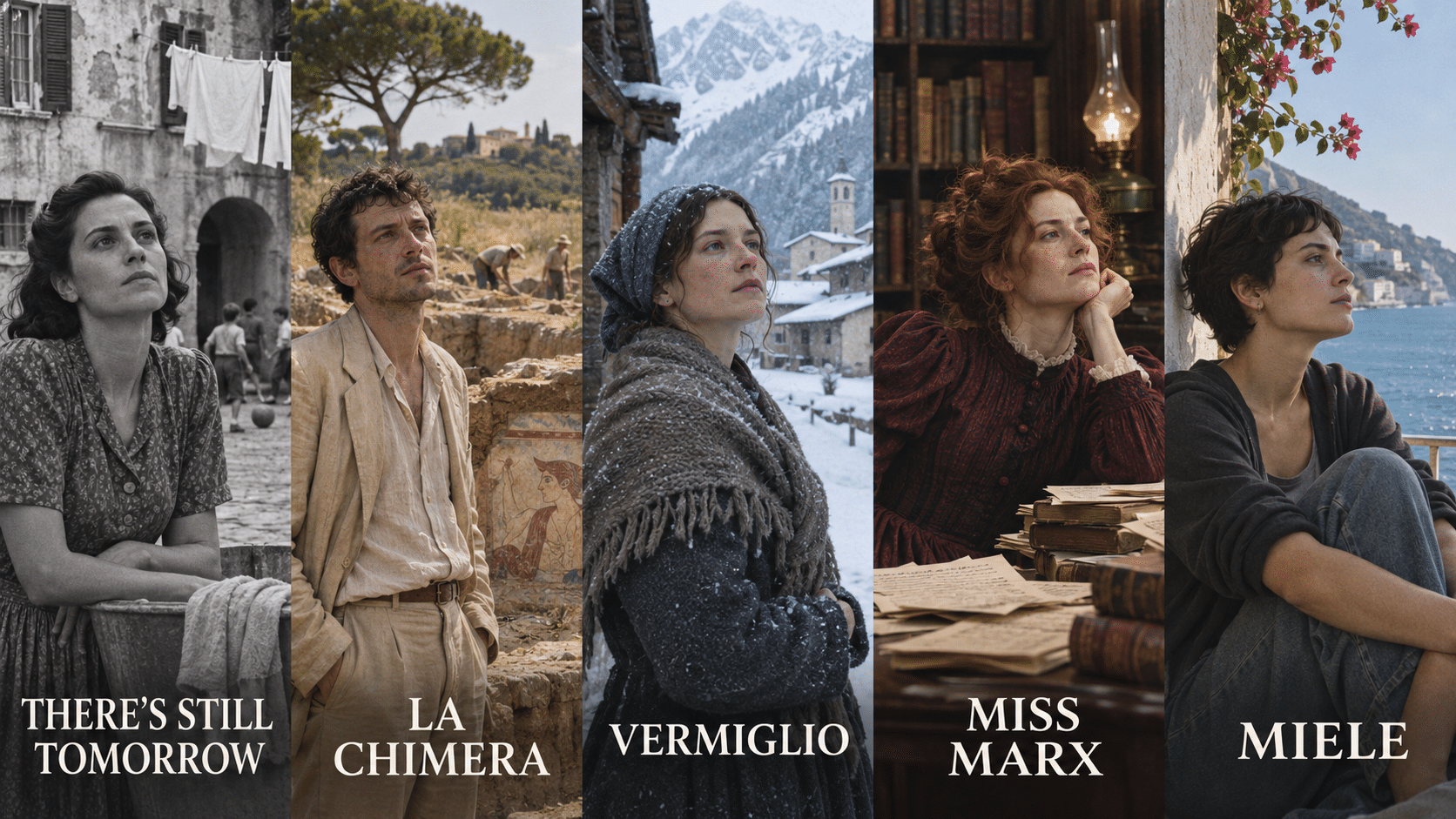
 Women directors are giving contemporary Italian cinema some of its most distinctive voices. Their films move between popular entertainment, historical biography, moral drama and stories in which the everyday opens onto something mysterious.
Five films offer a rewarding introduction: Paola Cortellesi’s There’s Still Tomorrow, Alice Rohrwacher’s La chimera, Maura Delpero’s Vermiglio, Susanna Nicchiarelli’s Miss Marx and Valeria Golino’s Miele. Each suggests a different answer to a basic question: what can a film help us see that we might otherwise overlook?
Our Rome Film Fest 2026 highlights and viewing recommendations follow discoveries emerging from the festival circuit. This guide takes a longer view, introducing five filmmakers through a single work apiece.
These are starting points rather than a ranking. Plot descriptions stay with the premises and leave the endings undisclosed.
Five Films at a Glance
| Film | Director | Year | Choose it for |
|---|---|---|---|
| There’s Still Tomorrow / C’è ancora domani | Paola Cortellesi | 2023 | Family drama, humor and social history |
| La chimera | Alice Rohrwacher | 2023 | Archaeology, longing and mystery |
| Vermiglio | Maura Delpero | 2024 | Patient observation of an Alpine family |
| Miss Marx | Susanna Nicchiarelli | 2020 | Political biography with an unconventional musical pulse |
| Miele / Honey | Valeria Golino | 2013 | Intimate drama and difficult ethical questions |
1. Paola Cortellesi: There’s Still Tomorrow
Start here if you want a compelling story with a clear emotional connection.
Paola Cortellesi directs and stars as Delia, a wife and mother in postwar Rome. Delia works to sustain her household while living under her husband’s control. Her daughter’s engagement seems to promise a more comfortable future for the next generation; a mysterious letter introduces another possibility.
The black-and-white photography recalls an earlier Italian screen tradition, but the film also uses humor and deliberately stylized sequences. That combination makes it an interesting introduction for viewers who might hesitate over a historical drama. Wildside
Watch how the story gives importance to ordinary labor. Money, errands, domestic responsibilities and conversations between women all help establish the limits of Delia’s freedom. The question of change grows from those practical details.
Cortellesi also offers a useful route from acting to directing: she places herself at the center of the story while shaping how we interpret the world around her character. The relationships between mother, daughter and friend give viewers several perspectives on Delia’s life.
What to notice: The relationship between the film’s period setting and its shifts in music and visual style.
Content note: Domestic violence and emotional abuse.
For the story, cast, awards and viewing information, continue with our individual guide to There’s Still Tomorrow and Paola Cortellesi’s directing debut.
2. Alice Rohrwacher: La chimera
Start here if you enjoy films that leave room for mystery.
In La chimera, an Englishman named Arthur becomes involved with tomb robbers searching for ancient Etruscan objects. For his companions, an archaeological discovery can mean money. Arthur’s search is entangled with the memory of Beniamina, the woman he has lost.
The premise combines an illicit adventure with a story of grief. It also makes the past materially present: objects buried underground can become commodities, while the lives and beliefs attached to them are harder to recover. Festival de Cannes
Rohrwacher places Arthur’s private longing beside the group’s more practical ambitions, creating a tension between the value of an object and the meaning someone gives it.
Approach the film with curiosity about its changes of tone. Its story moves among companionship, solitude and encounters with the ancient world. A scene can invite us to follow the adventure while also questioning the desire that drives it.
What to notice: The difference between possessing a remnant of the past and understanding it.
Choose this when: You are interested in atmosphere, memory and ambiguity.
Rohrwacher’s place within a wider range of filmmakers is explored in our history of Italian cinema from 2000 to today.
3. Maura Delpero: Vermiglio
Start here if you enjoy quiet films about families and the places that shape them.
Set in an Alpine village during the final year of the Second World War, Vermiglio follows a large family whose life changes after a soldier arrives seeking refuge. His relationship with the eldest daughter, Lucia, draws distant events into the household.
Delpero builds the story across the seasons. The mountain setting gives family life a physical framework: weather, work, shared rooms and established customs influence what people can imagine for themselves. Vermiglio
The film won the Silver Lion Grand Jury Prize at the 2024 Venice Film Festival. Its starting point is also personal: Delpero connects the project with her father’s childhood and the experiences of people who lived through the war away from its battlefields. Vermiglio
That perspective makes Vermiglio a rewarding companion to There’s Still Tomorrow. Both approach history through domestic life, while offering very different settings and rhythms.
What to notice: How the same family can provide belonging while placing unequal limits on its members.
Content note: Wartime separation, bereavement and difficult family experiences.
Give this film an evening when you can watch without interruption. Its patient pace asks for attention to relationships and small changes.
4. Susanna Nicchiarelli: Miss Marx
Start here if you like political history and unconventional period films.
Miss Marx follows Eleanor Marx, the activist, translator and youngest daughter of Karl Marx. Romola Garai plays a woman campaigning for workers’ rights and women’s emancipation while struggling with the contradictions of her own intimate life. Vivo film
Nicchiarelli makes the distance between public conviction and private experience central to the biography. Understanding inequality does not automatically give someone the power to escape it.
The film’s punk music creates a deliberate collision with its nineteenth-century setting. Viewers expecting a restrained costume drama may find that choice surprising; it invites a more immediate relationship with Eleanor’s anger, energy and frustrations. Viennale
This is also a reminder that an Italian filmmaker’s work can extend beyond Italian subjects and language. Nicchiarelli brings her perspective to an English-language story embedded in European political history.
What to notice: What changes when contemporary music interrupts the visual conventions of a period biography.
Content note: An emotionally destructive relationship, drug use and suicide.
Pair it with Cortellesi’s film for two different approaches to the distance between a woman’s abilities and the freedom available to her.
5. Valeria Golino: Miele
Start here if you want a film that can sustain a difficult conversation afterward.
Valeria Golino’s feature directing debut follows Irene, played by Jasmine Trinca, who uses the name Miele while secretly helping terminally ill people end their lives. An encounter with an older man whose circumstances challenge her assumptions unsettles her convictions.
The film screened in Un Certain Regard at Cannes in 2013. Its place in this selection shows how far back some of the foundations of today’s filmmaking extend. Festival de Cannes
Golino gives viewers a premise in which the central character’s understanding of her work becomes unstable. Questions about compassion, responsibility and loneliness arise through a relationship rather than an abstract debate.
It is a demanding choice for a casual movie night. For viewers drawn to morally complex drama, however, that discomfort is a reason to engage with it.
What to notice: How the film tests the boundaries Irene draws around her responsibilities.
Content note: Assisted dying, terminal illness and suicidal intent.
Miele makes a useful final film in this introduction because it leaves room for disagreement. A conversation afterward can begin with the characters’ choices and expand into the assumptions each viewer brings.
Which Film Should You Watch First?
For a first encounter, choose There’s Still Tomorrow. Its narrative momentum makes it an inviting entry point.
Follow it with Vermiglio to see how another director approaches family, history and women’s opportunities through a much quieter rhythm.
Choose La chimera when you want something stranger and more open-ended. Try Miss Marx for political biography with musical disruption, and Miele for an intimate ethical drama.
Together, the five films make a compact viewing series. The most rewarding comparisons concern form as well as subject: how a director uses sound, controls the pace of a scene, or decides which details deserve our attention.
From Festival Discoveries to a Personal Watchlist
Festivals can introduce a filmmaker, but a single prize or premiere offers only one point of entry. Following a director across different projects gives a fuller sense of the questions and techniques that interest her.
Use our Rome Film Fest roundup for festival discoveries, then return to the Italian movie guides for closer looks at individual titles.
When looking for these films, search both the English and original titles, together with the director’s name. Before renting or buying, confirm that the edition includes the subtitles you need. Streaming catalogs, rental rights and physical editions vary by country.
External Links
- Wildside: There’s Still Tomorrow — production information and director’s notes
- Festival de Cannes: La chimera
- La Biennale di Venezia: Vermiglio — synopsis and director’s statement
- Janus Films: Vermiglio
- Vivo film: Miss Marx
- Viennale: Miss Marx
- Festival de Cannes: Miele