

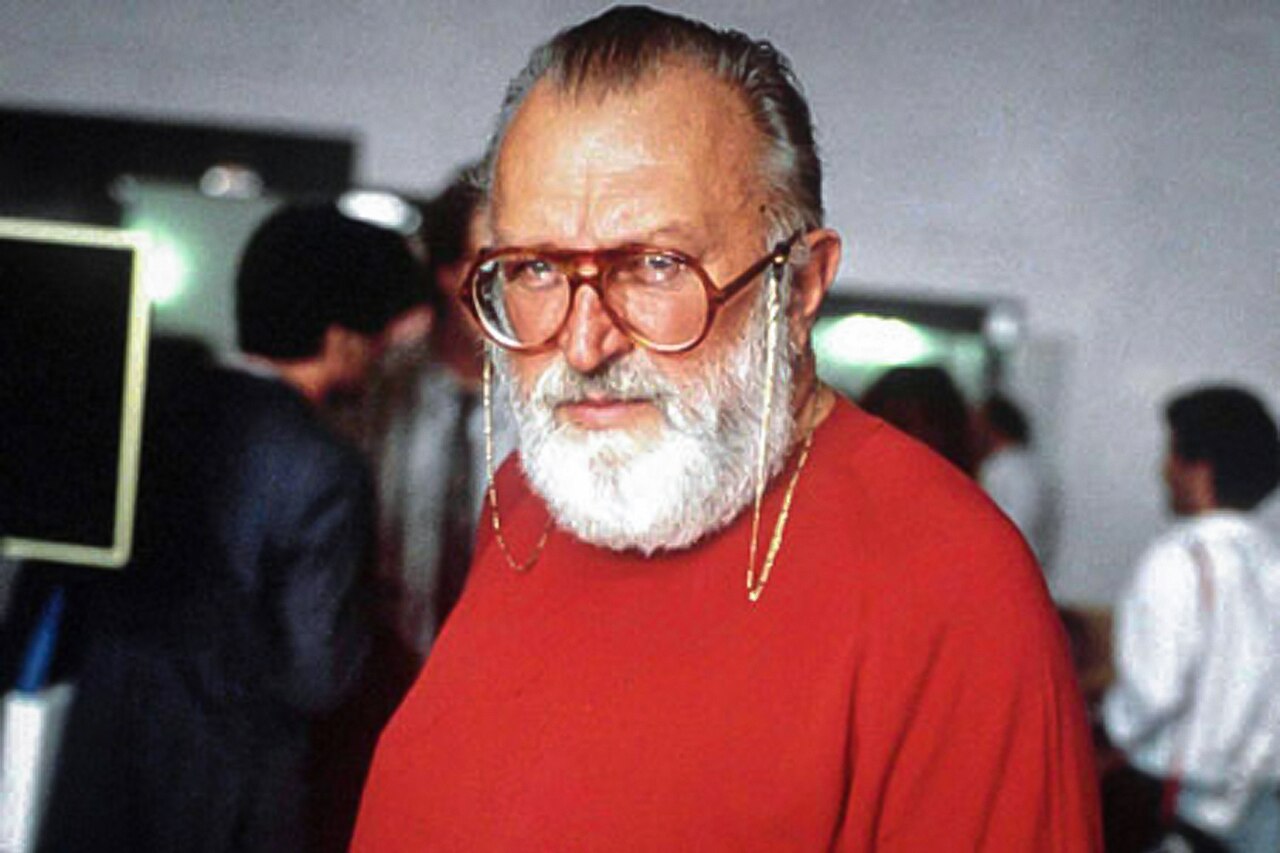
 Sergio Leone transformed the Western without being born anywhere near the American frontier. Working primarily in Rome and Spain, the Italian director took a genre associated with Hollywood and rebuilt it around morally ambiguous characters, expressive faces, ritualized violence, prolonged silence and the revolutionary music of Ennio Morricone.
Leone directed relatively few feature films, yet his influence is difficult to overstate. The Dollars Trilogy made Clint Eastwood an international star, Once Upon a Time in the West turned a familiar genre into tragic opera, and Once Upon a Time in America became one of cinema’s most ambitious meditations on friendship, betrayal and memory.
His movies are immediately recognizable: a vast landscape suddenly interrupted by an extreme close-up; a hand moving slowly toward a revolver; the sound of wind, boots or a creaking sign; and a musical theme that becomes inseparable from the character entering the frame. Leone did not simply direct Westerns. He created a new cinematic language.
Early Life in a Roman Film Family
Sergio Leone was born in Rome on January 3, 1929. Cinema was part of his life from the beginning. His father, Vincenzo Leone, was a director and actor who worked under the name Roberto Roberti. His mother, Edvige Valcarenghi, was a silent-film actress known professionally as Bice Waleran.
Vincenzo Leone had been active during the silent era but experienced professional difficulties under Fascism. His son therefore grew up understanding both the magic and the insecurity of filmmaking. Sergio briefly studied law, but the attraction of the studios proved stronger than university life.
At approximately 18, he began working in the Italian film industry in minor technical and assistant roles. One of his early experiences was on Vittorio De Sica’s neorealist masterpiece Bicycle Thieves. The restrained realism of De Sica appears far removed from Leone’s later operatic Westerns, but the experience exposed him to the importance of faces, locations and carefully observed physical behavior.
Leone learned filmmaking from the set rather than from a formal film school. During the 1950s, Rome’s Cinecittà studios became an important production center for Italian films and American historical spectacles. Leone worked as an assistant director or second-unit director on productions including Quo Vadis and Ben-Hur. These enormous projects taught him how to organize crowds, construct large-scale action and make a limited number of sets appear part of a much bigger world.
He also worked on the popular Italian historical epics known as peplum or “sword-and-sandal” films. When director Mario Bonnard became ill during the production of The Last Days of Pompeii, Leone reportedly assumed a substantial part of the directing work, although he was not officially credited as its director.
The Colossus of Rhodes and His Directorial Debut
Leone’s first officially credited feature as sole director was The Colossus of Rhodes (Il colosso di Rodi) in 1961. Set in the ancient Greek world, the film contains elaborate sets, political intrigue, spectacle and large action sequences.
It was still part of an established commercial genre rather than a completely personal work. Nevertheless, it demonstrated Leone’s ability to create a sense of scale with European resources. More importantly, it prepared him to recognize that Italian filmmakers could reinterpret a supposedly American genre for an international audience.
By the early 1960s, the traditional Hollywood Western was losing some of its commercial power. European producers saw an opportunity to make lower-cost Westerns using Italian crews, Spanish deserts and international casts. Leone would turn this practical production model into an artistic revolution.
A Fistful of Dollars Changes the Western
In 1964, Leone directed Per un pugno di dollari, released internationally as A Fistful of Dollars. Because distributors feared that audiences would reject an Italian-made Western, several members of the production adopted American-sounding names. Leone was initially billed as Bob Robertson, a playful reference to his father’s professional name.
The film starred Clint Eastwood, then best known for the American television series Rawhide. Eastwood played a mysterious gunman who arrives in a town divided between two criminal families and manipulates both sides for his own advantage.
The story closely resembled Akira Kurosawa’s Yojimbo, itself influenced by American crime fiction and Westerns. The resulting dispute with Kurosawa’s production company was eventually settled, but the film’s importance extended far beyond its borrowed narrative framework.
Leone’s visual and dramatic treatment was radically different from that of a conventional American Western. His frontier was dirty, violent and cynical. His characters were motivated by money, revenge or survival rather than civic responsibility. Heroes and villains were separated by degrees of ruthlessness rather than a simple moral boundary.
The director alternated immense landscapes with extreme close-ups of weathered faces, nervous eyes and hands hovering above weapons. Conventional dialogue gave way to silence, sound effects and ritual. A gunfight was no longer simply an action scene; it became a carefully prolonged ceremony.
The film was a major European success and helped turn Eastwood into an international movie star. It also began the creative partnership that would define Leone’s career.
Sergio Leone and Ennio Morricone
Leone and Ennio Morricone had attended the same primary school in Rome, although their celebrated professional collaboration began many years later.
Morricone’s scores rejected the conventional orchestral language of Hollywood Westerns. He incorporated whistles, bells, cracking whips, electric guitars, chanting voices, gunshots and other unconventional sounds. The music did not merely accompany Leone’s images. It helped determine their rhythm and emotional meaning.
Leone sometimes asked Morricone to compose themes before filming began. The music could then be played during shooting, helping the actors and camera movements follow its tempo. This unusual method contributed to the almost choreographed quality of Leone’s most famous sequences.
Their partnership became one of the most significant director-composer relationships in cinema, comparable to Alfred Hitchcock and Bernard Herrmann or Federico Fellini and Nino Rota.
For a Few Dollars More
The success of A Fistful of Dollars led to For a Few Dollars More in 1965.
Eastwood returned as a bounty hunter, joined by Lee Van Cleef as the older and more disciplined Colonel Douglas Mortimer. Gian Maria Volonté played the unstable outlaw El Indio. The film preserved the first movie’s cynicism and visual style while introducing a more complex plot and greater emotional depth.
Mortimer initially appears to be motivated by money, but the gradual revelation of his personal connection to El Indio gives the climactic confrontation unexpected poignancy. Morricone’s musical pocket watch becomes both a narrative object and a timing device, showing how Leone could merge music, editing and character psychology.
The film’s success confirmed that A Fistful of Dollars had not been an isolated phenomenon. Leone had created a recognizable cinematic world, and audiences wanted to return to it.
The Good, the Bad and the Ugly
The informal Dollars Trilogy reached its peak with The Good, the Bad and the Ugly in 1966.
Clint Eastwood played Blondie, “the Good”; Lee Van Cleef portrayed Angel Eyes, “the Bad”; and Eli Wallach gave one of the trilogy’s most memorable performances as Tuco, “the Ugly.” The three men pursue a fortune in buried Confederate gold while the American Civil War rages around them.
Although often funny, the film presents war as absurd, destructive and largely indifferent to the lives of individuals. The bridge sequence, in which Union and Confederate soldiers repeatedly fight over a strategically useless position, reveals a political and humane dimension sometimes overlooked in discussions of Leone’s style.
The final confrontation in the cemetery is among the most celebrated sequences in film history. Leone moves between faces, eyes, weapons and empty space while Morricone’s “The Trio” steadily increases the tension. Very little happens in conventional narrative terms, yet editing, framing and music turn the wait itself into drama.
The film completed Leone’s transformation of the Western. What began as an inexpensive European reinterpretation of an American genre had become an epic form with its own visual grammar.
Once Upon a Time in the West
After the Dollars Trilogy, Leone initially considered leaving the Western behind. He was eventually persuaded to direct another, but Once Upon a Time in the West (C’era una volta il West, 1968) was designed as something more than a continuation.
Working from a story developed with Bernardo Bertolucci and Dario Argento, Leone created a film about the death of the frontier and the arrival of modern industrial America. Railroads, water and property are more important than traditional codes of honor.
Claudia Cardinale plays Jill McBain, a former New Orleans prostitute who travels west to join her new family, only to find them murdered. Charles Bronson is the mysterious Harmonica, Jason Robards plays the charming outlaw Cheyenne, and Henry Fonda—one of Hollywood’s most trusted screen heroes—was deliberately cast against type as the cold-blooded killer Frank.
Jill is more than a conventional Western heroine. She represents survival, continuity and the society that will emerge after the gunfighters disappear. Her growing importance gives the film a perspective absent from many earlier Westerns.
The opening sequence, in which three gunmen wait at an isolated railway station, demonstrates Leone’s mastery of duration. Dripping water, buzzing flies, a squeaking windmill and the distant arrival of a train replace conventional exposition. The sequence prepares the audience to experience time rather than merely follow a plot.
Initially received unevenly in some markets, Once Upon a Time in the West later came to be regarded as one of the greatest Westerns ever made.
Duck, You Sucker! and Political Revolution
Leone’s next feature was Giù la testa (1971), known variously in English as Duck, You Sucker!, A Fistful of Dynamite and Once Upon a Time… the Revolution.
Set during the Mexican Revolution, it stars Rod Steiger as Juan Miranda, a bandit whose main concern is his family and personal enrichment, and James Coburn as John Mallory, an Irish explosives expert haunted by political betrayal.
The film is sometimes treated as a minor Leone work, but it offers a skeptical examination of revolution. Idealistic slogans repeatedly collide with suffering, manipulation and mass death. Juan’s transformation from bandit to accidental revolutionary carries both tragic and comic dimensions.
Leone had a complicated relationship with the project and did not initially intend to direct it himself. Nevertheless, the finished film contains many of his central concerns: male friendship, betrayal, memory, violence and the gap between romantic myths and historical reality.
Once Upon a Time in America
Leone spent many years developing Once Upon a Time in America, released in 1984. Based partly on Harry Grey’s novel The Hoods, the film follows a group of Jewish gangsters from childhood in New York’s Lower East Side through adulthood, Prohibition and the consequences of betrayal.
Robert De Niro stars as David “Noodles” Aaronson, with James Woods as his charismatic and dangerous friend Max. The cast also includes Elizabeth McGovern, Tuesday Weld, William Forsythe, James Russo and Joe Pesci.
Rather than presenting a straightforward rise-and-fall gangster story, Leone structured the film around fragmented memory. It moves between different periods without always announcing the transition, asking viewers to question what is remembered, imagined, regretted or deliberately forgotten.
The longer version shown in Europe preserves this complex structure. For its original American release, however, the film was drastically shortened and rearranged into chronological order without Leone’s approval. The altered version was widely criticized because it removed much of the emotional and thematic architecture. Longer restorations have since helped restore the film’s reputation.
The movie contains some of Leone’s most beautiful filmmaking, but it is also deliberately disturbing. Its treatment of women and its scenes of sexual violence remain subjects of serious criticism. A complete assessment of Leone should recognize both the film’s formal brilliance and the troubling aspects of its male-centered vision.
Today, Once Upon a Time in America is widely regarded as a major gangster epic and one of the director’s defining achievements.
Sergio Leone’s Directing Style
Several characteristics make a Leone film immediately identifiable.
Extreme Close-ups and Monumental Landscapes
Leone repeatedly moved from panoramic views to enormous close-ups. Faces became landscapes marked by sweat, scars, dust and fear. The contrast emphasized the relationship between an apparently limitless environment and the individual trapped within it.
Suspense Through Duration
Rather than rushing toward violence, Leone prolonged the moments preceding it. Characters wait, observe and calculate. Viewers become increasingly aware of small gestures and sounds. The eventual gunshot may last only an instant, but the anticipation gives it enormous force.
Music as Narrative
Morricone’s themes often function like dialogue. A melody can reveal a character’s history, announce an unseen presence or connect events separated by many years.
Morally Ambiguous Characters
Leone rejected the clean division between hero and villain common in traditional Western mythology. His protagonists lie, steal and kill, while even his villains may possess intelligence, charm or a personal code.
Humor Within Violence
His films combine brutality with exaggerated behavior, irony and dark comedy. Tuco’s restless energy in The Good, the Bad and the Ugly is the clearest example, but humor appears throughout Leone’s work.
Myth and Historical Disillusionment
Leone loved the mythology of America but distrusted its idealized version. His films celebrate the grandeur of popular storytelling while exposing the greed, violence and exploitation beneath stories of progress.
The Films Sergio Leone Did Not Complete
During the final years of his life, Leone considered several ambitious projects. The most famous was a film about the siege of Leningrad during the Second World War. He reportedly imagined another enormous international production combining historical spectacle with an intimate human story.
He was also associated at different times with projects involving the American West and other large historical subjects. None reached production under his direction.
These unrealized plans suggest that Leone did not intend Once Upon a Time in America to be his final film. He was still searching for subjects large enough to accommodate his fascination with history, memory and myth.
Death and Family Legacy
Sergio Leone died of a heart attack in Rome on April 30, 1989. He was only 60 years old. His death ended a career that had produced a small but extraordinarily influential body of work.
In the year of his death, he founded the company that became Leone Film Group. His children Andrea and Raffaella Leone subsequently continued the family’s involvement in film production and distribution.
Leone’s association with Rome also remains central to his story. Cinecittà, where he learned to manage international productions, represents the industrial and creative environment that made his films possible. Though his stories unfolded in Mexico, the American frontier or New York, they were shaped by the imagination of a Roman filmmaker.
Influence on Modern Filmmakers
Leone’s influence can be seen across world cinema. Quentin Tarantino adopted his love of prolonged confrontations, chapter-like storytelling, sudden violence and music-driven sequences. Martin Scorsese has championed Leone’s work and participated in efforts to preserve its legacy. Directors including Robert Rodriguez, John Woo and many others have drawn upon his use of framing, editing and ritualized action.
Clint Eastwood’s later career also carried traces of Leone’s influence. Eastwood’s spare performances and revisionist Westerns retained an awareness of the morally uncertain world the two men created together.
Leone also changed the critical status of genre filmmaking. He demonstrated that a commercially popular Western could be visually sophisticated, politically skeptical and emotionally operatic without abandoning entertainment.
Essential Sergio Leone Filmography
- The Colossus of Rhodes (Il colosso di Rodi, 1961)
- A Fistful of Dollars (Per un pugno di dollari, 1964)
- For a Few Dollars More (Per qualche dollaro in più, 1965)
- The Good, the Bad and the Ugly (Il buono, il brutto, il cattivo, 1966)
- Once Upon a Time in the West (C’era una volta il West, 1968)
- Duck, You Sucker! (Giù la testa, 1971)
- Once Upon a Time in America (C’era una volta in America, 1984)
Readers who want to explore the director’s films, biographies and critical studies can find Sergio Leone books and movies on Amazon.com.
For more background, see ItaliaMia’s guide to the history and defining style of the Spaghetti Western and the broader overview of Italian movies and the cinema of Italy.
Why Sergio Leone Still Matters
Sergio Leone approached America as both a real place and an enormous collective dream. Because he viewed the Western from Italy, he was free to dismantle its conventions and rebuild them in a more exaggerated, skeptical and operatic form.
His West was never historically neutral. It was a landscape shaped by capitalism, technology, war and the disappearance of older ways of life. The gunfighters may command the screen, but they are often already obsolete. Railroads, corporations and political movements are creating a world in which their personal codes no longer matter.
That sense of approaching disappearance also defines Once Upon a Time in America. Leone’s characters look backward, trying to recover friendships and possibilities destroyed by ambition and betrayal. Memory becomes another kind of frontier: vast, unreliable and impossible to conquer.
With only seven principal feature films as credited director, Leone achieved what many filmmakers with much larger bodies of work never accomplish. He created images, sounds and rhythms that audiences recognize immediately. Every prolonged cinematic standoff, every sudden shift from a wide landscape to a pair of watchful eyes, and every action sequence organized around music carries something of his legacy.
External Sources
- Fondazione Cineteca di Bologna – Sergio Leone programs, exhibitions and film preservation
- Leone Film Group – History of the company founded by Sergio Leone
- BFI – Reassessment of Duck, You Sucker! and Leone’s later Western period
- The Film Foundation – Film preservation and restoration projects
- Museo Nazionale del Cinema in Turin