
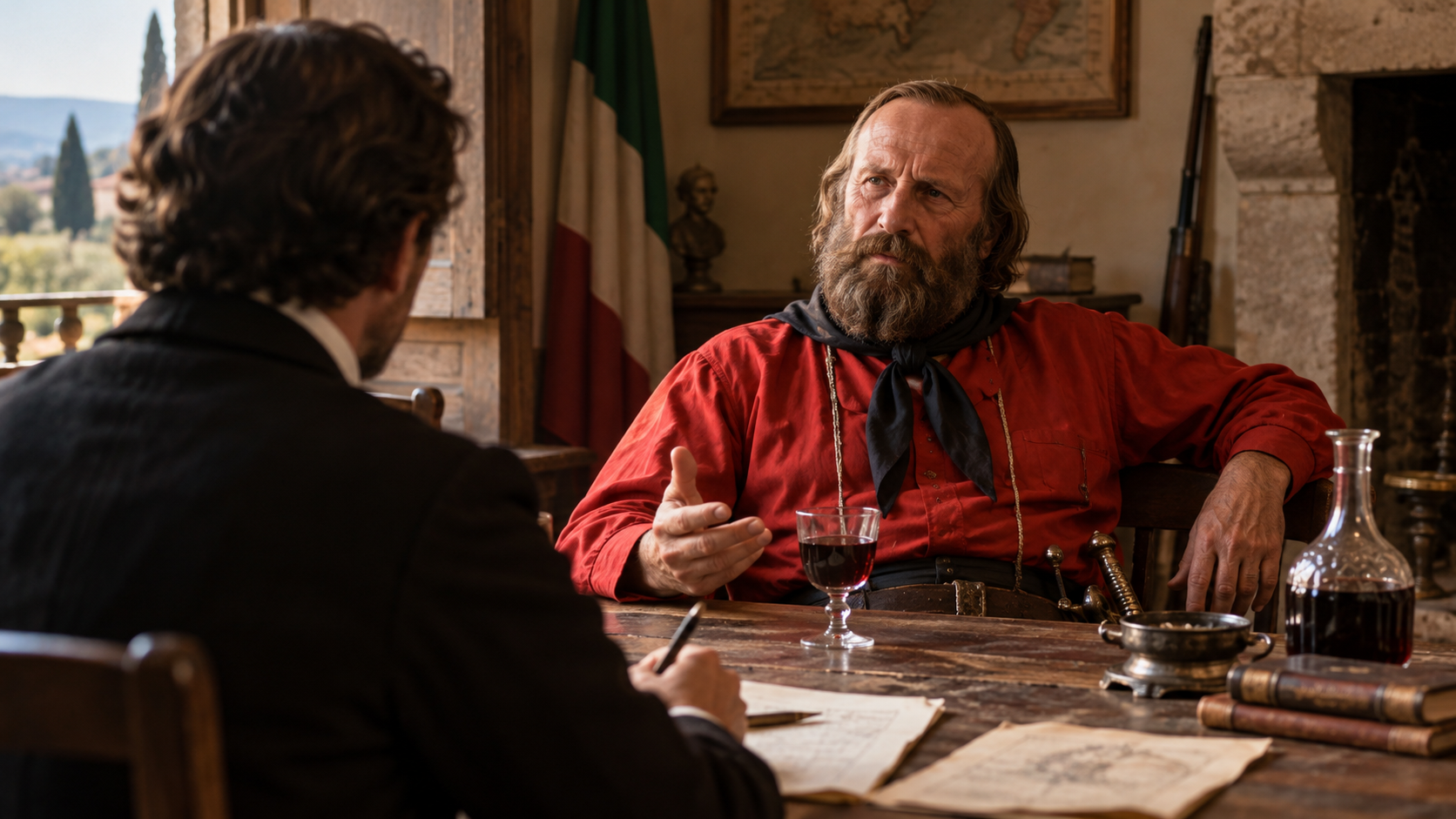
 What would Giuseppe Garibaldi say if we could sit down with him and ask about his extraordinary life? Would he defend his decision to support a king despite his republican convictions? Would he regret the political compromises that accompanied Italian unification? And what would he tell us about Anita, the woman who shared his dangerous adventures?
Giuseppe Garibaldi (1807–1882) was a sailor, revolutionary, military commander and one of the principal figures of the Risorgimento, the movement that created modern Italy. Known as the Hero of Two Worlds for his campaigns in South America and Europe, he became internationally famous for leading the Expedition of the Thousand in 1860.
His familiar red shirt, beard and military exploits made him a national symbol. Yet behind the legend stood a complicated man who experienced exile, personal tragedy, political disappointment and repeated conflict with the government he helped bring into existence.
A note about this interview: The following conversation is an imaginative historical reconstruction, not an authentic interview. Garibaldi’s answers are fictional literary interpretations informed by documented events, his political positions, contemporary accounts and historical research. They should not be treated as his actual words.
Childhood, the Sea and the Discovery of Italy
Interviewer: General Garibaldi, let us begin with your childhood. Where were you born?
Giuseppe Garibaldi: I was born in Nice on July 4, 1807, when the city belonged to Napoleonic France. My family lived by the sea, and my father was a merchant captain.
The sea shaped my childhood. Ships brought news from distant countries, and every voyage suggested possibilities beyond the familiar coastline.
As a young man, I became a sailor. I visited Mediterranean ports and encountered people whose languages, governments and customs were different from my own.
Those experiences taught me that the world was much larger than the borders drawn by kings.
Interviewer: But Italy was not yet a united country. When did you begin thinking of yourself as Italian?
Garibaldi: We spoke of Italy as a homeland long before it existed as a single state.
The peninsula was divided among kingdoms, duchies and territories governed by foreign powers. Austria exercised enormous influence in the north, the Bourbons ruled the south, and the pope governed much of central Italy.
Yet we shared centuries of history, artistic achievement and cultural traditions.
The idea that Italians could determine their own future became increasingly important to me. I came to believe that political freedom required national independence.
Readers unfamiliar with this period can explore Italia Mia’s history of Italy to understand the political divisions that preceded unification.
Interviewer: Who influenced your revolutionary ideas?
Garibaldi: Giuseppe Mazzini was decisive.
I encountered his ideas in the early 1830s and joined Young Italy, the movement he founded to pursue national unity and independence.
Mazzini believed that Italy should become a republic. His writings appealed to young people who were unwilling to accept the political order inherited from previous generations.
I admired his dedication and his belief that ordinary citizens had responsibilities toward their country.
But we would eventually disagree about the methods needed to achieve our common objective.
Interviewer: Your revolutionary career began with failure, didn’t it?
Garibaldi: Indeed.
In 1834, I became involved in an unsuccessful revolutionary conspiracy against the Kingdom of Sardinia. The authorities discovered the movement, and I was forced to escape.
A death sentence was issued against me in my absence.
Imagine being a young sailor and suddenly discovering that returning home could mean execution.
Exile was not something I had planned. Yet that failure changed the direction of my life.
It sent me across the Atlantic, where I would become a soldier as well as a sailor.
South America: The Making of the Hero of Two Worlds
Interviewer: Why did you travel to South America?
Garibaldi: I needed a place where I could live beyond the reach of the authorities who sought my arrest.
I arrived in Brazil in the 1830s and became involved in the conflict between the imperial government and republican forces in Rio Grande do Sul.
Later, I fought in Uruguay, where I helped defend Montevideo and organized an Italian volunteer legion.
Those years were an extraordinary military education.
I learned to command men, improvise under pressure and operate with limited resources.
I also discovered that a cause can attract people from different countries when they believe it represents something larger than themselves.
Interviewer: Is that where your famous red shirts originated?
Garibaldi: The red shirt became associated with my Italian Legion in Uruguay and later with the volunteers who followed me in Italy.
It was not the elaborate uniform of a traditional European army. It became a recognizable symbol of our movement.
A uniform can create unity among people who have little else in common.
But a red shirt alone makes no one courageous.
What matters is the conviction of the person wearing it.
Interviewer: You are called the Hero of Two Worlds. Did you consider your South American campaigns as important as your Italian ones?
Garibaldi: My experiences in South America prepared me for everything that followed.
There I learned about leadership, guerrilla warfare, naval operations and the difficulties of sustaining volunteer forces.
I also formed friendships that lasted for years.
Without those experiences, I doubt I would have possessed the confidence or practical knowledge needed to lead the campaigns in Italy.
The two parts of my life cannot be separated.
Interviewer: South America also brought you Anita. How did you meet her?
Garibaldi: I met Anita in Brazil in 1839.
She was courageous, determined and willing to take risks that many soldiers would have avoided.
She did not remain safely at home while I traveled and fought. She shared the hardships of military life and accompanied me through dangerous circumstances.
We married in Montevideo in 1842 and had children together.
Anita was not simply the wife of a revolutionary. She was a participant in the struggles that defined our lives.
Her independence and strength made an enormous impression on everyone who knew her.
Anita Garibaldi, Personal Loss and Exile
Interviewer: Anita’s death in 1849 was one of the great tragedies of your life. What happened?
Garibaldi: We had returned to Italy during the revolutionary upheavals of 1848 and 1849.
After the Roman Republic fell, I attempted to escape with my remaining followers. Anita accompanied me despite being ill and pregnant.
The journey was desperate. Enemy forces were pursuing us, and we struggled to find safety.
Anita died on August 4, 1849, near Ravenna.
I had survived battles and political defeats, but nothing could reverse that loss.
The woman who had shared so much of my life was gone.
Interviewer: Did her death change you?
Garibaldi: Anyone who loses someone central to their life understands that grief changes the meaning of everything.
Anita’s death became inseparable from my memories of the Roman Republic and our failed struggle to defend it.
Military history often records the movements of armies, the decisions of generals and the dates of battles.
It rarely communicates what those events cost individual families.
Yet the suffering of families was part of every campaign.
Interviewer: You later lived in New York. Is it true that you worked in a candle factory?
Garibaldi: Yes.
After the failure of the revolutions, I spent time in exile and eventually reached New York.
On Staten Island, I worked with Antonio Meucci, the Italian inventor, in a candle-making business.
There is something instructive about that episode.
A man may command troops one year and undertake ordinary work the next.
I did not consider honest labor beneath me.
My life had taught me that reputation could disappear quickly. The ability to work and survive was more reliable than public applause.
The Roman Republic and the Disagreements with Mazzini
Interviewer: Let us return to 1849. Why was the Roman Republic so important to you?
Garibaldi: The Roman Republic represented an opportunity to create a different political order in one of Europe’s most important cities.
The pope had fled Rome, and republican leaders were attempting to establish new institutions.
Mazzini became one of the republic’s leading political figures, while I participated in its military defense.
But France intervened to restore papal authority.
Despite determined resistance, the republic fell in July 1849.
Its existence was brief, yet it demonstrated how far the movement for Italian independence had developed.
Interviewer: You and Mazzini believed in a republic. Why did your relationship become difficult?
Garibaldi: We shared the goal of national unity, but we did not always agree on strategy.
Mazzini considered republican government an essential part of the national project.
I increasingly believed that the monarchy of Victor Emmanuel II might provide a practical route to unification.
I did not abandon the principles that had inspired me. But I was prepared to cooperate with institutions I did not necessarily admire.
Mazzini feared that such compromises would betray the revolutionary ideal.
I feared that insisting on agreement about every political principle would leave Italy divided indefinitely.
That difference became fundamental.
Cavour, Victor Emmanuel II and Political Compromise
Interviewer: What did you think of Count Camillo Benso di Cavour?
Garibaldi: Cavour and I approached the Italian question from very different directions.
He was a statesman, skilled in diplomacy and negotiations between governments.
I was a man of action who believed that volunteers and popular movements could accomplish what professional diplomats considered impossible.
His methods sometimes frustrated me.
He understood the importance of European alliances, however, and recognized that Austria could not be challenged successfully without international support.
We were never natural political partners.
But both of us contributed to the creation of Italy.
Interviewer: Did you trust Victor Emmanuel II?
Garibaldi: I believed he could become the monarch around whom the movement for unification could gather.
That did not mean I was a monarchist by conviction.
Italy contained republicans, liberals, conservatives and people who were primarily concerned with ending foreign domination.
A successful national movement had to bring together groups that disagreed about the country’s future government.
Supporting the king was a political decision.
It was not an announcement that monarchy had become my ideal.
Interviewer: Were you angry when Nice was transferred to France in 1860?
Garibaldi: Very angry.
Nice was my birthplace, and its transfer to France under the agreement associated with Cavour’s diplomacy was deeply painful.
I opposed the decision publicly.
The government regarded the territorial settlement as part of the price of securing French support for the Italian cause.
I understood diplomatic necessity, but understanding it did not make the loss acceptable.
It was one of the clearest examples of the difference between political calculations made in government offices and the feelings of those whose homes were affected.
The Expedition of the Thousand: The Campaign That Changed Italy
Interviewer: In May 1860, you led approximately one thousand volunteers toward Sicily. Why undertake such an extraordinary risk?
Garibaldi: News of an uprising in Palermo suggested that the Bourbon government faced serious opposition.
I believed the moment offered an opportunity.
Our force was small compared with the army of the Kingdom of the Two Sicilies.
We lacked the resources available to a regular army, and success was far from guaranteed.
But waiting for perfect circumstances would have meant waiting indefinitely.
We sailed from Quarto, near Genoa, during the night of May 5–6, 1860.
On May 11, we landed at Marsala.
From that moment, events developed with astonishing speed.
Interviewer: How could such a small force defeat a much larger kingdom?
Garibaldi: We did not succeed through numbers alone.
Local revolts, military weaknesses within the Bourbon state, volunteer reinforcements and popular support all contributed.
Our victories also had a psychological effect.
At Calatafimi, on May 15, we demonstrated that the Bourbon forces could be challenged.
Later, we fought our way into Palermo. The campaign continued through Sicily, including the important battle of Milazzo in July.
Each success attracted additional supporters.
By the time we crossed to the mainland, the original expedition had developed into a much larger movement.
Interviewer: Were you certain of victory?
Garibaldi: No commander should confuse confidence with certainty.
In battle, plans change rapidly. Orders arrive too late, supplies disappear and assumptions prove false.
A commander must act with the information available.
I believed that speed could be an advantage and that our opponents might find it difficult to respond effectively to unexpected movements.
But soldiers paid for errors with their lives.
Our victories were not inevitable, however inevitable they may appear when described afterward.
Interviewer: What happened when you entered Naples?
Garibaldi: I entered Naples on September 7, 1860, after the Bourbon king had departed.
It was a remarkable moment.
Only months earlier, we had sailed toward Sicily with a relatively small force. Now we were entering one of Europe’s largest cities.
The struggle was not finished. Bourbon troops continued to resist, and the decisive fighting at the Volturno followed in early October.
Nevertheless, the political position of the Bourbon monarchy had been transformed.
The campaign opened the way for southern Italy to join the emerging Italian kingdom.
Interviewer: Your victory is often described as a popular liberation. But did all Sicilians benefit?
Garibaldi: Political freedom and social justice are not automatically the same thing.
Sicilian society was marked by deep inequalities, particularly in land ownership and agricultural life.
Many peasants hoped that revolution would bring land and economic improvement.
My administration introduced measures intended to address some of these grievances, including provisions for distributing certain communal lands.
Yet the expectations of rural communities extended far beyond what was achieved.
I cannot claim that military victory resolved those problems.
Interviewer: One of the darkest episodes was the repression at Bronte in August 1860. How do you answer criticism of your forces?
Garibaldi: The events at Bronte reveal the violence and contradictions that accompanied the campaign.
A local uprising grew from longstanding disputes over land, power and social injustice. People were killed during the revolt.
Nino Bixio, one of my commanders, suppressed the uprising, and five men were executed following a military tribunal.
A campaign may seek national liberation while still imposing harsh measures on the people it claims to serve.
The historian must examine those actions as carefully as the victories.
A patriotic legend should never be allowed to erase the suffering of civilians.
Historical context: The reconstructed answer above is not an admission or statement recorded from Garibaldi. The events at Bronte and their interpretation remain an important subject of historical research.
Interviewer: On October 26, 1860, you met Victor Emmanuel II at Teano. Why surrender your authority to the king?
Garibaldi: I had fought for the unity of Italy, not to establish a personal kingdom.
The meeting with Victor Emmanuel symbolized the transfer of the southern campaign’s political achievements into the process of national unification under the House of Savoy.
I had disagreements with the king’s ministers and serious concerns about the future.
But I believed that creating a single Italian state was more important than preserving my own authority.
Afterward, I returned to Caprera.
I had not undertaken the expedition simply to gain a title or a government position.
The Unfinished Unification of Italy
Interviewer: The Kingdom of Italy was proclaimed in 1861. Did you believe the work was complete?
Garibaldi: No.
A kingdom had been created, but important territories remained outside it.
Venetia was not incorporated until 1866, and Rome did not become part of the kingdom until 1870.
Even beyond territorial questions, the country faced enormous difficulties.
People from different regions had lived under separate governments and legal systems for generations.
Creating a nation required more than drawing new borders.
It required institutions, education, economic development and a sense of shared responsibility.
Interviewer: Why were you so determined to make Rome part of Italy?
Garibaldi: Rome possessed extraordinary historical and symbolic significance.
For centuries, it had represented political and cultural authority across Europe.
I believed that a united Italy could not regard Rome as a permanent exception to national sovereignty.
But the city was protected by the pope’s government and supported by France.
This made the Roman question not merely Italian but international.
My attempts to resolve it through armed expeditions brought me into direct conflict with the government of the country I had helped create.
Interviewer: In 1862, Italian soldiers actually fired on you at Aspromonte. How could that happen?
Garibaldi: I was leading volunteers toward Rome when the Italian government intervened to stop us.
The authorities feared that my expedition might provoke a dangerous confrontation with France and the Papal States.
At Aspromonte, on August 29, 1862, Italian troops confronted my forces.
I was wounded and arrested.
It was a bitter episode.
Men who had fought for the creation of Italy now found themselves on opposite sides.
The event exposed how far my objectives could diverge from the policies of the Italian government.
Interviewer: Yet you returned to military service in 1866. Why?
Garibaldi: Because the conflict with Austria presented another opportunity to advance national unification.
During the Third War of Independence, I commanded volunteers in the Trentino.
We achieved a notable victory at Bezzecca in July 1866.
Later, I received orders to withdraw.
My response became famous for its brevity: “Obbedisco” — “I obey.”
The word expressed military discipline, even though I disagreed with abandoning the territory we had occupied.
One can accept an order without believing that it represents the best possible outcome.
Interviewer: And your attempt to take Rome in 1867 also failed?
Garibaldi: Yes.
My volunteers fought again in an effort to end papal temporal rule in Rome.
At Mentana, on November 3, 1867, French and papal troops defeated us.
Rome finally became part of the Kingdom of Italy in September 1870, following an operation conducted by the regular Italian army, not by my volunteers.
The achievement came through circumstances different from those I had attempted to create.
History rarely follows a single person’s plans.
The Man Behind the Legend
Interviewer: You were famous throughout Europe and beyond. Did you enjoy being a celebrity?
Garibaldi: Public enthusiasm could be useful when it encouraged people to support a cause.
My visit to Britain in 1864 demonstrated the extraordinary interest that the Italian struggle had attracted abroad.
But fame also distorts a person’s life.
People prefer simple stories.
They remember the victories, the red shirt, the dramatic speeches and the meetings with kings.
They are less interested in uncertainty, mistakes, political disagreements and the thousands of people whose contributions made events possible.
The story of Italy’s unification belongs to many people, not one general.
Interviewer: After fighting against foreign domination, you later fought for France against Prussia. Was that a contradiction?
Garibaldi: I distinguished between governments and peoples.
France had intervened against the Roman Republic, and French forces had later helped prevent our advance toward Rome.
Yet in 1870 I supported the new French Republic during the Franco-Prussian War.
I commanded the Army of the Vosges and participated in the fighting around Dijon in January 1871.
I did not believe that a commitment to liberty should end at the borders of one’s own country.
Interviewer: What political ideals remained important to you in later life?
Garibaldi: I continued to sympathize with republican principles and developed a growing interest in social reform.
I believed that national independence should be accompanied by improvements in people’s lives.
Education, political participation and the conditions of ordinary workers mattered.
The creation of Italy was a historic achievement, but it did not eliminate poverty or unequal opportunity.
A country cannot measure its success solely by the strength of its army or the prestige of its leaders.
Interviewer: Why did you spend so much time on Caprera, a relatively isolated island in Sardinia?
Garibaldi: Caprera offered me something that politics rarely provided: independence and a measure of peace.
I established a home there and devoted time to agriculture, animals and practical work.
I cultivated land and planted trees.
Visitors came from Italy and abroad, and political affairs continued to interrupt my life.
But I valued the simplicity of the island.
After years of sailing, fighting and exile, ordinary work offered its own satisfaction.
Today, visitors can explore the Compendio Garibaldino at Caprera, where my home, possessions and burial place are preserved.
Garibaldi’s Legacy and the Italy He Helped Create
Interviewer: Some historians argue that unification benefited political elites more quickly than ordinary citizens. Is that a fair criticism?
Garibaldi: It is a question worth asking.
Unification altered governments, borders and institutions, but it could not immediately overcome centuries of social and economic inequality.
The south faced particular difficulties, including concentrated land ownership, rural poverty and tensions with the new state.
A national movement can achieve its central political objective while leaving major social questions unanswered.
My military campaigns formed only one part of a larger historical transformation.
Anyone studying the Risorgimento should examine both its achievements and the experiences of those whose hopes were not fulfilled.
Interviewer: If you could visit Italy today, what would you want to discover?
Garibaldi: I would first want to know whether Italians considered themselves citizens of a common country without losing their regional identities.
I would ask whether young people could build meaningful lives and whether education was available to those without wealth.
I would want to understand how the country treated people in need and whether public institutions served their citizens.
I would also be curious to see how the towns and cities I once traveled through had changed.
And I would certainly want to see the sea again.
This answer is necessarily speculative. Garibaldi died in 1882 and could not have expressed an opinion about contemporary Italy.
Interviewer: Do you believe Italy was united by military victories or by ideas?
Garibaldi: Neither could have succeeded alone.
Ideas created the desire for independence. Political organization gave that desire direction. Diplomacy secured alliances, and military action altered the balance of power.
Mazzini inspired generations of patriots. Cavour negotiated with European powers. Victor Emmanuel II supplied a dynastic center around which unification could proceed.
Volunteers, soldiers, civilians and local movements all played their parts.
It would be a mistake to attribute the creation of Italy to one man.
Interviewer: How would you like history to remember Giuseppe Garibaldi?
Garibaldi: Remember me as a man who acted according to his convictions, sometimes successfully and sometimes at considerable cost.
Do not imagine that I was always correct.
I made decisions under difficult circumstances, and those decisions affected many lives.
I believed that Italians should have the opportunity to determine their own future.
If my life is worth studying, it is not because I was without contradictions.
It is because those contradictions reveal how difficult the creation of a nation can be.
What Giuseppe Garibaldi’s Life Teaches Us
Garibaldi died on June 2, 1882, at Caprera. By then, Italy had become a unified kingdom, although political disagreements and social divisions continued.
His life encompassed two continents, several revolutions, remarkable military victories and profound personal losses. He became famous as a champion of liberty while also making difficult compromises with monarchical power.
He helped end Bourbon rule in southern Italy, yet his campaign also exposed conflicts over land, class and political authority. He contributed to the creation of the Italian state, yet that same state arrested him when his ambitions threatened its diplomatic policies.
These contradictions make him more historically interesting than the familiar figure standing on a monument.
For another perspective on the transformation of Sicily during the Risorgimento, explore Italia Mia’s article on The Leopard (Il Gattopardo). Luchino Visconti’s film examines how political change affected the Sicilian aristocracy and the society surrounding it.
Readers who enjoy imaginative conversations with historical personalities may also appreciate our interview with Julius Caesar, interview with Michelangelo and interview with Leonardo da Vinci.
Frequently Asked Questions About Giuseppe Garibaldi
Was Giuseppe Garibaldi a real historical figure?
Yes. Giuseppe Garibaldi was born in Nice in 1807 and died on Caprera in 1882. He was a military commander, revolutionary and major figure in the movement for Italian unification.
Was this interview with Giuseppe Garibaldi real?
No. The interview is an imaginative reconstruction based on historical research. The answers were written for this article and are not authentic quotations from Garibaldi.
Why was Garibaldi called the Hero of Two Worlds?
He became known as the Hero of Two Worlds because he fought in South America and Europe, taking part in republican and independence movements on both continents.
What was Garibaldi’s greatest military achievement?
His most consequential campaign for Italian unification was the Expedition of the Thousand in 1860. Beginning with a relatively small volunteer force, he helped overthrow Bourbon rule in Sicily and Naples, enabling their incorporation into the emerging Italian kingdom.
Was Garibaldi a republican or a monarchist?
Garibaldi held republican convictions but supported Victor Emmanuel II as a practical means of achieving Italian unification. His willingness to accept the monarchy distinguished his strategy from that of Giuseppe Mazzini.
Where is Giuseppe Garibaldi buried?
Garibaldi is buried on the island of Caprera, near La Maddalena in Sardinia, at the historic property where he spent much of his later life.
External Sources
- Treccani — Giuseppe Garibaldi: Biography and Historical Overview
- Treccani — Garibaldi and Italian Unification
- Italian Army — Giuseppe Garibaldi
- University of Catania — Research on the Events at Bronte in 1860
- Italian Ministry of Culture — Compendio Garibaldino, Caprera
Editorial disclosure: This is a creative historical interview. All responses attributed to Garibaldi in the dialogue are fictional reconstructions, not verbatim statements from historical documents.