
 Few films make the passing of an entire world feel as personal as The Leopard. Directed by Luchino Visconti and released in 1963, Il Gattopardo follows a Sicilian prince watching the society that gave him authority gradually slip away.
Burt Lancaster, Alain Delon and Claudia Cardinale lead a film whose beauty is inseparable from its subject. The palaces, uniforms and elaborate dresses reveal how people present themselves, protect their positions and negotiate a changing social order.
Based on Giuseppe Tomasi di Lampedusa’s novel, The Leopard belongs among the essential works of Italian cinema. Its historical setting is the Risorgimento, the movement toward Italian unification, but its questions remain familiar: who benefits when a country changes, and how much power actually changes hands?
The Story
Spoiler notice: This section discusses the central relationships and political developments. Later sections also discuss the significance of the concluding ballroom sequence.
The story begins in Sicily in 1860, as Giuseppe Garibaldi’s campaign threatens Bourbon rule. Don Fabrizio Corbera, Prince of Salina, understands that the aristocratic order supporting his family’s position can no longer take its survival for granted.
His nephew Tancredi Falconeri responds more quickly. Young, charming and ambitious, Tancredi joins Garibaldi’s forces, recognizing that supporting change may offer a better future than resisting it.
When the family travels to its country residence at Donnafugata, the prince encounters another kind of rising power: Don Calogero Sedàra, a wealthy local figure whose money and influence outweigh his lack of aristocratic polish. Sedàra’s daughter Angelica attracts Tancredi, creating the possibility of a marriage that brings together an established name and a substantial fortune.
The relationship disappoints Concetta, the prince’s daughter, whose feelings for Tancredi collide with the practical calculations shaping his future.
A representative of the new political order later offers Don Fabrizio a place in the Senate. His response reveals his distance from the optimism surrounding unification. He recognizes the changes taking place but doubts that they will transform Sicily as thoroughly as their advocates hope.
The film’s drama grows through these encounters rather than through a single confrontation. A dinner invitation, a conversation about marriage or a change of uniform can carry as much significance as a battle.
For viewers unfamiliar with Italian history, one distinction helps: the new Italy taking shape here is a monarchy. Unification should not be confused with the creation of the Italian Republic, which came much later.
Cast and Characters
Burt Lancaster as Don Fabrizio Corbera, Prince of Salina
Lancaster gives the prince imposing physical authority while allowing uncertainty to emerge through his expressions and movements. Don Fabrizio can dominate a room, yet he increasingly senses that the future belongs to people with different instincts.
Alain Delon as Tancredi Falconeri
Tancredi is the prince’s nephew and an adaptable young aristocrat. Delon’s charm makes his ambition persuasive: affection, romance and political calculation coexist in the same person.
Claudia Cardinale as Angelica Sedàra
Angelica is the daughter of Don Calogero. Her arrival unsettles the Salina family’s assumptions about social rank, marriage and refinement. Cardinale gives her an assurance that makes her presence impossible to dismiss.
Paolo Stoppa as Don Calogero Sedàra
Angelica’s father represents the growing influence of wealth outside the hereditary aristocracy. His awkwardness in aristocratic company does little to diminish his practical strength.
Rina Morelli as Princess Maria Stella
The prince’s wife brings the anxieties of political change into the family’s domestic life.
Romolo Valli as Father Pirrone
The family priest offers a perspective shaped by religion, loyalty and his position within the household.
Lucilla Morlacchi as Concetta
The prince’s daughter gives the marriage negotiations their emotional cost. Decisions that seem sensible to the men arranging them have consequences for her.
The supporting cast also includes Serge Reggiani as Don Ciccio Tumeo, Leslie French as Chevalley, and Mario Girotti—the actor later known as Terence Hill—as Count Cavriaghi.
Awards and Recognition
The Leopard won the Palme d’Or at the 1963 Cannes Film Festival, with the festival’s official archive recording a unanimous decision.
At the 1964 Academy Awards, Piero Tosi received a nomination for Costume Design in the color-film category. The Oscar went to Cleopatra. The distinction matters: The Leopard was an Oscar nominee, while its major international festival victory was at Cannes.
Titanus also records a 1963 David di Donatello award for producer Goffredo Lombardo.
These honors recognize different aspects of the achievement, from the production itself to costumes that communicate age, status and social ambition before a character speaks.
How the Film Was Made
Visconti adapted a novel published in 1958, bringing its account of aristocratic decline into a medium capable of showing both intimate family negotiations and upheaval in the streets. The film expands the historical conflict through a battle sequence in Palermo, making the risks surrounding Tancredi’s choices visible.
The production’s principal collaborators included cinematographer Giuseppe Rotunno, costume designer Piero Tosi, art director Mario Garbuglia and composer Nino Rota. Their work gives the film its extraordinary consistency: faces, clothing, interiors and music all contribute to the atmosphere.
Sicily supplies more than a scenic background. Villa Boscogrande near Palermo was used for scenes at the family’s residence, while Ciminna helped create the film’s Donnafugata. Italy’s official tourism site identifies Ciminna’s church of Santa Maria Maddalena among the locations used in the production.
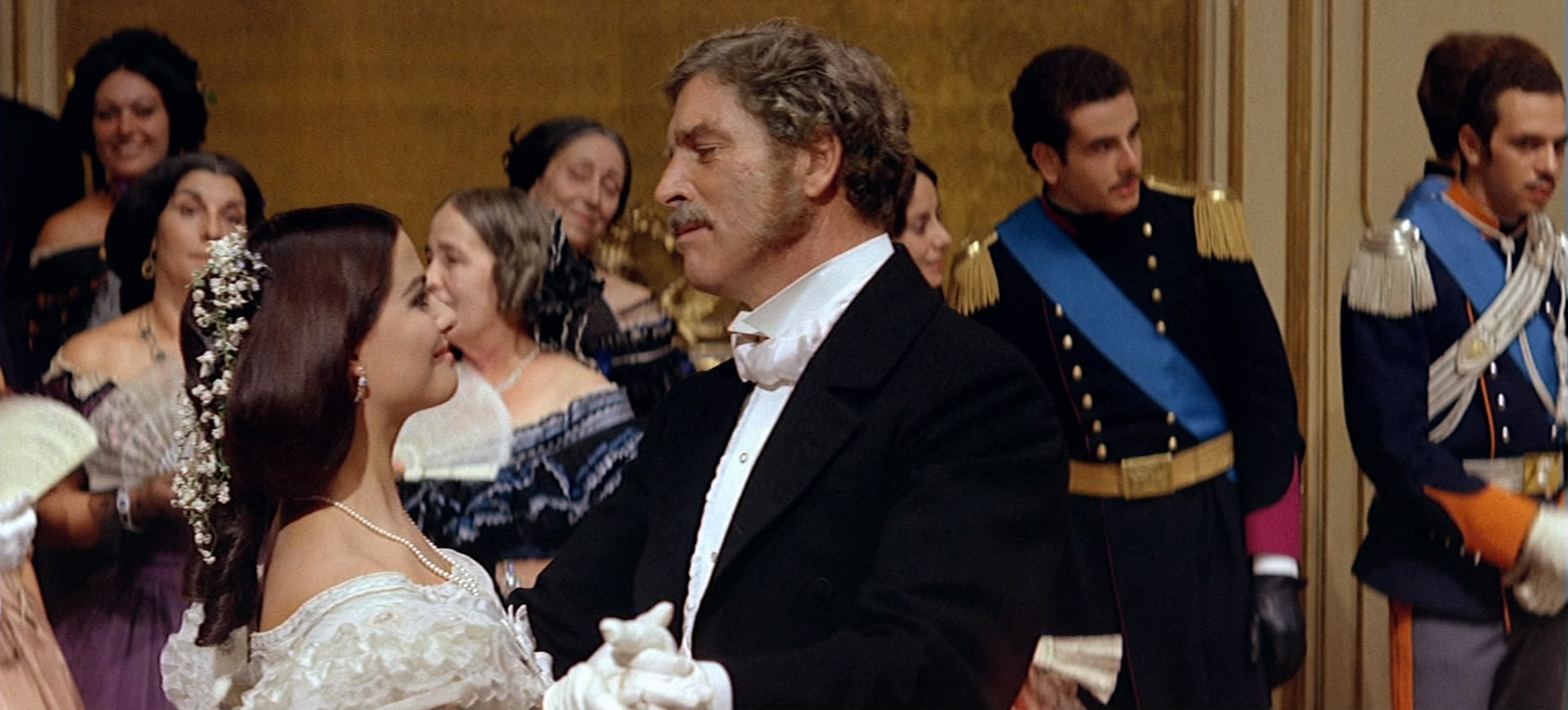
The famous ballroom sequence was filmed at Palazzo Valguarnera-Gangi in Palermo. Its interiors give the gathering a convincing sense of inherited grandeur.
The different versions
For a first viewing, I recommend the approximately 185-minute Italian-language edition. It gives the film’s relationships, political conversations and changes of mood the space they need.
The shortened American release runs approximately 161 minutes and uses an English-language soundtrack, including Lancaster’s own voice. It is a distinct release version, rather than simply a different audio option for the longer film. Criterion’s special edition includes both cuts.
That comparison offers a useful lesson in editing. In a film so concerned with the passage of time, duration affects how the viewer experiences a social world and the prince’s place within it.
Restoration also matters. A major restoration premiered at Cannes in 2010, supported by The Film Foundation and Gucci.
When choosing an edition, check the running time, soundtrack, subtitles and restoration information. A reference to a “4K restoration” describes restoration work; it does not by itself identify the product as a 4K Ultra HD disc.
Why It Still Matters
The Leopard asks a difficult question about political change: can a revolution alter institutions while allowing familiar patterns of privilege to survive?
Tancredi makes that question compelling because he is so appealing. His intelligence and confidence draw people toward him. The same qualities also help him recognize which allegiances will serve his future.
Don Fabrizio is more complicated than a noble victim of history. His dignity is real, but so is his investment in a society built around inherited advantage. We can sympathize with his fear of becoming irrelevant while questioning the world he mourns.
The ballroom brings those tensions together. Look beyond the dresses and chandeliers: observe who watches whom, how people move between rooms, and where the prince’s attention wanders. The gathering becomes a study of belonging, ambition and fatigue.
Lancaster’s performance makes the film’s political concerns deeply human. A man accustomed to authority discovers that understanding the future does not guarantee a place within it.
The Leopard also broadens the picture of Italian filmmaking. Alongside the everyday struggles associated with neorealism and the restless modern lives explored by other directors, Visconti offers historical spectacle with an intimate emotional center.
Find more films in Italia Mia’s Italian Movies collection.
Where to Watch or Buy
Availability checked on September 29, 2026, using country-specific listings. Catalogs can change; confirm the offer, language and version on the provider’s page before paying.
Make sure you select Luchino Visconti’s 1963 film. The Netflix series with the same title is a separate adaptation.
Streaming in the United States
The U.S. listings checked did not show an included subscription-streaming offer for the film. A rental available through Amazon Video should not be assumed to be included with an Amazon Prime subscription. Check the current United States viewing options for updates.
Rental and digital purchase in the United States
JustWatch lists Amazon Video, Apple TV Store and Fandango at Home for rental and digital purchase. Check the individual listing for Italian audio, English subtitles and running time, since provider metadata does not always distinguish release versions clearly.
Streaming in Italy
The Italian listings checked identify MUBI, MUBI Amazon Channel and Novecento Amazon Channel as subscription options, with RaiPlay listed as a free option with advertising. Amazon Channels may require a separate channel subscription.
The RaiPlay film page identifies Visconti’s 1963 production. Confirm playback availability in Italy when you visit.
Rental and digital purchase in Italy
The Italian listings identify Amazon Video, Apple TV Store, TIMVISION and Rakuten TV for rental and digital purchase. Use the current Italian viewing options to compare offers. English subtitles should be checked separately; an Italian-market listing does not guarantee them.
DVD and Blu-ray editions
For U.S. buyers, the Criterion Collection two-disc Blu-ray on Amazon.com is an identified physical edition whose product description includes the Italian and American versions and English subtitles. Check the current seller, price and playback compatibility before ordering.
For Italian buyers, search Il Gattopardo DVD and Blu-ray editions on Amazon.it. This is a search link, rather than a recommendation for a verified Italian edition. Compare the language tracks, subtitle options, running time and disc region before choosing.
My preference for a first viewing is the longer Italian version with subtitles, on the largest screen available. The film rewards time spent observing its rooms, faces and carefully arranged social encounters.
Affiliate disclosure: This article contains Amazon affiliate links. As an Amazon Associate, Italia Mia earns from qualifying purchases.
External Sources
Festival de Cannes: Il Gattopardo and its Palme d’Or
The Criterion Collection: The Leopard, cast, credits and editions
The Academy: 1964 Academy Awards
The Film Foundation: Restoration of The Leopard
Italia.it: The Sicilian places of Il Gattopardo
JustWatch: United States availability
JustWatch: Italian availability