The Last One for the Road (Le città di pianura) finds adventure in an unlikely corner of Italy. Directed by Francesco Sossai, this 2025 film follows three men through the Veneto plains. Their journey brings together late-night drinking, uncertain futures, and a friendship that nobody planned.
The premise suggests a loose comedy. However, Sossai also explores how people respond when their lives lose direction. His characters carry disappointments, tell stories, and keep moving, even when they have little idea where to go.
For readers exploring our selection of the best Italian movies, this is a distinctive contemporary addition. It gives ordinary roads and chance encounters the attention that other films reserve for grand adventures.
The Story
Spoiler note: This section introduces the story and its themes without revealing the ending.
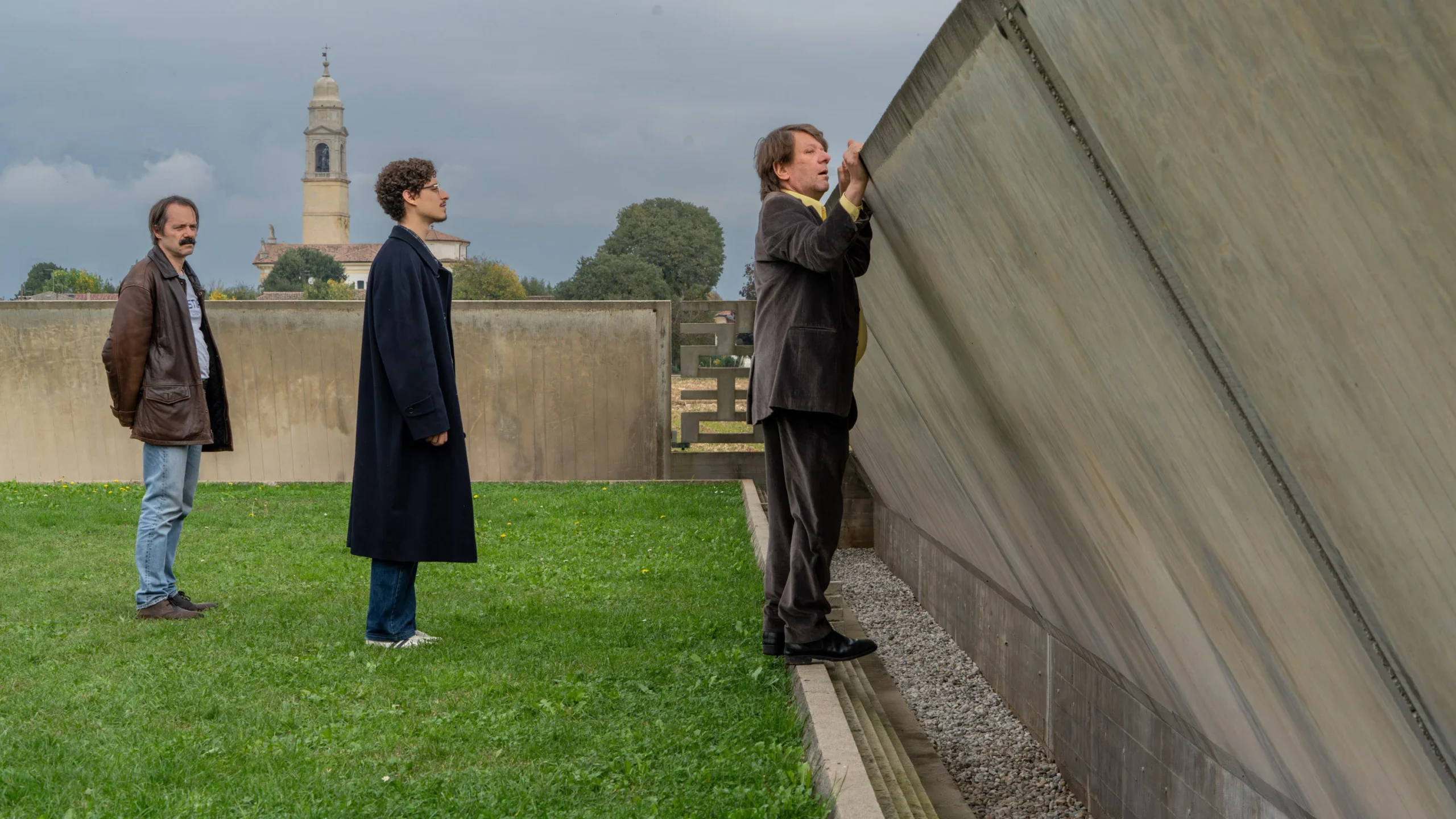
Carlobianchi and Doriano are two men in their fifties with little money and a shared attachment to one more drink. During their travels, they meet Giulio, a shy architecture student who feels uncertain about his future. Their encounter develops into an unexpected journey across northeastern Italy.
The older men also have a scheme involving an acquaintance returning from Argentina and the prospect of hidden money. Yet the film’s real interest lies in what happens along the way. Conversations, interruptions, and roadside stops gradually become more important than the destination.
Giulio initially seems an unlikely companion. He approaches life with hesitation, while Carlobianchi and Doriano push forward through jokes, stories, and questionable decisions. Nevertheless, their company creates room for him to imagine different possibilities.
Architecture gives this journey another dimension. Giulio studies at Venice’s Iuav university, and Carlo Scarpa’s Brion Memorial becomes an important point of reference. The relationship between people and places therefore belongs to the story itself. Buildings and roads help shape the characters’ understanding of their lives.
The appeal lies in that mixture of movement and uncertainty. A detour may reveal something that a carefully planned route would miss. Meanwhile, an awkward conversation can become the beginning of trust.
Cast and Characters
The central trio brings together Filippo Scotti as Giulio, Sergio Romano as Carlobianchi, and Pierpaolo Capovilla as Doriano. The supporting cast includes Roberto Citran as Cavalier Fadiga and Andrea Pennacchi as Genio.
Giulio provides the younger perspective. His uncertainty makes the encounter more than a comic interruption. He has questions about the future, and his companions offer answers that rarely resemble sensible advice.
Carlobianchi and Doriano, meanwhile, bring years of experience without presenting themselves as reliable guides. Their friendship gives the film its central tension. They can be generous, frustrating, funny, and careless within the same exchange.
Sossai’s comments about the actors reveal how carefully the performances took shape. In his Cannes interview, he explained that Romano spent time living in the director’s hometown while preparing. The experience helped him absorb the manners and presence of the people Sossai knew there.
The director also described a close connection with Scotti over their generation’s hopes and expectations. With Capovilla, he highlighted a combination of intensity and tenderness. These observations help explain the film’s interest in vulnerability beneath confident talk.
Crucially, the characters remain individuals. Their ages, finances, and drinking habits do not tell us everything about them. The story leaves space for contradiction, which makes their developing bond more interesting.
Awards and Recognition
The Last One for the Road appeared in Un Certain Regard at the 2025 Cannes Film Festival. This was an official selection in that section, rather than a Palme d’Or nomination in the main competition.
Its recognition continued at the 2026 David di Donatello Awards, where Le città di pianura won eight prizes:
- Best Film.
- Best Director.
- Best Original Screenplay.
- Best Producer.
- Best Leading Actor, for Sergio Romano.
- Best Casting.
- Best Original Song.
- Best Editing.
Francesco Sossai shared the screenplay award with Adriano Candiago. The directing and writing prizes recognised both the film’s perspective and the structure beneath its apparently wandering journey.
The range of awards is especially revealing. Recognition extended beyond the director and leading performance to casting, music, and editing. Each of those elements matters in a film built around the rhythm of encounters.
For viewers discovering the title after its festival run, these results provide useful context. This small-scale story became a major presence in Italy’s national film awards. Its regional setting proved compatible with much wider recognition.
How the Film Was Made
Sossai co-wrote the film with Adriano Candiago. Massimiliano Kuveiller handled the cinematography, Paolo Cottignola edited the film, and Krano supplied its original music. The production brought together Italy and Germany.
The choice of film stock contributes to its visual character. Kodak lists the production among the Cannes 2025 titles shot on 16mm, while Filmitalia records both 16mm and 35mm formats. That physical texture suits a story concerned with places, memories, and the passing of time.
The project also grew from Sossai’s personal connection to the region. He told Cannes that a night out with a friend in Venice, together with notes collected over years, helped inspire it.
His approach on set allowed for discovery. Rather than relying on prepared storyboards or shot lists, he wanted to respond to locations and the energy of the moment. This helps explain the film’s interest in encounters that feel open and unpredictable.
The landscape deserves particular attention. Iuav later used the film as the starting point for a seminar on architecture and territory. Its account highlights Giulio drawing a map on a paper tablecloth as he tries to understand the places they cross.
That detail captures the film’s method beautifully: the journey becomes a way of learning how to look.
Why It Still Matters
The film offers a useful question: what happens when a person’s life no longer follows the expected route?
Giulio faces that uncertainty near the beginning of adulthood. His older companions encounter it from another position. Bringing them together allows the story to explore different forms of doubt without assuming that age supplies all the answers.
Its regional focus is equally valuable. International images of Italy often favour famous monuments and carefully framed views. Here, the spaces between destinations carry meaning. A road, a bar, or an ordinary building can hold evidence of changing habits and lost connections.
The title itself suggests two ways of approaching the film. The Last One for the Road foregrounds companionship and the promise of another drink. Le città di pianura, meaning “the cities of the plain,” directs attention towards geography. Both perspectives belong to the journey.
There is also room to question the characters’ behaviour. Affection for them does not require admiration for every decision. Their drinking can be part of the comedy while their uncertainty gives the story a more troubled undertone.
Above all, the film invites attention to people who might otherwise pass unnoticed. Friendship emerges through shared time, imperfect listening, and unexpected generosity. That makes its modest encounters worth taking seriously.
Where to Watch or Buy
Viewing information checked on October 5, 2026. Catalogues can change, and some availability listings reflect earlier checks. Confirm the offer and subtitles before paying.
United States: digital rental and purchase
U.S. listings identify Amazon Video, Apple TV Store, and Fandango at Home as rental and purchase options. These are separate payments; an Amazon listing does not mean the film is included with Prime membership. I could not confirm a U.S. subscription-streaming option.
- Apple TV: The Last One for the Road.
- Search Amazon.com for the film.
- Music Box Films: official U.S. viewing links.
Italy: subscription streaming and rental
Italian listings show MUBI and MUBI Amazon Channel for subscription viewing. Rental and purchase options include Amazon Video, Apple TV Store, Rakuten TV, and TIMVISION. Mediaset Infinity also identifies the film as a rental title.
DVD and Blu-ray
Italian DVD and Blu-ray editions have been released through Eagle Pictures. Check subtitle languages and region compatibility, particularly when importing a copy into the United States. A separate U.S. physical edition was not confirmed during this check.
Search Amazon.it for DVD and Blu-ray editions.
For privacy while travelling, see NordVPN through Italia Mia. A VPN does not guarantee access to another country’s catalogue; platform terms and regional restrictions still apply.
Affiliate disclosure: Italia Mia may earn a commission from qualifying purchases through the Amazon and NordVPN links above.
External Sources
- Festival de Cannes: official film entry.
- Festival de Cannes: interview with Francesco Sossai.
- David di Donatello: 2026 award results.
- Filmitalia: production details.
- Music Box Films: U.S. distribution and credits.
- Iuav: architecture and landscape in the film.