

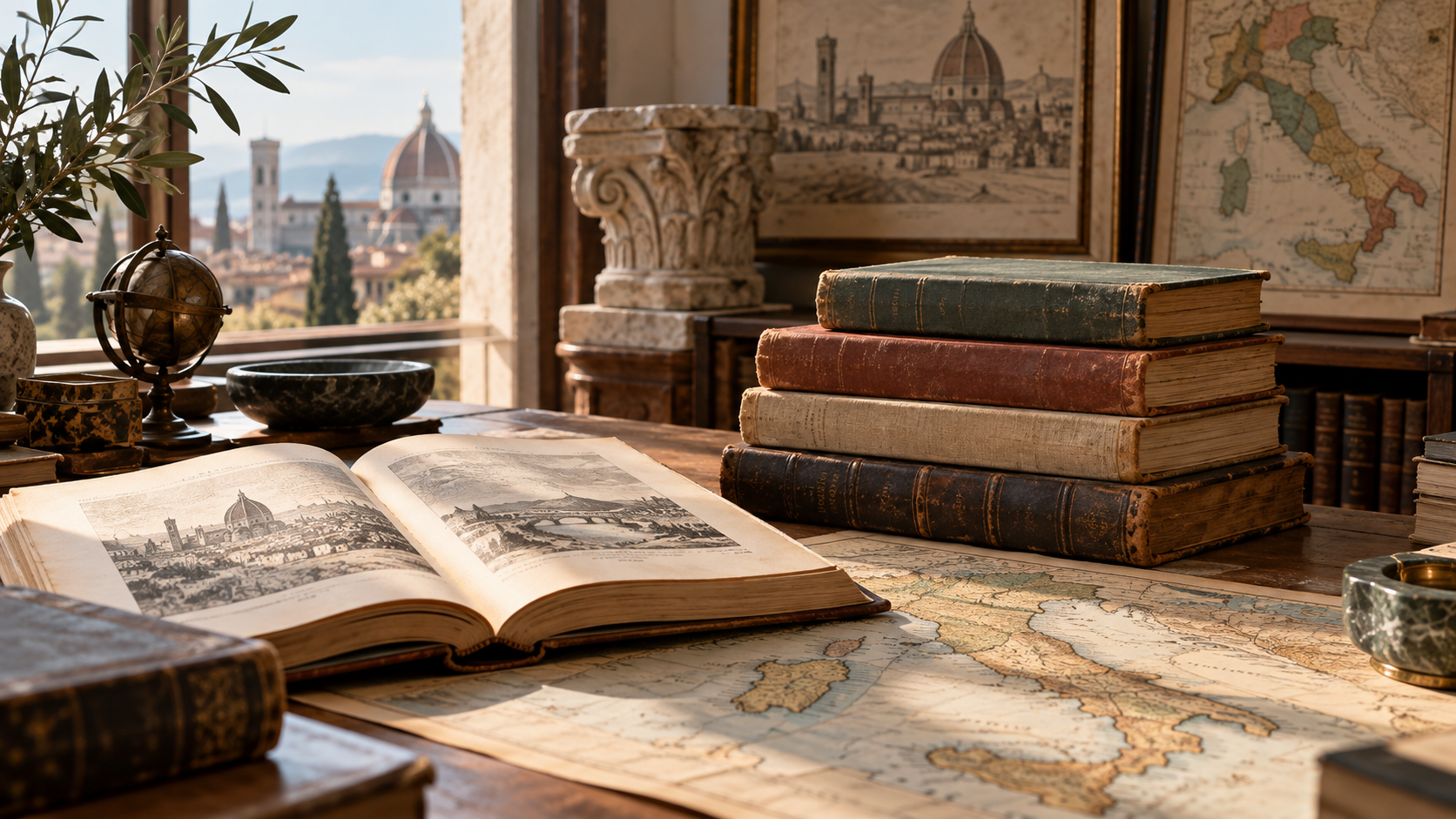
 Italy’s history did not begin with unification. Ancient Rome, medieval kingdoms, independent cities, foreign rulers, and regional traditions all shaped the country that emerged in the nineteenth century. These ten English-language books offer a reading path from antiquity to the modern republic.
Some links below are Amazon affiliate links. Italia Mia may earn a commission from qualifying purchases at no extra cost to you.
Where to Start: Two Views of the Whole Story
- A Concise History of Italy — Christopher Duggan
If you want one book to establish the chronology, start here. Duggan follows the peninsula from the end of the Western Roman Empire through the creation of the Italian state and its later struggles. It gives readers a framework for understanding why political unity came so late.
Find A Concise History of Italy on Amazon
- The Pursuit of Italy — David Gilmour
Gilmour tells Italy’s story through its regions and peoples. His central question—what was gained and lost when the peninsula became one country—makes this a useful companion to Duggan’s chronological account. Read the two together to see why a shared national history can still have strongly local perspectives.
Find The Pursuit of Italy on Amazon
Ancient Rome and the Medieval Peninsula
- SPQR: A History of Ancient Rome — Mary Beard
Rome’s history is part of the peninsula’s history, but the Roman Empire was not an early version of modern Italy. Beard explains how Rome grew, governed, and defined citizenship while asking how much we can really know from the surviving evidence. It is an inviting place to begin before moving to the centuries after Roman rule in the West.
- Italy and Its Invaders — Girolamo Arnaldi
After the Western Empire, Italy was shaped by successive rulers and competing centers of power. Arnaldi examines those encounters and the lasting role of Christianity. This shorter, more demanding book helps fill the gap that popular histories sometimes leave between ancient Rome and the Renaissance.
Find Italy and Its Invaders on Amazon
- Sicily: An Island at the Crossroads of History — John Julius Norwich
Sicily has been central to Mediterranean history, with Greek, Arab, Norman, Spanish, and other influences visible across the island. Norwich gives it a story of its own, showing why Italian history cannot be told solely from Rome, Florence, or the northern cities. For more regional context, see Italia Mia’s guide to Sicily.
Renaissance Florence and the Making of a Nation
- Fire in the City: Savonarola and the Struggle for the Soul of Renaissance Florence — Lauro Martines
Renaissance Florence produced extraordinary art and political upheaval. Martines uses the rise of the preacher Girolamo Savonarola to bring its religious conflicts, civic factions, and struggles for power into focus. It pairs well with Italia Mia’s introduction to the Italian Renaissance and biography of Machiavelli.
Find Fire in the City on Amazon
- Garibaldi: Invention of a Hero — Lucy Riall
Garibaldi’s campaigns helped bring about Italian unification, but his image as a national hero was also carefully built and widely circulated. Riall examines both the man and the making of his reputation. Read Duggan first for the broader sequence of events; then turn to this book for a closer look at how the Risorgimento gained a public face.
Find Garibaldi: Invention of a Hero on Amazon
Fascism, the Republic, and Historical Memory
- Fascist Voices: An Intimate History of Mussolini’s Italy — Christopher Duggan
Drawing on letters, diaries, and other personal records, Duggan asks how Italians experienced and understood Fascist rule. The result adds individual voices to a history often told through leaders and institutions. It is particularly valuable for readers trying to understand the regime’s appeal as well as its coercion.
- A History of Contemporary Italy: Society and Politics, 1943–1988 — Paul Ginsborg
Ginsborg follows Italy from wartime collapse through reconstruction, economic change, and the political conflicts of the republic. His attention to families, work, and social life makes this more than a history of governments. The date range matters: this is a substantial account of the postwar decades, not a guide to present-day politics.
Find A History of Contemporary Italy on Amazon
- Italy’s Divided Memory — John Foot
How does a country remember events on which its citizens disagree? Foot explores competing interpretations of Italy’s recent past and the difficulty of forming a shared account of it. Save this for after the broader histories: it will deepen your understanding of why arguments about the past remain part of Italian public life.
Find Italy’s Divided Memory on Amazon
If You Read Only Three
Begin with Duggan’s A Concise History of Italy for the timeline, Gilmour’s The Pursuit of Italy for the regional perspective, and Ginsborg’s A History of Contemporary Italy for the postwar republic. Then choose a period or place that interests you most.
For a shorter overview alongside the books, read ItaliaMia’s history of Italy or browse more titles at Italian Books.
External Sources
Cambridge University Press: A Concise History of Italy
Macmillan: The Pursuit of Italy
Yale University Press: Garibaldi
Oxford University Press: Fascist Voices
Springer Nature: Italy’s Divided Memory