

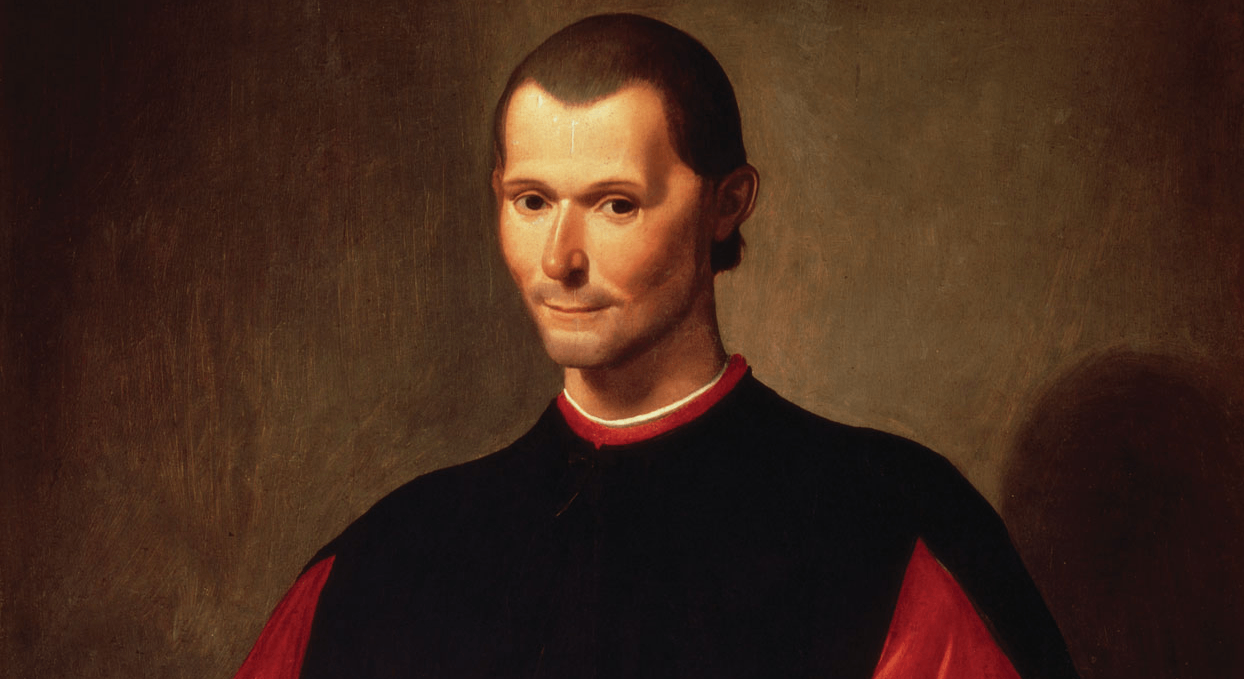
 Niccolò Machiavelli was a Florentine diplomat, political thinker, historian, playwright and poet whose name became inseparable from the study of power. Best known as the author of The Prince, he is frequently portrayed as a cold defender of manipulation and cruelty. That familiar image, however, captures only one part of a far more complex figure.
Machiavelli spent years serving the Florentine Republic, undertaking diplomatic missions, organizing military forces and observing some of Renaissance Europe’s most formidable rulers. His political ideas emerged not from an isolated academic life but from direct experience of war, conspiracy, fragile alliances and sudden changes of government.
While The Prince examines how a ruler can acquire and preserve a state, Machiavelli’s Discourses on Livy defend republican institutions, civic participation and the rule of law. Taken together, his works reveal a thinker fascinated by the conflict between political ideals and the difficult choices required to protect a community.
His influence extends far beyond political theory. Machiavelli also wrote one of the greatest comedies of the Italian Renaissance, produced an important history of Florence and helped establish a new way of examining politics through evidence, human behavior and historical comparison.
Early Life in Renaissance Florence
Niccolò di Bernardo dei Machiavelli was born in Florence on May 3, 1469. His father, Bernardo, was a lawyer from an old Florentine family whose distinguished name was not matched by great wealth. His mother, Bartolomea di Stefano Nelli, came from an educated family and composed religious poetry.
Machiavelli grew up during an extraordinary period in Florence. Lorenzo de’ Medici, known as Lorenzo the Magnificent, dominated the city’s political life while supporting artists, philosophers and writers. Florence was one of the principal centers of the Italian Renaissance, but its cultural brilliance concealed fierce rivalries among families, factions and neighboring states.
Young Niccolò received a humanist education centered on Latin grammar, rhetoric and classical history. His father’s books gave him access to authors such as Livy, Cicero and Plutarch. Roman history would become especially important to his political thought because it offered examples of republics, military organization, civic virtue, corruption and institutional decline.
Little reliable information survives about Machiavelli’s earliest career. He entered public life after the expulsion of the Medici and the fall of the Dominican preacher Girolamo Savonarola, whose attempt to establish a religious republic ended with his execution in 1498.
Secretary of the Florentine Republic
In June 1498, at the age of twenty-nine, Machiavelli was appointed secretary of Florence’s Second Chancery. He also worked for the Ten of War, the committee responsible for diplomatic and military affairs.
These positions placed him close to the center of government. Florence was officially a republic, but it existed in an unstable political environment. France, Spain, the papacy, the Holy Roman Empire, Venice and the major Italian states competed for territory and influence. Alliances could change rapidly, and the survival of a smaller state depended on accurate intelligence and skillful diplomacy.
During fourteen years of public service, Machiavelli participated in numerous diplomatic missions. He traveled to the French court of Louis XII, met Pope Julius II and observed Emperor Maximilian I. His dispatches show an exceptionally attentive political observer studying how rulers made decisions, managed their reputations and responded to fortune.
He was interested not only in what leaders claimed to believe but also in what they actually did. This distinction between public declarations and effective action later became a defining characteristic of his writing.
In 1501, Machiavelli married Marietta Corsini. The couple had several children, and their surviving correspondence suggests a marriage that continued despite his frequent travels, political anxieties and complicated personal life.
Machiavelli and Cesare Borgia
One of the most important experiences of Machiavelli’s diplomatic career was his encounter with Cesare Borgia. The son of Pope Alexander VI, Borgia attempted to create a powerful territorial state in central Italy through military force, political calculation and ruthless elimination of his opponents.
Machiavelli observed him closely during diplomatic assignments between 1502 and 1503. He was impressed by Borgia’s decisiveness, strategic intelligence and ability to impose order on territories previously affected by lawlessness and factional conflict.
The notorious execution of Borgia’s lieutenant Ramiro de Lorca offered Machiavelli a striking lesson in political theater. Borgia had given Ramiro extensive powers to pacify the Romagna. When the lieutenant’s severity created resentment, Borgia had him executed and his body displayed publicly. The act allowed Borgia to distance himself from the cruelty committed in his name while presenting himself as the restorer of justice.
Machiavelli later used Borgia as an important example in The Prince. Yet he did not consider him completely successful. Borgia’s power depended heavily on his father, and the death of Alexander VI exposed the fragility of everything he had built. His rise demonstrated the value of bold action, while his collapse revealed how even an able leader can be defeated by circumstances beyond his control.
Creating a Florentine Citizen Militia
Machiavelli distrusted mercenary armies, which were widely employed by the Italian states. He believed hired soldiers were unreliable because they fought primarily for money and could desert, rebel or change allegiance when conditions shifted.
He advocated a citizen militia composed of men whose homes and political community were directly connected to the state they defended. In 1506, Florence authorized him to help organize such a force.
The militia participated in the campaign that restored Pisa to Florentine control in 1509, apparently confirming Machiavelli’s belief that citizen soldiers could be more dependable than mercenaries. The success did not last. In 1512, Florentine forces were overwhelmed at Prato by Spanish troops supporting the return of the Medici.
The Florentine Republic collapsed, and the Medici regained control of the city. Machiavelli lost his government positions and was prohibited from leaving Florentine territory.
Arrest, Torture and Exile
Machiavelli’s situation became considerably worse in February 1513 when his name appeared on a list associated with a suspected conspiracy against the Medici. He was arrested, imprisoned and subjected to the strappado, a form of torture in which a prisoner’s arms were tied behind his back before he was raised and violently dropped by a rope.
He maintained his innocence and was released after Giovanni de’ Medici became Pope Leo X and declared an amnesty.
Unable to return to public office, Machiavelli withdrew to his family property at Sant’Andrea in Percussina, near San Casciano in Val di Pesa. His exile removed him from the political activity that had shaped his identity, but it also created the conditions for his most productive period as a writer.
In a celebrated letter to his friend Francesco Vettori, Machiavelli described spending his days dealing with ordinary village concerns and his evenings reading the great authors of antiquity. In imagination, he entered the courts of ancient rulers and questioned them about their actions.
It was in this setting that he composed the short political treatise that would make him famous.
The Prince
Machiavelli wrote most of The Prince in 1513, although he may have revised it afterward. The work was dedicated to Lorenzo di Piero de’ Medici, apparently in the hope that it would demonstrate the author’s political knowledge and help restore him to government service.
The Prince examines different kinds of states, the methods by which rulers acquire them and the measures required to keep them. Rather than describing an ideal Christian ruler, Machiavelli considers politics as it operates in a dangerous world populated by ambitious, fearful and changeable human beings.
A successful prince must know how to use law and force. He must appear merciful, faithful, humane and religious, but he must also be prepared to act against those virtues when the survival of the state requires it. A ruler who always behaves according to conventional morality may be destroyed by opponents who recognize no similar restrictions.
This argument does not mean that Machiavelli praises cruelty without limits. He distinguishes between violence used quickly for a definite political purpose and repeated brutality that produces permanent hatred. Cruelty, when judged unavoidable, should be limited and followed by policies that create stability. A prince who constantly attacks his subjects eventually places his own government in danger.
Machiavelli famously asks whether it is better for a ruler to be loved or feared. His answer is that possessing both qualities would be ideal, but because they are difficult to combine, fear is more dependable. Nevertheless, a prudent ruler must avoid becoming hated.
The often-repeated phrase “the end justifies the means” does not appear in The Prince. It is a simplified interpretation of Machiavelli’s larger argument that political actions must be evaluated partly by their consequences, especially when the security of a state is at risk.
Readers can find editions of The Prince on Amazon.com, including modern translations with historical introductions.
Virtù and Fortuna
Two essential concepts in Machiavelli’s thought are virtù and fortuna. Neither word can be translated adequately by its most obvious English equivalent.
Machiavellian virtù does not simply mean moral virtue. It describes the combination of courage, intelligence, flexibility, discipline and force of character that enables a political leader to shape events. A person with virtù recognizes opportunities and changes strategy when circumstances demand it.
Fortuna represents chance, uncertainty and the unpredictable forces that influence human affairs. Machiavelli compares fortune to a destructive river: people cannot prevent every flood, but they can construct defenses before the waters rise.
Political success therefore depends on the relationship between personal ability and changing circumstances. A strategy that succeeds in one situation may fail in another. Leaders often fall because their habits remain fixed while the world around them changes.
The Discourses on Livy and Republican Government
Readers who know Machiavelli only through The Prince may be surprised by the Discourses on the First Ten Books of Livy. In this much longer work, he examines the institutions and expansion of the Roman Republic.
The Discourses reveal Machiavelli’s deep commitment to republican government. He argues that a durable republic requires laws, active citizens, military independence and institutions capable of managing conflict among different social groups.
For Machiavelli, political conflict is not always destructive. The rivalry between the Roman people and the Senate helped produce laws that protected liberty. Attempts to eliminate all disagreement could instead allow a narrow elite to dominate public life.
He also believed that republics must be periodically renewed. Prosperity can weaken civic discipline, encourage private ambition and allow corruption to spread. Laws alone cannot preserve freedom if citizens no longer value the common good.
The apparent tension between The Prince and the Discourses has generated centuries of debate. Some scholars view the first book as advice written for a particular emergency and the second as the fullest expression of Machiavelli’s republican convictions. Others argue that both explore the same central question: how political order can be created and defended in an unstable world.
The Discourses on Livy and other Machiavelli books remain essential reading for anyone interested in republicanism and political history.
The Art of War
Machiavelli presented his military ideas most systematically in The Art of War, published in 1521. Structured as a dialogue, the book considers recruitment, training, discipline, fortification and battlefield organization.
Drawing heavily on Roman examples, Machiavelli argues that sound political institutions and military strength are inseparable. A state dependent on foreign soldiers cannot exercise genuine independence.
Some of his tactical recommendations were already becoming outdated as firearms transformed European warfare. His broader insight remained influential, however: military institutions reflect the political and social organization of the society that creates them.
Machiavelli the Playwright
Politics was only one part of Machiavelli’s literary life. He wrote poetry, songs, stories and plays, participating fully in the rich world of Renaissance Italian literature.
His masterpiece for the theater is Mandragola, or The Mandrake, probably written around 1518. The comedy tells the story of Callimaco, who desires Lucrezia, the young wife of a foolish older lawyer named Nicia. Through an elaborate deception involving a fraudulent fertility treatment, Callimaco and his accomplices manipulate nearly everyone around them.
Mandragola is extremely funny, but its world is as calculating as the politics of The Prince. Individuals pursue desire, money and social advantage while religious and moral language becomes another instrument of persuasion. The play’s compact plot demonstrates Machiavelli’s understanding of deception, self-interest and human weakness.
His lesser-known comedy Clizia, adapted from the Roman playwright Plautus, also explores domestic rivalry and the foolishness produced by uncontrolled desire.
The Florentine Histories
Machiavelli gradually regained limited favor with the Medici. In 1520, Cardinal Giulio de’ Medici, the future Pope Clement VII, commissioned him to write a history of Florence.
The resulting Florentine Histories traces the city’s development from antiquity to the death of Lorenzo the Magnificent in 1492. Rather than merely recording events, Machiavelli analyzes Florence’s recurring factional conflicts.
He compares Florence unfavorably with ancient Rome. Roman social conflict sometimes created institutions that strengthened the republic, whereas Florentine rivalries frequently produced exile, revenge and political instability. Families and factions placed private interests above the common good, preventing the creation of a durable constitutional order.
Machiavelli presented the completed work to Pope Clement VII in 1525. It is both an important historical source and another expression of his lifelong effort to understand why states flourish, decline and collapse.
Final Years and Death
During his final years, Machiavelli received occasional diplomatic and military assignments. He never fully recovered the influential position he had held under the republic.
The political world shifted again in 1527 after imperial troops sacked Rome. The Medici were expelled from Florence, and republican government was restored. Machiavelli might have expected the new regime to welcome an experienced former servant of the republic.
Instead, many republicans distrusted him because he had accepted commissions from the Medici. His attempts to return to office failed.
Machiavelli died in Florence on June 21, 1527, at the age of fifty-eight. He was buried in the Basilica of Santa Croce, although the monument honoring him there was erected much later. Its Latin inscription celebrates the greatness of a name for which, it declares, no praise is sufficient.
The Prince and the Discourses were published after his death. The Prince appeared in print in 1532 and quickly generated controversy across Europe.
Was Machiavelli Really “Machiavellian”?
The adjective “Machiavellian” came to describe behavior characterized by manipulation, deception and the ruthless pursuit of power. This reputation was strengthened by religious controversy, theatrical caricatures and attacks from writers who treated Machiavelli as an adviser to tyrants.
The historical Machiavelli was more difficult to categorize. He undeniably recognized that political leaders sometimes use fear, deception and violence. What made his writing so disturbing was his refusal to hide these actions behind idealized language.
Yet he also valued republican liberty, civic responsibility, effective laws and political institutions that could restrain private ambition. He did not simply ask how an individual could gain power. He asked how a state could survive, how citizens could remain free and why political systems repeatedly became corrupt.
Machiavelli’s originality lies partly in his method. He analyzed politics through history, experience and observable patterns of behavior instead of beginning with a model of how rulers ought to behave. This approach helped make him a foundational figure in modern political thought.
Machiavelli’s Influence and Legacy
Machiavelli influenced political theorists, historians, revolutionaries, diplomats and statesmen across ideological boundaries. Republican readers found important arguments about citizenship and liberty in the Discourses. Political realists drew on his examination of power, necessity and conflict.
Thinkers including Francis Bacon, Jean-Jacques Rousseau and later republican writers engaged with his work. His ideas also entered literature and popular culture, where his name became shorthand for secretive political calculation.
Modern scholars continue to debate whether he was primarily a republican, a realist, a patriot seeking Italian unity, a satirist exposing princely government or some combination of these identities. The persistence of that debate demonstrates the richness of his writing.
Machiavelli remains relevant because the problems he examined have not disappeared. Governments still depend on public trust while using coercive power. Leaders still struggle to reconcile moral principles with security. Republics still face corruption, inequality, factionalism and declining civic participation.
His works do not provide comfortable answers. Instead, they force readers to confront the distance that can exist between political intentions and political consequences.
Where to Follow Machiavelli’s Story in Tuscany
Machiavelli’s Florence can still be explored today. In Palazzo Vecchio, visitors can see the former chancery traditionally associated with his public service. The palace stands in Piazza della Signoria, the political heart of the city in which he spent much of his career.
Travelers planning to explore the city’s Renaissance heritage can also reserve Florence museum tickets through Weekend in Italy.
Outside Florence, the Casa Machiavelli museum at Sant’Andrea in Percussina preserves the country residence where he lived after his dismissal from government. Visitors can see the house, cellars and nearby inn associated with his famous letter to Francesco Vettori.
The landscape makes it easier to imagine the exiled secretary leaving the daily concerns of village life behind, putting on his formal clothes and entering his study to converse through books with the rulers and historians of the ancient world.
External Sources
Stanford Encyclopedia of Philosophy: Niccolò Machiavelli
Internet Encyclopedia of Philosophy: Niccolò Machiavelli
Italian Ministry of Culture: Casa Museo di Niccolò Machiavelli
Municipality of Florence: Palazzo Vecchio
National Central Library of Florence: Machiavelli Manuscripts
Project Gutenberg: Books by Niccolò Machiavelli