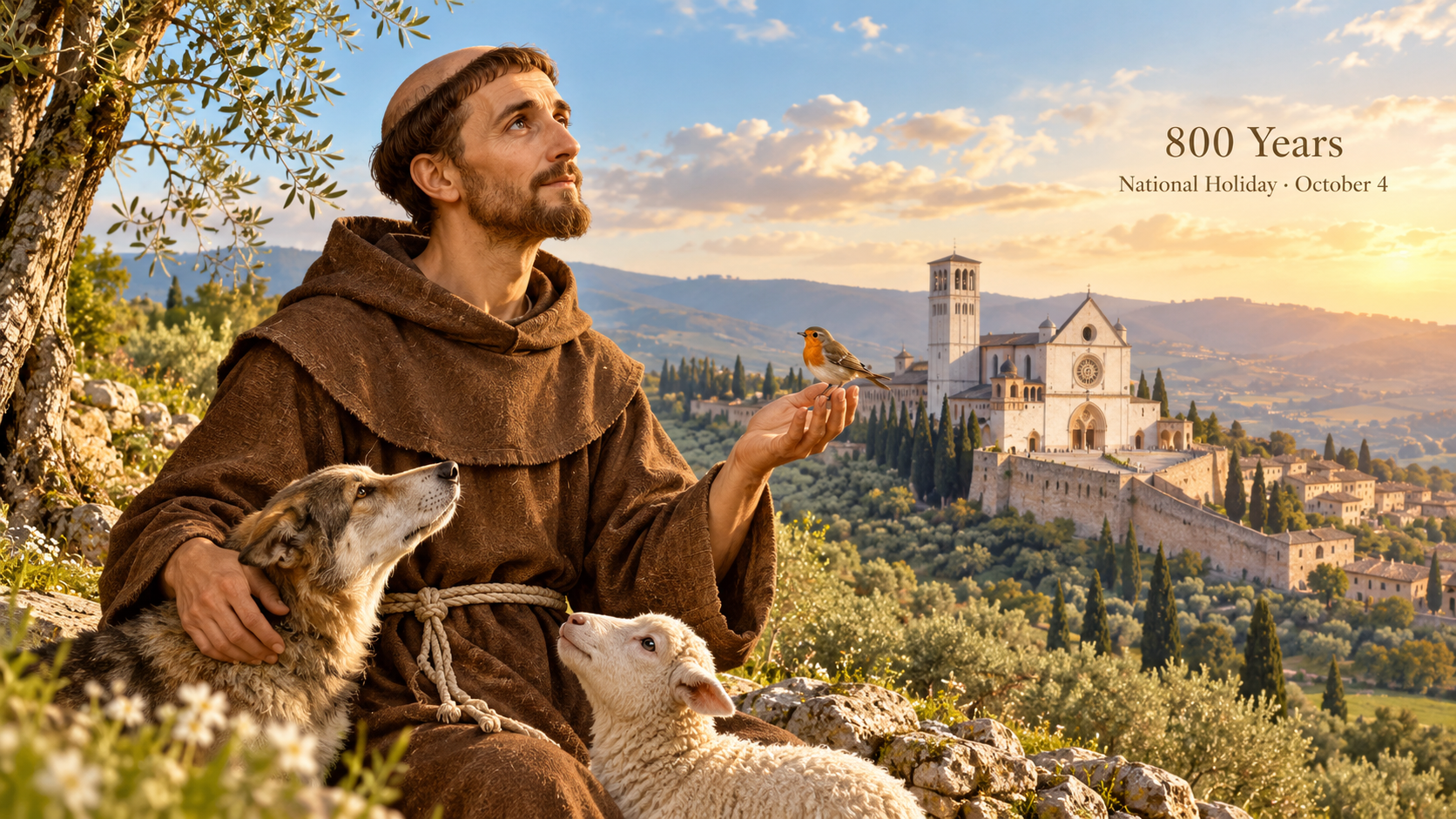
 Eight hundred years after the death of Saint Francis of Assisi, Italy has given his feast day a new place in its national calendar. From 2026, October 4 is an annual national public holiday honoring the saint whose name remains closely associated with peace, simplicity and care for creation.
The anniversary brings together several parts of Italian life: religious devotion, medieval history, literature, art and the landscape of Umbria. It also invites a question that reaches beyond faith. What can a man who rejected wealth in the thirteenth century still say to a society so often preoccupied with acquiring more?
For visitors, the answer begins in Assisi. For Italy, it also begins with a date that now carries renewed civic significance.
October 4 Is Now a National Public Holiday in Italy
Law No. 151 of October 8, 2025, established the national feast of Saint Francis of Assisi and added October 4 to Italy’s statutory public holidays. Published in the Gazzetta Ufficiale on October 10, 2025, the law took effect on January 1, 2026.
This is an annual holiday, continuing beyond the anniversary year. The legislation expressly connects it with peace, fraternity, environmental protection and solidarity.
In 2026, October 4 fell on a Sunday. In 2027, it falls on a Monday. The law fixes the celebration on October 4; it does not create a substitute Monday holiday whenever the date falls on a Sunday.
For anyone planning an October visit, the practical lesson is to check holiday opening hours and transport schedules. A national holiday does not mean every restaurant, museum or visitor attraction closes.
Why the Anniversary Is October 3 but the Feast Is October 4
Francis died at the Porziuncola, near Assisi, on the evening of October 3, 1226. His liturgical feast is celebrated on October 4.
The distinction explains why commemorations span two days. Franciscans remember his death through the Transitus, meaning his passage from earthly life to eternal life. The evening observance on October 3 leads into the feast the following day.
For the eighth centenary, Assisi’s official program scheduled the solemn commemoration of his passing at the Basilica of Santa Maria degli Angeli on October 3, 2026.
These dates belong together, but they describe different things: the historical anniversary of his death and the feast that has now become a national public holiday.
Who Was Saint Francis of Assisi?
Born in Assisi in 1181 or 1182, Francis grew up in a prosperous merchant family. His father traded in cloth, and the young Francis initially imagined a future shaped by status and chivalric ambition.
Military experience, captivity and illness preceded a gradual change in direction. He turned away from wealth and began a life centered on the Gospel, poverty, prayer and service.
Christian tradition places the church of San Damiano at the heart of this transformation. There, Francis understood Christ’s call to repair his church, a task that came to mean much more than rebuilding a damaged structure.
Companions gathered around him, forming the beginnings of the Franciscan movement. His example also inspired Clare of Assisi, whose religious community became central to the wider Franciscan story.
Francis was canonized in 1228, only two years after his death. His influence spread far beyond the town where he had been born.
Why Francis Matters to Italy
Saint Francis and Saint Catherine of Siena were proclaimed the principal patron saints of Italy by Pope Pius XII in 1939. Their religious significance sits alongside a wider place in the country’s cultural memory.
Francis offers an unusual model of national importance. His enduring authority rests on renunciation, humility and concern for others rather than political office or military victory.
That makes his anniversary an opportunity for reflection. A public holiday can create space to consider what a country chooses to honor, and how those values appear in everyday life.
For Catholics, Francis remains a saint whose choices grew from devotion to Christ. Readers of other faiths, or none, may find points of connection in his concern for vulnerable people, his rejection of excess and his language of kinship with the natural world.
Recognizing those shared concerns does not require removing the religious foundations of his life. Understanding them makes the encounter with Francis more complete.
The Canticle of the Creatures and His Lasting Voice
Francis also belongs to the history of Italian literature. His Canticle of the Creatures, associated with 1225 and San Damiano, is among the best-known early works in the Italian vernacular.
The poem praises God through the created world: the sun, moon, wind, water, fire and earth. Its language treats creation as a family to which human beings belong.
Reading it today, the striking quality is its attention. Ordinary elements become worthy of gratitude. Water matters. Light matters. The ground beneath our feet matters.
The Canticle gives the anniversary a voice that can still be read aloud and understood emotionally across the centuries. It also reminds us that Francis’s relationship with nature was spiritual: creation pointed him toward its Creator.
Its eight-hundredth anniversary was marked in 2025. The 2026 centenary concerns Francis’s death, bringing the commemorations of his final years into their concluding stage.
What Has Happened During the 2026 Anniversary?
The centenary has extended beyond the October feast. Italy’s national committee, supported by the Ministry of Culture, has presented a program involving music, performances, cultural projects and initiatives dedicated to Francis’s legacy.
One of the year’s most significant religious events was the public exposition of his mortal remains in Assisi, from February 22 to March 22, 2026. That event has finished; it should not be confused with ordinary visits to the basilica and his tomb.
A separate observance continues beyond October. Pope Leo XIV proclaimed a special Year of Saint Francis running from January 10, 2026, to January 10, 2027.
For Catholic pilgrims, the Vatican decree provides opportunities for a plenary indulgence under the prescribed conditions, including pilgrimage to qualifying Franciscan churches and places of worship. The decree also makes provision for people unable to leave home for serious reasons.
The national holiday, the cultural anniversary program and the religious jubilee are related, but each has its own purpose and timetable. Consult the official organizers for events still to come.
Visiting Assisi Through the Places of Francis
Assisi gives the anniversary a physical setting. The distances between its churches, the slope of its streets and the surrounding countryside help visitors place Francis’s life within a real landscape.
For a wider introduction to the region, see Italia Mia’s guide to Umbria.
The Basilica of Saint Francis
The basilica is a central destination for both pilgrims and art lovers. Its upper and lower churches bring together religious devotion and an extraordinary artistic inheritance, while the tomb provides a focus for prayer.
UNESCO recognizes Assisi, the Basilica of San Francesco and other Franciscan sites as a World Heritage property. The paintings associated with masters including Cimabue, Giotto, Simone Martini and Pietro Lorenzetti help explain the town’s importance to European art.
Allow time to look as well as move. A visit can become a succession of rooms unless you pause to notice how the paintings tell stories through faces, gestures and groups of figures.
Santa Maria degli Angeli and the Porziuncola
Down in the plain, the Basilica of Santa Maria degli Angeli encloses the small Porziuncola chapel. This is essential to understanding Francis’s life and the setting of his final days.
The contrast in scale is memorable: a little church protected inside a much larger building. Plan it as a distinct stop, rather than assuming every Franciscan site lies within the hilltop historic center.
San Damiano and the Eremo delle Carceri
San Damiano connects visitors with Francis’s conversion, Clare’s community and the Canticle. The Eremo delle Carceri, on the wooded slopes of Mount Subasio, introduces another part of the Franciscan landscape: retreat and contemplation.
Check access arrangements before setting out, especially if steep paths or uneven surfaces present difficulties. Choose the sites that interest you most rather than trying to complete every stop in one hurried day.
Italia Mia’s Umbria Between Friends and Stone Cities offers a personal companion to exploring Assisi and the surrounding region.
Planning a Meaningful Visit
Build your visit around a manageable number of places. You might give the basilica and historic center one part of the day, then arrange a separate visit to Santa Maria degli Angeli.
If your purpose is religious, look at service times before deciding when to arrive. If your main interest is art, confirm visitor access around worship and special ceremonies. These are working places of prayer as well as cultural landmarks.
For accommodation planning, Italia Mia’s guide to where to stay in every Italian region helps place Assisi within a wider Umbrian journey.
Leave room for the town itself. Sit in a square, walk a quieter street and look out toward the valley. The landscape is part of the experience, not simply the space between monuments.
What Eight Hundred Years Can Still Teach Us
An anniversary can honor the past without asking much of the present. Francis makes that comfortable distance harder to maintain.
His life raises practical questions. How much do we need? Who receives our attention? What happens when possessions become the measure of success? Can care for the natural world begin with gratitude rather than ownership?
There is no need to pretend that medieval Assisi and contemporary Italy face identical problems. The value of returning to Francis lies partly in encountering a different set of priorities.
October 4 now gives Italy a recurring date on which to consider those priorities. The most lasting tribute may be what happens after the ceremonies: an act of generosity, an attempt at reconciliation, or greater care for a place and the people who share it.
External Sources
- Gazzetta Ufficiale: Law No. 151 of October 8, 2025
- Vatican: Saint Francis of Assisi, historical and spiritual overview
- National Committee for the Eighth Centenary
- San Francesco Vive: the 2026 exposition
- Vatican: decree for the special Year of Saint Francis
- UNESCO: Assisi and its Franciscan sites
- Visit Assisi: official tourist information