Updated October 7, 2026
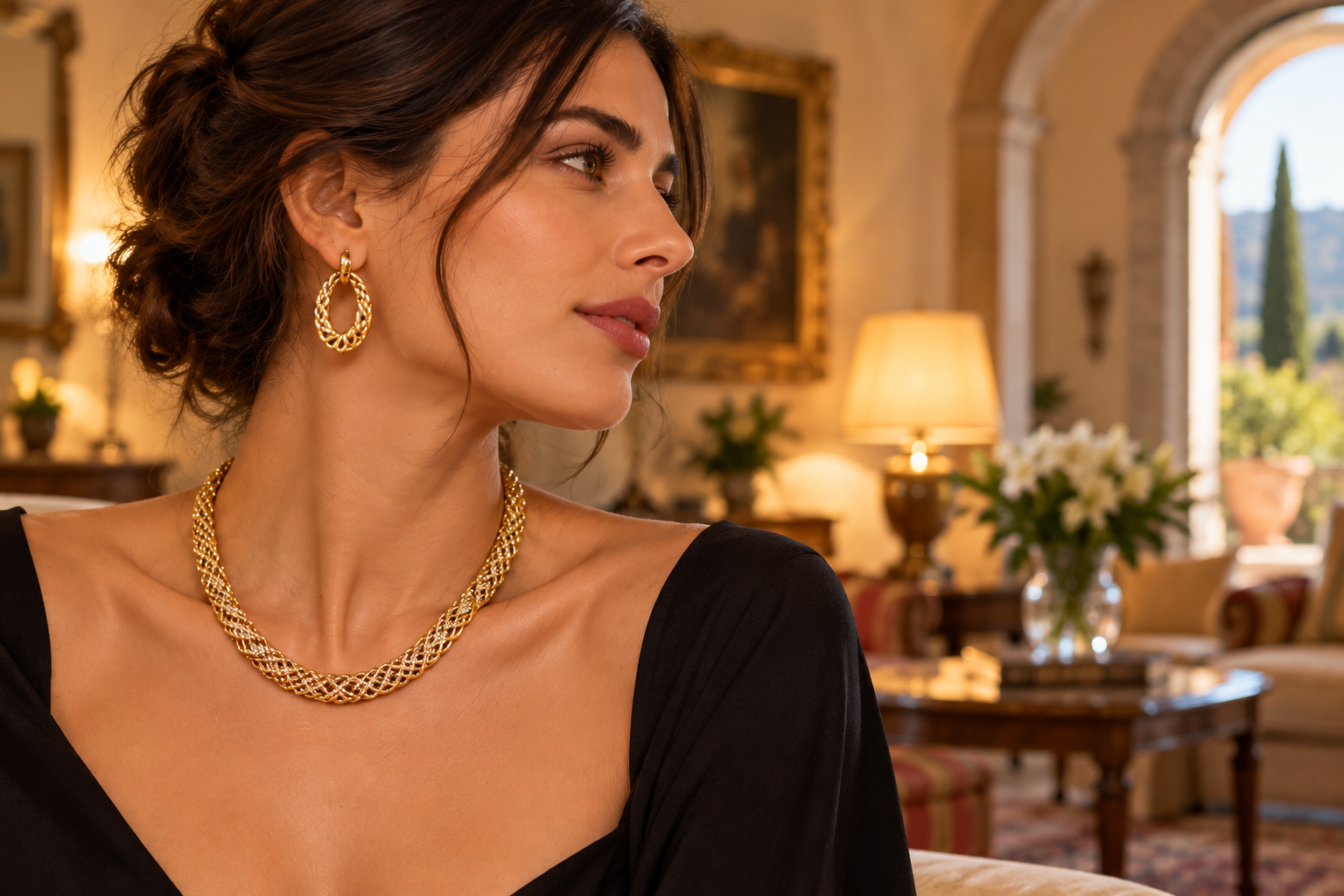 Italian jewelry is one of the most recognizable expressions of Made in Italy. From an 18-karat gold chain made in Arezzo to a diamond ring crafted in Valenza, an engraved bracelet from Vicenza, a coral cameo from Torre del Greco or colorful glass earrings made in Murano, jewelry in Italy is closely connected to place, craftsmanship and centuries of artistic tradition.
Italy’s reputation did not develop simply because Italian designers know how to create beautiful objects. The country’s strength comes from an extraordinary network of specialized jewelry districts, family businesses, goldsmiths, stone setters, engravers, designers and manufacturers.
The result is an industry that ranges from small artisan workshops to internationally famous luxury houses.
Jewelry also fits naturally into the wider story of Italian fashion. Italian style has traditionally depended on details: the cut of a jacket, the quality of leather, a beautiful pair of shoes, a scarf, a watch or a carefully chosen piece of jewelry.
But if you are buying Italian jewelry, beauty should not be your only consideration. You should understand what markings such as 750 and 925 mean, why the place of manufacture matters, and how to distinguish genuine Italian craftsmanship from products that simply use an Italian-sounding name.
This guide explores the materials, techniques, jewelry districts and traditions that have made Italy one of the world’s great jewelry-producing countries.
Why Italian Jewelry Is So Highly Regarded
Italian jewelry has never represented a single aesthetic.
Some pieces are delicate and traditional. Others are large, colorful and unmistakably contemporary. Italian designers work with yellow, white and rose gold, silver, platinum, diamonds, colored gemstones, coral, cameos, enamel and glass.
What connects the best Italian jewelry is the attention given to design and finishing.
A beautifully made chain, for example, may appear simple until you examine how consistently its links have been formed and joined. An engraved gold bracelet may require considerable hand finishing. A gemstone ring depends not only on the stone but on the precision of the setting and construction.
This relationship between design and manufacturing is one of the foundations of Made in Italy.
The same principle appears throughout Italian fashion. Our guide to Italian fashion designers explains how Italy’s fashion success has depended on networks of specialist manufacturers and craftspeople as much as on famous names.
Jewelry follows a similar model.
Several regions have developed particular expertise, creating districts where skills are passed between generations and where designers can work with highly specialized manufacturers.
The Great Jewelry Districts of Italy
If you want to understand Italian jewelry, begin with geography.
Arezzo, Vicenza and Valenza are particularly important centers of the Italian precious-metal industry, while Torre del Greco has a distinctive tradition associated with coral and cameos.
Each developed its own specialties.
Vicenza: One of Italy’s Great Gold Centers
Vicenza, in the Veneto region, is one of the most important names in Italian jewelry.
The city and surrounding area developed a sophisticated goldsmithing and jewelry-manufacturing network capable of producing everything from relatively accessible pieces to elaborate fine jewelry.
Vicenza is also internationally important because of Vicenzaoro, the major jewelry trade show that brings together designers, manufacturers, gemstone specialists, technology companies and buyers from around the world.
The district demonstrates an important point about Italian jewelry: craftsmanship and technology are not necessarily opposites.
Modern Italian manufacturers may use computer-assisted design, laser technology and sophisticated production equipment while preserving traditional skills such as polishing, setting, engraving and finishing.
Arezzo: The Goldsmithing Powerhouse of Tuscany
Arezzo is another major center of Italian gold production.
The Tuscan city has a long goldsmithing tradition and developed an extensive network of jewelry companies and specialist manufacturers.
Arezzo is particularly associated with gold jewelry, chains and industrial expertise. The district combines large manufacturers with smaller specialized businesses, allowing it to produce an enormous variety of styles.
For shoppers, this helps explain why two pieces labeled Made in Italy can look completely different.
One may be a delicate machine-assisted chain designed for everyday use. Another may involve extensive hand finishing. Both can represent legitimate Italian manufacturing traditions.
Valenza: Fine Jewelry and Precious Stones
Valenza, in Piedmont, occupies a particularly prestigious place in Italian jewelry.
Its reputation is strongly connected to fine jewelry, precious stones and highly skilled goldsmithing.
Creating an elaborate gemstone piece requires several distinct abilities. The design must account for the stones, settings and structure of the finished object. Gemstones must be selected and positioned correctly. Metal components must be formed and assembled with extraordinary precision.
That concentration of expertise helped make Valenza synonymous with high-end Italian jewelry.
It remains one of the places where the distinction between jewelry manufacturing and jewelry as an art form becomes especially difficult to draw.
Torre del Greco: Coral and Cameos
Near Naples, Torre del Greco represents a very different Italian jewelry tradition.
The town became internationally renowned for the working of coral and shell cameos.
Cameo carving requires the artisan to use differently colored layers of shell to create a raised image against a contrasting background. Classical profiles, mythological figures, flowers and portraits are traditional subjects, although contemporary artists have expanded the vocabulary considerably.
A fine cameo is not simply a souvenir.
It is a miniature sculpture.
Collectors should pay attention to the quality of the carving, the material, the mounting and, when buying an important piece, its maker and provenance.
Coral requires additional care from a modern buyer because international wildlife and trade regulations can affect particular species and products. For expensive or antique coral jewelry, ask the seller exactly what material is being sold and request documentation when appropriate.
Italian Gold: Understanding 18K and the 750 Mark
Gold is central to the international image of Italian jewelry.
Traditionally, Italian fine jewelry is strongly associated with 18-karat gold, which contains 75 percent pure gold.
That is why one of the most important numbers to recognize when shopping is:
750 = 18K gold
Italy’s legal gold fineness standards also include:
585 = 14K gold
375 = 9K gold
The higher proportion of pure gold in 18K jewelry gives it a rich appearance that many people associate with Italian fine jewelry.
However, color alone does not prove purity.
Gold can be alloyed with other metals to create different colors and properties. Italian jewelry is available in yellow gold, white gold and rose gold, and the precise appearance varies according to the alloy and finishing.
A genuine piece should be evaluated by its markings, construction and seller rather than by color alone.
How Italian Jewelry Hallmarks Work
This is one of the most useful things to understand before buying jewelry in Italy.
Italian precious-metal regulations cover gold, silver, platinum and palladium. Precious-metal objects placed on the Italian market are generally required to carry information identifying their fineness and an identification mark associated with the producer or importer, subject to the applicable rules and exemptions.
The identification mark traditionally includes a five-pointed star, a number and a two-letter provincial abbreviation.
That information provides considerably more assurance than vague phrases such as “Italian style” or “designed in Italy.”
For gold, common legal fineness marks include 750, 585 and 375.
For silver, the principal legal fineness marks are 925 and 800.
If you are considering an expensive piece, use a loupe or ask the jeweler to show you the marks.
And ask questions.
Where was the piece manufactured? Who made it? What is the metal fineness? Are the stones natural, laboratory-grown or treated? Is documentation provided?
A reputable jeweler should be comfortable answering them.
Italian Sterling Silver
Gold receives much of the attention, but Italy also has a significant silver-working tradition.
925 silver means that the alloy contains 925 parts silver per thousand, or 92.5 percent. This is what is commonly known as sterling silver.
Italian silver jewelry can range from minimalist contemporary designs to heavily textured, engraved or sculptural pieces.
Silver also allows designers to create larger pieces at a substantially lower material cost than gold.
That makes Italian silver particularly interesting for buyers who value craftsmanship and design but do not necessarily want the price of an equivalent piece in 18K gold.
As with gold, examine the marks rather than relying exclusively on the seller’s description.
Murano Glass Jewelry: Wearable Venetian Art
Not all great Italian jewelry is made from precious metals.
On the Venetian island of Murano, glassmakers have developed techniques that transformed glass into one of Italy’s most recognizable artistic materials.
Murano glass jewelry can include beads, pendants, rings, necklaces, bracelets and earrings in extraordinary combinations of color.
The attraction is not monetary value in the same sense as gold or diamonds. It is artistry.
Individual beads may contain layers of colored glass, metallic effects, floral patterns or complex decorative techniques.
If this side of Italian craftsmanship interests you, read our complete Murano Glass Guide and our guide to Muranonet and Murano glass jewelry.
Authenticity matters here too.
The words “Murano style” do not mean that an object was made on Murano. When origin matters to you, ask who produced the piece, where it was made and what documentation accompanies it.
Famous Italian Jewelry Houses
Italy’s jewelry culture also produced some of the world’s most recognizable luxury houses.
Bulgari, founded in Rome by Greek-born silversmith Sotirio Bulgari, developed a particularly bold interpretation of Italian luxury. Color, substantial forms, classical references and striking combinations of gemstones became part of its visual identity.
Buccellati, founded in Milan, is celebrated for elaborate goldsmithing and distinctive surface treatments that can make precious metal resemble silk, lace or finely woven fabric.
Damiani, founded in Valenza, emerged from the city’s fine-jewelry tradition and became an internationally recognized Italian luxury jewelry house.
Pomellato, founded in Milan in 1967, helped establish a more contemporary concept of fine jewelry designed to be worn relatively informally rather than reserved exclusively for important occasions.
Roberto Coin, based in Vicenza, represents another connection between an international luxury brand and one of Italy’s principal jewelry districts.
These companies are only the most visible part of the story.
Across Italy there are smaller workshops, independent designers and family goldsmiths producing work that may never have the global recognition of the major houses.
For travelers, discovering those artisans can be one of the pleasures of shopping in Italy.
Handmade Does Not Automatically Mean Better
The word “handmade” is heavily used in luxury marketing.
It deserves some skepticism.
Italian jewelry production ranges from completely hand-fabricated one-of-a-kind pieces to sophisticated industrial manufacturing. Many excellent pieces combine the two.
Modern technology can produce remarkable precision. Hand finishing can add character and refinement. Neither method automatically guarantees quality.
Instead, examine the finished object.
Look at the soldering, clasps, hinges, stone settings, symmetry, polish and backs of pieces. Earrings should feel balanced. Clasps should operate securely. Stones should sit properly in their settings.
Fine workmanship usually reveals itself in places that were not designed to be immediately visible.
How to Buy Italian Jewelry in Italy
Buying jewelry while traveling can be extremely rewarding, but do not allow the romance of being in Florence, Venice, Rome or Milan to replace normal shopping judgment.
First, decide what you are buying.
A €100 pair of decorative earrings requires a different level of investigation from a €10,000 diamond ring.
For precious-metal jewelry, examine the fineness and identification marks.
For significant gemstones, ask for documentation appropriate to the value of the stone.
For branded jewelry, buy through the brand itself or a clearly authorized retailer when authenticity is important.
Ask for a detailed receipt identifying the article and materials.
Do not assume that something is Made in Italy simply because you purchased it in Italy.
Italian tourist centers contain imported products alongside locally manufactured ones. “Italian design,” “Italian style” and an Italian company name do not necessarily establish Italian manufacture.
Our broader Italian Shopping guide can help you explore other Made in Italy products and specialist shopping guides.
Buying Vintage and Antique Italian Jewelry
Vintage jewelry offers another route into Italian design.
Estate jewelers, antique dealers and specialized auctions can reveal styles that are no longer widely produced.
Older gold chains, mid-century designs, cameos, coral jewelry and signed pieces can be especially interesting.
But vintage jewelry introduces additional questions.
Has the piece been repaired? Are all components original? Have stones been replaced? Is a signature authentic? Has the piece been resized? Is the stated date plausible?
For inexpensive jewelry, you may simply buy what you love.
For a costly collectible piece, provenance and specialist expertise become much more important.
Caring for Italian Jewelry
Good jewelry can last for generations, but different materials require different care.
Gold jewelry should be kept away from harsh chemicals and stored so that pieces do not continually scratch one another.
Gemstone jewelry requires more specialized treatment because not every stone tolerates heat, chemicals or ultrasonic cleaning.
Silver naturally tarnishes and can generally be polished with products intended for silver.
Coral, pearls and some other organic materials are more delicate. Avoid aggressive cleaners and unnecessary exposure to cosmetics, perfume and chemicals.
Murano glass should be protected from impacts and stored so that beads and pendants cannot strike hard objects.
When in doubt, follow the maker’s instructions or have valuable jewelry professionally cleaned.
Why Italian Jewelry Still Matters
Italian jewelry survives because the industry has never depended entirely on nostalgia.
Its history matters, but so does its ability to change.
Computer-aided design now exists beside hand engraving. International luxury groups operate beside family workshops. Contemporary designers experiment with forms that would have surprised earlier generations of Italian goldsmiths.
Yet the underlying principle remains remarkably consistent.
Italy excels at turning materials into objects people want to touch, wear and keep.
That is the same instinct found in Italian tailoring, leatherworking, furniture, ceramics, automobiles and glass.
It explains why jewelry belongs naturally within the broader tradition of Made in Italy.
A gold bracelet from Vicenza, a chain from Arezzo, a gemstone ring from Valenza, a cameo from Torre del Greco and a glass necklace from Murano may have little in common visually.
What connects them is place.
Each represents a specialized Italian tradition in which design, material and technical skill developed together.
For the buyer, that is the real appeal of Italian jewelry.
You are not simply choosing something beautiful.
At its best, you are buying an object connected to generations of Italian craftsmanship—and something beautiful enough to become part of your own history.
Frequently Asked Questions About Italian Jewelry
What is Italian gold?
Italian gold is not a separate type of gold. The term generally refers to gold jewelry manufactured in Italy. Italy is particularly well known for 18K gold jewelry, identified by the fineness mark 750.
What does 750 mean on Italian jewelry?
The number 750 indicates that the alloy contains 750 parts pure gold per thousand, equivalent to 18-karat gold.
What does 925 mean on Italian jewelry?
The number 925 means that the alloy contains 92.5 percent silver. It is commonly known as sterling silver.
Which Italian cities are famous for jewelry?
Vicenza, Arezzo and Valenza are three of Italy’s principal jewelry districts. Torre del Greco is especially famous for cameos and coral working, while Milan and Rome are important centers for jewelry design and luxury brands.
Is all jewelry sold in Italy made in Italy?
No. Italy is a major jewelry producer, but Italian shops also sell imported products. Check the markings, documentation and stated country of manufacture when Italian origin is important.
Is Murano glass jewelry valuable?
Its value varies enormously. Murano glass jewelry should primarily be evaluated according to authenticity, maker, technique, craftsmanship, design and condition rather than the intrinsic value of the glass itself.
What should I look for when buying Italian jewelry?
Check the metal fineness, maker or identification marks, quality of construction, seller’s reputation and documentation. For valuable gemstones or collectible pieces, request appropriate certification or provenance information.
External Sources
Italian Ministry of Enterprises and Made in Italy — Precious Metals
https://www.mimit.gov.it/it/mercato-e-consumatori/normativa-tecnica/metrologia/metalli-preziosi
Camera di Commercio di Vicenza — Precious-Metal Identification Marks
https://www.vi.camcom.it/it/servizi/metrologia/registro-assegnatari-marchio-identificazione-metalli-preziosi
Confindustria Federorafi — Italian Goldsmith and Jewelry Industry
https://www.federorafi.it/
Normattiva — Legislative Decree No. 251/1999
https://www.normattiva.it/