
 Artemide: Italian Lighting Where Design Meets Innovation
Few companies have influenced modern lighting as profoundly as Artemide. Founded in Milan in 1960, the Italian company has created some of the most recognizable lamps of the twentieth and twenty-first centuries. Its designs appear in private homes, offices, hotels, museums and architectural projects around the world.
Artemide lamps are more than sources of illumination. They are carefully designed objects that explore how light affects human comfort, concentration, mood and the perception of space.
The company’s philosophy, summarized by the expression “The Human Light,” places people at the center of lighting design. A successful lamp must not only look beautiful: it should provide the right kind of light, in the right place, for the person using it.
This combination of Italian creativity, engineering and attention to human needs has allowed Artemide to remain influential for more than six decades.
Alongside companies such as Alessi, Flos, Kartell and Bialetti, Artemide represents the remarkable ability of Italian manufacturers to turn practical household products into internationally recognized works of design.
The History of Artemide
Artemide was founded in Milan in 1960 by Ernesto Gismondi, an aeronautical engineer, and architect and designer Sergio Mazza.
The company emerged during one of the most exciting periods in the history of Italian design. Postwar Italy was experiencing rapid industrial growth, while architects and designers were experimenting with new plastics, metals, manufacturing processes and ideas about modern living.
From the beginning, Artemide combined industrial research with artistic imagination. Instead of treating a lamp as a decorative shell surrounding a bulb, the company explored the movement, direction, intensity and emotional effect of light.
Its early catalog included lighting, furniture and experimental plastic objects. Over time, however, lighting became Artemide’s defining specialty.
The company collaborated with an extraordinary list of architects and designers, including:
- Vico Magistretti
- Richard Sapper
- Michele De Lucchi
- Giancarlo Fassina
- Gio Ponti
- Giancarlo Mattioli
- Ettore Sottsass
- Mario Botta
- Ross Lovegrove
- Naoto Fukasawa
- Herzog & de Meuron
- Issey Miyake
- Zaha Hadid
- Bjarke Ingels Group
These collaborations produced lamps that ranged from simple desktop tools to sculptural installations and technically advanced architectural lighting systems.
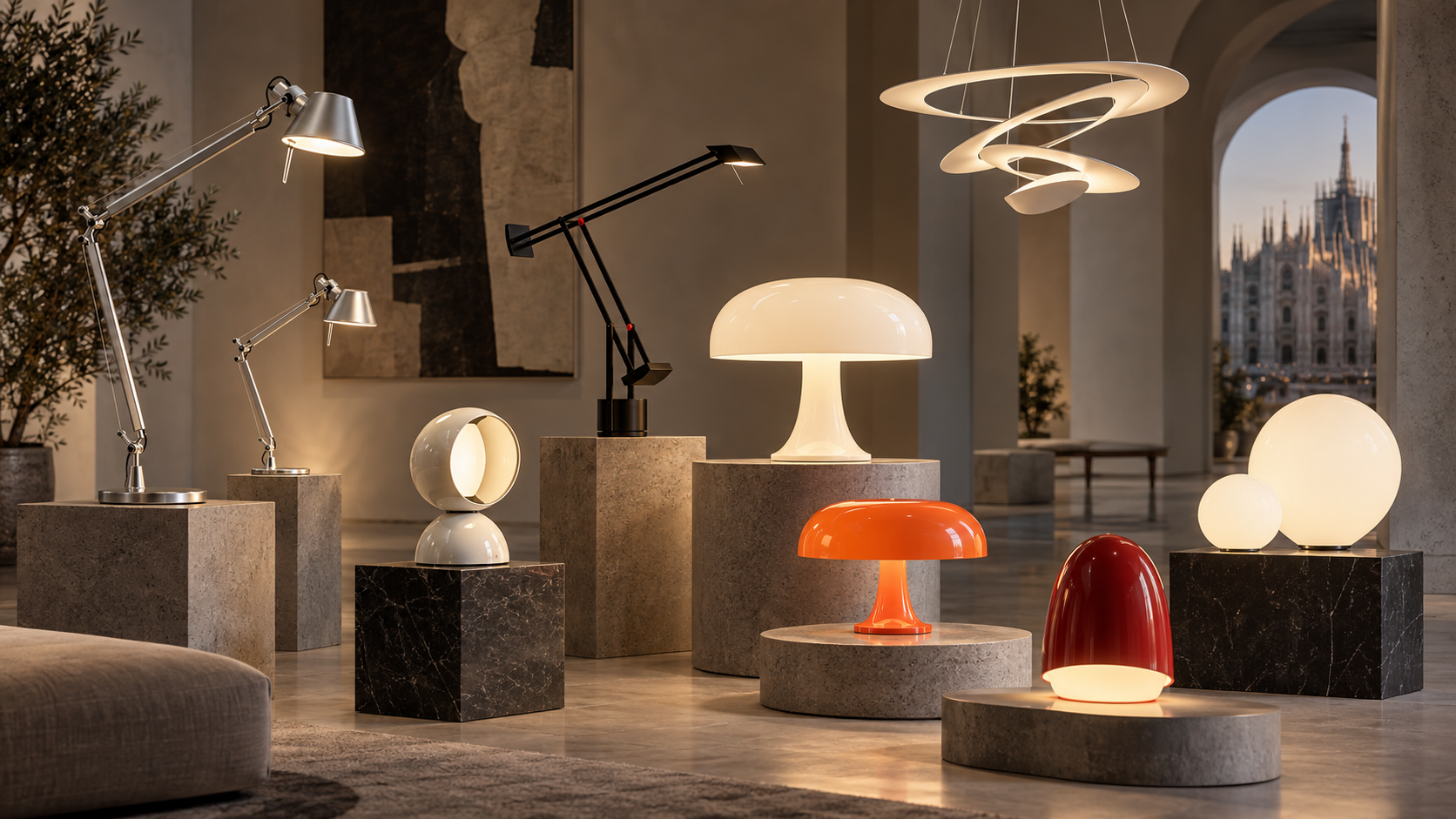
Artemide’s official history includes landmarks such as Eclisse, awarded the Compasso d’Oro in 1967; Tizio, introduced in 1972; and Tolomeo, launched in 1987 and later honored with the Compasso d’Oro.
Why Artemide Lamps Are Important
Artemide helped demonstrate that lighting could be simultaneously functional, emotional and intellectually sophisticated.
Several principles distinguish the company’s designs.
Light Designed Around People
Artemide’s lamps frequently allow users to control the direction, intensity or quality of illumination. Adjustable arms, rotating shades and dimming systems give people an active role in shaping their environment.
Technological Experimentation
The company has continually explored new materials, optical systems, LEDs, manufacturing methods and digital controls. Its designers often integrate the technical mechanism into the lamp’s appearance rather than attempting to conceal it.
Collaboration With Leading Designers
Each Artemide lamp reflects the personality of its designer while remaining connected to the company’s broader philosophy. The catalog includes minimalist task lamps, colorful Space Age objects, sculptural pendants and advanced architectural systems.
Designs That Remain in Production
Many Artemide products have remained available for decades. Lamps such as Eclisse, Tizio, Nesso and Tolomeo do not feel like short-lived fashion accessories. They belong to the permanent vocabulary of modern design.
Ten Iconic Artemide Lamps for the Home
The following ten products represent different periods, designers and approaches to light. Together, they provide an excellent introduction to the Artemide collection.
1. Artemide Tolomeo Table Lamp
Designed by Michele De Lucchi and Giancarlo Fassina, the Tolomeo table lamp was introduced in 1987. It has since become one of the most recognizable desk lamps in the world.
Tolomeo’s appearance is purposeful and architectural. Its aluminum structure, articulated arms, exposed tension cables and spring-balancing system communicate how the lamp works. Nothing feels unnecessarily decorative.
The adjustable arms allow the lamp to be raised, lowered and repositioned with minimal effort. Its rotating reflector directs the light precisely where it is needed, making Tolomeo especially useful for reading, drawing, studying or working at a desk.
Despite its technical construction, Tolomeo has a remarkably light visual presence. It works equally well in a traditional study, a contemporary office or a minimalist living space.
The lamp received the Compasso d’Oro in 1989 and eventually developed into an extensive family that includes floor, wall, suspension and smaller table versions. Artemide describes the original as a balance between functionality and aesthetics, built around a flexible spring mechanism and adjustable aluminum reflector.
Check the Artemide Tolomeo Table Lamp on Amazon
2. Artemide Tolomeo Micro Table Lamp
The Tolomeo Micro preserves the mechanical elegance of the original Tolomeo in a more compact format.
Its smaller proportions make it suitable for bedside tables, compact desks, bookshelves and work areas where a full-size Tolomeo might occupy too much space. The lamp still offers an adjustable arm and directional shade, allowing the user to position the light accurately.
Tolomeo Micro is particularly attractive in interiors where space is limited but design quality remains important. It can provide focused illumination without visually dominating the room.
Depending on the version and market, the lamp may be available in classic aluminum or a selection of colors. A brightly colored Tolomeo Micro can serve as a small accent piece, while the aluminum version retains the industrial character of the original.
It is a practical choice for anyone who admires Tolomeo but wants a lighter and less imposing desk lamp.
Check the Artemide Tolomeo Micro Lamp on Amazon
3. Artemide Eclisse
Designed by Vico Magistretti in 1965 and placed into production by Artemide in 1967, Eclisse is one of the great classics of Italian lighting.
Its name means “eclipse” in Italian. Inside the rounded outer body is a rotating inner shade that can partially or completely cover the light source. As the shade turns, the user can move from direct illumination to a softer, indirect glow.
This simple mechanism gives the lamp its identity. Instead of relying on complicated electronics, Eclisse controls light through physical movement.
The compact, rounded form reflects the optimism and experimentation of 1960s Italian design. At the same time, its simplicity allows it to fit comfortably into contemporary interiors.
Eclisse won the Compasso d’Oro in 1967. The lamp remains available in several finishes and colors, including versions that accentuate its playful Space Age personality.
It works well on a nightstand, shelf, side table or desk. Even when switched off, it remains an unmistakable design object.
Check the Artemide Eclisse Lamp on Amazon
4. Artemide Tizio
Tizio, designed by German industrial designer Richard Sapper in 1972, is an engineering masterpiece disguised as a desk lamp.
Its most distinctive feature is the absence of visible electrical wires along the arms. The structure itself conducts electricity to the light source. Counterweights allow the user to reposition the lamp while maintaining its balance.
The result is a sculptural composition of slender arms, joints and geometric forms. Tizio can be extended over a work surface, lowered for focused illumination or folded into a more compact configuration.
The original lamp used a halogen source, which was innovative when the design appeared. Contemporary versions and replacement configurations may differ, so buyers should examine the specifications carefully before ordering.
Tizio is ideal for a modern office, architectural studio or reading area. The black version is especially dramatic, creating a strong graphic silhouette against a pale wall.
Artemide considers Tizio one of the icons of both its collection and international Italian design.
Check the Artemide Tizio Lamp on Amazon
5. Artemide Nesso
With its mushroom-like silhouette and glowing curves, Nesso is one of the most exuberant lamps in the Artemide catalog.
Designed by Giancarlo Mattioli and the Gruppo Architetti Urbanisti Città Nuova, Nesso emerged from the experimental design culture of the 1960s. Its flowing form was made possible by advances in molded plastic technology.
The wide shade conceals the light sources and distributes illumination downward and through the body of the lamp. When illuminated, Nesso appears to glow from within.
Its sculptural form makes it particularly effective on a console, sideboard or substantial side table. The lamp requires more room than many conventional table lamps, but that visual presence is part of its appeal.
Orange versions emphasize Nesso’s unmistakable 1960s character, while white versions are easier to integrate into restrained contemporary interiors.
Nesso is a lamp for people who want lighting to be noticed. It serves as illumination, sculpture and a conversation piece simultaneously.
Check the Artemide Nesso Lamp on Amazon
6. Artemide Nessino
Nessino is the smaller, more versatile relative of Nesso. It retains the famous mushroom-shaped silhouette but adapts it to compact rooms and smaller surfaces.
The lamp’s curved shade creates a gentle pool of light, while its translucent body gives it a warm, luminous appearance. Its scale makes it suitable for a bedside table, bookcase, desk, console or small living-room table.
Nessino is one of the easiest Artemide icons to introduce into an ordinary home. It has a strong personality without requiring the amount of space demanded by the full-size Nesso.
Artemide describes Nessino as a compact reinterpretation of Nesso’s iconic lines.
The orange model provides a bold retro accent. White is quieter and works well in minimalist rooms, while red versions add a particularly vivid burst of color.
Because similar-looking reproductions are widely available, purchasers should check the manufacturer, dimensions, materials, packaging and seller carefully before assuming that a lamp is an authentic Artemide product.
Check the Artemide Nessino Lamp on Amazon
7. Artemide Dalù
Originally designed by Vico Magistretti in the 1960s, Dalù reflects the designer’s ability to create memorable objects using simple forms.
The lamp consists of a flowing molded body that curves forward to support and conceal the light source. Its smooth surfaces and compact dimensions give it a distinctly retro appearance without making it feel like a museum piece.
Dalù is less technically complex than Tolomeo or Tizio. Its attraction comes from the purity of its silhouette and the way the material interacts with light.
It works particularly well as a bedside lamp or as a decorative accent on a shelf or side table. Because of its modest dimensions, Dalù can also be used in pairs without overwhelming a room.
The lamp is an appealing choice for someone seeking an accessible example of Italian modernism. It has a recognizable designer pedigree, but it remains practical enough for everyday use.
Check the Artemide Dalù Lamp on Amazon
8. Artemide Come Together
Designed by Carlotta de Bevilacqua, Come Together brings Artemide’s human-centered approach into the era of portable LED lighting.
The lamp is rechargeable and designed to be moved from one area to another. It can provide light on a dining table, beside a chair, on a terrace or anywhere a permanent electrical connection would be inconvenient.
Its transparent body is more than a decorative element. It forms part of an optical system designed to control and distribute the LED light efficiently.
Come Together represents a different side of Artemide. Instead of becoming a fixed architectural presence, it follows the user and adapts to changing activities.
This mobility is particularly useful in smaller homes, where a single object may need to perform several functions. It also allows the lamp to create intimate pools of illumination during dinners or evening conversations.
Buyers should check the voltage, charging system, light temperature and included accessories, as specifications can vary among versions and markets.
Check the Artemide Come Together Lamp on Amazon
9. Artemide Pirce Suspension Lamp
Designed by Giuseppe Maurizio Scutellà, Pirce turns a ceiling light into an aerial sculpture.
The fixture appears to have been cut from a thin disc that unfolds into a descending spiral. Light is projected upward and reflected by the curved surfaces, creating indirect illumination and dramatic shadows.
Pirce is especially effective above a dining table, in a stairwell or in a room with sufficient ceiling height to accommodate its suspended form.
Unlike a conventional pendant with a shade surrounding the bulb, Pirce uses its entire structure to shape and reflect light. The visual effect changes according to the viewing angle, making the fixture feel dynamic even though it remains stationary.
This is one of the more architectural products in the selection. Before buying, it is essential to verify the dimensions, suspension height, electrical requirements and suitability of the ceiling.
Pirce can transform a simple room, but it needs enough open space to be appreciated.
Check the Artemide Pirce Suspension Lamp on Amazon
10. Artemide Dioscuri Table Lamp
Designed by Michele De Lucchi, Dioscuri reduces a lamp to one of the purest forms imaginable: a glowing sphere.
The diffuser sits on a discreet base, producing soft, even illumination. Its geometric simplicity allows the lamp to work in almost any interior, from a modern apartment to a more traditional bedroom.
Dioscuri is available in different sizes, making it possible to use a small version on a bedside table or a larger model as a more substantial decorative light.
The spherical diffuser softens the light and avoids the visual complexity of an exposed bulb or articulated mechanism. This makes Dioscuri a useful contrast to the technical character of Tolomeo and Tizio.
Several sizes can also be grouped to create a composition of luminous spheres. Before ordering, buyers should check whether the listing refers to the table or wall version and confirm the dimensions.
Check the Artemide Dioscuri Lamp on Amazon
Which Artemide Lamp Should You Choose?
The best Artemide lamp depends on how the light will be used.
For a desk or home office, Tolomeo offers exceptional flexibility and a lighter visual presence, while Tizio provides a more dramatic and technical appearance.
For a bedside table, Eclisse, Nessino, Dalù or a smaller Dioscuri can provide softer illumination without occupying too much space.
For a living room, Nesso makes a powerful decorative statement. Come Together is better suited to people who want a portable lamp that can move between rooms.
For a dining area or architectural interior, Pirce provides the greatest visual impact, although it requires professional installation and adequate ceiling space.
How to Recognize an Authentic Artemide Lamp
The international popularity of Artemide has led to numerous copies and “inspired by” products. Some reproductions may imitate the general shape while using inferior materials, electrical components and finishes.
Before purchasing, examine the following details:
- The listing should clearly identify Artemide as the manufacturer.
- The designer’s name and exact model should be provided.
- Dimensions should correspond with Artemide’s official specifications.
- Product photographs should show high-quality finishing and construction.
- Electrical certification should be appropriate for the buyer’s country.
- The seller should have a credible history and a clear return policy.
- Extremely low prices should be treated with caution.
- Used lamps should be checked for replacement parts or altered wiring.
With vintage Tizio, Eclisse and Nesso lamps, normal variations may exist among different production periods. Rewiring an older lamp may also be necessary before it can be safely used.
Artemide in Museums and Design History
Artemide’s influence extends far beyond retail lighting.
Its products have entered museum collections and exhibitions devoted to modern industrial design. Eclisse, Tizio, Nesso and Tolomeo are studied not merely as attractive lamps, but as examples of how designers solved practical problems through form, mechanics and new materials.
Italia Mia explores this broader relationship between everyday products and museum culture in Italian Design That Has Been Selected at the MoMA of New York.
Artemide also belongs to the larger history of Italian companies that built international identities through design. You can discover more of these companies in The Ultimate Guide to Iconic Italian Brands.
For readers interested in another major Italian lighting company, FLOS: The Art of Italian Lighting offers a useful comparison.
A Lasting Expression of Made in Italy
Artemide has succeeded because it does not treat lighting as an afterthought.
From Eclisse’s rotating inner shade to Tizio’s counterbalanced arms and Tolomeo’s spring mechanism, the company’s most memorable products invite people to interact with light.
Some Artemide lamps are playful. Others are technical, architectural or sculptural. What connects them is a belief that intelligent design can improve even the most ordinary daily activities.
A Tolomeo on a desk makes work more comfortable. An Eclisse beside the bed allows the user to soften the light with a simple gesture. A Nesso transforms a practical object into an illuminated sculpture.
That is the enduring appeal of Artemide: the company does not merely produce lamps. It creates tools that help people shape the atmosphere of the spaces in which they live.
Related Italia Mia Articles
- The Ultimate Guide to Iconic Italian Brands
- Italian Design That Has Been Selected at the MoMA of New York
- FLOS: The Art of Italian Lighting
- Italian Shopping Websites
External Links
- Artemide official website
- Artemide company history
- Artemide Design Collection
- ADI Design Museum
- The Museum of Modern Art Design Collection