
 Bialetti: The Italian Coffee Maker That Became a National Icon
Few objects express Italian identity as clearly as the Bialetti Moka Express.
Its octagonal aluminum body, black handle and familiar little man with a mustache have occupied Italian kitchens for generations. The moka is used in city apartments, country houses, student kitchens and seaside vacation homes. It accompanies hurried weekday mornings, long Sunday lunches and the arrival of unexpected guests.
Although its construction appears remarkably simple, the Moka Express changed the way Italians consumed coffee. It made it possible to prepare a strong, aromatic drink at home without the elaborate equipment used in cafés.
In doing so, Bialetti transformed a practical household appliance into one of the most recognizable examples of Italian industrial design.
The company now produces numerous stovetop coffee makers, induction models, electric appliances, milk frothers, cups and coffee blends. Nevertheless, its identity remains inseparable from the original Moka Express introduced in 1933.
From an Aluminum Workshop to an Italian Institution
The story began in 1919, when Alfonso Bialetti opened a workshop in Crusinallo, a hamlet near Omegna in Piedmont. The business initially manufactured semi-finished aluminum products before developing finished household objects.
Alfonso had previously worked in France, where he learned techniques for casting aluminum. At the time, aluminum was becoming associated with modern manufacturing: it was light, relatively economical and suitable for creating objects in distinctive geometric forms.
In 1933, Alfonso developed the Moka Express, a stovetop coffee maker that would eventually change everyday life in Italy. According to Bialetti, its name refers to Mokha, the Yemeni city historically associated with the international coffee trade.
The coffee maker’s operating principle was reportedly inspired by the lessiveuse, an early washing device in which heated water traveled upward through a central tube. Alfonso adapted the general concept to coffee preparation: water heated in a lower chamber would rise through ground coffee and collect in an upper chamber.
The idea was ingenious, but the earliest Moka Express models were manufactured on a relatively limited scale. The transformation of Bialetti into a widely recognized brand occurred largely through the work of Alfonso’s son, Renato Bialetti.
Renato Bialetti and the Rise of the Moka Express
After the Second World War, Renato Bialetti took control of the family company and concentrated its efforts on the Moka Express.
Rather than treating the coffee maker as merely another kitchen tool, Renato presented it as a symbol of a changing Italy. The postwar years brought economic growth, new consumer habits and increasing demand for affordable household products that combined modern design with practical value.
The Moka Express fitted that moment perfectly.
It did not require electricity, complicated machinery or special capsules. Families needed only water, ground coffee and a stove. Preparing coffee became an easily repeated domestic ritual.
Renato also understood the importance of advertising. Bialetti appeared at the Milan Fair, expanded its distribution network and promoted the moka through memorable campaigns.
The company’s most famous advertising character, **L’Omino con i Baffi—the Little Man with the Mustache—**was created by illustrator Paul Campani and inspired by Renato. The figure appeared in television advertising associated with Carosello and became inseparable from the Bialetti identity.
Today the mustachioed character continues to appear on Bialetti coffee makers as a symbol of authenticity.
Why the Moka Express Was Revolutionary
Before the Moka Express became widely available, many Italians used a caffettiera napoletana, or Neapolitan flip coffee pot. Café-style espresso, meanwhile, required specialized machines capable of forcing hot water through finely ground coffee under pressure.
The moka offered a practical alternative.
When the water in its lower chamber is heated, increasing pressure pushes it upward through a funnel containing ground coffee. The brewed coffee then passes through a central column and enters the upper chamber.
The result is stronger and more concentrated than drip coffee, although it is not technically the same as espresso produced by a professional espresso machine. A moka pot operates at considerably lower pressure.
That distinction matters to coffee specialists, but it has never reduced the moka’s cultural importance. For millions of people, the sound of the coffee rising—and the characteristic final gurgle—is simply the sound of morning in an Italian home.
Readers interested in the broader rituals surrounding espresso, cappuccino and the neighborhood bar can explore Italia Mia’s guide to Italian coffee culture.
An Icon of Italian Industrial Design
The Moka Express is memorable partly because its form communicates its function.
Its octagonal body makes the pot easy to grip while giving it a strong visual identity. The faceted aluminum reflects light differently on each side, producing an appearance that is both domestic and architectural.
The object emerged during an era influenced by Art Deco, Futurism and enthusiasm for machinery. Yet it avoided the coldness sometimes associated with industrial products. Its compact proportions, familiar materials and association with coffee allowed it to become an emotionally significant household object.
This combination of usefulness, affordability and visual personality places Bialetti within the larger history of iconic Italian design brands.
Like Alessi, Artemide, Kartell and other influential companies, Bialetti demonstrated that good design need not be limited to luxury furniture or decorative objects. It could be found in something used every morning.
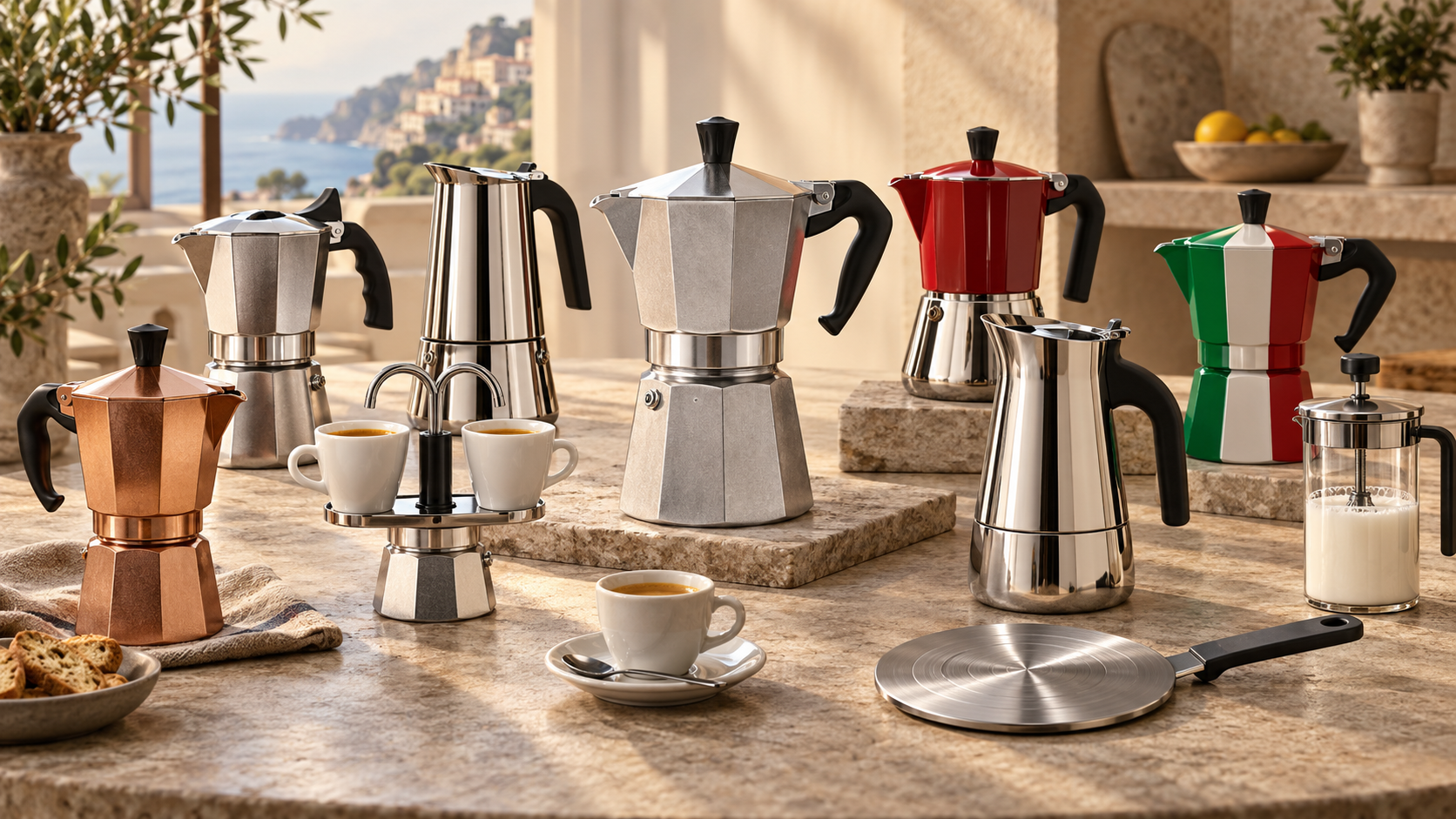
Ten of the Best Bialetti Products
The following selection includes the original Moka Express along with contemporary models designed for different kitchens, brewing preferences and serving styles.
Prices, colors and availability may change. Check the product specifications carefully, particularly when choosing a coffee maker for an induction cooktop.
Disclosure: Italia Mia may earn a commission from qualifying purchases made through the Amazon links below, at no additional cost to you.
1. Bialetti Moka Express
The Moka Express is the essential Bialetti product and the best place to begin for anyone interested in authentic Italian stovetop coffee.
Its recognizable octagonal body is made from aluminum, while the handle and lid knob are produced from heat-resistant thermoplastic material. It is available in several sizes, ranging from small individual models to larger versions suitable for families.
Remember that Italian “cups” refer to small espresso-sized servings. A six-cup moka does not produce six large American mugs of coffee.
The traditional aluminum Moka Express is suitable for gas and electric stovetops. For induction cooking, it generally requires a compatible adapter plate.
Buy the Bialetti Moka Express on Amazon
2. Bialetti Brikka
The Bialetti Brikka is designed for coffee drinkers who prefer a richer, more concentrated drink with a layer of foam.
Its specially engineered brewing system modifies the final stage of extraction, producing a result that more closely resembles the body and appearance of bar-style coffee. It remains a stovetop coffee maker rather than a true espresso machine, but its stronger character makes it appealing to people who find conventional moka coffee too light.
The Brikka requires attention to water quantity, coffee grind and heat. When used correctly, however, it produces a bold cup with an attractive crema-like surface.
Buy the Bialetti Brikka on Amazon
3. Bialetti Venus
The Bialetti Venus gives the traditional moka concept a more contemporary appearance.
Made from stainless steel, it has a smooth, rounded body rather than the sharply faceted aluminum form of the Moka Express. Its polished surface works especially well in modern kitchens and pairs naturally with stainless-steel appliances.
Many Venus models are compatible with induction cooktops, although compatibility can vary by size and market. Buyers should confirm the specifications of the exact model before ordering.
The Venus is a particularly good choice for anyone who wants the simplicity of a moka pot with the durability and appearance of stainless steel.
Buy the Bialetti Venus on Amazon
4. Bialetti Moka Induction
The Moka Induction adapts one of Italy’s most traditional coffee rituals to contemporary kitchens.
Its construction combines an aluminum upper chamber with a stainless-steel boiler capable of interacting with an induction cooking surface. This combination retains much of the familiar character of the original moka while solving one of its principal limitations.
The contrasting materials also create a distinctive visual effect. Depending on the edition, the upper portion may be available in classic black, bright red or other decorative finishes.
For households with induction cooking, this is often the most natural alternative to the traditional Moka Express. Bialetti introduced its induction design in 2014 as part of the company’s continuing effort to update the moka for changing domestic technology.
Buy the Bialetti Moka Induction on Amazon
5. Bialetti Mini Express
The Mini Express turns coffee preparation into a small theatrical performance.
Instead of collecting the brewed coffee inside a conventional upper chamber, the Mini Express directs it through two spouts and pours it directly into a pair of espresso cups. The cups rest on a platform above the boiler, where they become gently warmed while the coffee rises.
It is practical for serving two people, but much of its appeal comes from the experience. Watching two cups fill simultaneously makes the brewing process part of the presentation.
Bialetti has released the Mini Express in several colors and decorative editions, making it a popular gift for coffee lovers.
Buy the Bialetti Mini Express on Amazon
6. Bialetti Moka Express Italia
The Moka Express Italia retains the classic construction of the original moka while adding the colors of the Italian flag.
Green, white and red details transform a familiar kitchen object into a celebration of Italian identity. The design is especially appropriate as a housewarming gift, souvenir or present for someone with an affection for Italy.
Although more decorative than the standard aluminum version, it operates according to the same straightforward brewing principle. Its appeal lies in combining a functional coffee maker with a recognizable symbol of Italian culture.
Buy the Bialetti Moka Express Italia on Amazon
7. Bialetti Musa
The Bialetti Musa is another stainless-steel interpretation of the classic stovetop coffee maker.
Its shape is more restrained than that of the traditional Moka Express, with a clean cylindrical body, curved lines and a polished finish. The overall effect is elegant without being excessively decorative.
The Musa is suitable for buyers who appreciate Bialetti’s brewing tradition but prefer cookware with a streamlined, contemporary appearance. Certain versions are designed for induction, but shoppers should always verify compatibility for the chosen size.
Buy the Bialetti Musa on Amazon
8. Bialetti New Venus Copper
The New Venus Copper combines a stainless-steel structure with a warm copper-colored exterior.
This finish gives the coffee maker a more decorative presence while maintaining the practical advantages associated with the Venus collection. It looks particularly attractive in kitchens featuring wood, stone, brass or other warm materials.
The product is an appealing choice for someone who wants a moka that can remain visible on the stovetop rather than being stored in a cupboard after every use.
Because finishes and model specifications vary, buyers should review the manufacturer’s description before placing the coffee maker on a particular type of cooktop.
Buy the Bialetti Venus Copper on Amazon
9. Bialetti Tuttocrema Milk Frother
Bialetti is best known for black coffee, but the Tuttocrema milk frother helps recreate several popular Italian milk-based drinks at home.
The manual frother uses a plunger and fine mesh to incorporate air into warmed milk. It does not require capsules, steam wands or an electrical connection, making it a simple companion to a moka pot.
It can be used to prepare foam for cappuccino, caffè macchiato and other drinks. For best results, avoid overfilling it, since the milk expands considerably during frothing.
Readers curious about when Italians drink cappuccino may also enjoy Italia Mia’s explanation of Italian cappuccino customs.
Buy the Bialetti Tuttocrema on Amazon
10. Bialetti Induction Adapter Plate
The Bialetti induction adapter plate offers a practical solution for people who already own an aluminum Moka Express but have moved to a kitchen equipped with an induction hob.
The stainless-steel plate heats on the induction surface and transfers that heat to the coffee maker placed above it. It can therefore extend the useful life of a traditional moka without requiring its owner to replace it with a new induction model.
The adapter may also work with other small cookware that cannot interact directly with an induction surface. Users should follow the manufacturer’s instructions and select a plate appropriate for the dimensions of the coffee maker.
Buy the Bialetti Induction Adapter Plate on Amazon
Which Bialetti Coffee Maker Should You Choose?
The best model depends primarily on your stovetop and the style of coffee you enjoy.
Choose the Moka Express if you want the original design and use a gas or electric stove. It offers the most direct connection to Bialetti’s history and remains the model most people imagine when they hear the word moka.
Choose the Brikka if you prefer a stronger drink with more body and a crema-like top.
Choose the Venus, Musa or Moka Induction if your kitchen has an induction cooktop. Always check compatibility for the exact size, since very small coffee makers may not be recognized by every induction zone.
Choose the Mini Express if presentation matters or you usually prepare coffee for two people.
Finally, consider an induction adapter if you already own a traditional aluminum Moka Express and do not want to replace it.
Choosing the Correct Size
Bialetti coffee makers are sold according to the number of small espresso-sized cups they produce.
Approximate output varies among models, but these general guidelines can help:
- One cup: a very small individual serving
- Two cups: one generous serving or two small servings
- Three cups: suitable for one person who prefers a longer coffee
- Four cups: appropriate for two moderate servings
- Six cups: suitable for two large or several small servings
- Nine or twelve cups: intended for families and groups
A moka pot works best when used with the amount of water and coffee appropriate to its design. Buying an oversized model and filling it only halfway generally produces disappointing results.
How to Prepare Coffee in a Bialetti Moka
Begin with clean, fresh water. Fill the lower chamber only to the bottom of the safety valve.
Insert the funnel and fill it with coffee ground specifically for a moka pot. The grind should be finer than standard filter coffee but coarser than espresso-machine coffee.
Level the coffee gently without pressing or tamping it. Compressing the grounds can restrict the flow of water and interfere with proper extraction.
Screw the two chambers together securely and place the moka on low to medium heat. If using gas, keep the flame beneath the base rather than allowing it to rise around the sides.
Leave the lid open if you want to observe the extraction. As the coffee begins to flow, reduce the heat. Remove the pot when the stream becomes pale or immediately before the final aggressive gurgling begins.
Stir the coffee briefly in the upper chamber before pouring. This combines the more concentrated first part of the extraction with the lighter coffee produced toward the end.
Cleaning and Caring for a Bialetti Moka
Allow the coffee maker to cool before opening it. Remove the grounds, separate the components and rinse them thoroughly.
Bialetti instructs owners of the classic aluminum Moka Express to wash it with water and avoid the dishwasher and detergents, which can damage the product and affect the coffee’s flavor.
Let every component dry completely before reassembling the pot. Storing it while wet can produce oxidation, staining or unpleasant odors.
Inspect the rubber gasket and filter periodically. Replace them when the gasket becomes hard, cracked or unable to form a reliable seal.
The safety valve should remain clean and unobstructed. Coffee should never be packed tightly into the funnel, and the water level should not cover the valve.
With basic care, a Bialetti moka can remain in service for many years.
Bialetti and the Meaning of Everyday Italian Design
Bialetti’s achievement extends beyond the millions of coffee makers associated with its name.
The company showed that an industrial object could become part of a family’s emotional landscape. A moka may recall the kitchen of a parent or grandparent, the first apartment away from home or the coffee prepared after a memorable meal.
It is inexpensive enough to be widely accessible, durable enough to pass between generations and distinctive enough to be recognized almost anywhere in the world.
This is one reason the moka belongs naturally beside the products discussed in Italia Mia’s guide to Italian inventions that changed the world.
The Moka Express was not designed to sit untouched on a shelf. Its beauty emerges through repetition: filling it, closing it, placing it on the stove, listening and waiting.
In that sense, Bialetti represents Italian design at its most persuasive. It brings together engineering, visual identity, affordability and ritual without making any of those qualities feel forced.
More Than a Coffee Maker
More than ninety years after the Moka Express appeared, coffee preparation has become increasingly technological. Consumers can choose automated espresso machines, capsule systems, precision grinders and connected appliances.
Yet the moka continues to survive.
It asks the person preparing the coffee to participate. Water must be measured, the grounds must be added and the heat must be controlled. The familiar gurgle announces that the process is almost complete.
That small amount of attention may explain much of its enduring appeal.
A Bialetti coffee maker is not simply a device for producing caffeine. It is a link to an Italian domestic tradition in which even the most ordinary moment can be given a recognizable form, a distinctive sound and a little ceremony.
External Links
- Bialetti Official Website
- The History of Bialetti
- Official Bialetti Moka Express Guide
- How Alfonso Bialetti Invented the Moka