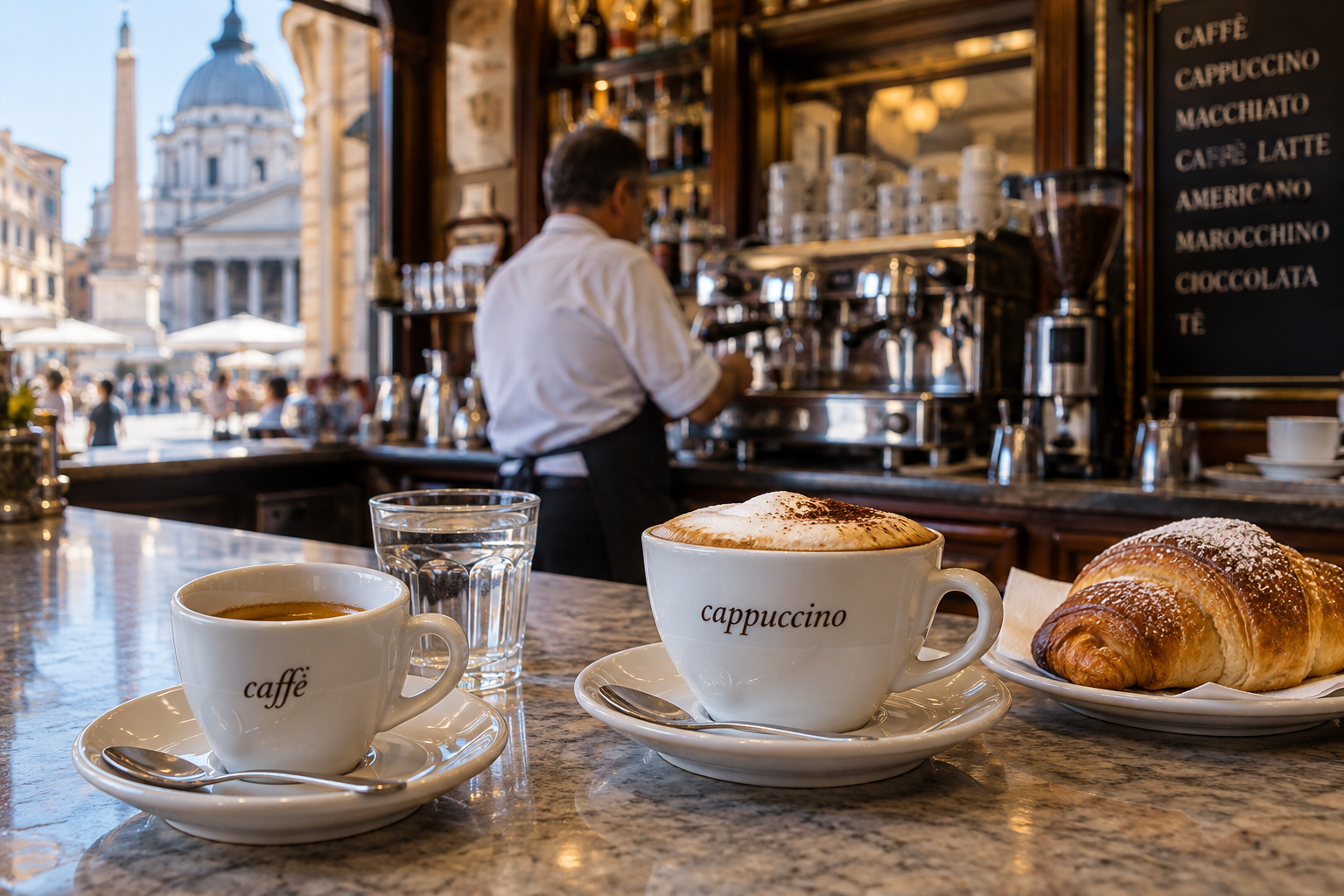
Walk into an Italian bar at eight in the morning and you will encounter one of the country’s most familiar rituals. Cups clatter against saucers, the espresso machine hisses, spoons strike porcelain, and customers exchange a few words with the barista before continuing to work, school or the day’s errands.
Some order a cappuccino and cornetto. Others simply ask for “un caffè.”
In Italy, everyone knows what that means.
A caffè is an espresso: small, concentrated, aromatic and usually consumed in a matter of minutes. It may be one of the smallest drinks served in Italy, but culturally it occupies an enormous place.
Italian coffee culture is not primarily about sitting for hours with a giant cup of coffee. It is about ritual, rhythm, sociability and habit. Coffee punctuates the Italian day: breakfast, the mid-morning break, after lunch, during an afternoon meeting, after dinner or whenever two people decide they need five minutes to talk.
To understand everyday Italian life, therefore, it helps to understand the bar.
Coffee Is a Daily Italian Ritual
Italy did not invent coffee. Coffee plants originated far from Europe, and coffee drinking developed first in Africa and the Middle East before spreading through European trading networks.
Italy did, however, profoundly change the way the modern world drinks it.
Italian inventors, manufacturers, roasters and baristas helped develop the espresso machine and the culture surrounding espresso. Over time, drinks such as espresso, cappuccino, caffè macchiato and caffè latte became international vocabulary.
The espresso became particularly important because it fit naturally into Italian urban life.
It was fast.
It was affordable.
It was social.
And it could be enjoyed several times during the day without turning every coffee break into a lengthy event.
That distinction remains important. In many countries, people carry large takeaway coffees while commuting or working. In Italy, coffee has traditionally been something you stop to drink, even when the stop lasts only two minutes.
The ritual is short, but it is still a ritual.
What Italians Mean When They Say “Caffè”
One of the first lessons for visitors is surprisingly simple:
If you walk into an Italian bar and say:
“Un caffè, per favore.”
you will normally receive an espresso.
There is usually no need to specify espresso.
The standard serving is small, concentrated and topped with a layer of crema. A properly prepared espresso balances aroma, sweetness, acidity and bitterness rather than simply tasting intensely bitter.
The Istituto Espresso Italiano, founded in 1998 after research into the characteristics expected from quality espresso, promotes standards for Italian espresso and cappuccino and emphasizes the importance of the blend, equipment and trained barista.
Yet everyday Italian coffee culture is not governed by a single rigid formula. Roasting styles, blends and preferences vary between regions, cities, bars and individual customers.
The essential idea is consistency: Italians expect the neighborhood bar to produce a satisfying espresso quickly and reliably.
The Italian Bar Is Not an American Bar
Visitors can initially be confused by the word bar.
In English-speaking countries, a bar is primarily somewhere people go for alcoholic drinks. In Italy, bar has a much broader meaning.
An Italian bar might serve:
- espresso and other coffee drinks
- cappuccino
- tea and hot chocolate
- cornetti and pastries
- sandwiches and tramezzini
- soft drinks and mineral water
- beer, wine and spirits
- aperitivi
- simple snacks and, sometimes, light lunches
Some are sleek contemporary cafés. Others have changed little in decades.
Almost every neighborhood has one.
For many Italians, the local bar functions as an informal extension of the neighborhood itself. Customers know the barista. The barista knows what regular customers drink.
Someone walks through the door and the coffee may already be underway.
That relationship is part of what distinguishes Italian coffee culture from a purely commercial transaction.
Standing at the Counter
Perhaps the most characteristically Italian way to drink coffee is al banco — standing at the counter.
You enter, order, drink your espresso, perhaps exchange a few words, and leave.
The entire experience might last three minutes.
There is nothing rushed or impolite about it. Quite the opposite: it is a normal part of daily life.
Sitting at a table creates a different experience. In tourist destinations especially, table service may cost considerably more than drinking the same coffee at the counter.
Visitors should therefore check the menu or price list before sitting down, particularly around famous squares and monuments.
This distinction between banco and tavolo also illustrates something fundamental about Italian coffee.
The coffee break does not have to be long to be meaningful.
Espresso: The Foundation of Italian Coffee
Nearly every classic Italian coffee drink begins with espresso.
Espresso is produced by forcing hot water through finely ground coffee under pressure. The process extracts flavor quickly, producing a concentrated beverage with a characteristic crema.
The development of espresso technology was closely linked to Italy’s industrial and design history.
Early machines attempted to prepare coffee faster for customers, while technological improvements during the 20th century gradually produced the espresso familiar today.
Italian companies subsequently became internationally associated with espresso machines, grinders, moka pots and coffee roasting.
The result was not simply a new beverage.
It was a new way of drinking coffee.
Cappuccino: Italy’s Famous Morning Coffee
Few Italian words have traveled as successfully as cappuccino.
A traditional cappuccino combines espresso with steamed and textured milk, creating a drink in which coffee and milk remain distinct but balanced.
The Istituto Espresso Italiano even maintains certification standards for Italian cappuccino, reflecting how seriously the preparation can be treated within the professional coffee industry.
In everyday Italian life, however, cappuccino is most strongly associated with breakfast.
A classic breakfast at a bar might consist of:
cappuccino + cornetto
The cornetto may be vuoto (plain) or filled with cream, jam, chocolate, pistachio or other fillings.
Breakfast habits vary, of course. Some Italians drink espresso in the morning, while others have caffè latte at home. But the cappuccino-and-cornetto combination remains one of the most recognizable Italian breakfast rituals.
Can You Order Cappuccino After 11 A.M.?
One of the most repeated pieces of travel advice about Italy says that Italians never drink cappuccino after 11 a.m.
Reality is less dramatic.
There is no cappuccino police.
You can order one whenever the bar serves coffee, and nobody is going to issue you a fine for ordering cappuccino at three in the afternoon.
The tradition is nevertheless real.
Because cappuccino contains a substantial amount of milk, Italians generally regard it as a breakfast drink rather than something consumed after a large meal.
After lunch or dinner, espresso is far more common.
So ordering a cappuccino after dinner may immediately identify you as a visitor, but it is not some grave violation of Italian etiquette.
Drink what you enjoy.
Understanding the tradition simply helps explain why Italians themselves usually make a different choice.
The Essential Italian Coffee Vocabulary
Visitors quickly discover that caffè is only the beginning.
Caffè
A standard espresso.
Ask for “un caffè” and this is normally what you receive.
Caffè ristretto
A shorter extraction than a normal espresso.
It is small, concentrated and intense.
Caffè lungo
An espresso prepared with more water passing through the coffee.
It produces a longer drink but is still very different from American drip coffee.
Caffè doppio
A double espresso.
Interestingly, Italians who want more caffeine often simply drink another espresso later rather than routinely ordering doubles.
Caffè macchiato
Espresso “stained” with a small amount of milk.
You may hear:
macchiato caldo — with warm milk
or
macchiato freddo — with cold milk.
Cappuccino
Espresso with steamed and textured milk.
Most strongly associated with breakfast.
Caffè latte
Coffee with considerably more milk.
Be careful when ordering: asking simply for “latte” means milk in Italian. If you tell a waiter “un latte”, you may quite correctly receive a glass of milk.
Latte macchiato
Milk “stained” with coffee — essentially the reverse concept of a caffè macchiato.
Caffè corretto
Espresso “corrected” with a small amount of liquor.
Grappa, sambuca and brandy are traditional possibilities.
Caffè decaffeinato
Decaffeinated coffee, often shortened simply to:
“un deca.”
Caffè americano
Espresso diluted with hot water.
It approximates a longer coffee but should not be confused with traditional American filter coffee.
Caffè con panna
Espresso topped with whipped cream.
Marocchino
Usually espresso combined with cocoa and milk foam, often served in a small glass. Recipes can vary by bar.
Caffè shakerato
Espresso shaken vigorously with ice, often with sugar.
It is especially refreshing during the Italian summer.
Regional Coffee Traditions
Italy has a national espresso culture, but coffee is far from identical everywhere.
Naples: Coffee as an Institution
Few cities are more closely associated with coffee than Naples.
Neapolitan coffee tends to be associated with strong flavor, darker roasting traditions and an almost ceremonial attitude toward preparation.
Coffee in Naples is not merely refreshment. It is part of the city’s identity.
The famous Neapolitan cuccumella, or flip coffee pot, predates the widespread domestic use of the moka pot and remains a nostalgic symbol of traditional home coffee preparation.
Naples is also associated with one of Italy’s most generous coffee customs: the caffè sospeso.
A customer orders one coffee but pays for two.
The additional coffee remains “suspended” for someone who cannot afford one.
The practice transforms a tiny everyday purchase into an act of anonymous solidarity.
Turin and the Bicerin
Turin developed a very different coffee tradition.
The city’s historic cafés became meeting places for intellectuals, politicians and artists, and Turin is famous for bicerin, a layered combination traditionally involving coffee, chocolate and cream.
It reflects Piedmont’s long relationship with chocolate as much as its coffee culture.
Trieste: Italy’s Coffee Port
Trieste occupies a special place in Italian coffee history because of its historic role as a major port for coffee imports.
Its Central European heritage also produced distinctive café traditions and vocabulary.
Ordering coffee in Trieste can therefore sound surprisingly different from ordering it elsewhere in Italy.
The city’s elegant historic cafés evoke Vienna as much as Rome or Naples, reflecting Trieste’s complex history under the Habsburg Empire.
Coffee and the Italian Piazza
The coffee bar is also closely connected to another essential Italian institution: the piazza.
As explored in Italia Mia’s guide to The Italian Piazza: History, Architecture and the Heart of Italian Life, Italian public squares have historically served as places for commerce, conversation, celebration and everyday social interaction.
The café terrace became a natural extension of this public life.
Sitting outside with coffee allows people to participate in the life of the street without necessarily doing anything at all.
You watch.
You talk.
You meet friends.
You see who passes.
This relationship between public space and social ritual is one reason coffee culture in Italy cannot be understood solely by analyzing what is inside the cup.
Coffee and the Passeggiata
Coffee also fits naturally into another Italian social tradition: the passeggiata.
During the late afternoon and early evening, people traditionally stroll through town centers, pedestrian streets and piazzas, meeting acquaintances and observing the passing scene.
As discussed in Italia Mia’s The Italian Passeggiata: The Art of the Evening Stroll, the passeggiata is simultaneously exercise, social ritual and public performance.
A stop at the bar may form part of that routine.
Depending on the hour, the drink might be coffee, mineral water, an aperitivo or something else.
The important element is the pause.
Italian social life is filled with these small pauses, and the bar provides one of their most important settings.
The Moka Pot: Coffee at Home
Not all Italian coffee is consumed in bars.
For generations, one of the most recognizable sounds in an Italian kitchen has been the bubbling of a moka pot on the stove.
The iconic Moka Express was introduced by Alfonso Bialetti in 1933 and helped transform domestic coffee preparation.
Its distinctive octagonal aluminum form became a classic of Italian industrial design.
The moka does not technically make espresso because it operates at much lower pressure than a professional espresso machine.
Nevertheless, moka coffee is strong, concentrated and deeply embedded in Italian domestic culture.
Preparing it often becomes almost automatic:
water in the bottom chamber,
coffee in the filter,
screw the pot together,
place it on the stove,
and wait.
The smell announces that coffee is ready.
For many Italians, that aroma is inseparable from home.
Readers interested in the intersection between everyday objects and Italian design can also explore Italia Mia’s coverage of famous Italian brands, including Bialetti and other companies that transformed functional household objects into internationally recognizable examples of Made in Italy design.
The Social Power of “Prendiamo un Caffè?”
“Shall we have a coffee?”
In Italy, “Prendiamo un caffè?” can mean much more than the literal words suggest.
It can mean:
let’s talk.
let’s take a break.
I want to tell you something.
let’s meet briefly.
let’s continue this conversation somewhere else.
Or simply:
I would like to spend a few minutes with you.
Because espresso is quick and relatively informal, asking someone for coffee does not necessarily imply a major social commitment.
That makes the bar useful for everything from friendships to business.
Colleagues leave the office for coffee. Friends meet for coffee. People conclude lunch with coffee. Someone visiting a neighbor may be offered coffee almost immediately.
The cup is small.
Its social function is enormous.
Coffee After Lunch
After lunch, one phrase can be heard throughout Italy:
“Prendiamo il caffè?”
Coffee acts almost like punctuation at the end of the meal.
In restaurants, the usual choice is espresso.
It is normally ordered after dessert rather than simultaneously with it, although individual habits obviously vary.
Milk-based coffees are unusual at this point.
An espresso may also be followed by an ammazzacaffè, literally a “coffee killer”: a small digestivo such as grappa, amaro, limoncello or sambuca.
The combination is particularly associated with leisurely meals rather than hurried weekday lunches.
For more on Italian dining customs, see Italia Mia’s guide to Italian Food Etiquette: What to Know and What Not to Order at an Italian Restaurant.
Coffee and the Italian Workday
The coffee break has an important role in Italian workplaces.
Someone announces:
“Caffè?”
Within minutes, several colleagues may be heading toward the nearest bar.
This is not necessarily a long break. It might last ten minutes or less.
Yet it provides an opportunity to step away from the desk, speak informally with colleagues and reset before returning to work.
Italy’s culture of the quick espresso makes these short breaks practical.
The ritual illustrates an interesting paradox.
Italian coffee culture can be extraordinarily fast without being impersonal.
Ordering Coffee Like an Italian
You do not need perfect Italian to order confidently.
A few phrases are enough:
“Un caffè, per favore.”
An espresso, please.
“Un cappuccino, per favore.”
A cappuccino, please.
“Un macchiato caldo.”
An espresso with a little warm milk.
“Un decaffeinato.”
A decaf.
“Un caffè lungo.”
A longer espresso.
“Un americano.”
An Americano.
“Posso pagare con la carta?”
Can I pay by card?
“Quanto costa?”
How much does it cost?
Depending on the bar, you may pay before ordering, after drinking or directly at the counter.
Watch what other customers do. The system usually becomes obvious quickly.
Sugar or No Sugar?
There is no universal Italian rule.
Some Italians drink espresso without sugar. Others add one packet or spoonful. Some add considerably more.
The important point is that espresso is not automatically expected to be sweet.
A good bar will generally provide sugar, and increasingly alternatives to ordinary white sugar may also be available.
Why Is the Glass of Water Served With Coffee?
Some Italian bars provide a small glass of water with espresso.
There is debate about whether water should be drunk before or after the coffee.
Those who drink it before argue that it cleanses the palate, allowing the coffee’s aromas to be appreciated more clearly.
Drinking water afterward removes the lingering coffee flavor.
Neither choice will cause an international incident.
If you are tasting particularly good coffee, drinking the water first makes sense because it leaves the palate relatively neutral.
Italian Coffee Versus American Coffee Culture
The contrast between Italian and American coffee culture is fascinating because both societies love coffee but often use it differently.
Traditional Italian coffee is generally:
- smaller
- stronger
- consumed quickly
- frequently drunk standing
- centered around espresso
- closely associated with the neighborhood bar
American coffee culture traditionally favors larger servings and filter coffee, although modern specialty coffee has dramatically diversified the picture.
Takeaway coffee is also much more deeply embedded in American daily life.
Italy has adopted international coffee trends, especially in large cities and tourist areas. Specialty cafés, cold brew, single-origin beans, alternative brewing methods and elaborate milk drinks are increasingly visible.
Nevertheless, the traditional espresso remains remarkably resilient.
Why Takeaway Coffee Never Dominated Italy
For decades, walking around with a large disposable cup was comparatively unusual in Italy.
There was a practical reason.
An espresso takes only a few moments to drink.
Why carry it around?
The Italian bar provided something that takeaway coffee could not: a brief interruption in the day.
You entered.
You stopped.
You drank.
You spoke.
Then you continued.
Takeaway culture has become more visible, particularly among younger consumers and in major cities, but the counter ritual remains deeply established.
The Barista: An Italian Profession
The word barista has become international, but in Italy its meaning is broader than the specialty-coffee interpretation common abroad.
An Italian barista may prepare hundreds of coffees during a busy shift while simultaneously serving pastries, sandwiches, drinks and customers at the cash register.
Speed matters.
So does memory.
A talented neighborhood barista remembers regular customers and their preferences.
“Il solito?”
“The usual?”
That simple question captures the relationship between customer and bar.
Professional espresso organizations emphasize that equipment alone does not guarantee quality. Preparation depends on grinding, dosing, extraction, milk texturing, maintenance and the skill of the person operating the machine. The Istituto Espresso Italiano accordingly places trained professionals alongside qualified blends, machines and grinders within its quality framework.
Coffee Machines and Italian Design
Coffee culture also became an important chapter in the history of Italian industrial design.
Espresso machines evolved from imposing early devices into increasingly sophisticated machines combining engineering, ergonomics and aesthetics.
Italian manufacturers became global leaders in professional espresso equipment.
At home, the moka pot accomplished something similar on a smaller scale.
Coffee equipment therefore belongs to a larger Italian tradition in which functional objects are often treated as design objects.
Cars, lamps, furniture, kitchen appliances and coffee makers all demonstrate the same tendency: practical engineering combined with attention to form.
The Changing Italian Coffee Scene
Italian coffee culture is traditional, but it is not frozen in time.
A new generation of specialty coffee shops has introduced many consumers to concepts such as:
single-origin coffee,
lighter roasting,
precise extraction,
pour-over brewing,
specialty-grade beans,
traceability,
and direct relationships with coffee producers.
This sometimes creates tension with traditional Italian expectations.
Many Italians grew up with darker espresso blends and a particular flavor profile. Specialty coffee may taste unexpectedly acidic or delicate by comparison.
Neither tradition necessarily needs to eliminate the other.
Italy’s future coffee culture may increasingly contain both: the classic neighborhood espresso bar and the experimental specialty café.
Common Coffee Mistakes Visitors Make in Italy
The most frequent mistakes are harmless, but knowing them can make the experience smoother.
Ordering “a latte.”
Latte means milk. Ask for caffè latte if you want coffee with milk.
Expecting a giant coffee.
Italian espresso is intentionally small.
Assuming every coffee must be consumed sitting down.
Try drinking one at the counter.
Expecting the same ordering system everywhere.
Some bars require payment first; others do not.
Thinking cappuccino after noon is forbidden.
It is a cultural habit, not a law.
Expecting endless customization.
Traditional Italian bars usually have plenty of variations, but the culture historically revolves around relatively simple drinks.
Calling espresso “expresso.”
The Italian word is espresso.
Coffee Etiquette for Travelers
The easiest way to experience Italian coffee culture is not to memorize dozens of rules.
Observe.
If everyone pays at the cash register before approaching the counter, do the same.
If customers order directly from the barista and pay afterward, follow their example.
Say buongiorno when entering and grazie when served.
Do not be intimidated by a crowded counter. Italian bars can look chaotic during the morning rush, but experienced baristas keep track of remarkable numbers of orders.
Most importantly, do not turn coffee etiquette into anxiety.
The point of understanding Italian customs is to enjoy them, not to fear making a mistake.
Coffee as Part of Italian Identity
Pizza, pasta, wine and gelato may receive more international attention, but espresso arguably appears more frequently in ordinary Italian life than any of them.
You may not eat pizza every day.
You probably will not drink wine every morning.
But millions of Italians encounter coffee several times throughout the day.
That repetition gives coffee its cultural power.
It accompanies waking up, arriving at work, finishing lunch, meeting friends and welcoming guests.
It marks transitions.
Morning begins.
Lunch ends.
A conversation starts.
A break finishes.
The ritual is so ordinary that it can be almost invisible to the people performing it.
Yet those ordinary rituals often reveal more about a country than spectacular monuments do.
Experiencing Italian Coffee Culture as a Visitor
When visiting Italy, resist the temptation to experience coffee only at famous historic cafés.
Those places can be wonderful, particularly in cities such as Turin, Venice, Trieste, Rome, Florence and Naples.
But also visit an ordinary neighborhood bar.
Go in around 8:30 in the morning.
Stand at the counter.
Order:
“Un cappuccino e un cornetto, per favore.”
Later, after lunch, return somewhere else and say:
“Un caffè.”
Watch the ritual around you.
Someone is reading the newspaper.
A construction worker drinks an espresso beside a lawyer.
A parent arrives with a child.
Two colleagues discuss work.
An elderly regular talks to the barista.
Someone places coins on the counter, drinks a coffee in three sips and disappears through the door.
Nothing extraordinary has happened.
And that is precisely the point.
More Than Espresso
Italian coffee culture ultimately cannot be reduced to the quality of the beans, the pressure of an espresso machine or the thickness of cappuccino foam.
Those things matter.
But the real story is human.
The bar is one of Italy’s small social institutions — alongside the piazza, the market, the passeggiata and the family table.
It provides a place where daily life briefly slows down even when the coffee itself is consumed quickly.
That may be the greatest paradox of Italian espresso.
It is one of the fastest drinks in the world, yet it creates a reason to stop.
And perhaps that is why the simple invitation “Prendiamo un caffè?” continues to mean so much more than having a cup of coffee.
Related Italia Mia Articles
For readers interested in exploring Italian food, daily life and traditions further, these Italia Mia articles complement this guide:
Italian Food Etiquette: What to Know and What Not to Order at an Italian Restaurant
The Ultimate Guide to Espresso Machines: Everything You Need to Know
External Links
Istituto Espresso Italiano — Official Website — Organization dedicated to safeguarding and promoting the culture and quality of Italian espresso and cappuccino.
Consorzio di Tutela del Caffè Espresso Italiano Tradizionale — Cultural project documenting traditional Italian espresso, its preparation, places of consumption and role in Italian sociability.