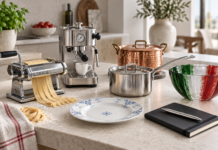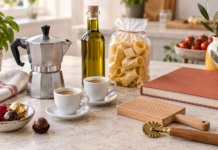

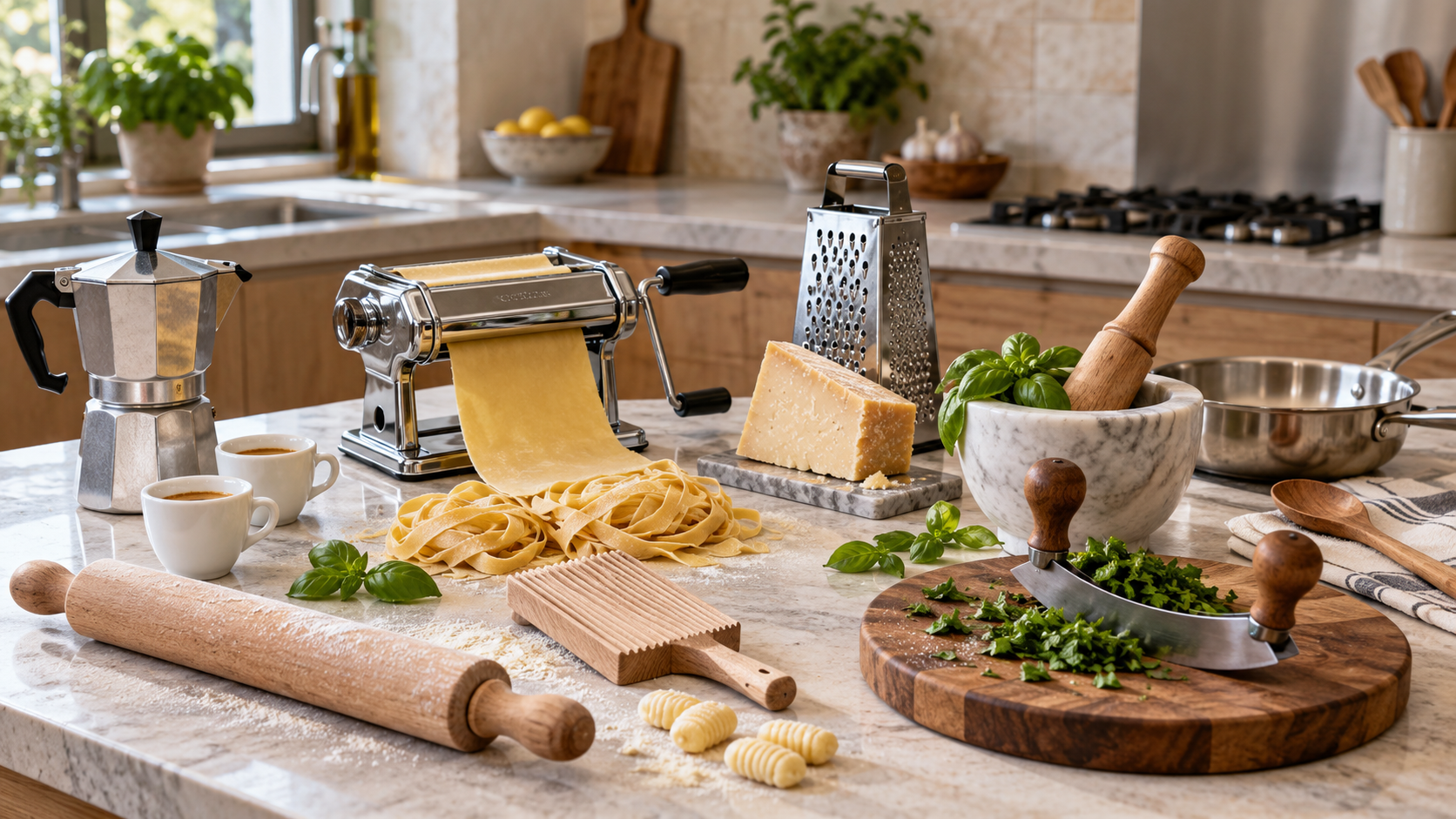
 An Italian kitchen is rarely filled with complicated gadgets. The most useful equipment tends to be simple, durable and dedicated to jobs that Italian cooks perform again and again: brewing coffee, grating cheese, making sauce, rolling dough and bringing pasta to the table without damaging it.
Some of these products are found in homes throughout Italy. Others belong to particular regions or to families that still make fresh pasta and traditional sweets. You do not need all 20 to cook Italian food well. Think of this list as a practical guide to the tools worth buying—and to the ones that make especially good gifts for anyone who loves Italian cooking.
As an Amazon Associate, Italia Mia may earn from qualifying purchases made through links in this article, at no additional cost to you.
Coffee Essentials
- Moka Pot
The aluminum moka pot is one of the most recognizable objects in an Italian home. It does not produce true bar-style espresso—the pressure is much lower than that of an espresso machine—but it makes the strong, aromatic coffee that millions of Italians drink every day.
The classic choice is the octagonal Bialetti Moka Express. A three-cup model makes roughly one generous mug-sized serving or several small Italian servings. Six-cup versions are better when coffee is shared. Traditional aluminum moka pots work on gas and many electric stovetops; induction users should choose a compatible model or use an adapter plate.
Buy: Bialetti Moka Express stovetop coffee makers
- Italian Espresso Cups
Italian coffee is served in small, thick-walled cups that retain heat without encouraging an oversized portion. Porcelain is the practical standard, while glass cups show off the crema when coffee comes from an espresso machine.
Look for cups that hold approximately 2 to 3 ounces and have comfortable handles. A set of six is useful for guests and takes up surprisingly little cabinet space. Saucers are traditional, but they are not essential for everyday coffee at home.
Buy: Italian espresso cup sets
- Manual Coffee Grinder
Many Italian households buy ground coffee in vacuum-packed bricks, but grinding whole beans just before brewing gives a fresher aroma. A compact burr grinder offers more consistent particles than a blade grinder, which helps the moka pot extract evenly.
Choose a grinder with a medium-fine setting rather than reducing the beans to the powder used for Turkish coffee. Do not compress the grounds inside a moka basket; fill it loosely and level the surface.
Buy: Manual burr coffee grinders
Fresh Pasta Tools
- Manual Pasta Machine
A hand-cranked pasta machine is not present in every Italian kitchen, but it is a trusted tool in homes where tagliatelle, lasagne and filled pasta are made regularly. It rolls dough into progressively thinner sheets and, with the cutting attachment, turns those sheets into even ribbons.
The Marcato Atlas 150 is the best-known Italian example and is made for cooks who want a sturdy machine rather than a novelty gadget. A pasta machine should clamp securely to the counter, turn smoothly and be brushed clean after use rather than immersed in water.
Buy: Marcato Atlas 150 pasta machines
- Long Wooden Rolling Pin
Before machines, the sfogline of Emilia-Romagna rolled pasta by hand with a long, slender mattarello. It remains the most versatile way to make a broad sheet of dough, and experienced cooks can feel thin or uneven areas through the pin.
A long, unfinished beechwood pin is ideal. Avoid decorative handles and heavy varnish: a simple cylinder gives the cook more control and can accommodate a much larger sheet than an ordinary pastry pin.
Buy: Italian-style long wooden rolling pins
- Wooden Pasta Board
The spianatoia is a large wooden work surface used for kneading bread, rolling pasta and assembling filled shapes. Wood gives dough enough grip to stretch without sliding, while a raised lip on the underside can prevent the board from moving across the counter.
Choose a generously sized unfinished board and reserve it for dough. Scrape away residue after use, wipe it lightly when necessary and let it dry completely. It should not be soaked or placed in a dishwasher.
Buy: Wooden pasta boards with counter lips
- Fluted Pasta Wheel
The rotella tagliapasta is a small wheel that cuts pasta sheets cleanly. A fluted wheel produces the familiar decorative edge on ravioli, tortelli and farfalle; a smooth wheel is useful for straight cuts and long noodles. Dual-wheel versions provide both options in one compact tool.
A brass or stainless-steel wheel with a solid wooden handle should last for decades. Check that the wheel turns freely and does not wobble excessively.
Buy: Italian fluted pasta wheels
- Ravioli Stamps
Ravioli can be cut with a knife or pastry wheel, but a stamp produces consistent portions and seals the edges in a single motion. Round and square stamps are the most useful. Brass cutters are beautiful and durable, while stainless-steel versions are usually easier on the budget.
The secret is not force but preparation: keep the lower pasta sheet lightly floured, press excess air away from the filling and make sure the upper sheet is not dry before stamping.
Buy: Italian ravioli stamps and cutters
- Gnocchi Board
The rigagnocchi is a little ridged board that performs an important task. Rolling each piece of dough across it creates grooves on the outside and a slight hollow on the opposite side, giving sauce more surface to cling to. The same tool can shape garganelli and several regional pastas.
Beechwood boards are inexpensive and traditional. Some include a small dowel for garganelli. This is one of the best starter tools for homemade pasta because it requires little space and delivers an immediate improvement in texture.
Buy: Wooden gnocchi and garganelli boards
- Potato Ricer
Light potato gnocchi depend on removing lumps without overworking the potatoes. A schiacciapatate presses cooked potatoes into fine strands, allowing them to be combined gently with flour. It is also useful for purées and for squeezing excess moisture from cooked vegetables.
Stainless steel is easier to clean and less likely to bend than thin aluminum. Choose a model with comfortable handles and a removable basket if storage space allows.
Buy: Stainless-steel potato ricers
Preparation Tools
- Box or Rotary Cheese Grater
Freshly grated Parmigiano Reggiano, Grana Padano or Pecorino Romano tastes and melts better than cheese grated long before it reaches the table. A sturdy box grater handles cheese, vegetables and breadcrumbs; a rotary grater keeps fingers away from the blade and can be passed around the table.
The best choice depends on how you cook. Use a fine surface for a soft veil of cheese over pasta and a coarser one when the cheese must remain distinct in a filling or gratin.
- Mezzaluna and Chopping Board
The curved mezzaluna rocks back and forth across a board, quickly chopping parsley, rosemary, garlic, onions and the vegetables used for a soffritto. Double-bladed models work quickly but trap more food; a single, well-sharpened blade offers excellent control and is simpler to clean.
Some sets include a shallow concave board that keeps herbs in the path of the blade. A flat wooden board works too and is more versatile. Always store the mezzaluna with its edge protected.
Buy: Italian mezzaluna knife and board sets
- Marble Mortar and Wooden Pestle
For pesto Genovese, a mortar crushes basil, garlic, pine nuts and cheese instead of slicing them at high speed. The traditional Ligurian combination is a heavy marble mortar with a wooden pestle. It takes longer than a food processor, but gives the cook precise control over texture.
Choose a stable mortar with a rough interior and enough room to rotate the pestle comfortably. Small decorative mortars are attractive, but they are frustrating for making enough pesto for several people.
Buy: Italian marble mortars and pestles
- Food Mill
The passaverdura, also called a passatutto, purées cooked tomatoes and vegetables while holding back many skins and seeds. It creates a more traditional texture than a high-speed blender and is invaluable for tomato sauce, vegetable soups, mashed potatoes and fruit preparations.
Look for a stainless-steel model with interchangeable discs and supports that sit securely over a bowl or pot. A removable crank and blade make cleaning considerably easier.
Buy: Stainless-steel food mills
- Wooden Spoons
The humble cucchiaio di legno may be the tool Italians reach for most often. It stirs ragù without scratching the pan, folds risotto, mixes polenta and reaches into the corners of a saucepan. Wood stays cool in the hand and does not make the harsh sound of metal against cookware.
Choose untreated beech or olive wood, wash it by hand and allow it to dry fully. Replace any spoon that develops deep cracks. A flat-ended spoon is particularly useful for loosening the flavorful browned bits at the bottom of a pan.
Buy: Italian olive-wood cooking spoons
- Wire Skimmer
A wide perforated skimmer, or schiumarola, lifts ravioli, gnocchi and other delicate pasta directly from the water. This avoids tipping fragile pieces into a colander and lets a little cooking water travel with the pasta into its sauce. It is equally useful for fried food and blanching vegetables.
Choose a stainless-steel head with openings small enough to catch gnocchi and a handle long enough to keep your hand away from steam and hot oil.
Buy: Stainless-steel Italian skimmers
Cookware for Everyday Italian Food
- Large Stainless-Steel Pasta Pot
Pasta needs abundant boiling water and enough room to move. A tall stainless-steel pot of around 8 quarts is a sensible size for many households. A thick base reduces hot spots, sturdy handles matter when draining, and a well-fitting lid brings the water to a boil more efficiently.
An insert can be convenient, but it is not obligatory. Italians often use a simple pot and colander—or transfer delicate pasta with a skimmer. Before draining, reserve some starchy cooking water to help bind the pasta and sauce.
Buy: Large stainless-steel pasta pots
- Wide Sauté Pan
The final minutes of pasta cooking often happen in the sauce, so a broad pan with gently sloping sides is more useful than a tiny saucepan. It gives spaghetti room to turn, encourages water to evaporate and helps oil, cheese and pasta water form an emulsion.
A 10- to 12-inch stainless-steel sauté pan is versatile enough for cacio e pepe, amatriciana, seafood, vegetables and scaloppine. A lid adds value, and an oven-safe handle expands the range of dishes it can prepare.
Buy: Italian stainless-steel sauté pans
- Rectangular Lasagna Pan
A proper lasagna pan needs straight, reasonably high sides and enough depth for several layers without bubbling over. Enameled steel, stainless steel and stoneware all work; the best material depends on whether low weight, browning or table presentation matters most to you.
Measure your oven before choosing an oversized pan. A common 9-by-13-inch format is practical for American kitchens, while Italian-made pans may use metric dimensions. Avoid very shallow baking sheets, which allow the top and edges to dry before the center is hot.
Buy: Italian lasagna and roasting pans
- Pizzelle Maker
Pizzelle are thin patterned wafers associated particularly with Abruzzo and neighboring areas, and they became a cherished tradition in many Italian-American families. A pizzelle iron is therefore a regional specialty tool, not a universal fixture in every Italian kitchen.
Electric makers are fast and easy for beginners. Traditional stovetop irons offer more control and a stronger connection to the old method, but require practice to heat and turn evenly. Choose the style according to how often you will make pizzelle, ferratelle or similar regional wafers.
Buy: Pizzelle makers and traditional irons
What Should You Buy First?
For everyday Italian cooking, begin with a good grater, wooden spoon, large pasta pot, wide sauté pan and moka pot if you drink coffee. Those five pieces will be used far more often than highly specialized gadgets.
If fresh pasta is your goal, start with a wooden board, rolling pin, pasta wheel and gnocchi board. Add a manual pasta machine when you know that you enjoy the process. A potato ricer is worth buying early if gnocchi are a priority, while ravioli stamps are helpful but not essential.
The mortar, food mill, mezzaluna and skimmer earn their space because they improve texture and control rather than merely saving a few seconds. The pizzelle maker is different: it is a wonderful purchase for someone who already loves the tradition, but not a basic requirement for cooking Italian food.
How to Recognize a Good Italian Kitchen Tool
Country of origin can matter, but “Italian style” does not necessarily mean made in Italy. Read the product description carefully if manufacturing location is important to you. More importantly, look for solid construction, repairable or replaceable parts and materials appropriate to the task.
Wooden pasta tools should be smooth but unfinished. Metal food mills, ricers and graters should feel rigid rather than flimsy. A moka pot needs replacement gaskets and filters that will remain available. A pasta machine should have a secure clamp and rollers that stay aligned. The best Italian kitchen products are designed to be used for years, not displayed briefly and discarded.
You can combine these tools with the regional ingredients in our guide to Italian food specialties that are difficult to find in the United States or choose a smaller present from the best Italian gifts under $50. For cooks who want to understand why dishes change so dramatically from one area to another, see what to eat in every region of Italy.
External Sources
An Italian Nonna’s Kitchen Tool Tour — La Cucina Italiana
Italian Cooking Tools Must-Have: The Definitive Gift Guide — La Cucina Italiana
Gnocchi Board — La Cucina Italiana