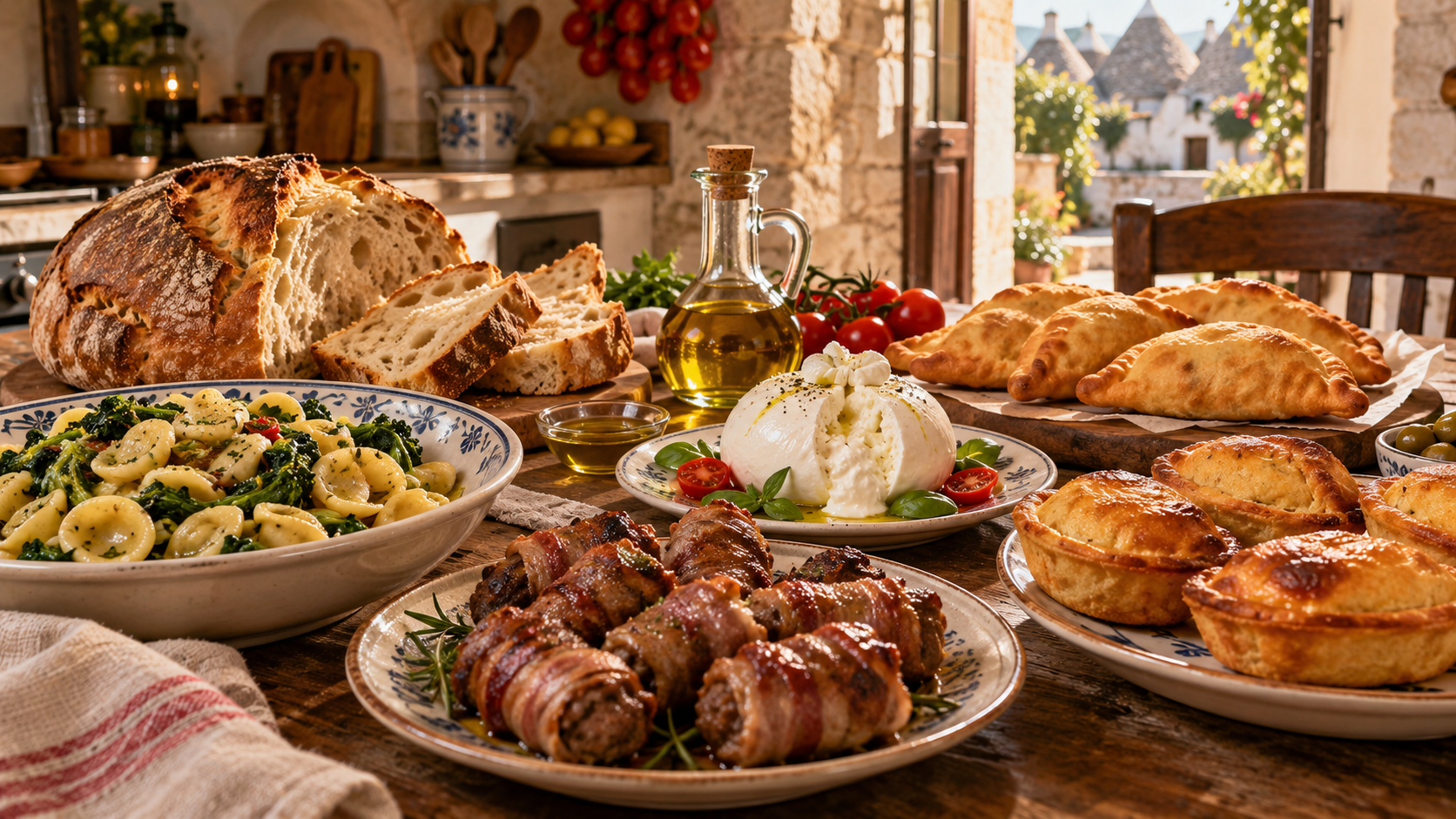
 Puglia is one of those regions of Italy where I find it almost impossible to have a disappointing meal. Not because every restaurant is exceptional, but because the ingredients themselves are so good. A ripe tomato, a slice of freshly baked bread, a little extra virgin olive oil and a piece of local cheese can become a meal that I remember longer than something served in an expensive restaurant.
What I love about Puglia is its honesty. The cooking is rarely complicated. It comes from the land, the sea and generations of families who learned to make wonderful food from relatively inexpensive ingredients.
Here, food is not simply something to enjoy between sightseeing stops. It is one of the best reasons to visit.
From the narrow streets of Bari to the whitewashed villages of the Valle d’Itria, from the fishing harbors of the Adriatic to the countryside and beaches of Salento, Puglia has an extraordinary culinary identity.
I have always believed that the best way to understand an Italian region is to eat what its residents eat. In Puglia, that means forgetting elaborate menus occasionally and paying attention to bakeries, family-run trattorias, neighborhood markets, butcher shops and small agricultural producers.
In this guide, I want to take you on a culinary journey from Bari to Salento, explaining what to eat, where to look for it, what to drink and how to make the most of Puglia’s food culture.
If you are planning your journey, I also recommend our Puglia Road Trip: The Perfect 7-Day Itinerary from Bari to Lecce, which follows much of the same route.
Why Puglia Has Some of Italy’s Best Food
Puglia’s cuisine is rooted in cucina povera, literally “poor cooking.” I prefer to think of it as intelligent cooking.
For centuries, farming families relied on what they could produce themselves: durum wheat, vegetables, legumes, olives, seasonal greens and modest amounts of meat. Fishing communities added the daily catch from the Adriatic and Ionian Seas.
Nothing was wasted. Stale bread became a new dish. Dried beans became substantial meals. Wild vegetables supplied flavors that expensive ingredients could never reproduce.
The result is a regional cuisine that feels remarkably modern.
Many traditional Puglian dishes naturally emphasize vegetables, beans, whole ingredients and olive oil. Meat is important, particularly inland, but it is not always the center of the table.
The region is also famous for its exceptional agricultural products: tomatoes, almonds, figs, artichokes, wheat, grapes and dairy products.
And then there is the olive oil.
I cannot imagine Puglian cooking without it.
A good extra virgin olive oil is not merely an ingredient used in cooking. It is added to vegetables, soups, grilled fish, bread and practically anything that benefits from its flavor.
One of my favorite simple pleasures is dipping warm bread into local olive oil and tasting the difference between a delicate, fruity variety and a more robust oil with a peppery finish.
That experience alone tells you something about Puglia.
Bari: Where I Would Begin Eating
Bari is the natural starting point for a food journey through central and southern Puglia.
The regional capital is energetic, noisy, welcoming and full of food traditions that are still part of everyday life.
Bari Vecchia, the old town, is particularly fascinating. Its narrow streets are famous for women preparing fresh pasta by hand, often on wooden tables outside their homes.
But Bari is also a wonderful city for inexpensive street food.
Focaccia Barese: My First Stop at a Bakery
If I arrive in Bari feeling hungry, I would look for a bakery before looking for a restaurant.
Focaccia barese is one of the city’s great specialties.
Unlike the thin focaccia you might find elsewhere in Italy, the Bari version is generally soft inside, with a beautifully browned, oil-rich crust. Potatoes are often incorporated into the dough.
The surface is traditionally covered with tomatoes, olives, oregano and plenty of olive oil.
What makes it irresistible is the combination of textures: soft bread, juicy tomatoes and a crisp, flavorful underside.
I particularly like the way Puglian bakeries sell focaccia by weight or in large slices. You can eat it standing up, sitting on a bench or walking toward the waterfront.
It is perfectly acceptable as a midmorning snack, a light lunch or something to share before dinner.
My advice is simple: buy it fresh, preferably when it is still warm.
Orecchiette con Cime di Rapa: Puglia’s Signature Pasta
Orecchiette are probably Puglia’s most recognizable culinary symbol.
Their name means “little ears,” a reference to their small, concave shape.
Traditionally made with durum-wheat semolina and water, they have a slightly chewy texture that I find particularly satisfying.
The classic preparation is orecchiette con cime di rapa: pasta with turnip greens, garlic, olive oil, chili pepper and often anchovies.
The greens bring a pleasant bitterness, while the anchovies provide a savory depth without making the dish taste overtly fishy.
It is the kind of recipe that demonstrates why Italian cooking does not need twenty ingredients to be excellent.
When the vegetables are in season, particularly during the cooler months, this is one of the first dishes I would order.
You will also encounter orecchiette served with tomato sauce, meat ragù, broccoli or fresh ricotta.
I enjoy these variations, but I consider the traditional version with cime di rapa essential.
One detail worth remembering: although the pasta itself contains no eggs in its traditional form, the classic sauce often contains anchovies. Vegetarians should ask before ordering.
Panzerotti: Southern Italy’s Irresistible Fried Snack
A panzerotto looks a little like a small folded pizza, but it is something quite different.
The dough is filled, sealed and fried until golden.
The traditional filling is tomato and mozzarella, although many variations now exist.
The result is crisp on the outside and wonderfully soft inside, with melted cheese and hot tomato sauce.
Be careful with the first bite. The filling can be extremely hot.
I think panzerotti are at their best eaten immediately, wrapped in paper, without plates or unnecessary ceremony.
They are also among the most affordable and enjoyable things to eat in Bari.
Spaghetti all’Assassina: The Pasta That Breaks the Rules
One of Bari’s most distinctive pasta dishes is spaghetti all’assassina, or “assassin’s spaghetti.”
The name is dramatic, but the method is even more interesting.
Instead of boiling spaghetti normally and then adding sauce, the pasta is cooked and toasted in a pan with tomato sauce and tomato liquid, producing intensely flavored, partly charred and crispy strands.
Chili pepper adds heat.
The contrast between crunchy pasta and concentrated tomato is unlike most Italian pasta dishes.
I would recommend it particularly to visitors who think they have already tried every possible way of preparing spaghetti.
It can be quite spicy, so ask about the heat level before ordering.
Tiella Barese: Rice, Potatoes and Mussels
Known locally as patate, riso e cozze, this baked dish combines potatoes, rice, mussels, tomatoes, onions, herbs and olive oil.
The ingredients are layered together and baked, allowing their flavors to mingle.
It may seem unusual to combine rice and potatoes in one dish, but the result is deeply satisfying.
The potatoes become tender, the rice absorbs the seafood juices and the upper layer develops an appealing crust.
This is a dish I would seek out in a traditional restaurant rather than somewhere specializing in modern interpretations.
Recipes vary from household to household, and discussions about the correct preparation can become surprisingly passionate.
That, to me, is part of its charm.
Bari’s Seafood Tradition: What to Know Before Ordering
The Adriatic Sea has always shaped Bari’s food culture.
Fish markets and waterfront restaurants offer octopus, mussels, clams, cuttlefish, sea bream, sea bass and other seasonal catches.
Bari is also famous for raw seafood.
While this is deeply rooted in local tradition, I would be cautious about treating it as something every visitor should automatically try.
Raw shellfish and other uncooked seafood can carry foodborne risks. Lemon juice does not make raw seafood safe.
If you choose to eat raw seafood, select a reputable establishment that follows the required handling and food-safety procedures. People who are pregnant, immunocompromised or otherwise at increased risk should avoid it.
Personally, I find there are plenty of excellent cooked alternatives.
Grilled octopus, mussels prepared in tomato sauce and simply roasted fish with olive oil and lemon are all wonderful ways to appreciate the local catch.
And I would always ask what is fresh that day rather than automatically ordering the most expensive fish on the menu.
From Bari to Andria and Altamura: Burrata, Bread and Traditional Baking
Leaving Bari, I would make time for some of Puglia’s most celebrated agricultural products.
Two names immediately come to mind: Andria and Altamura.
Burrata di Andria: Much More Than Mozzarella
Burrata is one of Italy’s most luxurious fresh cheeses, even though its origins are relatively humble.
It consists of a delicate outer shell of stretched-curd cheese filled with stracciatella, a mixture of shredded cheese and cream.
Cutting open a good burrata is one of those small culinary pleasures that never gets old.
The filling spills onto the plate, rich and creamy.
I prefer burrata served simply, with tomatoes, olive oil and bread.
There is rarely any need for elaborate garnishes.
Andria is particularly associated with burrata, and Burrata di Andria has Protected Geographical Indication (PGI) status.
The important thing is freshness.
Burrata is highly perishable, so I would buy it from a reliable dairy producer and eat it promptly, keeping it properly refrigerated until serving.
Pane di Altamura: Bread Worth Traveling For
Italian bread varies enormously from region to region, and Pane di Altamura is one of the country’s best-known protected breads.
Made with durum-wheat semolina and natural leavening, it has a substantial crust and a fragrant, golden interior.
It is the kind of bread that can turn a few local ingredients into a memorable lunch.
I would happily eat it with pecorino, tomatoes, olives and olive oil.
The bread also keeps better than many soft industrial loaves, making it practical for picnics or a road trip.
For me, a good loaf of Pane di Altamura is one of the best edible souvenirs from Puglia.
If you are interested in how regional specialties fit into the wider culinary traditions of Italy, see What to Eat in Italy: All 20 Regions Explained.
Polignano a Mare and Monopoli: Seafood Along the Adriatic
The coastal towns south of Bari are among Puglia’s most attractive destinations.
Polignano a Mare is known for its spectacular position above the sea, while Monopoli combines a historic center with a working harbor.
Both offer opportunities to enjoy fresh fish and seafood.
My preference in these towns would be to keep lunch simple.
A plate of grilled fish, a seasonal vegetable dish, bread and a glass of local white wine can be far more satisfying than a complicated seafood tasting menu.
What I Would Order
Depending on availability and season, I would look for grilled octopus, cuttlefish, mussels, anchovies and local fish prepared al forno, baked with potatoes and herbs.
A mixed fried seafood platter, frittura di mare, can also be excellent when prepared properly.
The difference between a good fried seafood dish and a disappointing one is enormous.
The best versions arrive hot, crisp and lightly fried, without being greasy.
I would also ask about the catch of the day and confirm whether fish is sold by weight.
This is particularly important in tourist-oriented waterfront restaurants, where the final bill can be considerably higher than expected.
For more ideas on exploring this stretch of coastline, read our Best Places to Visit in Puglia: 20 Towns, Beaches & Hidden Gems.
Valle d’Itria: My Favorite Area for a Traditional Meat Dinner
As you travel inland toward Alberobello, Locorotondo, Cisternino and Martina Franca, the culinary landscape changes.
Seafood becomes less dominant.
Meat, cured products, cheeses, bread and vegetables take center stage.
This is the Puglia of stone farmhouses, olive groves, trulli and countryside restaurants.
And it is one of the areas where I would most enjoy a long, relaxed dinner.
Bombette Pugliesi: Small Rolls, Big Flavor
Bombette are small rolls of pork, usually made with thin slices of meat stuffed with cheese and sometimes herbs or cured meat.
They are cooked over hot coals or in a traditional oven.
When properly prepared, the outside becomes browned while the filling stays rich and flavorful.
Cisternino and other towns of the Valle d’Itria are especially associated with bombette and the tradition of the fornello pronto.
This is a butcher shop where customers can choose cuts of meat and have them cooked on the premises.
I find the concept particularly appealing.
Instead of selecting a dish from a conventional restaurant menu, you choose the meat, indicate the quantity and enjoy it freshly cooked.
Bombette are often served with local bread, potatoes or vegetables.
My advice is to order several different preparations rather than filling the entire meal with one type.
Capocollo di Martina Franca
Another product I would seek out is Capocollo di Martina Franca, a traditional cured pork specialty.
It is made from the neck of the pig and seasoned through a process involving salt, spices, wine and aromatic smoking or maturation methods, depending on the producer.
The finished product is delicately savory, aromatic and rich.
I prefer it thinly sliced, served as part of an antipasto with bread and local cheese.
It is an excellent introduction to Puglia’s inland charcuterie traditions.
Gnummareddi: For Adventurous Eaters
Gnummareddi are small bundles of seasoned lamb or kid offal, traditionally wrapped with intestines and cooked over a grill or in an oven.
They are not for everyone.
But they are an important part of traditional southern Italian cooking, reflecting a culture in which every part of an animal was used.
If you enjoy offal and want to discover something genuinely regional, they are worth considering.
Otherwise, bombette and other grilled meats provide plenty of alternatives.
Alberobello, Locorotondo and Ostuni: The Pleasure of Eating Slowly
One thing I particularly appreciate about the Valle d’Itria is that a meal can become the main event of the day.
These towns are beautiful, but their surrounding countryside is just as important.
Traditional masserie, the region’s historic farm estates, sometimes operate as accommodations, restaurants or agricultural businesses.
A good masseria lunch might begin with several small appetizers: olives, cheeses, vegetables, cured meats and bread.
This is followed by fresh pasta, perhaps grilled meat, seasonal vegetables and a simple dessert.
I prefer this style of dining when I have nowhere urgent to be.
It is also a good opportunity to sample dishes that rarely attract the same attention as orecchiette or burrata.
Fave e Cicoria: One of My Favorite Simple Dishes
Fave e cicoria combines a smooth purée of dried fava beans with cooked chicory or other bitter greens.
It is a classic example of how the cuisine of Puglia transforms modest ingredients into something remarkable.
The beans provide creaminess, while the greens add contrast.
Olive oil completes the dish.
I would order this whether or not I was eating meat.
It can be a starter, a main dish or part of a larger traditional meal.
Acquasale: A Meal Made from Bread and Tomatoes
Another example of resourceful cooking is acquasale, a simple preparation based on bread, tomatoes, olive oil and other ingredients that vary according to local custom.
The bread is softened and combined with fresh vegetables and seasoning.
What began as practical food for people working in the countryside has become something that many visitors now consider a taste of authentic Puglia.
I understand why.
On a warm day, a dish like this is exactly what I want.
Taranto: Mussels and the Flavors of the Ionian Sea
Although it requires a detour from the most direct Bari-to-Lecce route, Taranto deserves attention for its culinary traditions.
The city has long been associated with mussel cultivation, particularly in the waters around its two seas, the Mar Grande and Mar Piccolo.
Taranto mussels are an important part of local gastronomic identity.
You will find them prepared in several ways, including with pasta, in tomato-based dishes and simply cooked with garlic, parsley and olive oil.
I particularly like mussels served with crusty bread, because the cooking liquid is often as appealing as the shellfish themselves.
As with any shellfish, I would choose a reputable restaurant serving properly handled, thoroughly cooked mussels.
Taranto also offers other traditional seafood preparations, and its fish markets reflect a culinary culture that is quite different from the inland meat traditions of the Valle d’Itria.
Lecce: Where Salento’s Food Culture Comes Alive
As I travel farther south, I arrive in Salento.
This area has a distinct identity, shaped by agriculture, fishing, centuries of cultural exchange and a warm climate.
Lecce is a natural base for exploring it.
The city is famous for its Baroque architecture, but I would argue that its cafés, bakeries and trattorias deserve just as much attention.
There are several specialties I would not leave without trying.
Pasticciotto Leccese: My Essential Breakfast in Lecce
Pasticciotto is a small pastry made from shortcrust dough and traditionally filled with custard cream.
It is baked until the outside becomes golden.
The contrast between the slightly crumbly pastry and the warm, creamy filling is wonderful.
In Lecce and throughout Salento, pasticciotto is a beloved breakfast pastry.
I would choose a traditional custard version before experimenting with chocolate, pistachio or other modern fillings.
Some pastry shops serve it warm, which I particularly recommend.
Although pasticciotto is associated throughout the Lecce area, Galatina has a particularly strong historical connection with its development.
Caffè Leccese: Coffee With Almond Milk and Ice
On a hot day, one of the best drinks to order in Lecce is caffè leccese.
It is usually prepared with espresso, ice and almond syrup, often described locally as latte di mandorla.
The result is refreshing, sweet and distinctly different from ordinary iced coffee.
I especially enjoy the contrast between the strong espresso and the almond flavor.
It is worth noting that the traditional almond ingredient is often a sweet syrup rather than the unsweetened almond drink sold in supermarkets.
If you prefer coffee without sugar, this may taste sweeter than expected.
Rustico Leccese: A Savory Pastry I Would Never Ignore
A rustico leccese is a round puff pastry filled with béchamel, tomato and mozzarella.
Baked until golden, it is rich, savory and extremely satisfying.
It makes an excellent quick lunch or afternoon snack.
I think of it as one of those foods that demonstrate how Italian street food can be both inexpensive and delicious.
Unlike a panzerotto, a traditional rustico is baked rather than fried.
Puccia Salentina: The Local Sandwich
Puccia is a traditional Salento bread, often round, with a substantial crust and a soft interior.
It can be filled with local cheeses, vegetables, cured meats, tuna or other ingredients.
Some versions of the bread incorporate olives directly into the dough.
A good puccia makes an excellent casual lunch, particularly when you are traveling between towns.
I would choose a filling that emphasizes regional products instead of automatically ordering something that could be found in any sandwich shop.
Ciceri e Tria: The Salento Pasta Dish Everyone Should Try
Among the dishes of Salento, ciceri e tria deserves special attention.
It combines chickpeas with strips of pasta, some of which are boiled while others are fried.
The fried pasta gives the dish a distinctive crunchy element.
I find the combination particularly clever.
It takes humble ingredients—legumes, flour, water and olive oil—and creates different textures within the same plate.
The result is comforting, filling and memorable.
For anyone interested in the history of Italian regional cooking, ciceri e tria is an excellent example of how old recipes continue to survive.
It is also a good alternative to the meat-heavy dishes found in some parts of inland Puglia.
Other Salento Dishes Worth Seeking Out
Beyond Lecce’s pastries and street food, the Salento countryside has a rich collection of traditional recipes.
Sagne ‘Ncannulate
These are long, twisted ribbons of pasta traditionally served with tomato sauce, sometimes with ricotta forte or other local additions.
Their irregular shape helps capture the sauce.
I would choose them in a small trattoria specializing in homemade pasta.
Pittule
Pittule are small fritters made from a simple leavened batter.
They may be plain or incorporate ingredients such as olives, vegetables or seafood.
They are associated particularly with celebrations and traditional gatherings, although they can also appear as appetizers.
Freshly fried pittule are difficult to resist.
Pitta di Patate
This is a baked potato dish, often layered with a savory filling of tomatoes, onions, olives, capers or other ingredients.
It is comforting, filling and practical.
I particularly like dishes such as this because they reflect everyday home cooking rather than cuisine designed for tourists.
Purpu alla Pignata
This traditional preparation involves octopus slowly cooked in an earthenware pot, often with tomatoes, onions and seasonings.
Slow cooking helps produce tender octopus and a concentrated sauce.
It is precisely the sort of seafood dish I would order in a family-run restaurant.
Scapece Gallipolina
Gallipoli is associated with scapece, a traditional preparation of fried fish preserved in a marinade containing vinegar, breadcrumbs and saffron.
The bright yellow color is distinctive.
The dish reflects historic methods of preserving fish before refrigeration.
Its flavor is quite pronounced, particularly because of the vinegar, but it is worth trying if you enjoy regional specialties.
Friselle: The Food I Associate With a Puglian Summer
If I had to choose one food that captures the simplicity of Puglia in summer, friselle would be a serious contender.
Friselle are twice-baked bread rings, traditionally made from wheat or barley.
Because they are very dry, they are briefly softened with water before being topped with tomatoes, olive oil, salt and sometimes oregano.
The secret is not to soak them too long.
They should soften enough to eat comfortably while retaining some structure.
I love the combination of ripe summer tomatoes, fragrant olive oil and rustic bread.
You can add other ingredients, but I generally prefer to keep things simple.
Friselle also make an excellent souvenir because the dry bread travels well.
Once home, you can recreate a little of the Puglian summer with good tomatoes and olive oil.
Gallipoli, Otranto and Porto Cesareo: Eating by the Sea
One of the pleasures of Salento is being able to explore two different coastlines.
The Adriatic side includes Otranto and other beautiful coastal towns, while the Ionian side includes Gallipoli, Porto Cesareo and numerous beaches.
Seafood is an obvious attraction.
But I would resist the temptation to choose restaurants solely because they offer a spectacular view.
A waterfront location does not automatically guarantee excellent food.
I prefer to look for restaurants with a manageable menu, seasonal dishes and clear information about the fish they serve.
A few choices I would consider include grilled local fish, seafood pasta, octopus prepared in a traditional style and seasonal vegetable antipasti.
I would also ask about pesce del giorno, the fish of the day.
Freshness, preparation and transparency about pricing matter more to me than elaborate presentation.
For beach planning, see our Discover Puglia: A Coastal Paradise in Southern Italy.
Puglia’s Cheeses: What I Would Put on an Antipasto Plate
Burrata may be internationally famous, but Puglia produces several other cheeses worth exploring.
Stracciatella: The creamy mixture of cheese strands and cream found inside burrata, also enjoyed on its own.
Caciocavallo: A semi-hard stretched-curd cheese that can be enjoyed young or aged.
Canestrato Pugliese: A traditional sheep’s-milk cheese, often firm and full-flavored when matured.
Ricotta forte: A strongly flavored fermented cheese preparation used in small quantities to season bread or pasta.
Fresh ricotta: Delicate and mild, especially enjoyable with bread or seasonal vegetables.
My ideal cheese plate would include both mild and aged varieties.
I would add local olives, fresh bread and perhaps some seasonal fruit.
There is no need to overload the table with dozens of products. A few carefully selected ingredients are enough.
Puglia’s Olive Oil: The Ingredient That Connects Everything
Puglia is one of Italy’s most important olive-growing regions.
Olive oil is central to its cuisine, and tasting it can be almost as interesting as tasting wine.
Different cultivars and production areas create markedly different results.
Coratina olive oil, associated particularly with northern and central Puglia, is often robust, peppery and pleasantly bitter.
Other varieties may offer softer, fruitier characteristics.
When visiting an olive farm or producer, I would look for an opportunity to taste the oil on its own before adding bread or food.
A fresh, well-made extra virgin olive oil may produce a slight peppery sensation at the back of the throat.
That is not necessarily a defect. It can be a characteristic of the oil’s natural phenolic compounds.
I would also pay attention to harvest dates, proper storage and dark glass or other protective packaging when buying oil to bring home.
What to Drink in Puglia: Wines I Would Choose
Puglia has a long winemaking history, and its wines deserve more attention than they sometimes receive.
The region produces everything from refreshing whites and rosés to rich, full-bodied reds.
Primitivo di Manduria
This is one of the region’s best-known red wines.
Made from Primitivo grapes, it often displays ripe dark fruit, spice and considerable body.
I would pair it with grilled meats, aged cheeses or a traditional countryside dinner.
Negroamaro
Negroamaro is strongly associated with Salento and is used to produce both red and rosé wines.
The reds can be savory, fruity and structured.
I enjoy them with rustic pasta dishes, grilled meat and mature cheese.
Salice Salentino
Salice Salentino is a well-known appellation, particularly for red wines based largely on Negroamaro.
It is a good name to recognize when exploring local restaurant wine lists.
Locorotondo DOC
For seafood and lighter meals, I would look for white wines from the Locorotondo area.
These wines can be fresh, delicate and well suited to the warmer climate.
Puglian Rosato
I have always thought that rosé wine is especially appropriate for Mediterranean dining.
A good Puglian rosato works beautifully with grilled fish, vegetables, appetizers and summer lunches.
It is often an excellent compromise when people at the same table are ordering very different dishes.
For visitors interested in wine tourism, a cellar visit can provide a useful introduction to the region’s native grapes and winemaking traditions.
Desserts Beyond Pasticciotto
Although pasticciotto is the pastry I most strongly associate with Lecce, it is far from the only traditional sweet worth trying.
Cartellate
These delicate, ribbon-like pastries are twisted into decorative shapes, fried and traditionally coated with vincotto or honey.
They are particularly associated with Christmas celebrations.
Purceddhruzzi
Small pieces of fried dough, often coated with honey and decorated, are another traditional festive sweet in Salento.
Mostaccioli
These spiced biscuits, sometimes covered with a chocolate-style glaze, belong to the traditional southern Italian confectionery repertoire.
Almond Sweets
Almonds are widely used in Puglian desserts, from biscuits to elaborate pastry preparations.
I particularly enjoy visiting traditional pastry shops where several generations of recipes are represented on the same counter.
I would rather buy a small selection of local sweets than a large box of generic souvenir chocolates.
My Ideal Seven-Day Puglia Food Itinerary
If I were organizing a week specifically around food, I would follow a route that leaves time for both major destinations and unexpected discoveries.
| Day | Destination | What I Would Eat |
|---|---|---|
| 1 | Bari | Focaccia barese, panzerotti, orecchiette |
| 2 | Bari and nearby towns | Spaghetti all’assassina, tiella barese, seafood |
| 3 | Andria and Altamura | Burrata, local cheeses, Pane di Altamura |
| 4 | Monopoli and Polignano a Mare | Fresh fish, seafood pasta, local wine |
| 5 | Cisternino and Martina Franca | Bombette, capocollo, grilled meat |
| 6 | Lecce | Pasticciotto, caffè leccese, rustico, ciceri e tria |
| 7 | Gallipoli or Otranto | Traditional seafood, friselle, Salento rosato |
This itinerary can be adjusted according to the season, where you stay and whether you have a rental car.
I would also avoid trying to eat every specialty in one week.
Part of the enjoyment comes from returning to a place and discovering what you missed the first time.
For accommodation ideas, read Where to Stay in Puglia: Bari, Monopoli, Ostuni, Lecce or Salento?.
How I Choose Restaurants in Puglia
I have a few habits that I follow when eating in unfamiliar Italian towns.
First, I look at the menu before sitting down.
I prefer restaurants offering traditional dishes and seasonal ingredients rather than enormous menus covering every imaginable Italian specialty.
Second, I pay attention to where local families eat.
This is not an infallible test, but a restaurant attracting residents as well as visitors is often worth considering.
Third, I ask about daily specials.
A small trattoria may have something particularly good that does not appear on the printed menu.
Fourth, I avoid assuming that higher prices mean better food.
Some of my favorite meals in Italy have been in modest restaurants where the ingredients were excellent and the cooking was straightforward.
Finally, I make room for markets, bakeries and food shops.
An Italian regional food experience does not need to involve three restaurant meals a day.
A picnic assembled from local products can be equally memorable.
Practical Food Tips for Visitors
Meal times: Lunch is commonly served around 12:30–2:30 p.m., while dinner frequently begins around 7:30–8:00 p.m. or later, especially in summer. Hours vary by restaurant and season.
Reservations: Book ahead for popular restaurants, particularly in July and August and on weekend evenings.
Bread and cover charges: Some restaurants charge coperto, a per-person cover charge. Check the menu and the posted prices.
Fish pricing: Ask whether fresh fish is priced per portion or by weight before ordering.
Food allergies: Tell the restaurant clearly about allergies. Traditional dishes may contain anchovies, dairy, wheat, shellfish or nuts even when these ingredients are not obvious.
Vegetarian dining: Puglia offers excellent vegetable and legume dishes, but ask whether preparations contain anchovies, lard, meat broth or other animal ingredients.
Seasonality: Cime di rapa is especially associated with cooler months, while tomatoes, figs and many fresh vegetables are at their best during warmer weather.
Payment: Cards are widely accepted, but I still find it practical to carry a little cash for small purchases at markets or rural stalls.
Restaurant language: Learning a few phrases makes ordering easier. Qual è la specialità della casa? means “What is the house specialty?” and Cosa mi consiglia? means “What do you recommend?”
What Food Should You Bring Home From Puglia?
Whenever I travel through a region with such strong food traditions, I like to bring home something that allows me to revisit the experience.
Puglia offers plenty of possibilities.
My favorites would be extra virgin olive oil, dried orecchiette, taralli, friselle, preserved vegetables, local honey and carefully selected wines.
Taralli deserve particular attention.
These small, crunchy bread rings are popular throughout Puglia and come in numerous flavors, including fennel, olive oil, pepper and other seasonings.
They are convenient for travel and make excellent accompaniments to wine or appetizers.
I would be more cautious about transporting highly perishable cheeses unless I could guarantee appropriate refrigeration and comply with the rules of my destination country.
For readers outside Italy, imported shelf-stable products are often a more practical way to recreate these flavors at home.
When Is the Best Time to Visit Puglia for Food?
For a trip focused on restaurants, markets and traditional cooking, I particularly like spring and autumn.
April, May, September and October often offer a good combination of pleasant weather and opportunities to explore towns without the intensity of peak summer tourism.
Spring brings seasonal vegetables and an enjoyable atmosphere for countryside excursions.
Late summer and early autumn can be wonderful for tomatoes, figs, grapes and the grape harvest.
October and November introduce another fascinating period associated with the olive harvest and the production of new olive oil, though timing varies by location and year.
Summer is wonderful for seafood, tomatoes, friselle and outdoor dining.
However, July and August bring higher visitor numbers, greater pressure on popular restaurants and, frequently, higher accommodation prices.
My choice would depend on whether the purpose of the journey was primarily beach time or culinary discovery.
For food alone, I would happily choose May or late September.
Where to Stay and Book Food Experiences in Puglia
A good food itinerary deserves time to explore without rushing from one town to another.
I would divide a longer stay between central Puglia and Salento.
Bari or Monopoli works well for exploring the Adriatic coast and traditional bakeries. Cisternino, Ostuni or Martina Franca provides a countryside base, while Lecce is ideal for discovering the foods and wines of southern Puglia.
You can compare accommodations through Expedia’s Puglia hotel search or Trip.com’s Puglia hotels. For the latter, enter your chosen Puglian town to narrow the search.
I would also consider a local cooking class, an olive oil tasting or a winery visit. These experiences can explain the ingredients and techniques behind the dishes far better than simply ordering from a menu.
Affiliate disclosure: Italia Mia may earn a commission from qualifying bookings or purchases made through some recommended partner links, at no additional cost to you.
Final Thoughts: Why I Keep Coming Back to Puglian Food
If there is one thing I would like readers to remember about Puglia, it is that the best food is not necessarily the most elaborate.
It may be a piece of focaccia purchased from a bakery in Bari.
It may be burrata eaten with ripe tomatoes and local olive oil.
It may be bombette cooked over hot coals in Cisternino, a plate of ciceri e tria in Lecce or grilled fish beside the Ionian Sea.
What unites these experiences is a respect for ingredients and traditions.
I especially appreciate how closely food remains connected to individual towns.
Bari has its focaccia and orecchiette. Andria has its burrata. Altamura has its bread. The Valle d’Itria has its grilled meats. Lecce has its pastries, and Salento offers an extraordinary combination of rustic countryside cooking and seafood.
Of course, these traditions overlap, and no single town owns the entire culinary identity of Puglia.
But traveling between them reveals something that is sometimes lost when we talk too generally about “Italian food.”
Italy is not one cuisine. It is a collection of regional and local food cultures, each shaped by geography, climate, history and everyday life.
Puglia demonstrates that better than almost anywhere.
My advice is to arrive hungry, be curious, ask questions and resist the temptation to eat only the dishes you already recognize.
Some of the most memorable flavors may turn out to be the simplest.
External Sources and Further Reading
- Italia.it – Typical Food and Dishes in Puglia
- Italia.it – Puglia’s Flavours
- Italia.it – Traditional Products and Dishes of Salento
- Visit Lecce – Gastronomic Itinerary
- Tourist Information Bari – Food and Wine
- Visit Puglia – Martina Franca