
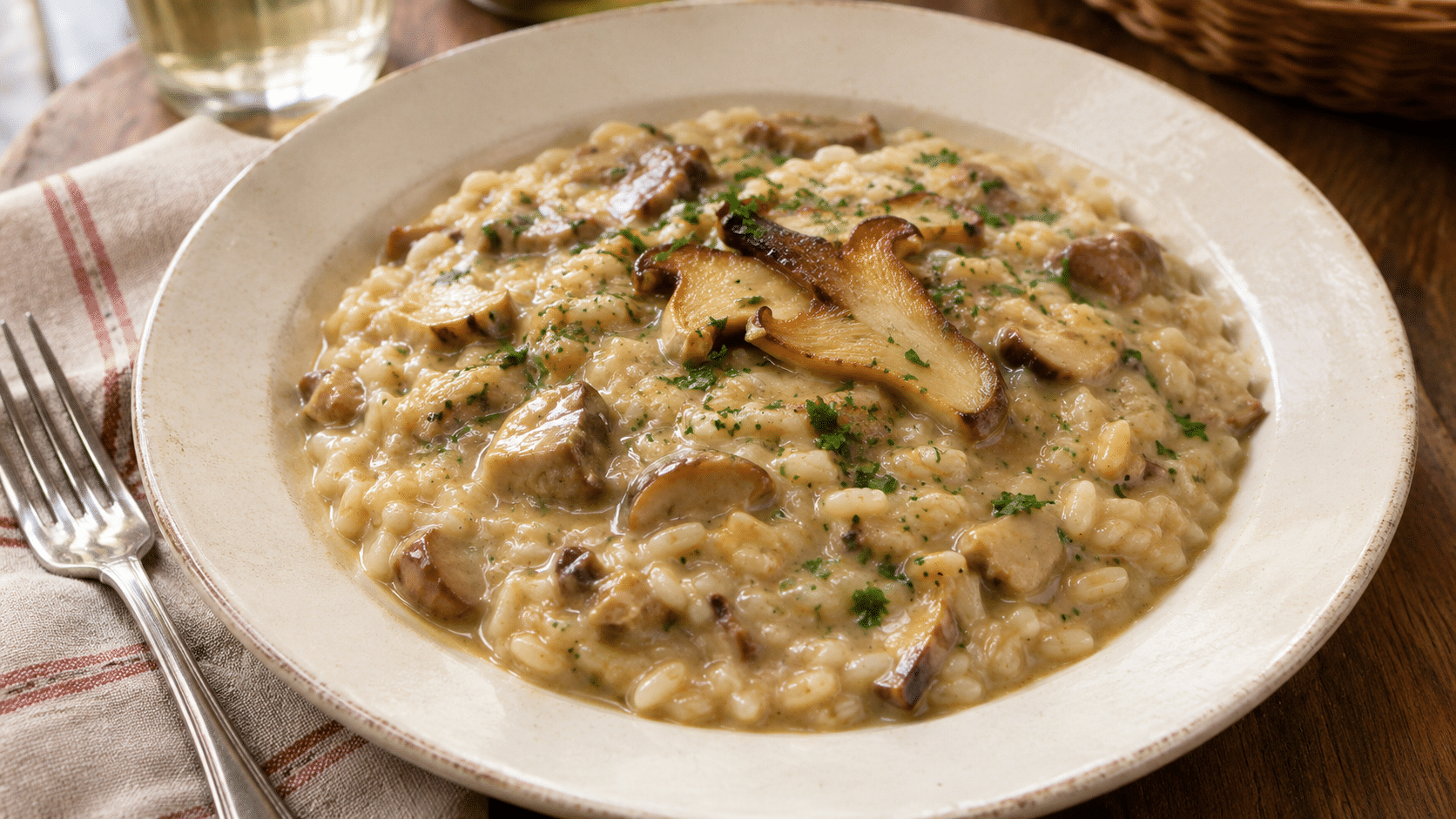
A good risotto ai funghi porcini brings together two distinct pleasures: the earthy aroma of mushrooms and rice cooked until tender, with a little firmness at its center. The finished dish should spread gently across a warm plate, with a glossy sauce surrounding the grains.
That creaminess comes from the rice, careful cooking and the final addition of butter. No cream is needed. Porcini provide enough character to carry the dish without a long list of extra ingredients.
This recipe uses fresh porcini, with a practical dried-mushroom variation for cooks who cannot find them locally. It makes four Italian-style first courses or three more generous portions.
A Mushroom Risotto with Northern Italian Roots
Risotto is closely associated with northern Italian cooking, while porcini feature in kitchens across many parts of Italy. Mushroom risotto therefore belongs to a broad cooking tradition rather than a single town with one fixed recipe.
In Trentino’s Val di Sole, for example, the local tourism board presents a porcini risotto finished with TrentinGrana. Other cooks use Parmigiano Reggiano, vary the stock or leave out the wine. These choices change the balance without changing the basic idea: rice cooked gradually in broth, flavored with mushrooms and finished until creamy.
On an Italian menu, this dish usually appears among the primi, alongside pasta and soups. Our guide to how to read an Italian menu explains these courses and useful cooking terms.
Choosing Rice and Porcini
Carnaroli is a useful first choice. It gives you a little flexibility as the rice approaches doneness. Arborio also works well and is often easier to find. Use rice sold for risotto, and do not rinse it before cooking: its surface starch helps form the sauce.
For more on choosing rice, olive oil and cheese, see Italian pantry essentials.
Fresh porcini should feel firm rather than slimy, with no unpleasant smell. Clean them shortly before cooking, trimming away soil and damaged sections. A brush and damp cloth often do the job. If grit remains, rinse briefly and dry immediately; avoid leaving them soaking in water.
Dried porcini are a useful alternative, with a concentrated aroma and a firmer texture after rehydrating. Check the package for soaking and cooking directions. You can also combine dried porcini with fresh cultivated mushrooms for a more affordable everyday version.
Risotto ai Funghi Porcini Recipe
Serves: 4 as a first course, or 3 as a main dish
Preparation: About 20 minutes
Cooking: About 30 minutes
Total: About 50 minutes
Equipment: A wide, heavy saucepan, a frying pan, a small pot for stock and a ladle
Ingredients
- 320 g Carnaroli or Arborio rice
- 400 g fresh porcini mushrooms
- 1.2 liters mild vegetable stock, with extra hot water available if needed
- 1 small onion or 2 small shallots, finely chopped
- 2 tablespoons extra virgin olive oil, divided
- 50 g unsalted butter, divided into 20 g and 30 g portions
- 1 small garlic clove, lightly crushed
- 100 ml dry white wine, optional
- 40 g freshly grated Parmigiano Reggiano, plus a little extra if desired
- 1 tablespoon finely chopped flat-leaf parsley
- Salt and freshly ground black pepper
The amount of stock you use will depend on the rice, the width of the pan and the heat. Keep it available, but judge the risotto by texture rather than trying to empty the pot.
1. Keep the Stock Hot
Bring the vegetable stock to a gentle simmer in a separate pot, then lower the heat to keep it hot.
Choose a mild stock so the porcini remain the main flavor. If using stock cubes or concentrate, taste before adding salt. The cheese will contribute salt at the end as well.
2. Cook the Mushrooms Separately
Slice the cleaned porcini about 5 mm thick, cutting larger pieces into manageable portions.
Heat 1 tablespoon of olive oil in the frying pan with the garlic. Once the garlic becomes fragrant, add the mushrooms. Cook over medium-high heat, turning occasionally, until their released moisture has mostly evaporated and they are cooked through, usually about 8–10 minutes.
Work in batches if the pan is crowded. Season lightly, discard the garlic and set the mushrooms aside. Reserve a few attractive slices for serving.
3. Soften the Onion
In the risotto saucepan, warm the remaining tablespoon of olive oil with 20 g butter. Add the onion or shallots and cook gently for about 5–7 minutes.
The onion should soften without developing a dark color. If it starts catching, lower the heat and add a spoonful of stock.
4. Toast the Rice
Add the unwashed rice and stir for about 2 minutes, coating the grains in the fat and onion.
Pour in the wine, if using, and let it reduce until the sharp alcoholic smell has faded. For a version without wine, move directly to the first addition of stock.
5. Add Stock Gradually
Add enough hot stock to just cover the rice. Maintain a steady, gentle simmer and stir regularly, sweeping the base and corners of the pan.
When the liquid has reduced substantially, add another ladleful. Keep the rice moist throughout cooking; there is no need to let the pan become dry between additions.
After about 10 minutes, stir in the cooked mushrooms, keeping the reserved slices aside. Continue cooking and adding stock as needed.
Begin tasting the rice around 15 minutes after the first stock addition. Many risotto rices take roughly 16–20 minutes, but follow the grain’s texture and use the packet timing as a guide. The center should offer slight resistance without tasting hard or chalky.
6. Finish with the Mantecatura
When the rice is ready, leave the risotto slightly looser than you want to serve it. Remove the saucepan from the heat.
Add the remaining 30 g butter and the grated Parmigiano Reggiano. Stir firmly or move the pan back and forth to bring the rice, liquid and fat together. This finishing stage is called mantecatura.
Let it settle for about a minute, then check the consistency. Add a little more hot stock if necessary. Taste for salt, add black pepper and fold in the parsley.
Spoon onto warm plates, top with the reserved mushrooms and serve immediately.
How to Make It with Dried Porcini
For four first-course portions, use 30–40 g dried porcini instead of the fresh mushrooms.
Rehydrate them according to the package instructions, typically in warm water for around 20–30 minutes. Lift them out rather than pouring everything through a sieve at once, so any sediment stays behind. Check for remaining grit and chop larger pieces.
Strain the soaking liquid through a paper coffee filter or a very fine filter. Taste it before using: it should have a pleasant mushroom flavor. If clean-tasting, add about 200–300 ml to the stock, replacing an equal amount of broth. Discard any gritty or bitter liquid.
Sauté the rehydrated porcini with the garlic and oil, then add them to the rice with the first stock addition so they have ample time to cook. Follow any longer cooking requirement on the mushroom packet.
For a mixed-mushroom version, use 20–25 g dried porcini with about 250 g fresh cremini mushrooms. Sauté the cremini as described for the fresh mushrooms, adding them later in cooking. The result has porcini aroma with more substantial mushroom pieces.
Getting the Creamy Texture Right
Keep the simmer steady. A very low heat can make cooking drag, while an aggressive boil evaporates stock quickly and makes the pan harder to manage.
Stir regularly, with a gentle hand. You need enough movement to prevent sticking and help release starch. You do not need to beat the rice throughout cooking.
Check the consistency after adding cheese. Risotto thickens as it stands. A spoonful should relax across the plate rather than hold a rigid mound.
Use restraint with the finishing ingredients. Extra cheese, garlic or parsley can easily overpower porcini. Taste before adding more.
If the rice is still firm and the stock is running low, use hot water to finish cooking. Adding more salty stock concentrate can make an otherwise balanced risotto too salty.
Variations and Serving Ideas
For a dish without wine, simply omit it; the porcini provide plenty of flavor. For a dairy-free variation, use olive oil instead of butter and leave out the cheese, adjusting the seasoning at the end.
If serving vegetarians, check the cheese carefully. Parmigiano Reggiano uses animal rennet, so choose a suitable vegetarian alternative and use vegetable stock.
Serve porcini risotto as the main event with a simple green salad or cooked seasonal vegetables. If it forms part of a longer Italian meal, keep the portions modest and follow it with a light second course.
For entertaining, clean and slice the mushrooms, grate the cheese and prepare the stock in advance. Cook the rice close to serving time: its flowing texture is at its best straight from the pan.
Italian Cookbooks to Explore
A useful cookbook helps you understand how rice, stock and finishing ingredients work together, then gives you other dishes on which to practice.
As an Amazon Associate, Italia Mia earns from qualifying purchases.
- Essentials of Classic Italian Cooking by Marcella Hazan: A broad guide for readers who enjoy detailed explanations of Italian home cooking. Find Marcella Hazan’s cookbook on Amazon.com.
- The Silver Spoon: A substantial collection of Italian recipes for cooks who want a wide reference covering everyday dishes and regional cooking. Find The Silver Spoon on Amazon.com.
These links open Amazon search results, where you can compare editions, formats and availability. The recipe above is an independently written home-cooking version, rather than a reproduction from either book.
External Links
- Visit Val di Sole: Risotto ai Funghi Porcini
- GialloZafferano: Porcini Mushroom Risotto
- Penguin Random House: Essentials of Classic Italian Cooking
- Phaidon: The Silver Spoon