
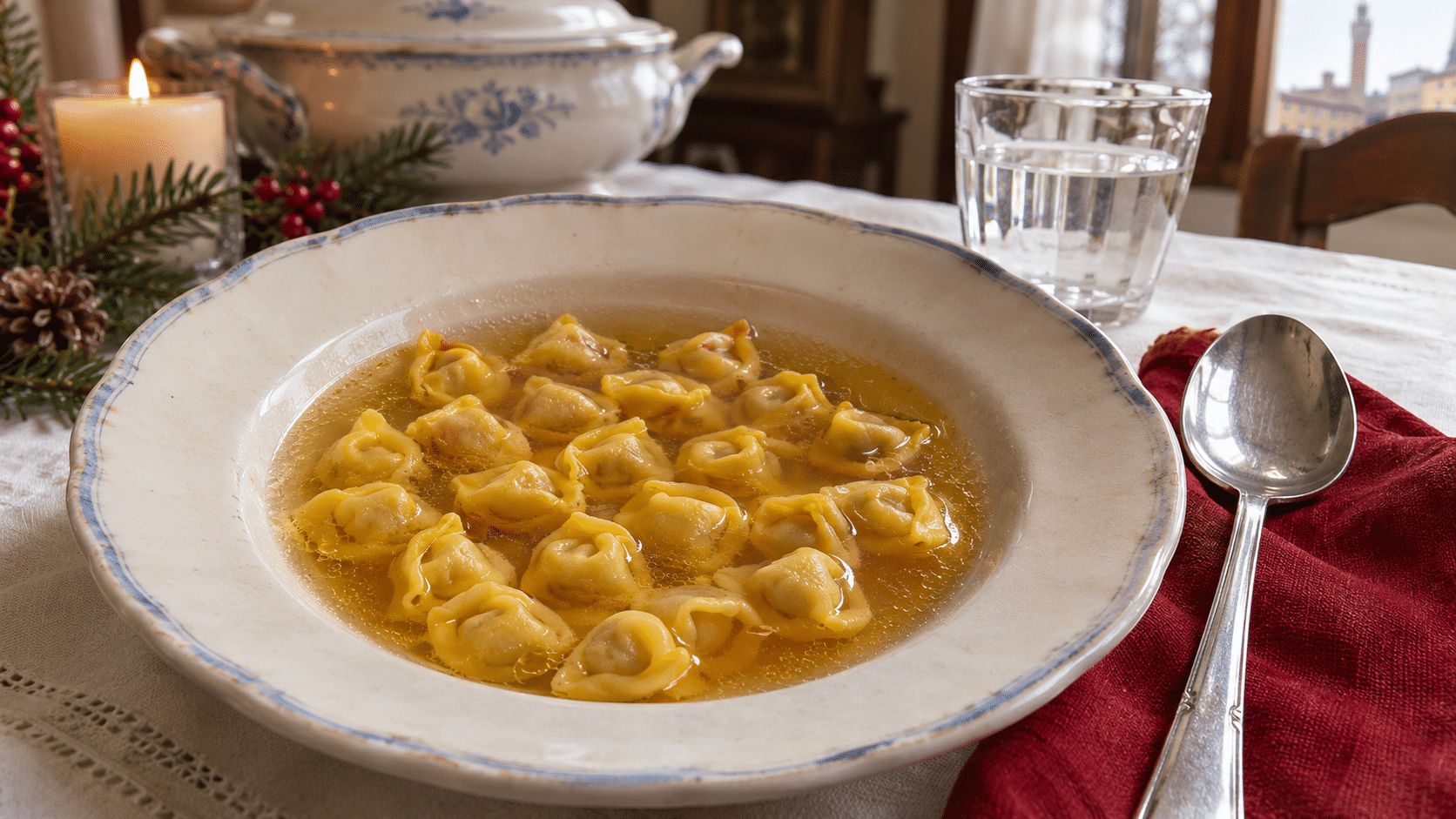
 The best tool for judging the size of a tortellino is a soup spoon. You want room for a couple of the little pasta rings and a mouthful of broth. Bite into one and you should taste mortadella, Parmigiano Reggiano and a trace of nutmeg. The next spoonful might hold only broth, which is a good reason to give the stockpot as much attention as the pasta board.
In Bologna and Modena, tortellini in brodo belong to Christmas Day lunch. They arrive as the primo, the first course, with the rest of the meal still to come. Their place on the table helps explain their proportions. A modest bowl of tiny, richly filled parcels in clear broth leaves room for a secondo. If you’ve ever wondered how one kitchen manages all the courses of an Italian Sunday lunch, this dish offers a clue. Most of the work can be finished before anyone sits down.
What goes into a Bolognese tortellino?
The wrapper is a thin sheet of egg pasta, or sfoglia. The filling brings together pork loin, prosciutto crudo, mortadella and grated Parmigiano Reggiano. The loin gives the mixture substance, the prosciutto seasons it and the mortadella contributes fat and a little sweetness. Finely grinding the meats matters here. Even a small strand of prosciutto can catch across the edge of a three-centimetre square and keep it from sealing.
Bologna has recorded the dish in stages. The recipe for the filling was deposited with the Chamber of Commerce in 1974, followed by the specifications for the shape in 2008. On 16 October 2026, the Dotta Confraternita del Tortellino deposited the broth recipe. Alongside capon and beef, it calls for half a tomato and a rind from a 24-month Parmigiano Reggiano. Free-range chicken is an accepted variation. The tomato is a particularly revealing detail. Half of one goes into five litres of water, enough to season the broth while leaving it golden.
Tortellini in brodo recipe
Serves six as a first course. Allow about four hours for the broth, mostly unattended, and roughly two hours to make and shape the pasta. Give yourself longer for a first batch. The filling rests overnight. This home version uses chicken legs and beef short ribs, cuts you can ask for at most butcher counters.
For the broth
- 2 large bone-in chicken legs (thigh and drumstick), about 650 g total, or the equivalent weight of bone-in capon
- 500 g meaty beef short ribs
- 1 small onion, halved, 1 carrot and 1 celery stalk
- A wedge of ripe tomato and a small piece of clean Parmigiano Reggiano rind, if available
- 3 litres cold water and salt to taste
For the pasta
- 200 g Italian type 00 flour or plain all-purpose flour, plus a little for the board
- 2 large eggs
For the filling and table
- 50 g pork loin, cut into thin slices
- 1 teaspoon butter
- 50 g prosciutto crudo and 50 g mortadella, roughly chopped
- 75 g finely grated Parmigiano Reggiano, plus extra to serve
- 1 small egg, beaten, and a pinch of freshly grated nutmeg
Make the broth and filling the day before
Brown the cut sides of the onion in a dry pan until golden. Transfer the onion to a stockpot with the chicken, beef, carrot, celery, tomato and cheese rind. Pour in the cold water and add a small pinch of salt. Bring the pot slowly up to a simmer, lifting away the foam that rises with a slotted spoon. Once the surface clears, adjust the heat until you see only an occasional bubble.
Simmer gently, partly covered, for three to four hours. Lift out the meat and vegetables, then ladle the broth through a fine sieve into a clean pot. Resist pressing on the solids, which pushes fine particles back into the liquid. You’ll need about two litres for six bowls and a little extra for cooking. If the flavour is faint, simmer the strained broth uncovered for a few minutes. If it tastes too concentrated, add water a ladleful at a time. Divide into shallow containers, cool promptly and refrigerate. Keep the cooked meat for a second course with salsa verde.
For the filling, melt the butter in a small pan and cook the sliced pork through, turning once. Let it cool, then chop it with the prosciutto and mortadella in a food processor until very fine. Scrape down the sides once or twice. Add the grated cheese and nutmeg, then enough beaten egg to bind the mixture. A small pinch of filling should hold its shape between your fingers. Cover and refrigerate for about 12 hours.
Roll, fill and fold the pasta
Work the eggs into the flour with a fork, then knead by hand for about 10 minutes, until the dough feels smooth and springs back slowly under a fingertip. If dry crumbs remain after several minutes, wet your hands and knead again. Cover the dough and let it rest for 30 minutes. Divide it into four pieces and keep three covered while you roll the first.
Use a rolling pin or pasta machine to produce a thin sheet. You should just see the shadow of your hand through it. Cut a strip into 3 cm squares and place a small dab of filling, about the size of a lentil, in the centre of each. Try folding the first square before filling the rest of the strip. If meat squeezes out as the corners meet, reduce the next dab.
- Bring one corner over the filling to meet the opposite corner, forming a triangle.
- Press around the mound to ease out trapped air, then pinch the two open edges shut.
- Curve the filled base of the triangle around the tip of your little finger. Bring its two corners together, overlap them and pinch firmly.
- Slip the ring off your finger and set it on a lightly floured tray. Leave a little space between pieces.
Work a few squares at a time. A freshly rolled sheet seals with finger pressure alone. If a square has started to dry, run a barely damp fingertip along one edge. Too much water makes the corners slippery. Divide the work if someone is keeping you company. One person can roll and cut the next strip while the other finishes the folds.
Cook the tortellini and serve immediately
Bring the strained broth to a gentle boil. Set aside a few ladlefuls in a small saucepan and keep them hot for topping up the bowls. Shake excess flour from the tortellini, lower them into the main pot and stir gently once to release any sticking to the bottom. Keep the liquid at a lively simmer. Fresh, thinly rolled tortellini usually take about three to four minutes. Taste one, paying particular attention to the overlap where the dough is thickest. Give it another minute if the fold still tastes floury.
Warm six shallow soup bowls. Distribute the pasta first, then ladle broth over each portion so the rings can move freely when you dip in a spoon. Taste the broth once more before adding salt, since the filling and any cheese at the table contribute plenty. Pass freshly grated Parmigiano Reggiano separately and serve while the pasta still has a little bite.
A Christmas lunch timetable
On 23 December, make the broth and filling. On Christmas Eve, roll and fold the tortellini. For the following day, freeze them in a single layer on trays, then transfer them to a sealed container once firm. They can go straight from the freezer into simmering broth. Cook a test tortellino and allow a few extra minutes for the centre to heat through.
On Christmas Day, lift the set fat from the chilled broth, leaving a few golden flecks if you like. Reheat the broth while everyone eats the antipasto, and add the pasta when the bowls are ready. For more ideas on what to serve next, see Italia Mia’s guide to traditional Italian Christmas dishes from north to south.
For a winter supper with less time at the pasta board, buy small, fresh meat tortellini from a pastificio and make the broth yourself. Ask for tortellini da brodo and follow the maker’s cooking time. Cook only as many as you plan to serve. A second batch takes minutes, and the last person to the table gets the same tender folds as the first.
External Links
- Bologna Chamber of Commerce — the broth recipe deposited in October 2026
- Dotta Confraternita del Tortellino — illustrated recipe for tortellini in meat broth (PDF, Italian)
- Bologna Welcome — ingredients and preparation of tortellini in brodo