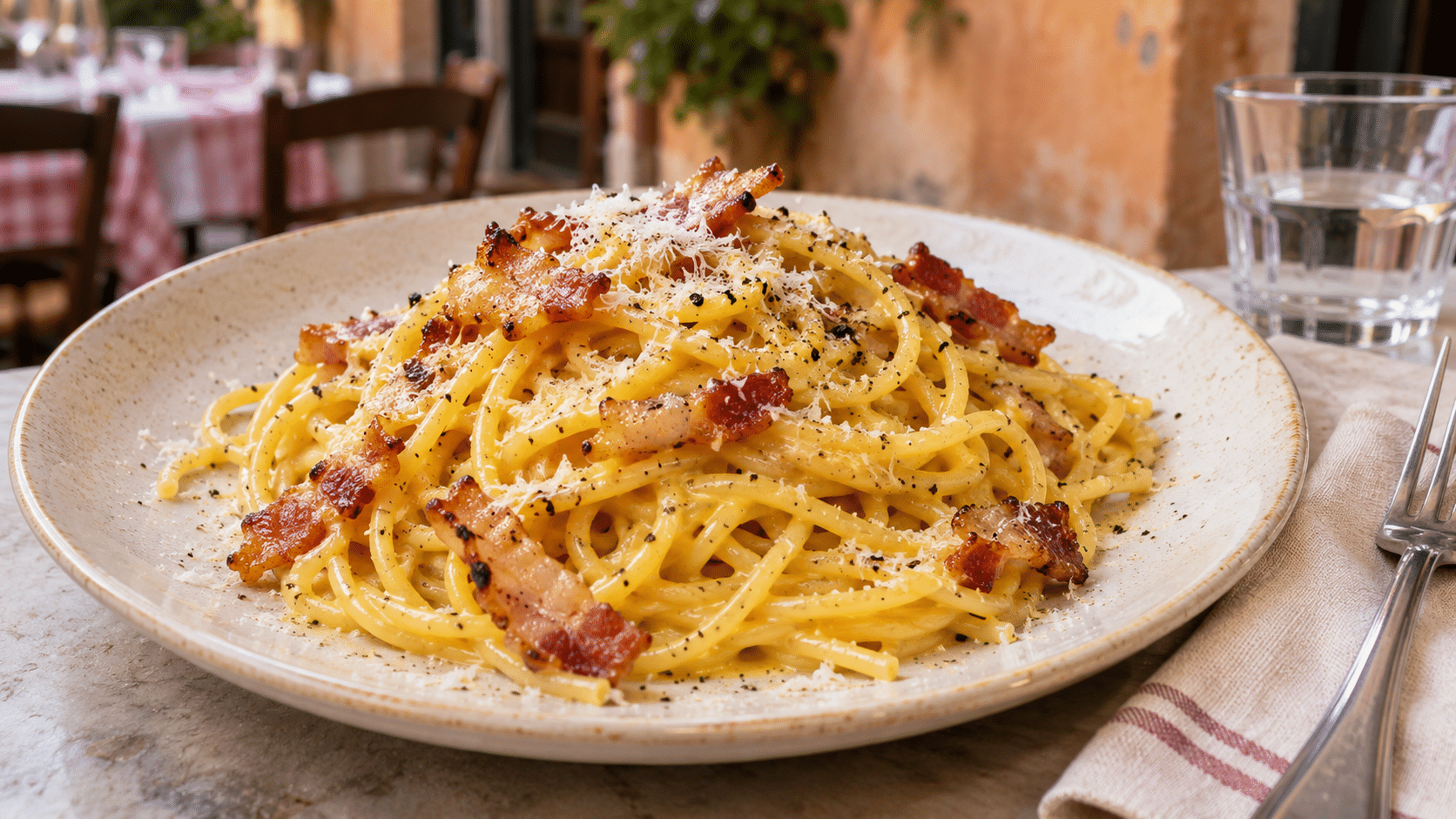
Spaghetti alla carbonara turns a short shopping list into one of Rome’s most satisfying pasta dishes. Golden egg sauce clings to the spaghetti, guanciale provides crisp edges and savory richness, and Pecorino Romano and black pepper give every forkful a distinctive bite.
The creaminess comes from the ingredients themselves: eggs, finely grated cheese, rendered pork fat and a little starchy pasta water. There is no need for cream. The real skill is controlling the heat during the final mixing, so the sauce coats the pasta without becoming scrambled eggs.
Carbonara features in our collection of famous Italian recipes to make at home. This dedicated guide explains the ingredients, a practical recipe for four, and how to avoid the problems that can turn a silky sauce into a dry or grainy one.
Carbonara at a Glance
| Detail | What to know |
|---|---|
| Region | Lazio, especially Rome |
| Course | Primo piatto; also suitable as a standalone meal |
| Servings | 4 |
| Preparation | About 10 minutes |
| Cooking | About 15–20 minutes |
| Total time | About 30 minutes, depending on how quickly the water boils |
| Main ingredients | Spaghetti, guanciale, eggs, Pecorino Romano, black pepper |
| Key technique | Add the egg mixture off the heat and loosen gradually with pasta water |
| Allergens | Wheat, eggs and milk |
What Goes into Traditional Carbonara?
The modern Roman reference point is pasta with guanciale, eggs, Pecorino Romano and black pepper. Salt seasons the cooking water, but the pork and cheese already contribute plenty.
Guanciale
Guanciale is cured pork jowl. Its fat renders as it cooks, providing much of carbonara’s flavor and helping carry the sauce through the spaghetti. Cut it into short, reasonably even strips so the pieces cook at a similar rate.
Remove any tough rind before slicing. Start the guanciale in an unheated pan and let it cook gently: the aim is golden meat with some crispness, not blackened edges and bitter fat. You generally do not need oil or butter.
Pancetta is a practical substitute if guanciale is unavailable, but it comes from pork belly and produces a different result. Smoked bacon changes the flavor more noticeably. Both substitutions are worth labeling honestly.
Pecorino Romano
Pecorino Romano brings the salty, sharp character associated with Roman carbonara. Grate it very finely so it can disperse through the egg mixture. Coarse shreds are harder to incorporate smoothly.
Parmigiano Reggiano, alone or mixed with Pecorino, produces a milder variation. For this recipe, use Pecorino Romano throughout.
Eggs
There is no single egg ratio followed by every Roman cook. Some recipes use yolks alone; others combine yolks and whole eggs.
Here, four yolks and two whole eggs provide a rich sauce with enough fluidity to coat 400 grams of spaghetti. Separate the eggs before you begin cooking, rather than trying to do it while the pasta is ready to drain.
Spaghetti and Black Pepper
Spaghetti is the classic choice for this guide, although rigatoni also works well. Use dried pasta and cook it al dente, following the packet timing as a guide and tasting before draining.
Freshly ground black pepper gives a more fragrant finish than pepper that has been sitting ground for months. Start moderately; you can always add more at the table.
Spaghetti alla Carbonara Recipe
Ingredients for Four
- 400 g spaghetti, about 14 oz
- 150 g guanciale, about 5¼ oz, rind removed
- 4 large egg yolks
- 2 large whole eggs
- 80 g Pecorino Romano, about 2¾ oz, very finely grated, plus a little extra to serve
- About 1 teaspoon freshly ground black pepper, adjusted to taste
- Salt for the pasta water
- About 250 ml reserved pasta water; you will probably use only part of it
Have ready a large pot, a wide frying pan, a mixing bowl, a whisk or fork, tongs and a heatproof cup for the pasta water. Set out your serving bowls before cooking: carbonara is best eaten as soon as it is finished.
1. Prepare the Guanciale
Cut the guanciale into short strips roughly 5 mm thick. Put them in a cold, wide frying pan and set it over medium-low heat.
Cook for approximately 7–10 minutes, stirring occasionally, until the fat has rendered and the pieces are golden with crisp edges. Timing varies with the thickness of the pieces and the heat of the pan.
Turn off the heat and move the pan away from the hot burner. If there is a deep pool of fat, spoon some into a heatproof bowl, leaving roughly 2–3 tablespoons in the pan with the guanciale. Reserve a few pieces of meat for the final topping if you like.
2. Mix the Eggs and Cheese
In a bowl, whisk the four yolks, two whole eggs, grated Pecorino and black pepper until evenly combined. The mixture will be thick.
Do not add salt at this stage. It is easier to judge the seasoning once the cheese, guanciale and pasta are together.
3. Cook the Spaghetti
Bring a large pot of water to the boil and salt it moderately. Cook the spaghetti until al dente, stirring during the first minute to separate the strands.
Shortly before draining, reserve about 250 ml of the cooking water. Keep it within reach for the final mixing. Do not rinse the pasta.
4. Coat the Pasta with the Guanciale Fat
Transfer the drained spaghetti to the guanciale pan and toss thoroughly. Add a small splash of the reserved water to help distribute the fat.
The pan should be warm, but no longer fiercely hot. If the pasta is sizzling or frying, let the pan cool briefly before introducing the eggs. A heavy pan may retain heat longer than a thin one.
5. Add the Egg Mixture Off the Heat
With the burner off, pour the egg and cheese mixture over the spaghetti, immediately tossing and stirring with tongs.
Add reserved pasta water a tablespoon at a time while continuing to mix. Stop when the sauce is glossy and flows around the strands. You are aiming for pasta coated in sauce, without a puddle underneath.
If the sauce remains too loose as the pasta cools, warm the pan over the lowest heat in very brief bursts, moving it off the burner and tossing between each burst. Do not let the sauce simmer. This final adjustment needs attention: too much heat will set the eggs into curds.
6. Serve Immediately
Divide between warm bowls and finish with the reserved guanciale, a little extra Pecorino and freshly ground pepper.
Leave the sauce slightly looser in the pan than you want it on the plate. It thickens as it stands.
How Carbonara Becomes Creamy Without Cream
The sauce depends on moisture, fat, gentle heat and movement. Egg yolks help bring the fat and water together; finely grated cheese adds body; and starchy cooking water helps the mixture spread evenly over the pasta.
Too little water leaves the sauce stiff. Too much heat makes the egg proteins set into visible curds. Adding a little water while tossing gives you more control than pouring in a full ladle at once.
Cream changes both the taste and consistency, and it is unnecessary for the version described here. The finished sauce should feel rich but still allow the Pecorino, guanciale and pepper to stand out.
Common Carbonara Problems and How to Avoid Them
| Problem | Likely cause | What to do |
|---|---|---|
| Scrambled egg pieces | Pan too hot or prolonged direct heat | Remove from heat immediately. A little water may loosen the pasta, but set egg curds cannot be turned back into a smooth sauce. |
| Thick, sticky sauce | Too little liquid or a delay before serving | Toss in warm reserved pasta water, one tablespoon at a time. |
| Watery sauce | Too much water or insufficient gentle warming | Keep tossing; if needed, use very brief bursts of low heat. |
| Cheese clumps | Coarse grating or excessive heat | Grate finely and mix with the eggs before adding to the pasta. |
| Greasy pasta | More rendered fat than the sauce can incorporate | Spoon off excess fat before adding the pasta; mix thoroughly with a little water. |
| Excessive saltiness | Salty water combined with cured pork and Pecorino | Salt the cooking water moderately and taste before adding more cheese. |
Does Carbonara Have an Ancient Roman History?
Carbonara belongs firmly to Rome’s modern culinary identity, but its precise origin is disputed. Stories connect it with charcoal workers or with the availability of eggs and bacon around the Second World War; neither should be presented as a conclusively established invention story.
The historical recipes also complicate the idea of one unchanged formula. La Cucina Italiana’s 1954 version included pancetta, Gruyère and garlic. The modern preference for guanciale and Pecorino developed within a changing recipe tradition.
Following today’s Roman ingredient combination is a useful cooking choice. It does not require claiming that every earlier carbonara was made the same way.
What to Serve with Carbonara
Carbonara is rich enough to be the center of a simple meal. Follow it with a green salad, seasonal vegetables or fresh fruit. A large, creamy starter is unnecessary.
In a traditional Italian meal, it is a primo rather than a side dish for grilled chicken or meat. For a broader introduction to regional specialties, explore our guide to 20 popular dishes in Italy.
Frequently Asked Questions
Does traditional carbonara contain garlic or onion?
Neither is included in this modern Roman version. Some historical recipes used garlic, but it is not part of the ingredient combination followed here.
Can I prepare carbonara ahead of time?
You can grate the cheese and cut the guanciale ahead, keeping perishable ingredients refrigerated. Cook and dress the pasta immediately before serving. Finished carbonara loses its silky texture as it sits, and reheating tends to set the eggs further.
Are the eggs fully cooked?
The eggs are gently thickened by the heat of the pasta and pan. This method does not guarantee a fully cooked egg temperature throughout the sauce. Use pasteurized eggs for a preparation that leaves the eggs lightly cooked, especially when serving people who need to avoid undercooked eggs. Freshness alone does not remove that risk.
Can I make it without pork?
You can make a different pasta dish using eggs, cheese and vegetables, but guanciale contributes a distinctive flavor and fat to this recipe. Simply removing it will change the result; a vegetable variation needs its own balance of fat and seasoning.
Can I halve the recipe?
Yes. For two people, use 200 g spaghetti, 75 g guanciale, two yolks, one whole egg and 40 g Pecorino. Add pasta water according to the consistency of the sauce rather than automatically halving a fixed amount.
Cookbooks for Exploring Roman Cooking
Disclosure: As an Amazon Associate, Italia Mia earns from qualifying purchases.
Tasting Rome, by Katie Parla and Kristina Gill, explores the food of the capital through recipes and the culture surrounding them. It is a useful companion for readers who want to continue beyond carbonara into Roman cooking.
Find Tasting Rome on Amazon.com · Find Tasting Rome on Amazon.it
For Italian-language readers, Il sapore di Roma, by the same authors and published by Guido Tommasi Editore, offers another way to explore their work on the city’s food.
Find Il sapore di Roma on Amazon.it · Find Il sapore di Roma on Amazon.com
These links open title searches. Check the language, edition, seller and availability before ordering.
External Links
- Barilla: Traditional Carbonara
- La Cucina Italiana: Carbonara Recipes from 1954 to Today
- Penguin Random House: Tasting Rome
- Guido Tommasi Editore: Il sapore di Roma