 Best Places to Visit in Puglia: 20 Towns, Beaches and Hidden Gems
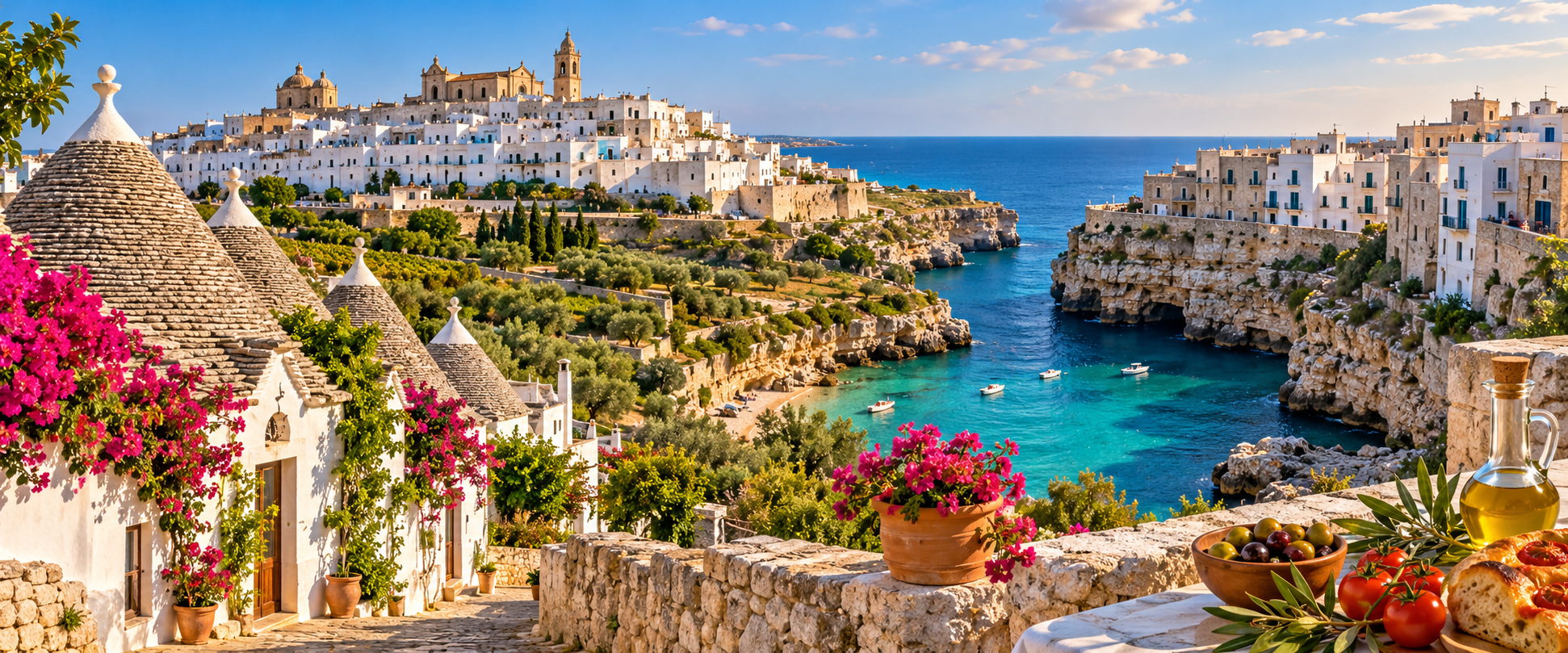
Puglia stretches along the heel of Italy’s boot, between the Adriatic and Ionian seas, and contains some of southern Italy’s most compelling landscapes. Whitewashed hill towns rise above ancient olive groves, fishing villages cling to limestone cliffs, Baroque churches fill historic centers, and hundreds of kilometers of coastline lead to beaches ranging from rocky coves to long sweeps of pale sand.
For travelers who already know Rome, Florence, Venice and perhaps the Amalfi Coast, Puglia offers a very different version of Italy.
Life often feels slower here. Food remains closely connected to the land and sea. Small towns still revolve around their evening passeggiata, while masserie—historic fortified farmhouses—have become some of the region’s most distinctive places to stay.
Puglia is also much larger than many first-time visitors expect. Driving from the Gargano Peninsula in the north to Santa Maria di Leuca in the far south takes several hours. Trying to see everything in three or four days is therefore a mistake.
Instead, think of Puglia as several destinations within one region.
This guide introduces 20 of the best places to visit in Puglia, from famous destinations such as Alberobello and Lecce to seaside towns, spectacular beaches and lesser-known places worth adding to a road trip.
For a broader introduction to the region, start with Italia Mia’s complete guide to the Region of Puglia.
Puglia at a Glance
Region: Puglia (Apulia in English)
Regional capital: Bari
Location: Southeastern Italy
Main airports: Bari and Brindisi
Seas: Adriatic and Ionian
Best known for: Trulli, beaches, olive oil, orecchiette, burrata, masserie, Baroque architecture and whitewashed towns
Best time to visit: May–June and September–early October for a combination of pleasant weather and fewer crowds
Ideal trip length: 7–10 days
Best way to explore: Car, especially for smaller towns, beaches and countryside
1. Bari – Gateway to Puglia
Many travelers treat Bari merely as the place where their plane lands.
That is a mistake.
Puglia’s capital deserves at least a full day, particularly for Bari Vecchia, the atmospheric old town squeezed between the modern city and the Adriatic.
The narrow streets form a maze of churches, tiny squares, shrines, arches and family homes. Along certain streets you can still see local women making orecchiette by hand.
The great religious landmark is the Basilica di San Nicola, an important pilgrimage destination containing the relics of Saint Nicholas.
Walk through the old city toward the Castello Svevo before continuing along Bari’s long seafront promenade.
Don’t miss
- Bari Vecchia
- Basilica di San Nicola
- Castello Svevo
- Lungomare
- Strada delle Orecchiette
- Focaccia Barese
How long: 1–2 days
Bari also makes an excellent base for travelers relying on trains rather than renting a car.
2. Polignano a Mare – Puglia’s Dramatic Seaside Town
Few views symbolize modern Puglia better than Polignano a Mare.
The historic center sits dramatically above limestone cliffs while the Adriatic crashes into caves beneath the town.
Its most photographed location is Lama Monachile, the small pebble beach framed by cliffs and overlooked by white buildings.
But Polignano deserves more than a photograph.
Walk through the historic center, find the terraces overlooking the sea, explore the coastline by boat and stay until evening when many day-trippers have departed.
Polignano is also associated with Italian singer Domenico Modugno, famous worldwide for “Nel blu dipinto di blu,” better known as “Volare.”
Best for
Sea views, photography, romantic walks, swimming and boat excursions.
How long: Half day to 1 day
3. Monopoli – The Seaside Town You Shouldn’t Skip
Only a short distance from Polignano lies Monopoli, but the two towns have very different personalities.
Monopoli combines an attractive fishing harbor, historic churches, whitewashed streets and small beaches within walking distance of its old center.
It is also one of the best places to base yourself in central Puglia.
You can reach Polignano easily, drive inland to Alberobello and the Valle d’Itria, or spend the day exploring beaches farther down the Adriatic coast.
Don’t miss
- Porto Vecchio
- Monopoli Cathedral
- Castello Carlo V
- Old-town lanes
- Cala Porta Vecchia
How long: 1 day, or 2–4 nights as a base
4. Alberobello – Land of the Trulli
No first journey through Puglia feels complete without seeing Alberobello.
The town is famous for its trulli, small stone buildings topped by distinctive conical roofs.
Hundreds survive in Alberobello, creating a landscape unlike anywhere else in Italy.
The principal concentration is in Rione Monti, while the quieter Aia Piccola district gives visitors a somewhat less commercial impression of traditional trullo architecture.
Alberobello’s trulli are recognized as a UNESCO World Heritage Site.
Don’t miss
- Rione Monti
- Aia Piccola
- Trullo Sovrano
- Sant’Antonio Church
- Panoramic viewpoints across the trulli
How long: Half day to 1 day
Tip: Arrive early in the morning or remain until evening. Midday tour groups can completely change the atmosphere.
5. Locorotondo – One of Puglia’s Prettiest Small Towns
Not far from Alberobello, Locorotondo crowns a hill overlooking the Valle d’Itria.
Its name roughly reflects the circular layout of its historic center.
White houses, flower-filled balconies, narrow lanes and panoramic views make Locorotondo one of Puglia’s most photogenic towns.
Yet it often feels calmer than Alberobello.
The countryside surrounding it is particularly beautiful, scattered with trulli, vineyards and olive trees.
Best for
Slow travel, photography, wine, countryside views and evening walks.
How long: 2–4 hours
6. Martina Franca – Baroque Elegance in the Valle d’Itria
While nearby villages are known primarily for whitewashed simplicity, Martina Franca introduces a more ornate architectural personality.
Its historic center contains elegant palazzi, Baroque churches, elaborate stone balconies and graceful piazzas.
The Basilica di San Martino is among its architectural highlights.
Martina Franca is also associated with capocollo di Martina Franca, one of the area’s best-known cured meats.
Combine Martina Franca with Locorotondo and Cisternino for an outstanding day in the Valle d’Itria.
How long: Half day
7. Cisternino – Small-Town Puglia at Its Best
Cisternino is smaller and less monumental than Lecce or Bari. That is precisely its appeal.
The whitewashed old town is a maze of stairways, arches, tiny courtyards and unexpected viewpoints.
Cisternino is particularly enjoyable in the evening.
One local tradition worth experiencing is choosing meat at a fornello pronto, essentially a butcher shop that cooks the meat for you.
Best for
Food, atmosphere, evening passeggiata and slow travel.
How long: Half day
8. Ostuni – The White City
From a distance, Ostuni looks like a white crown rising above the olive-covered countryside.
Known as La Città Bianca, the White City, Ostuni is among the most visually striking destinations in southern Italy.
Inside the historic center, lanes climb between whitewashed houses before reaching the cathedral at the top of the hill.
The real pleasure is wandering without a rigid itinerary.
Doorways, staircases, small restaurants and glimpses of the Adriatic continually appear around unexpected corners.
Don’t miss
- Ostuni Cathedral
- Piazza della Libertà
- Historic center
- City walls
- Panoramic viewpoints
How long: Half day to 1 day
9. Torre Guaceto – Nature and Sea
Travel south from Ostuni toward Brindisi and you encounter one of the region’s important protected coastal environments.
Torre Guaceto combines beaches, dunes, Mediterranean vegetation and marine habitat.
It provides a striking contrast with Puglia’s busier resort beaches.
Travelers interested in nature, swimming, cycling and snorkeling should consider making it part of the journey between central Puglia and Salento.
How long: Half day
10. Lecce – The Baroque Masterpiece of Salento
If Bari is Puglia’s commercial capital, Lecce is arguably its architectural showpiece.
The local golden limestone proved ideal for elaborate carving, helping produce the extravagant style now known as Barocco Leccese.
The façade of the Basilica di Santa Croce is its most celebrated example.
Nearby are Piazza Sant’Oronzo, the remains of a Roman amphitheater and the spectacular enclosed Piazza del Duomo.
Lecce also becomes wonderfully animated in the evening.
Don’t miss
- Basilica di Santa Croce
- Piazza del Duomo
- Piazza Sant’Oronzo
- Roman Amphitheater
- Lecce Cathedral
- Traditional papier-mâché workshops
Try pasticciotto, a pastry traditionally filled with custard, while exploring the city.
How long: 1–2 days
11. Otranto – Where History Meets the Adriatic
On Salento’s eastern coast, Otranto combines an attractive waterfront with a compact historic center.
Its cathedral contains an extraordinary medieval mosaic floor depicting biblical, legendary and symbolic figures.
The cathedral also preserves the memory of the inhabitants killed during the Ottoman invasion of 1480.
Walk through the old town, visit the Aragonese Castle and follow the walls for views toward the Adriatic.
Nearby coastline makes Otranto an excellent base for combining history and swimming.
How long: 1 day
12. Baia dei Turchi – A Beautiful Salento Beach
A short distance north of Otranto lies Baia dei Turchi, one of the beaches most frequently associated with the Salento coast.
Pine vegetation, pale sand and clear water create an environment that feels surprisingly natural considering its proximity to one of Puglia’s major tourist destinations.
The beach can become busy during July and August, so arrive early or travel during the shoulder season.
For more coastal ideas, see Italia Mia’s guide to the beaches of Puglia.
13. Gallipoli – The Ionian Side of Salento
Cross Salento and the landscape changes again.
Gallipoli occupies a spectacular position on the Ionian Sea. Its historic center sits on an island connected to the modern town by a bridge.
Inside you’ll find churches, tightly packed lanes, seafood restaurants and sea views in virtually every direction.
The surrounding coast contains some of Salento’s most popular sandy beaches.
Gallipoli can be extremely busy during peak summer, particularly in August. June and September provide a more relaxed experience.
Best for
Beaches, seafood, sunsets and nightlife.
How long: 1 day or several nights for a beach holiday
14. Porto Cesareo and Punta Prosciutto
Travel north along Salento’s Ionian coast and you’ll reach Porto Cesareo, surrounded by long stretches of shallow, remarkably clear water.
Farther north is Punta Prosciutto, one of the area’s most celebrated sandy beaches.
This part of Puglia is less about monuments and more about the sea.
If your ideal Italian vacation involves spending several hours in turquoise water followed by seafood and a sunset aperitivo, build time into your itinerary here.
How long: 1–3 beach days
15. Santa Maria di Leuca – At the End of the Heel
At Puglia’s southern extremity lies Santa Maria di Leuca.
The town is distinguished by its lighthouse, sanctuary, waterfront and elaborate historic villas.
Boat trips reveal sea caves scattered along the surrounding coastline.
Leuca also has powerful symbolic appeal: after traveling the length of Italy, you have essentially reached the bottom of the heel.
The Adriatic and Ionian waters converge in this area, although the idea of seeing a precise permanent line separating the two seas should be treated more as local imagery than geographical spectacle.
How long: Half day to 1 day
16. Specchia – A Salento Hidden Gem
Visitors rushing between Lecce and the beaches frequently miss the smaller inland towns.
Specchia is one of the places worth slowing down for.
Its stone historic center contains narrow lanes, noble residences, churches and quiet squares without the volume of visitors encountered in Puglia’s famous destinations.
It is an excellent example of why a Puglia road trip benefits from leaving space for spontaneous stops.
How long: 2–3 hours
17. Castel del Monte – Puglia’s Mysterious Medieval Castle
Not all of Puglia’s great attractions lie beside the sea.
Castel del Monte, built during the reign of Frederick II in the 13th century, rises in the countryside near Andria.
Its octagonal geometry has fascinated historians and visitors for generations.
Eight sides, eight towers and carefully planned architectural relationships give the building an almost mathematical quality.
The castle is a UNESCO World Heritage Site and one of medieval Italy’s most recognizable monuments.
Combine it with Andria—and taste burrata in the area where this celebrated cheese originated.
How long: Half day
18. Trani – One of Puglia’s Most Elegant Waterfronts
North of Bari, Trani offers one of the most beautiful harbor settings in Puglia.
Its Romanesque cathedral rises almost directly beside the sea, creating an unforgettable silhouette.
Nearby stand the Swabian Castle, historic Jewish quarter and an attractive marina lined with restaurants and cafés.
Trani works particularly well for travelers who want a quieter coastal destination without abandoning history and architecture.
Don’t miss
- Trani Cathedral
- Castello Svevo
- Historic Jewish quarter
- Harbor
- Seafront promenade
How long: Half day to 1 day
19. Vieste and the Gargano Peninsula
Puglia doesn’t end at Bari.
Continue north and the flat landscapes eventually give way to the dramatic Gargano Peninsula, projecting into the Adriatic.
Vieste is one of its principal destinations.
The old town rises above the sea, surrounded by cliffs, beaches, sea stacks and caves.
Gargano feels sufficiently different from Salento that it could almost constitute a separate vacation.
Visitors can combine beach days with boat excursions, coastal drives and hiking.
How long: At least 2–3 days for Gargano
20. Foresta Umbra and Peschici – Puglia’s Wild Side
One of Puglia’s biggest surprises lies inland from the Gargano coast.
Foresta Umbra is a dense woodland of beech and other trees within Gargano National Park.
After days of olive groves, sun-bleached stone and beaches, walking through a cool forest can feel like entering another region entirely.
Continue toward Peschici, a whitewashed coastal town perched above the Adriatic.
Together, Peschici, Vieste and Foresta Umbra make Gargano one of the most rewarding areas for travelers willing to venture beyond Puglia’s famous central and southern destinations.
Which Part of Puglia Should You Visit?
Choosing where to stay becomes much easier when Puglia is divided into several travel zones.
Bari and the central Adriatic coast
Choose this area for:
Bari, Polignano a Mare, Monopoli and easy transportation.
Valle d’Itria
Choose this area for:
Alberobello, Locorotondo, Cisternino, Martina Franca, Ostuni, trulli, masserie and countryside.
Lecce and Salento
Choose this area for:
Baroque architecture, Otranto, Gallipoli, beach towns and access to both Adriatic and Ionian coasts.
Gargano
Choose this area for:
Nature, Vieste, Peschici, forests, sea caves and dramatic coastal scenery.
A Perfect 7-Day Puglia Itinerary
For a first visit, this route provides an excellent introduction.
Day 1 – Bari
Explore Bari Vecchia, Basilica di San Nicola, the castle and waterfront.
Day 2 – Polignano a Mare and Monopoli
Spend the morning in Polignano and the afternoon/evening in Monopoli.
Day 3 – Alberobello, Locorotondo and Martina Franca
Drive through the Valle d’Itria and stay in a trullo or masseria.
Day 4 – Ostuni and Lecce
Visit Ostuni in the morning before continuing south to Lecce.
Day 5 – Otranto and the Adriatic beaches
Explore Otranto and swim at one of the nearby beaches.
Day 6 – Santa Maria di Leuca and Gallipoli
Drive around the southern tip of Salento and finish with sunset on the Ionian coast.
Day 7 – Lecce
Enjoy a slower final day exploring Lecce’s architecture, food and shops.
With 10–14 days, add Gargano, Trani, Castel del Monte and several dedicated beach days.
Best Beaches in Puglia
Puglia’s long coastline means that there is no single “best beach.”
Among the most interesting areas are:
- Baia dei Turchi
- Torre Guaceto
- Punta Prosciutto
- Pescoluse
- Porto Cesareo
- Baia delle Zagare
- Gargano coastline
- Beaches around Gallipoli
- Coast around Otranto
- Monopoli’s coves
Read Italia Mia’s complete Puglia beaches guide for more ideas.
You can also compare Puglia with destinations around the rest of the country in our guide to Italy’s most beautiful coastal destinations.
What to Eat in Puglia
Puglia is a destination where food should be treated as part of the sightseeing.
Look for:
Orecchiette con cime di rapa – Puglia’s famous ear-shaped pasta traditionally paired with turnip greens.
Focaccia Barese – Soft focaccia usually topped with tomatoes, olives and olive oil.
Burrata – Fresh cheese with a creamy center, strongly associated with Andria.
Panzerotti – Fried dough pockets generally filled with tomato and mozzarella.
Bombette – Small rolls of meat particularly associated with the Valle d’Itria.
Friselle – Hard twice-baked bread softened with water and topped with tomatoes, olive oil and other ingredients.
Pasticciotto – A pastry filled traditionally with custard and strongly associated with Lecce and Salento.
And don’t overlook Puglia’s olive oil, seafood, vegetables and wines, particularly Primitivo and Negroamaro.
When Is the Best Time to Visit Puglia?
For many travelers, May, June, September and early October offer the best balance.
The weather is generally suitable for sightseeing, coastal areas remain attractive, and crowds are usually easier to manage than at the height of summer.
July and particularly August bring hotter temperatures and substantially greater demand at popular beach destinations.
Spring is excellent for road trips and cultural sightseeing.
Autumn brings a more agricultural atmosphere, including grape and olive harvest activity.
Winter is quiet and can be rewarding for city visits, but many coastal tourism businesses operate seasonally.
Do You Need a Car in Puglia?
Not necessarily—but a car changes the trip dramatically.
Bari, Polignano, Monopoli, Ostuni, Brindisi and Lecce can form part of a rail-based itinerary.
However, many beaches, masserie, countryside restaurants, small villages and rural areas are considerably easier to reach by car.
For a first-time seven-day trip focused on Bari, Valle d’Itria and Salento, renting a car provides maximum flexibility.
Before driving elsewhere in the country, read Italia Mia’s Italian Autostrade guide.
Puglia Travel Books to Take With You
A good guidebook remains useful in Puglia, particularly when you’re driving through rural areas and want background information about towns, architecture, food and history.
Lonely Planet – Southern Italy
A practical choice for travelers combining Puglia with Basilicata, Campania, Calabria or other parts of southern Italy.
Check Lonely Planet Southern Italy on Amazon.com
Lonely Planet – Italy
Useful if Puglia is part of a longer journey that also includes Rome, Florence, Venice or other Italian regions.
Check Lonely Planet Italy on Amazon.com
Puglia Travel Guides
Several dedicated English-language guides concentrate specifically on Puglia, Salento, Bari, Lecce and the Valle d’Itria.
Browse Puglia travel guides on Amazon.com
Puglia Maps and Road-Trip Guides
A physical road map can still be useful when exploring the countryside, particularly as a backup to phone navigation.
Browse Puglia maps and road-trip guides on Amazon.com
As an Amazon Associate, Italia Mia may earn from qualifying purchases.
Puglia for First-Time Visitors: Where Should You Base Yourself?
For a one-week trip, changing hotel every night isn’t necessary.
A practical approach is:
Bari or Monopoli – 2 nights
Ideal for Bari, Polignano a Mare and the central Adriatic coast.
Valle d’Itria – 2 nights
Stay around Ostuni, Alberobello, Locorotondo or in a countryside masseria.
Lecce – 3 nights
Use Lecce as your cultural base while making day trips to Otranto, Gallipoli and other parts of Salento.
Travelers with ten days or more can add Gargano separately.
Puglia or Amalfi Coast?
This is one of the questions travelers increasingly ask.
The two destinations provide very different experiences.
Choose the Amalfi Coast if dramatic cliff scenery, famous luxury hotels and iconic destinations such as Positano and Amalfi are your priorities.
Choose Puglia if you want to combine beaches with road trips, historic towns, rural landscapes, masserie, food and a much larger geographical area to explore.
Puglia is particularly rewarding for travelers who enjoy discovering several small destinations rather than remaining on one famous stretch of coastline.
Is Puglia Worth Visiting?
Absolutely.
But Puglia’s greatest strength isn’t one blockbuster attraction.
It is the combination.
You can wake up in a centuries-old trullo, walk through an olive grove in the morning, explore a Baroque city after lunch, swim in the Adriatic in the afternoon and eat handmade orecchiette in a piazza that evening.
The next day can be completely different.
That variety separates Puglia from many of Italy’s more concentrated destinations.
Bari provides urban energy. Polignano and Monopoli deliver the Adriatic. Alberobello introduces the strange beauty of the trulli. Ostuni, Locorotondo and Cisternino reveal whitewashed inland Puglia. Lecce brings Baroque grandeur. Otranto and Gallipoli open the doors to Salento, while Gargano demonstrates just how wild Puglia can become.
For travelers willing to slow down, rent a car and occasionally turn away from the most famous route, Puglia offers something increasingly precious: the feeling that there is always another town, beach, masseria or country road waiting around the next corner.
Continue Exploring Italy with Italia Mia
Start with our complete guide to the Region of Puglia, then explore the beaches of Puglia.
For a wider Italian journey, see Italia Mia’s Top Italian Destinations and Italian Cities, Italy Travel Guide and Italy’s Hidden Gems.
External Sources
For official visitor information, cultural heritage details, destination planning and current travel information for Puglia, consult these authoritative resources:
- Italia.it – Official Puglia Tourism Guide — Italy’s official national tourism portal, with information about Bari, Puglia’s coastline, historic sites, food, itineraries and major destinations.
- Pugliapromozione – Regional Tourism Agency — The official regional tourism agency for Puglia, with information about destinations, cultural attractions, events and tourism services.
- UNESCO – The Trulli of Alberobello — UNESCO’s official World Heritage page explaining the history and significance of Alberobello’s remarkable trulli districts.
- Italia.it – Alberobello and the Trulli — Official Italian tourism information about Alberobello, including its trulli, attractions, history and local specialties.
- UNESCO – Castel del Monte — UNESCO’s official guide to Frederick II’s extraordinary 13th-century octagonal castle near Andria and its World Heritage significance.
- Italia.it – Castel del Monte — Practical and historical information about visiting Castel del Monte, one of Puglia’s most important monuments.
- Regione Puglia – Tourism — Official regional government tourism resources and information concerning tourism in Puglia.
Before traveling, verify current opening hours, admission requirements, transportation schedules, beach access and protected-area regulations, particularly when visiting seasonal attractions or natural reserves.