

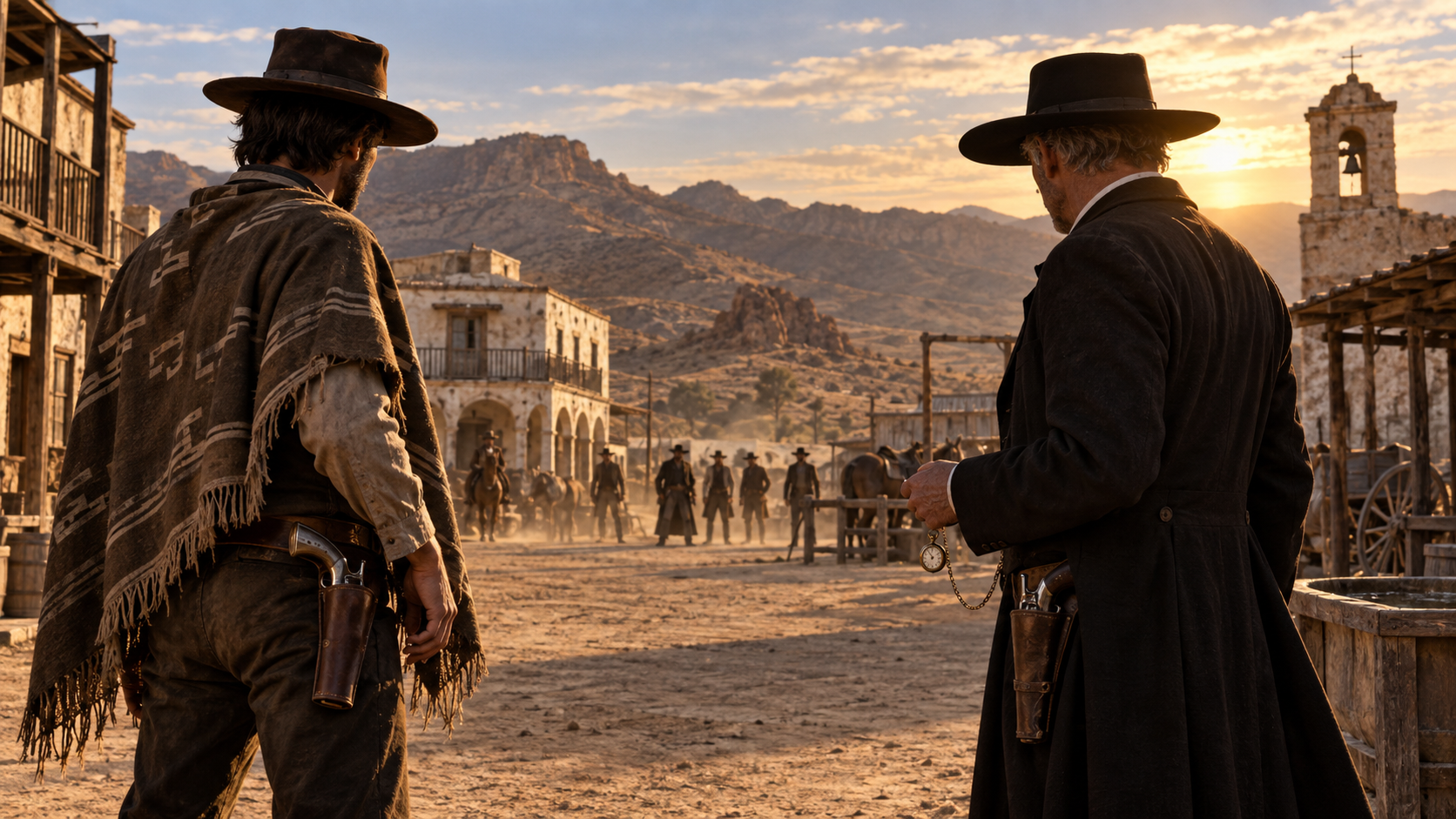
 For a Few Dollars More: Sergio Leone’s Spaghetti Western Masterpiece
Released in Italy in 1965 as Per qualche dollaro in più, Sergio Leone’s For a Few Dollars More is the powerful second chapter of the celebrated Dollars Trilogy. It followed A Fistful of Dollars and prepared the way for the director’s epic achievement, The Good, the Bad and the Ugly.
Although Clint Eastwood returned as the quiet, calculating gunslinger commonly associated with the “Man with No Name,” this time he shared the screen with Lee Van Cleef. Their tense partnership gave the film greater emotional and narrative depth than its predecessor.
The result is more than a conventional Western about collecting rewards. It is a story of professional rivalry, concealed motives, obsession and revenge, told through Sergio Leone’s unmistakable combination of extreme close-ups, vast landscapes, sudden violence and prolonged suspense.
More than sixty years after its original release, For a Few Dollars More remains one of the defining works of Italian Spaghetti Western cinema.
Quick Film Facts
- Original Italian title: Per qualche dollaro in più
- English title: For a Few Dollars More
- Director: Sergio Leone
- Release year: 1965 in Italy; 1967 in the United States
- Genre: Spaghetti Western
- Countries of production: Italy, Spain and West Germany
- Screenplay: Sergio Leone and Luciano Vincenzoni, with additional screenplay contributions
- Music: Ennio Morricone
- Cinematography: Massimo Dallamano
- Principal cast: Clint Eastwood, Lee Van Cleef and Gian Maria Volonté
- Running time: Approximately 132 minutes, depending on the edition
- Trilogy: The second film in Sergio Leone’s Dollars Trilogy
Why the Film Matters
A Fistful of Dollars introduced audiences to Leone’s radical reinterpretation of the Western. For a Few Dollars More demonstrated how far that new cinematic language could go.
The film expanded nearly everything that had made its predecessor distinctive. The story became more intricate, the characters acquired stronger motivations, the confrontations became more elaborate and Ennio Morricone’s music played an even more direct role in the action.
Most importantly, the movie introduced Lee Van Cleef to Leone’s cinematic world. His Colonel Douglas Mortimer is not simply a rival to Eastwood’s character. He is intelligent, disciplined and burdened by a private history that slowly changes the meaning of his pursuit.
Eastwood and Van Cleef represent two different kinds of Western hero. One is young, instinctive and motivated primarily by money. The other is older, methodical and driven by something much more personal. Their uneasy alliance gives the film its dramatic center.
Plot Overview
The story begins with the escape of El Indio, a ruthless outlaw played by Gian Maria Volonté. Once free, Indio rejoins his gang and begins planning an audacious robbery of the heavily guarded Bank of El Paso.
A substantial reward is offered for his capture.
Two bounty hunters independently take an interest in the prize. The first is Manco, played by Clint Eastwood: a laconic gunfighter whose calm expression disguises extraordinary speed and tactical intelligence. The second is Colonel Douglas Mortimer, played by Lee Van Cleef, an older marksman equipped with an impressive arsenal and an almost military sense of precision.
Their first encounters are not friendly. Each man considers the other a competitor, and neither is willing to surrender the reward. A memorable nighttime confrontation establishes their abilities—and their mutual respect—without requiring either man to admit it.
They eventually recognize that capturing Indio and dismantling his gang will require cooperation. Manco attempts to infiltrate the criminal organization while Mortimer works from outside.
The arrangement is dangerous from the beginning. Indio is intelligent, unstable and suspicious, while his gang includes violent men who would kill a stranger for the slightest mistake. Among them is the hunchbacked Wild, played with memorable intensity by Klaus Kinski.
As the plan unfolds, it becomes clear that Mortimer’s interest in El Indio is not motivated solely by money. The significance of a musical pocket watch gradually emerges, leading toward one of Leone’s most emotionally satisfying and beautifully constructed finales.
Sergio Leone and the Expansion of the Dollars Trilogy
Following the international success of A Fistful of Dollars, Sergio Leone was able to work on a larger canvas. He used the additional resources not merely to create bigger action sequences, but to refine his visual and narrative style.
Leone rejected the clean morality that had traditionally separated heroes from villains in many American Westerns. His bounty hunters are professionals who kill for money, yet they operate according to personal codes. His villains can be charismatic and intelligent while remaining genuinely terrifying.
The director also transformed silence into a dramatic tool. Characters study one another. Hands hover near revolvers. Boots cross empty streets. The camera moves between eyes, weapons and nervous faces while the audience waits for the inevitable explosion of violence.
This manipulation of time became one of Leone’s signatures. A confrontation that might last only seconds in another film becomes a ritual governed by glances, sounds and carefully measured movements.
The movie was filmed primarily in Spain, including locations in the arid landscapes of Almería. European scenery, sets and performers combined to create an exaggerated vision of the American frontier rather than a historically precise reconstruction.
That artificial quality is essential to the film’s appeal. Leone’s West is a mythical arena in which greed, violence and memory determine the fate of every character.
Clint Eastwood as Manco
Clint Eastwood’s character is called Manco in the film, a Spanish word meaning “one-armed” or referring to someone who makes limited use of one hand. He performs most everyday tasks with his left hand, preserving his right for drawing his revolver.
Eastwood’s performance builds on the persona established in A Fistful of Dollars. Manco speaks little and reveals even less. He is relaxed when others are frightened, observant when others are talking and usually several moves ahead of everyone around him.
His humor comes from understatement. Rather than delivering elaborate speeches, he responds with a look, a pause or a brief remark. Leone’s close-ups turn even the smallest change in Eastwood’s expression into a dramatic event.
Yet Manco is not invulnerable. His decision to enter Indio’s gang places him in genuine danger, while his partnership with Mortimer forces him to recognize another gunman as his equal.
Lee Van Cleef as Colonel Mortimer
Lee Van Cleef gives one of the film’s defining performances as Colonel Douglas Mortimer.
Before appearing in For a Few Dollars More, Van Cleef had often been cast in supporting roles and as minor villains. Leone recognized that his angular face, penetrating eyes and controlled physical presence could support a much more substantial character.
Mortimer is elegant, patient and technologically prepared. He travels with a collection of specialized firearms and approaches bounty hunting as both a science and an art. Unlike Manco, however, he carries an emotional weight that cannot be measured in dollars.
Van Cleef communicates that history without excessive dialogue. His formal clothing, rigid posture and haunted attention to the pocket watch suggest a man whose entire life has narrowed toward a single purpose.
The casting proved enormously influential. Van Cleef subsequently became one of the most recognizable stars of European Westerns, appearing in films such as The Big Gundown, Day of Anger and Death Rides a Horse.
Gian Maria Volonté as El Indio
Gian Maria Volonté, who had played Ramón Rojo in A Fistful of Dollars, returned as an entirely different villain.
El Indio is unpredictable, theatrical and psychologically tormented. He can move from apparent calm to extreme violence with almost no warning. His addiction and recurring memories suggest a man who is unable to escape his own crimes.
Volonté gives the character an unsettling intelligence. Indio does not rule his gang solely through brutality; he understands fear, temptation and betrayal. He devises an ambitious robbery and repeatedly manipulates both his enemies and his own followers.
The relationship between Indio and the pocket watch adds an unusual psychological dimension to the film. Music, guilt and memory become inseparable, transforming a simple object into the story’s most powerful symbol.
The Pocket Watch and Ennio Morricone’s Music
The score by Ennio Morricone is one of the film’s greatest achievements.
Morricone combined whistles, bells, choral voices, electric instruments and orchestral passages to create music that was unmistakably modern yet perfectly suited to Leone’s mythical frontier.
In most films, background music accompanies the action. In For a Few Dollars More, music becomes part of the plot.
El Indio uses the melody of a pocket watch to control the timing of a duel. The gunfighters must wait for the tune to finish before drawing their weapons. Leone and Morricone therefore turn music into a countdown, extending suspense while linking the present confrontation to a traumatic event in the past.
The melody is delicate and almost sentimental, creating a disturbing contrast with the violence it precedes. When another watch enters the story, its meaning changes again, revealing a connection that words alone could not express as effectively.
Morricone reportedly developed musical ideas early enough for Leone to play them during filming. This helped coordinate the actors’ movements and the camera’s rhythm with the score, making image and sound feel inseparable.
Themes and Interpretation
Money and motivation
The title suggests that every character can be motivated by a sufficiently large reward. Manco openly pursues money, but Mortimer’s real objective gradually challenges that assumption.
The film distinguishes between price and value. A criminal may have a price on his head, yet grief, loyalty and revenge cannot be reduced to a financial calculation.
Rivalry and respect
Manco and Mortimer initially communicate through competition. Each tests the other’s courage and shooting ability before they can cooperate.
Their partnership develops without sentimental declarations. Respect emerges through action: each man recognizes the other’s competence and ultimately understands what the pursuit means to him.
Time and ritual
Clocks, watches and carefully measured pauses appear throughout the story. Time determines when a duel begins, when a plan succeeds and when a buried memory returns.
The final confrontations resemble ceremonies. Leone slows down the moments before violence, forcing the audience to experience every second of anticipation.
Justice and revenge
Neither Manco nor Mortimer represents conventional law. They operate outside formal institutions in a world where sheriffs are often powerless or corrupt.
Nevertheless, Mortimer’s mission acquires a moral force. The film asks whether personal revenge can provide justice when official systems have failed, without offering a simple answer.
Cinematography and Visual Style
Cinematographer Massimo Dallamano helped Leone create an extraordinary contrast between enormous landscapes and tightly framed human faces.
Wide shots establish the isolation of towns, deserts and railway stations. Extreme close-ups then reveal sweat, dust, suspicion and fear. Leone frequently cuts from a vast environment to a pair of eyes filling the screen.
The technique makes every duel both epic and intimate.
The production design also contributes to the movie’s distinctive atmosphere. Streets are unusually broad, buildings appear weathered and interiors are filled with smoke, rough wood and deep shadows. Rather than reproducing the historical West literally, the film creates a heightened, almost operatic version of it.
Gunshots are loud and abrupt. Spurs, footsteps, bells and creaking doors receive unusual emphasis. Long stretches of near silence make these isolated sounds feel even more dramatic.
Reception and International Success
For a Few Dollars More became a major commercial success in Europe. It further established Sergio Leone as an international director and strengthened Clint Eastwood’s transition from television actor to global film star.
The movie was released in the United States in 1967, after its Italian debut. Like other early Spaghetti Westerns, it initially received mixed reactions from some American critics, who were unaccustomed to its cynicism, stylized violence and deliberately exaggerated characters.
Its reputation improved enormously over time. The film is now frequently ranked among the finest Spaghetti Westerns and is often regarded as one of those rare sequels that deepens and improves upon the ideas of the original.
Rather than repeating A Fistful of Dollars, Leone created a more complex film that pointed directly toward the scale, visual confidence and moral ambiguity of The Good, the Bad and the Ugly.
Legacy and Influence
The movie helped redefine the screen partnership between two powerful but distrustful protagonists. Its influence can be felt in action films, crime thrillers and modern stories built around reluctant alliances.
The musical pocket-watch duel became one of the most recognizable sequences in Western cinema. Leone’s combination of extended anticipation and sudden action influenced directors including Martin Scorsese, John Woo, Robert Rodriguez and Quentin Tarantino.
The film also elevated the bounty hunter into a central Western archetype. Instead of serving the law or defending a community, Leone’s heroes work for themselves. Their morality must be judged through individual choices rather than official titles.
Above all, For a Few Dollars More proved that Italian filmmakers were not simply imitating Hollywood Westerns. They were dismantling the genre and rebuilding it with a new visual grammar, a harsher moral landscape and a distinctly European sensibility.
Where to Watch or Buy
Streaming availability changes according to country and licensing agreements, so viewers should check the film’s current listing on their preferred streaming service.
Collectors in the United States can purchase the restored Kino Lorber edition directly through Amazon.com:
Buy For a Few Dollars More – 4K UHD edition on Amazon.com
Physical Edition Details
- Format: 4K Ultra HD
- Video: Restored 4K presentation
- Audio: English-language audio options
- Subtitles: Optional English subtitles
- UHD region: 4K UHD discs are generally region-free
- Restoration: Newer restored presentation rather than the older standard master
- Collector features: Audio commentaries, archival material, interviews and promotional features may be included
- Important: Package contents, accompanying discs and bonus features can vary by edition or seller; buyers should confirm the Amazon listing before ordering
Viewers who want all three films together can also consider the Blu-ray trilogy collection:
Buy The Man with No Name Trilogy on Blu-ray from Amazon.com
As an Amazon Associate, Italia Mia may earn from qualifying purchases.
Related Italia Mia Articles
Continue exploring the history and influence of Italian filmmaking through these Italia Mia features:
- Cinema of Italy: The Spaghetti Western
- The Music of Ennio Morricone
- Top Italian Movies of All Time
- Italian Cinema: 100 Years of Masterpieces That Shaped World Film
- Browse More Italian Movies
External Sources
- For a Few Dollars More – Kino Lorber
- For a Few Dollars More – IMDb
- For a Few Dollars More – Rotten Tomatoes
- Official Trailer – MGM
Conclusion
For a Few Dollars More occupies the ideal middle position in Sergio Leone’s Dollars Trilogy. It preserves the compact energy and dry humor of A Fistful of Dollars while anticipating the emotional depth and operatic scale of The Good, the Bad and the Ugly.
Clint Eastwood supplies the cool, enigmatic presence that made him an international icon. Lee Van Cleef gives the story dignity, intelligence and unexpected emotional power. Gian Maria Volonté creates a villain whose cruelty is inseparable from his tormented past.
Massimo Dallamano’s cinematography turns faces and landscapes into monuments, while Ennio Morricone’s pocket-watch melody transforms a final duel into a ritual of memory and revenge.
The film begins as a contest between two bounty hunters pursuing the same reward. By its conclusion, it has become something richer: a story about two men who discover that they are hunting the same criminal for very different reasons—and that some debts cannot be settled for money alone.