
 A Fistful of Dollars: The Western That Changed the Rules
Few films have altered an entire genre as decisively as A Fistful of Dollars. Released in Italy in 1964 under the title Per un pugno di dollari, Sergio Leone’s lean, violent and visually audacious Western introduced international audiences to a new kind of screen hero: mysterious, calculating, morally ambiguous and almost impossibly cool.
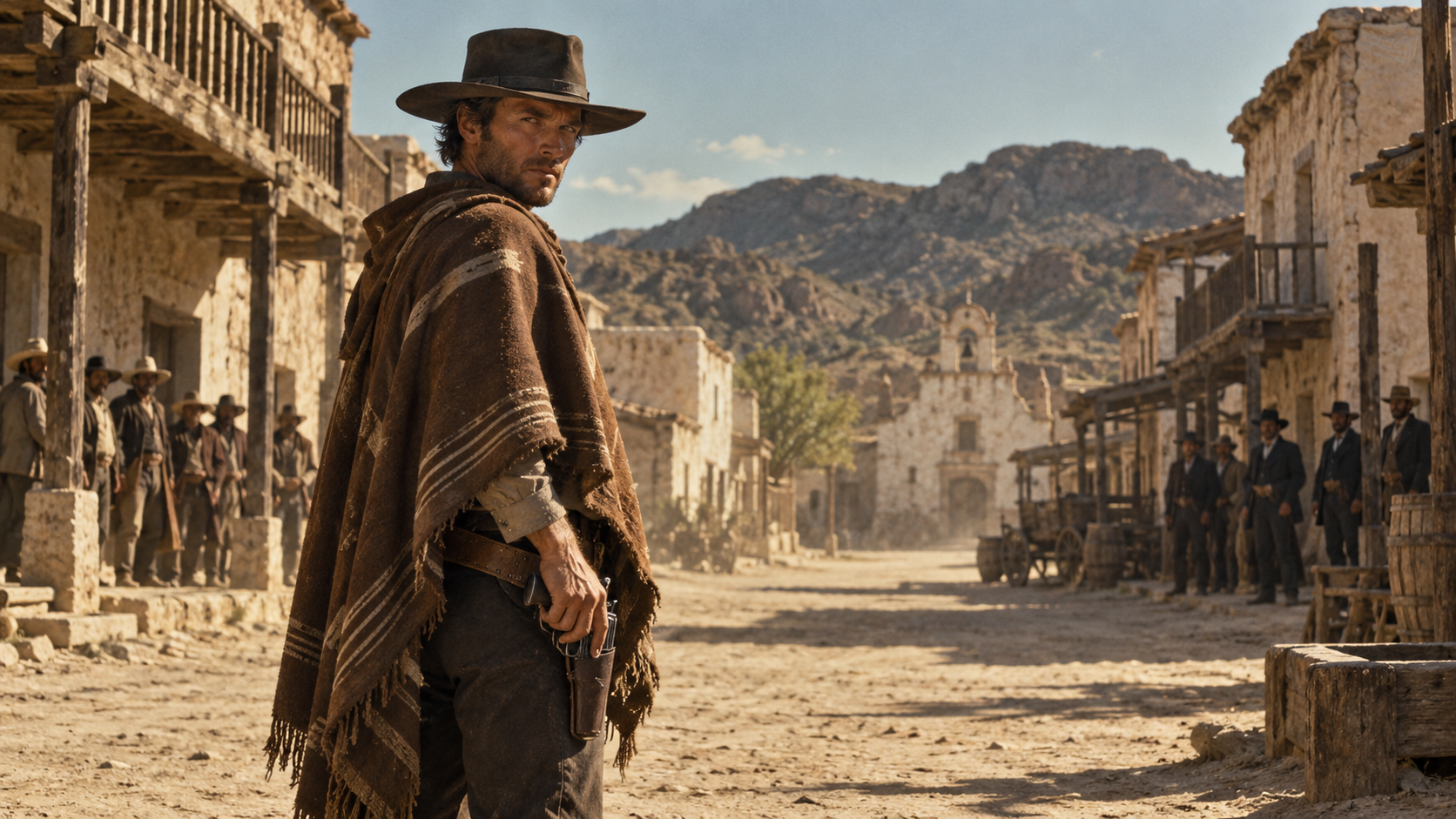
The film also transformed Clint Eastwood from a television actor best known for Rawhide into an international movie star. His poncho, cigarillo, narrowed eyes and economical way of speaking became defining images of the modern Western.
Yet A Fistful of Dollars is more than the beginning of Eastwood’s film career. It established the distinctive language of the Spaghetti Western, began Leone’s celebrated Dollars Trilogy and marked the start of one of cinema’s greatest director-composer collaborations: Sergio Leone and Ennio Morricone.
More than six decades after its release, the film remains tense, entertaining and unmistakably modern.
Quick Film Facts
| Detail | Information |
|---|---|
| Original Italian title | Per un pugno di dollari |
| English title | A Fistful of Dollars |
| Release year | 1964 in Italy; 1967 in the United States |
| Country | Italy, Spain and West Germany |
| Director | Sergio Leone |
| Producers | Arrigo Colombo and Giorgio Papi |
| Screenplay | Sergio Leone, Duccio Tessari and collaborators |
| Cinematography | Massimo Dallamano |
| Music | Ennio Morricone |
| Principal cast | Clint Eastwood, Gian Maria Volonté, Marianne Koch, Wolfgang Lukschy and José Calvo |
| Genre | Spaghetti Western |
| Running time | Approximately 99–100 minutes |
| Trilogy | First film in the Dollars Trilogy |
| Italian filming title | Per un pugno di dollari |
The British Film Institute identifies the production as an Italian, West German and Spanish collaboration directed by Leone, produced by Arrigo Colombo and Giorgio Papi, and featuring Eastwood, Marianne Koch and Gian Maria Volonté.
Why A Fistful of Dollars Matters
Before Sergio Leone, most popular Westerns presented relatively clear moral boundaries. Heroes protected communities, lawmen represented order and villains threatened civilization from outside it.
A Fistful of Dollars enters a very different world.
Its border town is already corrupt. Violence is not an interruption of civilized life but the town’s principal business. Law and authority are almost nonexistent, and the stranger who arrives is not an idealistic sheriff. He is an opportunist who quickly realizes that the town’s conflict can be turned to his advantage.
Leone did not invent the European Western, but this film established the visual and narrative formula that audiences would come to associate with the Spaghetti Western: dusty landscapes, morally compromised characters, sudden brutality, extreme close-ups, black humor and music that functions almost like another character.
The British Film Institute describes the film as the work that set the template for the Spaghetti Westerns that followed.
The movie’s enormous international success demonstrated that an Italian-led production, filmed largely in Spain and featuring an American television actor, could compete with Hollywood on its own territory.
Plot Overview Without Excessive Spoilers
A solitary gunfighter arrives in San Miguel, a desolate Mexican border town divided between two criminal families.
On one side are the Baxters, led by the town sheriff, John Baxter. On the other are the Rojos, three brothers whose smuggling operations have made them wealthy and feared. The most dangerous of them is Ramón Rojo, a charismatic but ruthless gunman.
Rather than choosing a side, the stranger studies the situation and develops a more profitable strategy. As the town’s innkeeper Silvanito explains, the Baxters are on one side and the Rojos on the other. The stranger decides to place himself in the middle.
He begins selling information and his services to both families, carefully increasing their suspicions and encouraging each side to weaken the other. At first, his motivations appear entirely financial. He is faster, smarter and less sentimental than anyone around him.
However, his encounter with Marisol—a woman being held apart from her husband and young son by Ramón—reveals that the stranger is not completely indifferent to the suffering around him.
His decision to intervene changes the balance of power and sets the stage for one of the most memorable confrontations in Western cinema.
Sergio Leone and the Reinvention of the Western
Sergio Leone grew up surrounded by Italian filmmaking. His father, Vincenzo Leone, was a director and actor during the silent era, while his mother, Edvige Valcarenghi, worked as an actress under the name Bice Waleran.
Before directing A Fistful of Dollars, Leone had spent years working as an assistant director and second-unit director on Italian and American productions filmed in Europe. His experience included large-scale historical epics, giving him a strong understanding of sets, crowds, composition and cinematic spectacle.
When he turned to the Western, however, Leone moved in the opposite direction. Instead of creating a grand frontier epic, he built a compact story around faces, gestures, anticipation and sudden explosions of violence.
Because Italian Westerns were initially marketed to appear more American, several members of the production used English-sounding pseudonyms. Leone was originally credited as “Bob Robertson,” Ennio Morricone as “Dan Savio” and cinematographer Massimo Dallamano as “Jack Dalmas.”
What could easily have been dismissed as a low-budget imitation of an American Western instead became something genuinely new.
Leone stretched time before a gunfight, allowing silence, glances and small movements to create unbearable tension. He then resolved that tension with startling speed. A confrontation might take several minutes to prepare but only seconds to finish.
That rhythmic contrast became one of his signatures.
From Yojimbo to the American West
The central story of A Fistful of Dollars closely follows Akira Kurosawa’s 1961 samurai film Yojimbo. Both films feature an enigmatic warrior who arrives in a town controlled by two rival factions and manipulates them for his own purposes.
The connection was not merely a matter of general inspiration. The filmmakers had not secured the rights to remake Yojimbo, resulting in a legal action by Kurosawa and the Japanese studio Toho. The dispute delayed the film’s American release until 1967 and ended with a settlement that gave Kurosawa and the rights holders a share of the film’s worldwide receipts and distribution rights in several Asian territories.
Despite the controversy, Leone did more than transfer a samurai story to the Mexican border. He absorbed Kurosawa’s narrative structure and reinvented it through the visual traditions of Italian cinema, American Westerns, comic books and Mediterranean popular culture.
The result is both a reinterpretation of Yojimbo and a highly original declaration of Leone’s cinematic style.
Clint Eastwood as the Man with No Name
Clint Eastwood’s performance is built on restraint.
The stranger watches more than he speaks. He reveals little about his background, avoids emotional explanations and rarely makes an unnecessary movement. His silence forces viewers to study his eyes, posture and reactions.
Although the character is often called the Man with No Name, he is referred to as “Joe” during the film. The more mysterious label became especially powerful through the American marketing of Leone’s trilogy.
Eastwood understood that the film needed a character who appeared to be thinking constantly while saying almost nothing. He stripped away dialogue, simplified gestures and allowed the costume to create part of the character’s identity.
The poncho conceals his movements. The cigarillo creates a ritual of waiting. His weathered clothes suggest a history the film never explains.
Unlike the spotless heroes of many earlier Westerns, Joe is willing to lie, steal, manipulate and kill. Nevertheless, the rescue of Marisol shows that he follows a private moral code. He may reject conventional heroism, but he is not without compassion.
That combination—dangerous, emotionally guarded and secretly principled—would influence action heroes for generations.
Gian Maria Volonté as Ramón Rojo
A memorable Western needs a villain capable of matching its hero, and Gian Maria Volonté gives the film one of its most commanding performances.
Ramón Rojo is intelligent, theatrical and terrifyingly confident. He does not simply rely on violence; he understands fear, spectacle and psychological control. His prized rifle also allows him to kill from a distance, creating a striking contrast with Joe’s faith in the revolver.
Volonté’s intensity provides an important counterweight to Eastwood’s stillness. Where Joe conserves emotion, Ramón displays it. His smiles, anger and sudden changes of mood make him unpredictable.
Volonté would return in For a Few Dollars More, playing a different character, El Indio. His powerful performances in the two films helped make him one of the most recognizable faces of early Spaghetti Western cinema.
He later became celebrated for politically engaged Italian films such as Investigation of a Citizen Above Suspicion, The Working Class Goes to Heaven and Christ Stopped at Eboli.
Marianne Koch and the Human Cost of Violence
Marianne Koch plays Marisol, a woman separated from her husband Julio and their young son Jesús through Ramón’s cruelty.
The character brings emotional weight to a film populated largely by killers and opportunists. Through her story, the audience sees that the rivalry between the Baxters and Rojos is not merely an entertaining contest between criminals. Ordinary people are trapped inside it.
Joe’s decision to help Marisol is therefore crucial. Until this point, he has treated the conflict as a business opportunity. His intervention reveals that there are limits to his cynicism.
Marisol is not given as much narrative independence as a modern audience might wish, but Koch communicates fear, exhaustion and determination with relatively little dialogue. Her performance gives the film a moral center without changing its hard-edged tone.
Other Important Characters
Wolfgang Lukschy plays John Baxter, the sheriff whose official position means little in a town ruled by competing gangs. Margarita Lozano appears as his formidable wife, Consuelo Baxter, who is often more decisive than her husband.
José Calvo brings warmth and caution to Silvanito, the innkeeper who becomes Joe’s closest ally. He recognizes the stranger’s intelligence but also understands how quickly the plan could lead to disaster.
Joseph Egger provides dark humor as Piripero, the coffin maker. His thriving business becomes Leone’s grim joke about a town where death is the only reliable industry.
Mario Brega, a familiar face in Leone’s films, appears as Chico, one of Ramón’s enforcers.
Together, these supporting characters make San Miguel feel like a complete, if deeply unhealthy, social system.
Themes and Interpretation
Survival in a Corrupt World
The film presents a society in which traditional institutions have failed. The sheriff is compromised, the military is vulnerable and wealth comes from smuggling, intimidation and murder.
Joe survives because he sees the system clearly. He does not pretend that either family deserves loyalty. Instead, he turns their greed against them.
The Antihero
Joe is neither an honorable lawman nor a straightforward criminal. He helps innocent people, but he also profits from deception and violence.
This moral ambiguity was one of the film’s most influential features. Later Westerns and action films increasingly centered on protagonists who did the right thing for complicated—or sometimes selfish—reasons.
Money and Power
The title suggests that money drives the story, but the film gradually shows that power is even more important. The Baxters and Rojos already control much of the town. What they cannot tolerate is the existence of a rival.
Joe exploits that hunger for total control.
Performance and Identity
Nearly everyone in the film plays a role. The Baxters maintain the appearance of legitimate authority, the Rojos disguise organized crime as family business, and Joe presents a different version of himself to each side.
Even his identity is uncertain. The absence of a complete name transforms him from an ordinary individual into a cinematic archetype.
Violence as Spectacle
Leone does not treat violence realistically in every detail. Instead, he stylizes it through framing, sound, duration and ritual.
The moments before a shooting often matter more than the gunfire itself. Leone makes the audience wait, observe and anticipate, turning the gunfight into a kind of lethal performance.
Cinematography and Spanish Locations
The film’s landscapes may represent Mexico, but much of A Fistful of Dollars was filmed in Spain.
The dry terrain, whitewashed buildings and rugged mountain scenery offered European filmmakers an economical substitute for the American Southwest and northern Mexico. Spanish locations would subsequently become central to the production of countless Spaghetti Westerns.
Cinematographer Massimo Dallamano helped Leone create a visual language based on contrasts. Sweeping landscapes establish isolation, while extreme close-ups reduce a confrontation to eyes, sweat, facial scars and trembling hands.
Leone frequently places faces at the extreme edges of the widescreen frame. Background and foreground remain active at the same time, giving even simple conversations a feeling of tension.
The appearance of the film was also shaped by Techniscope, a two-perforation widescreen process widely used in Italian cinema during the period. It allowed filmmakers to create widescreen images while using less film stock than conventional formats.
The surviving camera negative later became the basis of a major restoration undertaken with the involvement of the Cineteca di Bologna and The Film Foundation.
Ennio Morricone’s Revolutionary Music
It is almost impossible to imagine A Fistful of Dollars without Ennio Morricone’s score.
Instead of imitating the sweeping orchestral music associated with classical Hollywood Westerns, Morricone created a strange and instantly recognizable sound world using whistling, electric guitar, bells, voices, percussion and whip-like effects.
The music does not merely accompany the images. It announces danger, identifies characters and shapes the rhythm of entire scenes.
Morricone and Leone had known one another as schoolboys, although they did not initially recognize the connection when they began working together. A Fistful of Dollars launched a collaboration that continued through the Dollars Trilogy, Once Upon a Time in the West, A Fistful of Dynamite and Once Upon a Time in America. The BFI identifies this film as the beginning of their famous director-composer partnership.
The film’s whistling was performed by Alessandro Alessandroni, whose guitar work and vocal ensemble, I Cantori Moderni, became important ingredients in the unmistakable Morricone sound.
Morricone received the 1965 Nastro d’Argento for the film’s music, an early major recognition in a career that would eventually encompass hundreds of scores.
Reception and International Success
A Fistful of Dollars was released in Italy in September 1964. Its initial reception was not immediately overwhelming, but audience enthusiasm grew rapidly.
Viewers responded to the unusual hero, brutal action, memorable music and irreverent treatment of Western conventions. The movie became a major commercial success and encouraged Italian and Spanish producers to finance hundreds of additional Westerns.
Its American release did not arrive until January 1967, when United Artists introduced American audiences to the first two Dollars films in quick succession, followed later that year by The Good, the Bad and the Ugly.
Critics were divided. Some dismissed the film as excessively violent or derivative, while others recognized Leone’s exceptional visual intelligence and Eastwood’s commanding presence.
Over time, its reputation improved dramatically. Today, it is widely regarded as a landmark of Italian popular cinema and one of the films that permanently changed the Western.
The Beginning of the Dollars Trilogy
A Fistful of Dollars became the first chapter in the trilogy that defined Sergio Leone’s early international career:
- A Fistful of Dollars (1964)
- For a Few Dollars More (1965)
- The Good, the Bad and the Ugly (1966)
The films are connected more by style, themes, actors and atmosphere than by strict narrative continuity. Eastwood plays a similar mysterious gunfighter in all three, but the character’s name and circumstances change.
The trilogy grows progressively more ambitious. A Fistful of Dollars is compact and elemental. For a Few Dollars More adds greater narrative and emotional complexity. The Good, the Bad and the Ugly expands the formula into an epic set against the American Civil War.
Seen together, the three films document Leone’s rapid development from an inventive genre filmmaker into one of the great visual stylists of world cinema.
Legacy and Influence
The film’s influence extends far beyond the Spaghetti Western.
Its morally ambiguous hero helped shape later characters played by Charles Bronson, Lee Van Cleef and Franco Nero, as well as the protagonists of revisionist Westerns and modern action movies.
Its mixture of stillness, close-ups, music and sudden violence can be felt in the work of directors including Quentin Tarantino, Robert Rodriguez, George Miller and Takashi Miike. The influence of Leone’s Westerns on the Mad Max series has also been noted by the British Film Institute.
The basic story has continued to travel between cultures and genres. Kurosawa transformed elements of the American Western and hard-boiled crime fiction into a samurai film. Leone returned the story to the West through Italian cinema. Later filmmakers adapted similar ideas into gangster movies, science-fiction stories and contemporary thrillers.
Most importantly, A Fistful of Dollars demonstrated that a genre could be renewed by outsiders. Leone did not attempt to reproduce the American Western perfectly. He exaggerated, rearranged and reimagined its conventions until they became something distinctly his own.
Where to Watch A Fistful of Dollars
Streaming availability varies by country and changes frequently. Before subscribing or renting, check the current listing for your location.
The film may be available to rent, purchase or watch through a subscription service depending on your region.
Buy A Fistful of Dollars on 4K UHD or Blu-ray
Kino Lorber 4K UHD and Blu-ray Special Edition
The Kino Lorber edition is an excellent choice for collectors who want the film in its best widely available North American physical format.
- Format: Two-disc 4K Ultra HD and Blu-ray set
- Video: Restored 4K presentation
- HDR: The Kino Lorber UHD presentation is SDR rather than HDR
- Audio: English 5.1 surround and original English 2.0 mono
- Subtitles: Optional English subtitles
- 4K disc region: 4K UHD discs are generally region-free
- Included Blu-ray: Region A
- Edition: Restored special edition
- Collector features: Multiple commentaries, interviews, archival material, location comparisons, outtakes, galleries, trailers and the television prologue
- Release: Kino Lorber Studio Classics, 2022
Buy A Fistful of Dollars 4K UHD + Blu-ray on Amazon.com
Kino Lorber confirms that its edition includes optional English subtitles, the original mono and 5.1 audio options, commentaries by Tim Lucas and Sir Christopher Frayling, and an extensive collection of supplementary material.
Kino Lorber Blu-ray Edition
For viewers without a 4K player, Kino Lorber also offers a standard Blu-ray edition based on the restored master.
- Format: Blu-ray
- Resolution: 1080p high definition
- Audio language: English
- Audio options: 5.1 surround and 2.0 mono
- Subtitles: Optional English subtitles
- Disc region: Region A
- Edition: Restored special edition
- Extras: Commentaries, interviews, featurettes, archival material, galleries and trailers
Buy A Fistful of Dollars on Blu-ray at Amazon.com
Buyers should always confirm the format, region and included discs on the Amazon product page before ordering, particularly when purchasing from a marketplace seller.
The Complete Dollars Trilogy on Blu-ray
Collectors who want all three Clint Eastwood and Sergio Leone Westerns can also consider the remastered trilogy collection.
- Includes: A Fistful of Dollars, For a Few Dollars More and The Good, the Bad and the Ugly
- Format: Blu-ray
- Audio language: English
- Subtitles: English options included
- Disc region: Check the specific seller listing for compatibility
- Edition: Remastered trilogy collection
Buy the Man with No Name Trilogy on Blu-ray at Amazon.com
Final Thoughts
A Fistful of Dollars is a relatively small film with an enormous legacy.
Its story is simple, its locations are limited and its protagonist barely speaks. Yet Sergio Leone transformed those apparent limitations into strengths. He filled the screen with unforgettable faces, extended moments of suspense beyond their expected limits and allowed Ennio Morricone’s music to redefine how a Western could sound.
Clint Eastwood’s stranger is neither a conventional hero nor a simple mercenary. He is an observer who understands corruption well enough to manipulate it—and who eventually reveals just enough humanity to make his victory meaningful.
The later films in the Dollars Trilogy would become larger, richer and more technically elaborate. But the essential Leone style is already present here: the close-ups, the silence, the humor, the cruelty, the rituals and the explosive release of tension.
With A Fistful of Dollars, the Western left Hollywood, crossed the Atlantic and returned forever changed.
Related Italia Mia Articles
- The Good, the Bad and the Ugly: Sergio Leone’s Spaghetti Western Masterpiece
- Cinema of Italy: The Spaghetti Western
- Italian Movies and the Cinema of Italy
- Italian Cinema: 100 Years of Masterpieces That Shaped World Film
- Top Italian Movies of All Time
External Sources
- British Film Institute: A Fistful of Dollars
- British Film Institute: 10 Great Spaghetti Westerns
- The Film Foundation: A Fistful of Dollars Restoration
- Kino Lorber: A Fistful of Dollars 4K UHD
- Apple TV: A Fistful of Dollars