
 The Good, the Bad and the Ugly: Sergio Leone’s Western Masterpiece
Few films can be identified from only a handful of notes. Fewer still have created images, sounds and character types that remain instantly recognizable decades after their release. Sergio Leone’s The Good, the Bad and the Ugly accomplished both.
Released in Italy in 1966 as Il buono, il brutto, il cattivo, the film brought Leone’s unofficial “Dollars Trilogy” to a spectacular conclusion. Clint Eastwood returned as the laconic gunfighter commonly called the Man with No Name, joined by Lee Van Cleef as a cold-blooded mercenary and Eli Wallach as the unpredictable bandit Tuco.
Their hunt for buried Confederate gold provides the structure of the story, but the film is far more than a treasure hunt. It is an epic about greed, survival, shifting loyalties and the senseless destruction of war. Leone combines enormous landscapes with extreme close-ups, bleak violence with black comedy, and long stretches of silence with one of Ennio Morricone’s most famous scores.
The result is not merely a classic spaghetti western. It is one of the defining works of Italian popular cinema and one of the most influential films ever made.
Quick Film Facts
| Detail | Information |
|---|---|
| Original Italian title | Il buono, il brutto, il cattivo |
| English title | The Good, the Bad and the Ugly |
| Director | Sergio Leone |
| Year | 1966 |
| Italian release | December 23, 1966 |
| U.S. release | December 1967 |
| Countries of production | Italy, Spain and West Germany |
| Genre | Spaghetti western, adventure, war film |
| Principal cast | Clint Eastwood, Eli Wallach, Lee Van Cleef |
| Screenplay | Age & Scarpelli, Luciano Vincenzoni and Sergio Leone |
| Producer | Alberto Grimaldi |
| Cinematography | Tonino Delli Colli |
| Music | Ennio Morricone |
| Original language versions | Italian and English dubbed versions were prepared for different markets |
| Running time | Approximately 161–162 minutes for the international theatrical cut; about 178–179 minutes for extended versions |
| Filming format | Techniscope, color |
| Place in the series | Third film in the Dollars Trilogy |
Running times differ because the film has circulated in several theatrical, international and extended versions. The Academy describes the 1966 theatrical presentation as 161 minutes, while longer restorations reinstate material removed for international distribution.
Why the Film Matters
The Good, the Bad and the Ugly changed what a western could look and sound like.
Traditional Hollywood westerns frequently drew a recognizable line between heroes and villains. Leone erased that certainty. His frontier is inhabited by bounty hunters, deserters, thieves, opportunists and professional killers. Even Blondie, identified as “the Good,” earns money through a fraudulent bounty scheme and rarely acts from purely moral motives.
The titles are therefore partly ironic. “Good,” “Bad” and “Ugly” are not complete moral judgments. They are theatrical labels assigned to three men who occupy different positions on the same spectrum of violence and self-interest.
Leone also rejected the polished rhythm of many classical westerns. His camera waits. Characters stare, sweat and calculate. A hand moving toward a revolver may become more important than pages of dialogue. When violence finally arrives, it is sudden and decisive.
This combination of ritual, silence, music and explosive action established a cinematic vocabulary that would be imitated in westerns, crime films, action movies, television, advertising and video games. The film’s extreme close-ups became especially influential in the visual presentation of gunfights and tense confrontations.
For American viewers, it also demonstrated how European filmmakers could take a thoroughly American genre, dismantle its conventions and return it to international audiences in an entirely new form.
Plot Overview Without Excessive Spoilers
The story takes place during the American Civil War, as Union and Confederate armies fight across a landscape already ruled by hunger, fear and opportunism.
Three gunslingers learn pieces of information concerning a fortune in stolen Confederate gold.
Blondie, played by Clint Eastwood, is a cool and highly capable gunfighter. Tuco, played by Eli Wallach, is a wanted bandit whose long list of crimes is read aloud whenever he is about to be hanged. The two men develop an ingenious but dangerous partnership: Blondie delivers Tuco to the authorities, collects the reward and then shoots through the hanging rope before Tuco can be executed.
The arrangement is profitable, but mutual trust is nonexistent.
Angel Eyes, portrayed by Lee Van Cleef, is a professional killer investigating the disappearance of a large shipment of gold. He performs his assignments with chilling efficiency and is willing to work for competing interests—as long as he is paid.
Through a series of encounters, each man acquires only part of the information needed to locate the treasure. One knows the name of the cemetery; another knows the grave. None can claim the gold without keeping at least one rival alive.
Their uneasy pursuit carries them through deserts, military prisons, ruined towns and active battlefields. Alliances form and collapse according to immediate necessity. Revenge repeatedly interrupts cooperation, while the Civil War continues to destroy lives around men who care primarily about private wealth.
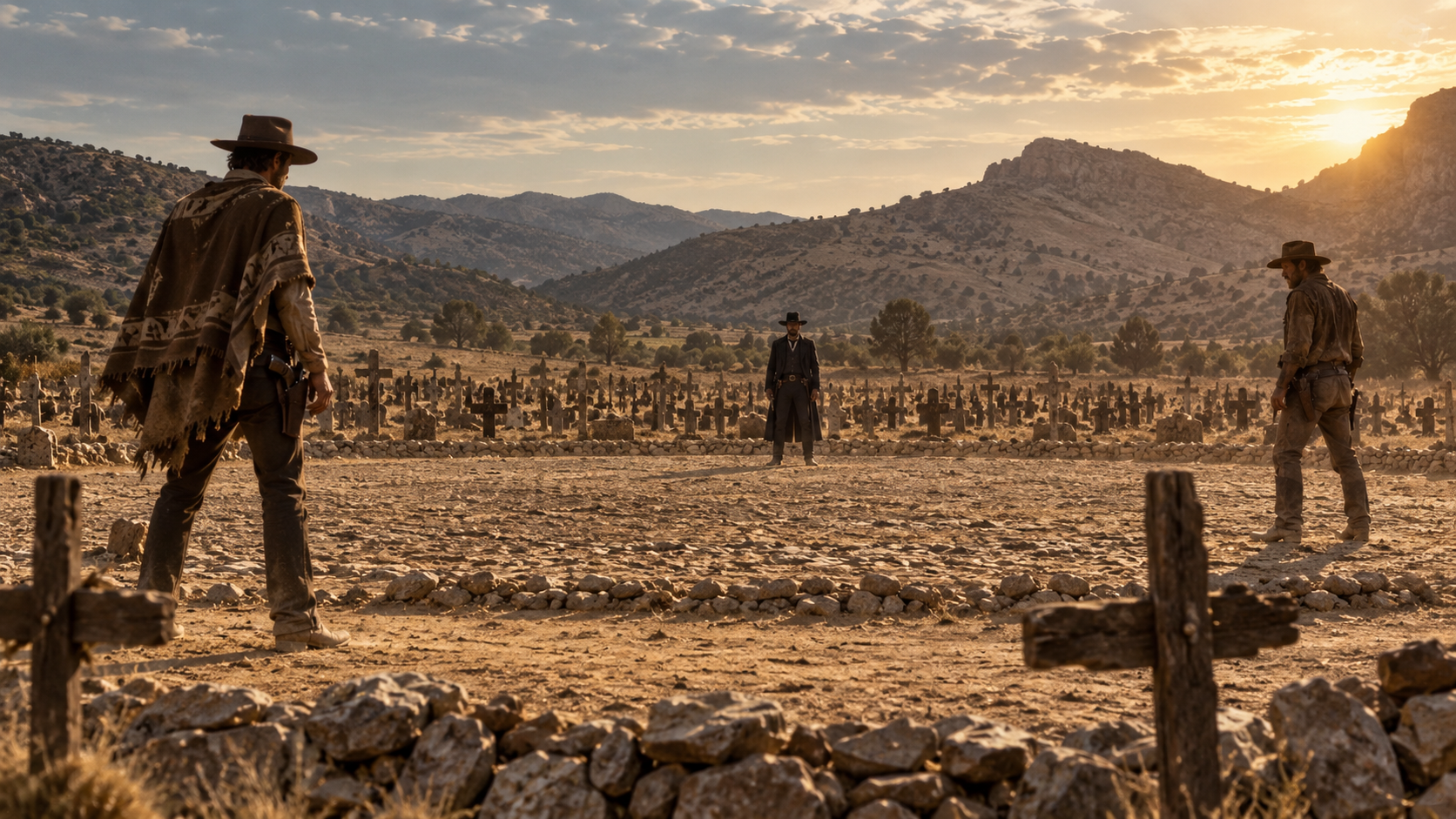
The search ultimately leads to one of the most celebrated climaxes in film history: an extended confrontation built from movement, glances, music and editing rather than dialogue.
Sergio Leone and the Production Background
Sergio Leone had already reinvented the western with A Fistful of Dollars in 1964 and expanded his style with For a Few Dollars More in 1965. The Good, the Bad and the Ugly gave him a larger budget, broader landscapes and a story with a more epic historical setting.
The three films are now known as the Dollars Trilogy, although they were not originally constructed as a tightly connected narrative. Eastwood plays a similar mysterious gunfighter in each film, but the characters, chronology and supporting casts do not form a completely consistent series.
United Artists became involved after the international success of the first two films. The expanded financing allowed Leone to stage battlefield sequences, construct substantial sets and employ large numbers of extras.
Although the story is set in the American Southwest, much of the film was made in Spain. The arid landscapes of Almería supplied deserts and frontier terrain, while other sequences were filmed around Burgos. The Sad Hill Cemetery set was constructed near Santo Domingo de Silos and has since been restored by dedicated local volunteers and film admirers.
The Civil War bridge sequence was also created in Spain with assistance from members of the Spanish army. A well-known production mishap forced the bridge to be rebuilt and destroyed a second time after cameras failed to capture the first explosion properly.
Interiors were completed in studios in Italy, connecting the film to the industrial system behind many Italian and European genre productions of the period.
Like numerous Italian films of its era, the picture was largely shot without synchronized production dialogue. Actors spoke in their own languages during filming, and dialogue was dubbed afterward for different markets. This explains why lip movements do not always correspond perfectly to either the English or Italian soundtrack.
Far from weakening the film, the multilingual production method contributed to its unusual international identity. The Good, the Bad and the Ugly is simultaneously Italian, Spanish, European and unmistakably engaged with American mythology.
Principal Cast and Performances
Clint Eastwood as Blondie, “the Good”
Clint Eastwood’s Blondie is defined by economy. He speaks only when necessary, rarely reveals what he is thinking and maintains control by observing others.
Eastwood’s stillness works perfectly within Leone’s compositions. A narrowed gaze, a cigar or a small movement of the poncho communicates more than a conventional speech could. His performance completed the screen persona that began in A Fistful of Dollars and helped transform him from a television actor into an international film star.
The American Film Institute notes that Eastwood’s initially surprising decision to make Leone’s Italian westerns ultimately helped establish him as one of the world’s most popular screen figures.
Eli Wallach as Tuco, “the Ugly”
Tuco is the film’s most energetic and fully developed character. He can be comic, cruel, frightened, resourceful, sentimental and treacherous—sometimes within the same scene.
Eli Wallach supplies the emotional and physical force that counterbalances Eastwood’s restraint. Tuco talks constantly, reacts visibly and survives through improvisation. Although the title labels him “the Ugly,” he is also the character whose poverty, family history and desperation receive the greatest attention.
His relationship with Blondie becomes the film’s unstable emotional center. They mistreat and deceive each other, yet gradually develop a bond that neither man would acknowledge openly.
Lee Van Cleef as Angel Eyes, “the Bad”
Lee Van Cleef had played Colonel Mortimer, a very different character, in For a Few Dollars More. Here he becomes a quietly terrifying antagonist.
Angel Eyes rarely displays anger because he rarely needs to. His calmness suggests that killing is simply a profession. He collects information, identifies weakness and uses institutions—including the machinery of war—to advance his private interests.
Van Cleef’s controlled performance gives the film a villain who is dangerous not because he is unpredictable, but because he is methodical.
The Supporting Cast
The supporting performers include Aldo Giuffrè as the Union officer Captain Clinton, Mario Brega as Corporal Wallace, Luigi Pistilli as Father Pablo Ramirez and Antonio Casas as Stevens.
Father Pablo’s encounter with Tuco briefly reveals the family history beneath the bandit’s theatrical personality. Captain Clinton, meanwhile, embodies the exhaustion of soldiers condemned to repeat a strategically meaningless battle.
These characters help turn what could have been a simple adventure into a larger portrait of men trapped inside poverty, violence and war.
Themes and Interpretation
Morality Without Conventional Heroes
The film’s title appears to organize its characters morally, yet Leone repeatedly undermines those categories.
Blondie is relatively “good” because the other two men are worse, not because he follows a heroic code. Tuco is labeled “ugly,” but he is capable of loyalty, grief and human vulnerability. Angel Eyes is unmistakably cruel, yet even he operates according to a professional rule: once he accepts payment, he completes the job.
Their morality is comparative rather than absolute.
Greed and Cooperation
The buried gold forces the three rivals into temporary relationships. Information is divided among them, making cooperation necessary even when betrayal is inevitable.
This arrangement produces the film’s central tension. Each character constantly calculates when an ally will become more valuable dead than alive. Their partnerships resemble economic transactions rather than friendships, reflecting a world in which almost everything—including human life—has a price.
The Absurdity of War
The Civil War is not simply historical decoration. It functions as a dark mirror of the protagonists’ private struggle.
Blondie, Tuco and Angel Eyes kill for personal advantage, but the armies around them sacrifice hundreds of men for objectives that often seem equally irrational. One repeated battle concerns a bridge neither side can use effectively while the other controls it.
Leone presents war without patriotic grandeur. Soldiers are hungry, wounded, drunk, imprisoned or exhausted. The treasure hunt occasionally looks almost logical when compared with the organized destruction surrounding it.
The BFI describes the film as both a critique of capitalist greed and an exposure of war’s brutal absurdity.
Myth Versus History
Leone’s West is deliberately artificial. It is not a documentary reconstruction of the United States during the Civil War. It is a European cinematic dream—or nightmare—assembled from American films, pulp stories, history and the director’s imagination.
Yet the artificiality allows Leone to examine the mythology of the western more freely. His gunfighters are not pioneers building a nation. They are survivors moving through a society where political ideals have been overwhelmed by violence and money.
Cinematography and Music
Tonino Delli Colli’s Widescreen Images
Cinematographer Tonino Delli Colli gives the film two apparently opposite visual scales.
At one extreme are immense landscapes in which riders, buildings and armies become tiny elements within the frame. At the other are enormous close-ups of eyes, scars, fingers, guns and weathered faces.
Leone cuts between these scales to manipulate tension. The landscape establishes physical danger; the close-up turns an almost invisible reaction into a dramatic event. The Academy has specifically celebrated the film’s movement between panoramic vistas and extraordinarily tight close-ups.
The widescreen Techniscope format is used not only to show scenery but also to arrange competing characters within the same frame. Distance itself becomes part of the drama.
Ennio Morricone’s Score
Ennio Morricone’s music is inseparable from the film.
The main theme imitates the cry of a coyote and assigns distinctive instrumental colors to the three central characters. Whistles, voices, electric guitar, percussion and orchestral passages produce a sound that is simultaneously primitive, modern and theatrical.
“The Ecstasy of Gold,” heard during the cemetery sequence, is among the most famous pieces of film music ever recorded. Edda Dell’Orso’s soaring vocal line turns frantic physical movement into something approaching religious revelation.
“The Trio,” which accompanies the final confrontation, stretches anticipation through recurring musical phrases that rise in intensity as Leone cuts between faces, hands and guns.
Morricone often composed music before filming rather than waiting to score completed footage. Leone could therefore play the music during production, allowing rhythm and performance to develop in direct conversation with the score.
The soundtrack does not merely accompany the images. It determines how time, tension and emotion are experienced.
Reception and Awards
Initial critical reaction was divided, particularly in the United States. Some reviewers admired Leone’s visual imagination but objected to the film’s length, violence, dubbing and morally unpleasant characters.
The film did not receive the major Academy Award recognition that might now be expected of a work with such a reputation. Its status developed gradually through popular success, repertory screenings, television broadcasts, home-video releases and critical reassessment.
Modern evaluations are dramatically more favorable. The film ranked joint 169th in the 2022 Sight and Sound critics’ poll of the greatest films ever made. The BFI also includes it among the essential spaghetti westerns, describing its cemetery confrontation as one of the genre’s greatest shootouts.
Its absence from major contemporary award lists now says more about the period’s attitude toward genre cinema than about the film’s artistic achievement.
Legacy and Influence
The legacy of The Good, the Bad and the Ugly extends far beyond the western.
Its influence can be seen in the work of Quentin Tarantino, Robert Rodriguez, John Woo, Sam Peckinpah and numerous other filmmakers interested in stylized violence, morally ambiguous characters and the relationship between music and editing.
Tarantino has repeatedly championed the film, and the BFI identifies it as an important influence on his approach to cinema.
The film’s techniques have become part of popular visual language:
- Extreme close-ups before a confrontation
- Long pauses interrupted by sudden action
- Characters identified through musical motifs
- Rapid cutting between multiple opponents
- Wide landscapes contrasted with minute physical detail
- Violence treated as ritual, spectacle and black comedy
- Uneasy alliances among protagonists with conflicting motives
The main musical theme has been quoted, parodied and reused throughout popular culture. Metallica has traditionally used “The Ecstasy of Gold” as concert entrance music, introducing Morricone’s composition to generations of listeners who may not initially have known its cinematic origin.
The film also strengthened the international reputation of Italian genre cinema. It proved that a European production could reinterpret a famous American form and influence the future of that form worldwide.
Today it stands alongside the central achievements of 100 years of Italian cinema and holds the leading position in Italia Mia’s guide to the top Italian movies of all time.
Where to Watch or Buy
Streaming rights change frequently and differ by country. Before subscribing or paying to rent the film, check the title directly on the streaming service available in your location.
In the United States, the film commonly rotates among digital rental and purchase services such as Amazon Prime Video, Apple TV, YouTube and Fandango at Home. Availability in Italy and other European markets may be different.
For viewers who want consistent access and the best possible presentation, a physical edition remains the safest choice.
Recommended Physical Edition: Kino Lorber 4K UHD
The Kino Lorber Studio Classics release is a strong choice for North American viewers who want the international theatrical version and a substantial collection of supplementary material.
| Feature | Kino Lorber 4K UHD edition |
|---|---|
| Format | 4K Ultra HD plus Blu-ray |
| Film version | Approximately 162-minute international theatrical cut |
| Video | 2160p presentation sourced from a 4K scan and extensive color grading |
| English subtitles | Yes, optional English subtitles |
| Audio languages | English-language soundtrack; check the current retailer listing for the exact audio configuration |
| Italian audio | Not guaranteed on this particular U.S. edition |
| 4K disc region | 4K UHD discs are generally region-free |
| Included Blu-ray | Intended for the North American market; assume Region A unless the packaging states otherwise |
| Restoration | Restored theatrical presentation, not a standard older master |
| Collector’s features | Audio commentary, documentaries, Morricone featurettes, deleted or reconstructed material, trailers and image galleries |
| Extended cut | The main feature is the theatrical cut; extended material appears among the supplements rather than as the principal 4K presentation |
Kino Lorber states that its theatrical edition underwent extensive shot-by-shot color grading, using a 4K scan of a 1967 IB Technicolor print as a secondary reference. It also confirms optional English subtitles and a collection of historical supplements.
Buy the Kino Lorber 4K UHD edition on Amazon.com
Blu-ray Alternative
Viewers without a 4K player can choose Kino Lorber’s restored Special Edition Blu-ray. It contains the approximately 162-minute theatrical cut and many of the same contextual supplements.
Buy The Good, the Bad and the Ugly on Blu-ray from Amazon.com
DVD Option
DVD editions remain available, but some use older transfers and may contain different cuts, sound mixes or supplements. DVD is suitable for basic viewing, but Blu-ray or 4K UHD is preferable for Tonino Delli Colli’s widescreen photography.
Find The Good, the Bad and the Ugly on DVD at Amazon.com
Collector’s Edition Information
Collectors should be aware that several editions have appeared in different countries, including MGM anniversary releases, Kino Lorber editions and a later Arrow Video limited edition.
The Arrow set includes both the international and extended cuts in 4K, but its supplementary Blu-ray is Region B locked. It may therefore require a multi-region Blu-ray player outside Europe, even if the UHD feature discs play internationally.
Availability Warning
Physical editions, prices and retailer inventories can change without notice. Always verify the film cut, disc region, subtitle options, audio languages and number of included discs before ordering.
A listing showing “4K,” “Blu-ray” or “collector’s edition” does not automatically guarantee that it contains the same restoration or supplements described above. Buyers outside the United States should pay particular attention to Region A and Region B compatibility.
Related Italia Mia Articles
- Cinema of Italy: The Spaghetti Western
- Italian Cinema: 100 Years of Masterpieces That Shaped World Film
- Top Italian Movies of All Time