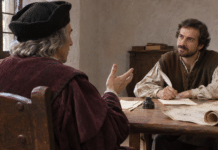

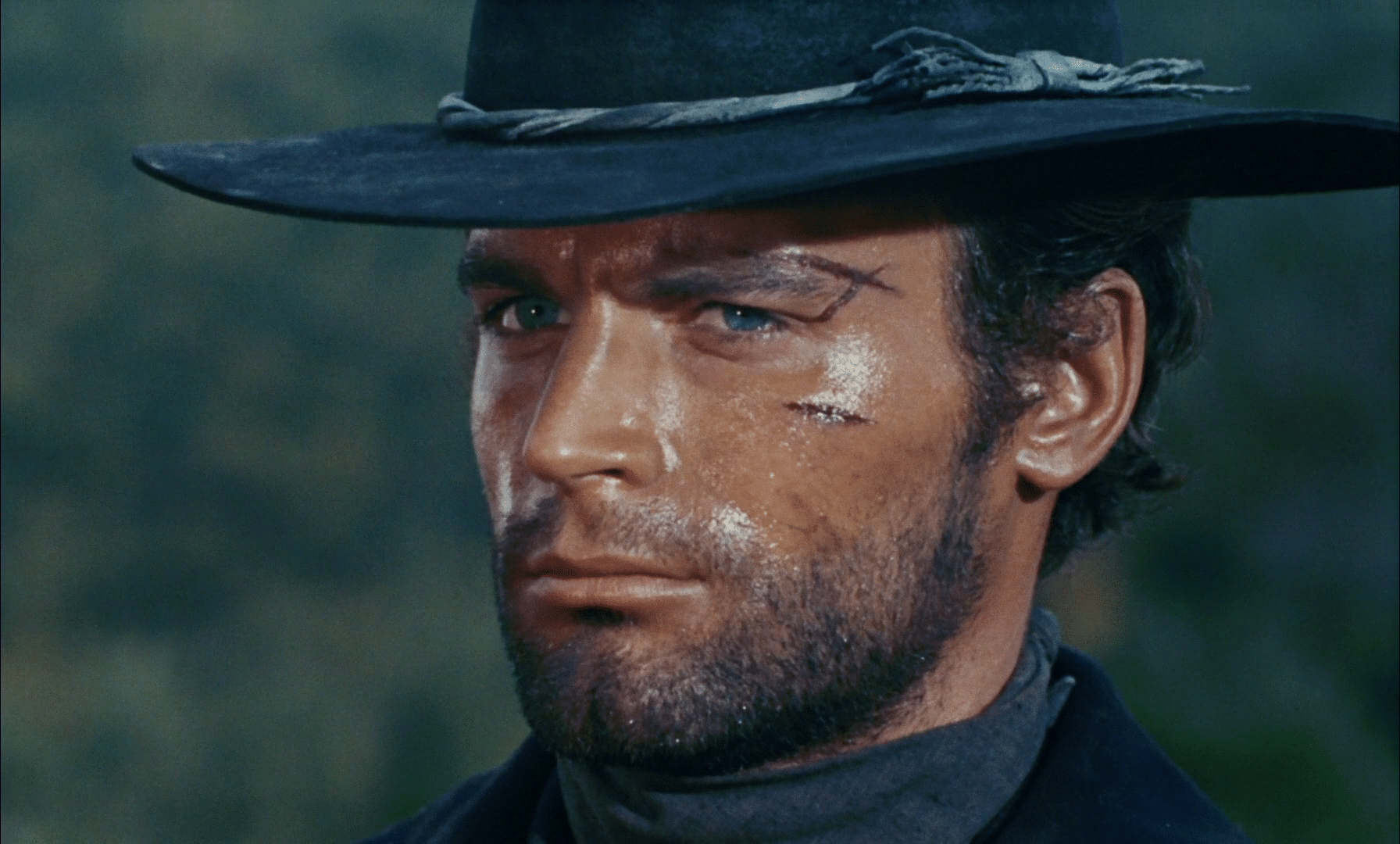
Terence Hill can suggest two very different images: a dusty cowboy with a mischievous smile, or a priest riding a bicycle through an Umbrian town. Between Trinity and Don Matteo lies a career that connects Italian westerns, international comedy and the enduring appeal of television built around a familiar, reassuring face.
Born Mario Girotti, Hill was already an experienced actor before his partnership with Bud Spencer made him internationally famous. His story includes an early appearance in The Leopard, a western opposite Henry Fonda, work behind the camera and a second period of enormous visibility on Italian television.
What connects these different roles is an unusually relaxed screen presence. Hill often lets other people become angry, suspicious or overconfident while he waits. The smile usually arrives just before the balance of a scene changes.
Mario Girotti Before Terence Hill
Mario Girotti was born in Venice on March 29, 1939. His early screen career began with Dino Risi’s Vacanze col gangster, made in 1951, when he was still a boy.
During the 1950s, he worked in an Italian film industry that offered young actors opportunities across very different genres. His credits included Mauro Bolognini’s La vena d’oro, Francesco Maselli’s Gli sbandati and Gillo Pontecorvo’s La grande strada azzurra.
In 1963, he appeared in Luchino Visconti’s Il Gattopardo, known internationally as The Leopard. It is a useful starting point for understanding how much acting experience preceded his western fame. The performer later associated with broad comedy had worked within one of Italian cinema’s most celebrated historical productions.
He also appeared in German adventure films associated with Karl May’s Winnetou stories. His later international career grew from an industry in which actors, directors and crews regularly crossed national and linguistic boundaries.
How the Partnership with Bud Spencer Began
Hill’s decisive professional meeting with Carlo Pedersoli, the future Bud Spencer, took place on Giuseppe Colizzi’s Dio perdona… io no! (God Forgives… I Don’t!, 1967).
There had been earlier near encounters. In his own account, Hill recalls admiring Pedersoli at their swimming club in Rome. Both also appeared in Hannibal, but their scenes were filmed on different days. Sharing a film credit had not yet made them a double act.
Colizzi’s western brought them together properly. Both adopted English-sounding stage names to help the production appeal internationally. Mario Girotti became Terence Hill; Carlo Pedersoli became Bud Spencer.
Further westerns followed, including Ace High in 1968 and Boot Hill in 1969. Their contrasting appearances and temperaments offered filmmakers something immediately useful: two leading men who could make the relationship itself an attraction.
For the other side of that partnership, our Bud Spencer biography follows Pedersoli’s journey from competitive swimming to cinema and his substantial career outside the duo.
Trinity and the Comic Western
Enzo Barboni, credited as E. B. Clucher, directed They Call Me Trinity (Lo chiamavano Trinità…, 1970) and Trinity Is Still My Name (…continuavano a chiamarlo Trinità, 1971).
These films made Hill’s apparent ease central to the entertainment. Trinity can look hungry, scruffy and barely interested in making an effort, yet remain completely in command of a situation. Spencer’s Bambino supplies a wonderfully irritated response to that confidence.
Watch the pauses between the action. An argument, a meal or a look can establish the joke before anyone throws a punch. Hill’s performance depends on the distance between how little Trinity seems to care and how precisely he understands what is happening.
The films belong to the broader story of the spaghetti western, its directors and essential films. They demonstrate how readily western conventions could accommodate comedy: the intimidating stranger, the confrontation and the supposedly dangerous opponent all become opportunities for a reversal.
Why Hill and Spencer Worked So Well Together
Hill frequently plays the instigator. His character nudges a situation toward trouble, enjoys the confusion and leaves his companion to register the inconvenience.
Spencer’s resistance gives that mischief a shape. A glare or a delayed reaction can be as important as Hill’s next movement. Their scenes work because each performer gives the other room.
Much of the humour is visual. An audience can understand provocation, disbelief and wounded pride before catching every line of dialogue. This helps explain why their films travelled so successfully across languages.
Their partnership also survived a move away from western settings. Watch Out, We’re Mad! (1974), Crime Busters (1977) and Odds and Evens (1978) brought their comic relationship into contemporary adventures.
The fights are often structured like routines: anticipation, interruption, repetition and a final flourish. The pleasure comes from recognizing the pattern and watching how the performers vary it.
My Name Is Nobody and a Career Beyond the Duo
Hill’s work with Spencer was only one part of his film career. In My Name Is Nobody (Il mio nome è Nessuno, 1973), directed by Tonino Valerii and produced by Sergio Leone, he starred opposite Henry Fonda.
The pairing creates a different contrast. Hill’s youthful irreverence meets the authority Fonda brings to the western. For viewers who know Hill mainly through the Trinity films, it offers another way to appreciate his ability to unsettle a more solemn screen presence.
His solo filmography also includes Superfuzz (1980) and They Call Me Renegade (1987). These films give him room to carry the story without relying on the familiar rhythm of the Spencer partnership.
Looking at this work alongside the double act makes his particular contribution clearer. His charm depends on agility and timing, but also on making confidence seem casual rather than laborious.
Directing and Returning to the Western
Hill also moved behind the camera. Don Camillo marked his feature directing debut, with Hill taking the title role as well.
He later played the comic-book cowboy Lucky Luke in film and television, returning to a frontier world suited to physical humour.
In 1994, he directed Troublemakers (Botte di Natale), which reunited him with Spencer in a western setting. By then, recognition was part of the appeal: viewers were watching familiar performers return to a relationship they already understood.
In 2010, Hill and Spencer received special David di Donatello recognition for their contribution to cinema. The honour acknowledged a body of popular entertainment whose international reach had become part of Italian film history.
Don Matteo: A Second Defining Role
In 2000, Hill began playing the title character in Don Matteo. The priest-detective gave his career a new centre and introduced his familiar face to viewers who encountered him first through television.
Initially associated with Gubbio and later Spoleto, Don Matteo approaches mysteries through attention to people. The friendship with Nino Cecchini, played by Nino Frassica, adds comedy and affection to the investigations.
The bicycle, clerical clothes and patient manner create a very different silhouette from Trinity’s. Yet there is a continuity in the performance: Hill can suggest that his character has understood something before everyone around him has caught up.
The series combines criminal investigations with stories about mistakes, responsibility and the possibility of forgiveness. Its central character listens, notices and makes room for people to explain themselves.
Hill handed over the leading role during the thirteenth season in 2022. Raoul Bova entered as Don Massimo, a different priest, allowing the series to continue under its established title.
Beyond Don Matteo
Hill also starred as Pietro in the first three seasons of Un passo dal cielo, broadcast between 2011 and 2015. The mountain setting gave him another context for a watchful, reserved character.
His later film My Name Is Thomas (2018), which he directed and starred in, follows a traveller whose desired solitude is interrupted by an encounter with a young woman.
Taken together, these roles show how adaptable his screen presence became. A western drifter, a priest and a man seeking solitude need different settings and stories, but all allow Hill to work through observation and restraint.
Where to Start Watching Terence Hill
A short introduction can cover several stages of his career:
- They Call Me Trinity (1970): Begin with the western comedy that gives his partnership with Spencer its clearest early expression.
- Trinity Is Still My Name (1971): Watch the sequel for another encounter with Trinity and Bambino.
- My Name Is Nobody (1973): See Hill opposite Henry Fonda in a different kind of western pairing.
- Crime Busters (1977): Follow the double act into a contemporary setting.
- Don Matteo: Try an early episode to see how Hill adapted his timing and quiet confidence to television.
Across these performances, Hill rarely appears to force a scene. He draws attention through a glance, a pause or a small change of expression. That economy helps connect the cowboy and the priest, even when almost everything around them has changed.
External Links
- Terence Hill’s official website: filmography
- Terence Hill’s account of his partnership with Bud Spencer
- Treccani: Terence Hill biography
- Rai Teche: Terence Hill’s career and David di Donatello recognition
- Rai Libri: Don Matteo and his approach to investigations
- ANSA: the 2022 Don Matteo handover