

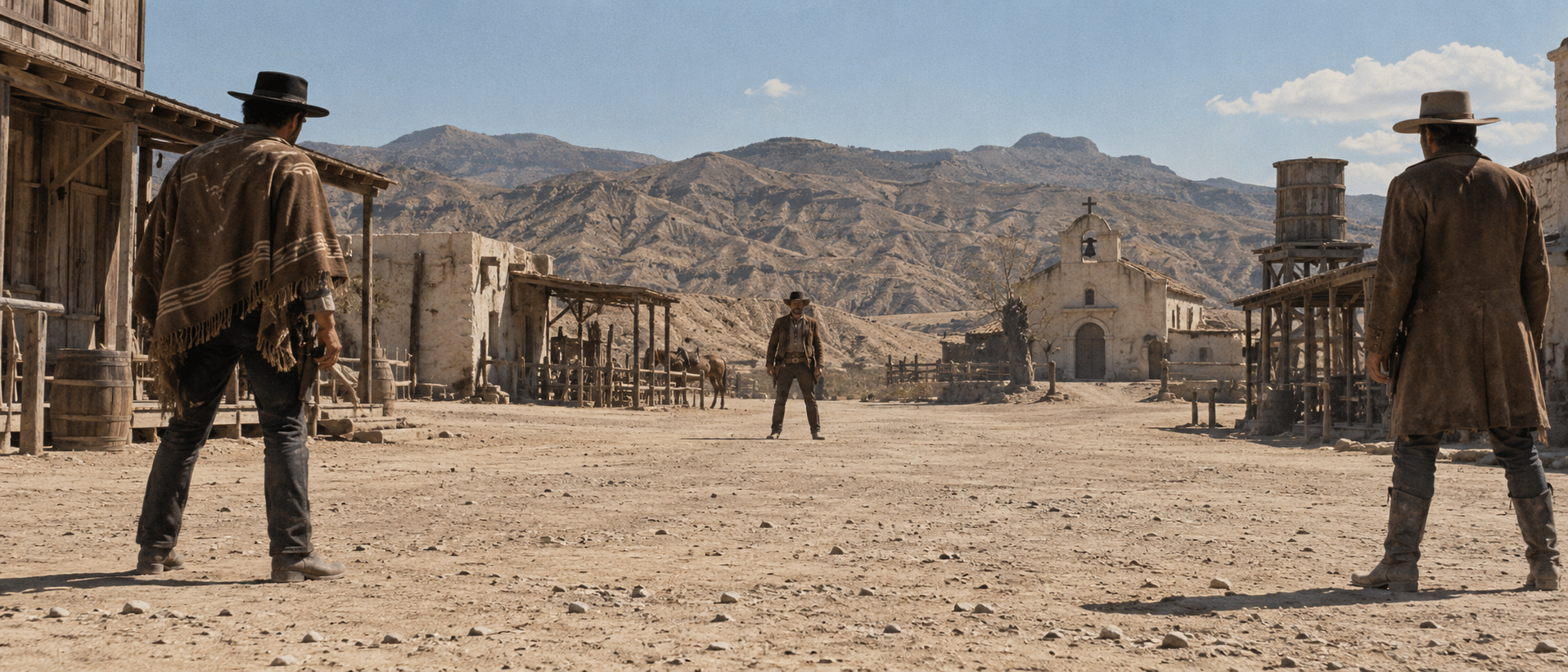
 The spaghetti western was one of Italy’s most successful and influential contributions to popular cinema. Known in Italy as the western all’italiana, the genre transformed familiar stories of gunslingers, outlaws and frontier justice into something more stylized, cynical and operatic.
These films were usually European co-productions rather than exclusively Italian productions. Italian directors and crews frequently worked with Spanish, German and French partners, while desert locations in Almería and other parts of Spain stood in for Mexico and the American Southwest. Multinational casts often spoke different languages during filming, with dialogue dubbed during post-production.
What distinguished the spaghetti western was not simply where it was made. Its filmmakers replaced the morally certain heroes of many classical American westerns with bounty hunters, mercenaries and drifters whose motives were rarely noble. Extreme close-ups, prolonged silences, sudden violence, dark humor and unconventional music created an unmistakable cinematic language.
Sergio Leone and the Breakthrough of the Spaghetti Western
European westerns existed before Sergio Leone, but his 1964 film A Fistful of Dollars established the style that made the genre an international phenomenon.
Leone understood the American western tradition but refused to imitate it respectfully. He stretched time, isolated physical gestures and turned confrontations into elaborate rituals. Dust, sweat, weathered faces and nearly empty landscapes became as important as dialogue.
His collaboration with composer Ennio Morricone was equally transformative. Morricone used whistles, bells, electric guitars, human voices, gunshots and other unexpected sounds to create music that did more than accompany the action. The scores helped determine the rhythm and emotional character of Leone’s films.
The director’s life and wider career are explored in Italia Mia’s biography of Sergio Leone.
The Dollars Trilogy
Leone’s three films with Clint Eastwood are commonly known as the Dollars Trilogy. Although their characters and stories are not connected in the conventional sense, the films share a recognizable visual style, moral atmosphere and central antihero.
A Fistful of Dollars
A Fistful of Dollars appeared in 1964 and introduced Eastwood as the laconic gunfighter later promoted as “the Man with No Name.”
The story was closely adapted from Akira Kurosawa’s Yojimbo, transferring its wandering samurai and rival criminal factions to a violent border town. Leone added a distinctive mixture of ritual, irony, Catholic imagery and frontier mythology.
The film’s commercial success encouraged Italian producers to finance hundreds of westerns, some highly inventive and others designed to capitalize quickly on the new fashion.
For a Few Dollars More
For a Few Dollars More followed in 1965. Clint Eastwood and Lee Van Cleef play rival bounty hunters who form an uneasy alliance while pursuing the outlaw El Indio, portrayed by Gian Maria Volonté.
The second film expanded Leone’s world through more complex characters, larger set pieces and the memorable use of a musical pocket watch as part of both the narrative and Morricone’s score.
The Good, the Bad and the Ugly
The Good, the Bad and the Ugly completed the trilogy in 1966. Eastwood, Lee Van Cleef and Eli Wallach play three men searching for buried gold during the American Civil War.
Its climactic cemetery confrontation remains one of cinema’s most famous sequences. Leone alternates panoramic compositions with increasingly tight close-ups, while Morricone’s “The Ecstasy of Gold” and the film’s main theme turn the scene into an almost abstract combination of movement, music and suspense.
Leone’s Later Western Epics
With Once Upon a Time in the West, released in 1968, Leone moved beyond the relatively compact structures of the Dollars films. The arrival of the railroad becomes a symbol of historical change, bringing wealth and modernity while destroying the older frontier world.
Henry Fonda was deliberately cast against type as the cold-blooded Frank. Claudia Cardinale plays Jill McBain, a former prostitute who becomes the emotional and historical center of the story, while Charles Bronson’s Harmonica embodies the genre’s familiar figure of the avenger.
Leone returned to revolutionary Mexico in Duck, You Sucker!, also known as A Fistful of Dynamite, in 1971. James Coburn and Rod Steiger play an Irish revolutionary and a Mexican bandit drawn into political violence. The film questions romantic ideas about revolution while retaining Leone’s characteristic combination of spectacle, tragedy and sardonic humor.
Sergio Corbucci: Violence, Politics and Pessimism
Sergio Corbucci developed a harsher and frequently more political version of the Italian western.
Django, released in 1966, stars Franco Nero as a mysterious gunfighter who arrives dragging a coffin through the mud. The film’s bleak setting, racial conflict and brutal violence created an alternative to Leone’s more controlled and operatic style. Its success inspired numerous unofficial films that used the name Django despite having no connection to Corbucci’s original story.
The Great Silence, released in 1968, abandoned the familiar desert for a snow-covered landscape. Jean-Louis Trintignant plays a mute gunfighter opposing bounty killers led by Klaus Kinski’s chilling Loco. Its pessimistic conclusion attacks the assumption that justice and individual heroism must ultimately triumph.
Corbucci also helped develop the revolutionary or “Zapata” western through films such as The Mercenary and Compañeros. These stories used the Mexican Revolution to explore exploitation, imperialism, political idealism and betrayal.
Sergio Sollima and the Political Western
Sergio Sollima brought psychological tension and explicit social themes to the genre.
The Big Gundown stars Lee Van Cleef as Jonathan Corbett, a celebrated gunman pursuing a Mexican peasant played by Tomas Milian. What begins as a conventional manhunt gradually becomes an examination of prejudice, political manipulation and the abuse of power.
In Face to Face, a mild-mannered professor becomes involved with an outlaw gang and is slowly transformed by his new environment. Rather than presenting violence as an instinct belonging only to criminals, the film investigates how authority, ambition and ideology can corrupt an apparently civilized person.
Run, Man, Run continued Sollima’s interest in Tomas Milian’s character Cuchillo, combining revolutionary politics with adventure and humor.
Damiano Damiani and the Zapata Western
Damiano Damiani’s A Bullet for the General, released in Italy as Quien sabe?, is one of the most important political spaghetti westerns.
Gian Maria Volonté plays El Chuncho, a Mexican bandit who sells stolen weapons to revolutionary forces. His relationship with an American passenger concealing his true purpose gives the film its central conflict between political awakening and foreign intervention.
The screenplay was co-written by Franco Solinas, whose work on The Battle of Algiers also examined revolution, colonial power and political violence. A Bullet for the General helped establish the conventions of the Zapata western, in which the Mexican Revolution provided a setting for contemporary debates about capitalism, imperialism and resistance.
Other Directors and Essential Films
The genre extended well beyond Leone, Corbucci, Sollima and Damiani.
Duccio Tessari’s A Pistol for Ringo and The Return of Ringo made Giuliano Gemma one of the leading stars of the Italian western. Tonino Valerii’s Day of Anger paired Gemma with Lee Van Cleef in a story about mentorship, resentment and corrupted ambition.
Giulio Petroni’s Death Rides a Horse offered another memorable Van Cleef performance, accompanied by an intense Morricone score. Gianfranco Parolini’s Sabata moved toward increasingly elaborate weapons, colorful characters and playful action.
Enzo G. Castellari’s Keoma, released in 1976, belongs to the genre’s late period. Starring Franco Nero, it combines stylized violence, religious imagery and an elegiac awareness that the classic spaghetti western cycle was reaching its end.
Comedy Westerns and the Trinity Phenomenon
By the beginning of the 1970s, audiences were becoming familiar with the genre’s conventions. Filmmakers increasingly replaced bleak revenge stories with comedy, slapstick and exaggerated fistfights.
Enzo Barboni’s They Call Me Trinity, released in 1970, transformed Terence Hill and Bud Spencer into an internationally popular screen partnership. Hill’s relaxed charm and Spencer’s physical comedy offered a lighter alternative to the severe antiheroes of the previous decade.
Its sequel, Trinity Is Still My Name, followed in 1971 and became an even greater commercial success. The popularity of the Trinity films encouraged numerous comedy westerns, sometimes called fagioli westerns, or “bean westerns.”
My Name Is Nobody, directed by Tonino Valerii from a story by Sergio Leone, brought comedy and elegy together. Terence Hill plays a playful young gunfighter who wants an aging Western hero, portrayed by Henry Fonda, to achieve one final legendary confrontation. The film works simultaneously as parody, tribute and farewell.
The Importance of Ennio Morricone’s Music
Music was central to the identity of the spaghetti western. Morricone’s work with Leone is the most celebrated example, but he also composed scores for films by Corbucci, Sollima, Petroni and other directors.
His arrangements replaced the sweeping orchestral language of many American westerns with whistles, choral voices, percussion, electric instruments and sounds associated with the physical world of the films. A musical theme could identify a character, reveal a memory or shape the timing of an entire sequence.
Morricone’s influence was so profound that the sound of the spaghetti western became recognizable even to people who had never watched the films themselves.
Decline and Lasting Influence
The production cycle began to lose momentum during the 1970s. Repetition, declining budgets and the dominance of comedy gradually weakened the darker form of the genre. Later films such as Keoma attempted to revive or elegize it, but the period of intense production had largely ended.
Its influence, however, never disappeared. Filmmakers including Quentin Tarantino, Robert Rodriguez and Takashi Miike have borrowed its music, framing, antiheroes and ritualized confrontations. Modern action films, crime dramas and revisionist westerns continue to use techniques popularized by Leone and his contemporaries.
The spaghetti western succeeded because Italian filmmakers did more than reproduce an American genre. They dismantled its familiar mythology and reconstructed it through Italian visual style, political debate, popular entertainment and musical experimentation. What was once dismissed as inexpensive imitation is now recognized as one of the most creative chapters in the history of Italian cinema.
Further Reading
Christopher Frayling’s Sergio Leone: Something to Do with Death is an extensive study of Leone’s life, filmmaking methods and cultural influence.
External Sources
British Film Institute: 10 Great Spaghetti Westerns
Cineteca di Bologna: Sergio Leone and A Fistful of Dollars
Cineteca di Bologna: The Origins of A Fistful of Dollars
MoMA: The Big Gundown by Sergio Sollima
MoMA: Akira Kurosawa’s Yojimbo