

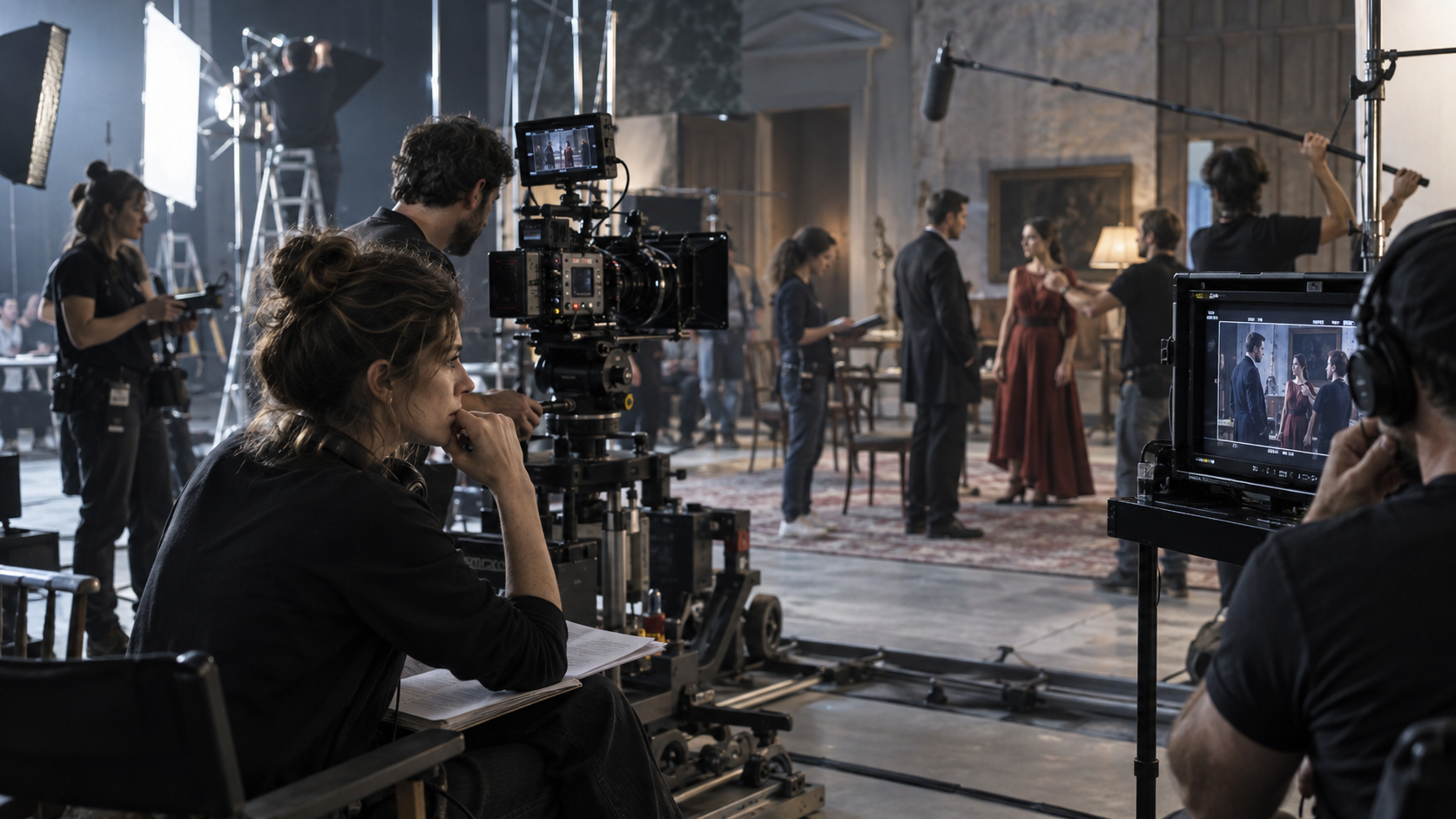
 Italian cinema entered the twenty-first century without a single dominant movement comparable to Neorealism or commedia all’italiana. Instead, it developed through several overlapping traditions: personal auteur films, socially engaged dramas, documentaries, popular comedies, crime stories, international co-productions and, increasingly, productions financed or distributed by streaming platforms.
The result has been more varied than the familiar narrative of decline and revival suggests. Italian films have continued to win major festival prizes, reach global audiences and introduce important new directors, while established filmmakers such as Nanni Moretti, Marco Bellocchio and Paolo Sorrentino have remained remarkably productive.
This period is best understood as a transformation of the industry rather than the emergence of one unified cinematic school.
A New Generation Emerges in the 2000s
At the beginning of the millennium, several filmmakers who had established themselves during the previous decades continued to define Italian cinema internationally.
Nanni Moretti won the Palme d’Or at Cannes for The Son’s Room in 2001. The intimate family drama demonstrated that Italian films could achieve international recognition without relying on historical spectacle or nostalgic images of the country.
Marco Tullio Giordana’s The Best of Youth, originally conceived for television, followed two brothers and their family through several decades of Italian history. Its six-hour length and episodic construction anticipated the increasingly fluid relationship between cinema and television.
Emanuele Crialese explored migration, identity and isolation in Respiro, Golden Door and later Terraferma. His films connected contemporary migration with Italy’s own history of departure, displacement and cultural transition.
The international success of Matteo Garrone’s Gomorrah and Paolo Sorrentino’s Il Divo in 2008 confirmed the arrival of two of the most influential Italian directors of the new century. Garrone adapted Roberto Saviano’s investigation of the Camorra into a fragmented, unsentimental crime drama. Sorrentino transformed the political career of Giulio Andreotti into an extravagant and deliberately ambiguous portrait of power.
These films rejected the polished, sentimental image of Italy commonly marketed abroad. Their cities were corrupt, divided and difficult to interpret. Naples, Rome and the southern periphery became psychological and political landscapes rather than decorative settings.
Paolo Sorrentino and the Return of International Prestige
Paolo Sorrentino became the most internationally visible Italian director of his generation. After films including The Consequences of Love, The Family Friend and Il Divo, he directed The Great Beauty, a portrait of an aging writer moving through Rome’s privileged social world.
The Great Beauty won the Academy Award for Best Foreign Language Film in 2014. Its success encouraged comparisons with Federico Fellini, particularly La dolce vita, although Sorrentino’s visual style, irony and fascination with spiritual emptiness are distinctly his own.
Youth, The Hand of God, Parthenope and La Grazia expanded his international reputation. The Hand of God was also his most autobiographical film, returning to his adolescence in Naples and to the family tragedy that shaped his life.
Sorrentino’s career illustrates an important characteristic of contemporary Italian cinema: the ability to remain culturally Italian while working with international actors, financing partners, distributors and streaming services.
Readers interested in the earlier filmmakers who shaped this tradition can continue with Italia Mia’s overview of the history of Italian cinema.
Matteo Garrone: From Urban Realism to Myth and Migration
Matteo Garrone has followed a markedly different path. Gomorrah brought him worldwide recognition, but subsequent films demonstrated his refusal to remain within one genre.
Reality examined celebrity culture through the story of a man obsessed with appearing on a reality television program. Tale of Tales adapted stories by the seventeenth-century writer Giambattista Basile into a visually elaborate English-language fantasy. Dogman returned to a marginal urban environment, while Pinocchio offered a dark, material interpretation of Carlo Collodi’s tale.
With Io Capitano, Garrone followed two Senegalese teenagers attempting to reach Europe. Rather than presenting migration primarily from the perspective of Europeans, the film places the young travelers and their experiences at its center. Garrone won the Silver Lion for Best Director at the Venice Film Festival, and the film received an Academy Award nomination for Best International Feature Film.
His career reflects the range of modern Italian filmmaking: local stories, literary adaptations, international casts, social observation and large-scale co-production can all belong to the same body of work.
Documentary Cinema Gains New Authority
One of the most important changes of the new millennium has been the growing international prestige of Italian documentary cinema.
Gianfranco Rosi’s Sacro GRA, a study of people living around Rome’s ring road, became the first documentary to win the Golden Lion at Venice in 2013. Fire at Sea, filmed on Lampedusa during the Mediterranean migration crisis, won the Golden Bear at the Berlin International Film Festival in 2016.
Rosi’s films avoid conventional narration and explanatory interviews. He builds meaning through observation, patient composition and contrasts between lives occupying the same geographical space.
Other filmmakers have similarly blurred the division between documentary and fiction. Pietro Marcello combines archival material, literary adaptation and invented narrative in films such as The Mouth of the Wolf, Martin Eden and Scarlet. Michelangelo Frammartino’s Le quattro volte and Il buco use landscape, sound and physical labor to create forms of cinema that are almost independent of dialogue.
This documentary tradition has become one of Italy’s strongest contributions to contemporary world cinema.
Alice Rohrwacher and a Different Vision of Rural Italy
Alice Rohrwacher emerged as one of the most distinctive European directors of her generation. Her films are rooted in rural communities, but they do not treat the countryside as an uncomplicated refuge from modern life.
Corpo Celeste examined religion and adolescence in Calabria. The Wonders followed a family of beekeepers whose isolated life is disrupted by a television production. Happy as Lazzaro combined social realism, fable and temporal dislocation, while La Chimera explored grief, archaeological theft and the uncertain boundary between the living and the dead.
Rohrwacher’s Italy exists between past and present. Ancient objects, abandoned customs, television culture, economic exploitation and magic can occupy the same frame. Her work has helped international audiences recognize a form of Italian cinema that is neither urban crime drama nor picturesque nostalgia.
Women Directors Reshape Contemporary Italian Cinema
Women filmmakers are not simply a new addition to Italian cinema. Directors such as Lina Wertmüller, Liliana Cavani and the filmmaker and actor Valeria Golino had already established important precedents. However, the new millennium has brought a broader and more visible group of women directing films across multiple genres.
Susanna Nicchiarelli has reinterpreted historical and political figures in Nico, 1988, Miss Marx and Chiara. Laura Bispuri’s Sworn Virgin and Daughter of Mine examine identity, family and female autonomy. Emma Dante moved from theatre to cinema with A Street in Palermo and The Macaluso Sisters. Francesca Comencini has worked across film and television, including the series Gomorrah.
Maura Delpero gained international attention with Maternal and then Vermiglio, an intimate drama set in a mountain village during the final period of the Second World War. Vermiglio won the Grand Jury Prize at the Venice Film Festival and became Italy’s submission for the Academy Award for Best International Feature Film.
Paola Cortellesi achieved an exceptional popular success with her directorial debut, There’s Still Tomorrow. Shot largely in black and white and set in postwar Rome, the film combines domestic drama, comedy and a reflection on women’s political rights. Its Italian box-office performance showed that a female-centered historical film could become a mass-audience event rather than remain confined to the festival circuit.
Margherita Vicario’s musical period film Gloria!, Valeria Golino’s dramas Miele and Euforia, and the continuing work of Alice Rohrwacher demonstrate the variety within women’s filmmaking. Their films cannot be reduced to a single style or subject.
Questions about access, financing and representation nevertheless remain. Greater visibility for a few successful directors does not automatically mean equal opportunity throughout the industry.
Italian Cinema During the Pandemic
The COVID-19 pandemic interrupted film production and closed cinemas across Italy. Projects were delayed, theatrical release schedules collapsed and festivals adopted reduced, hybrid or online formats.
The crisis accelerated changes already underway. Streaming platforms became more important as distributors, financiers and international showcases. Films that might previously have depended on a long theatrical campaign could reach viewers simultaneously in many countries.
Edoardo Ponti’s The Life Ahead, starring Sophia Loren, was distributed internationally by Netflix. Paolo Sorrentino’s The Hand of God was also produced and released with Netflix, receiving a limited theatrical run before becoming globally available on the platform.
Streaming did not replace Italian cinema, but it changed the routes through which films reached audiences. It also weakened the old boundary between theatrical filmmaking and prestige television. Directors, screenwriters and actors now move regularly between feature films, limited series and platform productions.
This convergence has been especially visible in crime dramas, literary adaptations and historical series. It has created new employment and international exposure, while also raising concerns about theatrical attendance, ownership of film libraries and the influence of global platforms over production choices.
Genre Films and Popular Audiences
Festival cinema represents only part of the Italian industry. Comedies, crime films, biographical dramas and genre hybrids continue to attract substantial domestic audiences.
They Call Me Jeeg combined the superhero film with the criminal outskirts of Rome. Freaks Out mixed wartime drama, fantasy and spectacle. The Man Who Bought the Moon used comedy to explore Sardinian identity, while Love and Bullets combined Naples-set crime cinema with the musical.
Filmmakers such as Sydney Sibilia have used energetic editing, popular music and genre conventions to address generational frustration and precarious employment. His I Can Quit Whenever I Want trilogy portrayed underemployed academics who turn to the production of legal drugs, while Mixed by Erry reconstructed the rise of a real Neapolitan cassette-counterfeiting operation.
These films challenge the assumption that artistically ambitious Italian cinema must always be solemn or purely realist.
International Co-Productions Become the Norm
Many of the most prominent films associated with Italy are now international co-productions. Italian companies frequently work with partners in France, Belgium, Germany, Switzerland, the United Kingdom and other countries.
Co-production allows filmmakers to assemble larger budgets, qualify for multiple sources of public support and secure distribution across several territories. It can also influence casting, language and story structure.
Luca Guadagnino’s career demonstrates the possibilities of this model. I Am Love, A Bigger Splash, Call Me by Your Name, Bones and All, Challengers and Queer involve different combinations of Italian settings, international actors, foreign financing and English-language dialogue.
Guadagnino is unmistakably an Italian filmmaker, but his career does not fit comfortably inside a cinema defined only by national language or production capital. The same is true, in different ways, of films by Alice Rohrwacher, Matteo Garrone, Pietro Marcello and Maura Delpero.
It is therefore important to distinguish among an Italian film, an Italian-led co-production and an international production filmed in Italy. A Hollywood project using Rome, Venice or Sicily as a location does not automatically belong to Italian cinema.
Regional Film Commissions and New Production Centers
Rome remains central to the Italian film industry, particularly through Cinecittà, national broadcasters and major production companies. Yet contemporary filmmaking is increasingly decentralized.
Regional film commissions provide location support, production incentives and assistance to local crews. Piedmont, Friuli-Venezia Giulia, Apulia, Sicily, Sardinia, Tuscany, Emilia-Romagna and other regions have attracted both Italian and international projects.
This development has widened the geographical representation of Italy on screen. Contemporary films increasingly explore provincial cities, border regions, Alpine communities, industrial suburbs and rural landscapes that were once largely absent from mainstream national cinema.
The expansion of regional production has also made Italy attractive to major foreign projects, although economic benefits from hosting an international production should not be confused with the development of Italian authorship.
Festival Successes in the 2020s
The 2020s have produced a substantial body of Italian films recognized at major international festivals.
Bad Tales by the D’Innocenzo brothers won the Silver Bear for Best Screenplay at Berlin in 2020. The Hand of God received the Grand Jury Prize at Venice in 2021. Luca Guadagnino won Venice’s Silver Lion for Best Director for Bones and All in 2022.
The Eight Mountains, directed by Felix van Groeningen and Charlotte Vandermeersch from Paolo Cognetti’s novel, shared the Jury Prize at Cannes in 2022. In 2023, Marco Bellocchio’s Kidnapped and Alice Rohrwacher’s La Chimera competed at Cannes, while Matteo Garrone’s Io Capitano received major awards at Venice before earning an Academy Award nomination.
In 2024, Maura Delpero’s Vermiglio won Venice’s Grand Jury Prize. Paolo Sorrentino’s Parthenope competed at Cannes, and Margherita Vicario’s Gloria! premiered in competition at Berlin.
Italian cinema maintained its international visibility in 2025. Mario Martone’s Fuori competed at Cannes, while Paolo Sorrentino’s La Grazia opened the Venice Film Festival. Toni Servillo’s performance in La Grazia earned him the Volpi Cup for Best Actor.
These successes do not represent a single movement. They show the coexistence of established auteurs, emerging filmmakers, women directors, documentary traditions, literary adaptations and increasingly international systems of production.
Essential Italian Films of the New Millennium
A representative viewing list should include:
The Son’s Room — Nanni Moretti, 2001
The Best of Youth — Marco Tullio Giordana, 2003
Gomorrah — Matteo Garrone, 2008
Il Divo — Paolo Sorrentino, 2008
We Have a Pope — Nanni Moretti, 2011
Sacro GRA — Gianfranco Rosi, 2013
The Great Beauty — Paolo Sorrentino, 2013
The Wonders — Alice Rohrwacher, 2014
They Call Me Jeeg — Gabriele Mainetti, 2015
Fire at Sea — Gianfranco Rosi, 2016
Call Me by Your Name — Luca Guadagnino, 2017
Happy as Lazzaro — Alice Rohrwacher, 2018
Dogman — Matteo Garrone, 2018
Martin Eden — Pietro Marcello, 2019
Bad Tales — Damiano and Fabio D’Innocenzo, 2020
The Macaluso Sisters — Emma Dante, 2020
The Hand of God — Paolo Sorrentino, 2021
The Eight Mountains — Felix van Groeningen and Charlotte Vandermeersch, 2022
La Chimera — Alice Rohrwacher, 2023
Kidnapped — Marco Bellocchio, 2023
Io Capitano — Matteo Garrone, 2023
There’s Still Tomorrow — Paola Cortellesi, 2023
Gloria! — Margherita Vicario, 2024
Parthenope — Paolo Sorrentino, 2024
Vermiglio — Maura Delpero, 2024
Fuori — Mario Martone, 2025
La Grazia — Paolo Sorrentino, 2025
The list is not a ranking. It is a starting point for understanding the directors, subjects and production models that have shaped Italian film since 2000.
Italian Cinema Continues to Reinvent Itself
Contemporary Italian cinema does not possess a convenient label comparable to Neorealism. Its identity lies precisely in its diversity.
The country’s filmmakers move between intimate family drama and fantasy, documentary and fiction, Italian-language production and international collaboration. They address migration, organized crime, political memory, gender, religion, economic insecurity and the continuing tension between Italy’s historical inheritance and its present-day realities.
Streaming services and international financing have changed how films are produced and watched, but cinemas and festivals remain essential to their cultural life. The strongest works of the new millennium do not merely repeat Italy’s celebrated cinematic past. They question it, reinterpret it and create new ways of representing the country.
Explore more directors, movements and films in Italia Mia’s Italian Cinema section.
External Sources
Directorate General for Cinema and Audiovisual – Italian Ministry of Culture
La Biennale di Venezia – Cinema
Festival de Cannes – Official Website
Berlin International Film Festival – Archive
Academy of Motion Picture Arts and Sciences – Oscars Ceremonies
David di Donatello – Italian Film Academy