

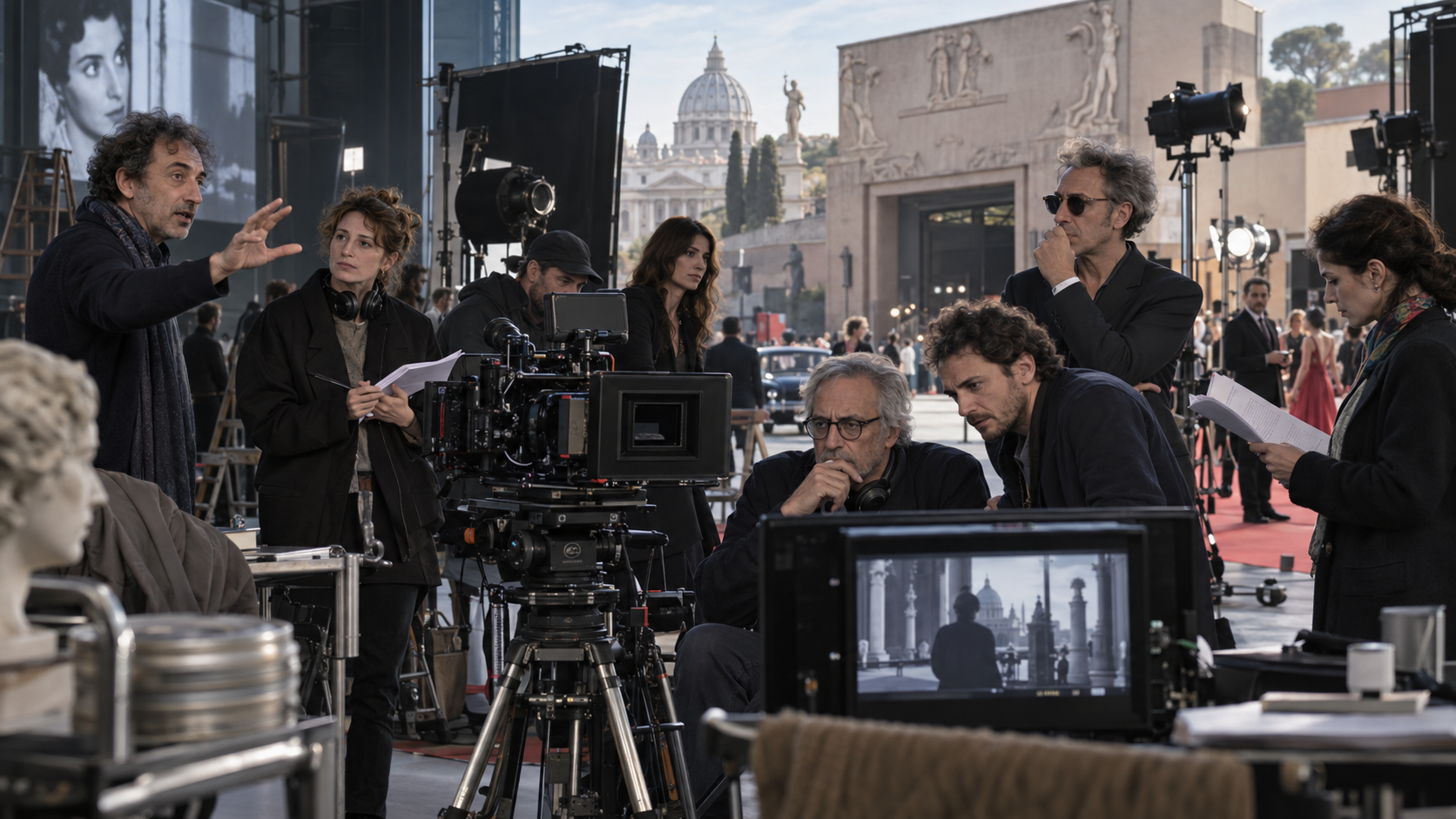
 Italian cinema did not end with Federico Fellini, Luchino Visconti, Michelangelo Antonioni and the masters of Neorealism. From the 1980s onward, a new and remarkably varied group of filmmakers confronted political disillusionment, organized crime, migration, family tensions and Italy’s changing place in the world.
Some directors continued the tradition of socially committed cinema. Others turned toward autobiography, comedy, fantasy or international productions. Together, their films demonstrate that modern Italian cinema is not a single movement but a constantly evolving collection of regional voices and personal styles.
This period deserves to be considered separately from the great directors of postwar Italian cinema. The earlier generation established Italy as a major cinematic power; the directors discussed here inherited that prestige while responding to an entirely different social and industrial landscape.
Italian Cinema Enters a New Era
By the beginning of the 1980s, the Italian film industry was losing part of the large domestic audience it had enjoyed during the postwar decades. Television had become a dominant form of entertainment, many traditional studios were struggling, and several popular genres were declining.
Yet this difficult transition did not eliminate creative filmmaking. It encouraged directors to pursue more personal projects, independent productions and new forms of political engagement.
Veteran filmmakers such as Federico Fellini, Ettore Scola, Marco Bellocchio, Ermanno Olmi and the Taviani brothers remained active. At the same time, Nanni Moretti, Gianni Amelio, Giuseppe Tornatore and Gabriele Salvatores emerged as leading figures of a new era.
Rather than creating another unified movement comparable to Italian Neorealism, these filmmakers developed individual approaches to Italy’s recent history, regional identities and contemporary contradictions.
Nanni Moretti: Autobiography, Politics and Irony
Nanni Moretti became one of the most recognizable voices in modern Italian cinema by combining autobiography, political commentary and dry humor.
His early films often place an awkward, opinionated or emotionally unsettled character—frequently played by Moretti himself—against the institutions and ideological habits of Italian society. In Bianca and Palombella Rossa, personal anxiety becomes inseparable from political and cultural confusion.
Caro diario is perhaps the clearest expression of his distinctive approach. Divided into three episodes, it follows Moretti through Rome on a Vespa, around the Aeolian Islands and through a frustrating series of medical consultations. The film moves effortlessly between intimate confession, comedy, landscape and social criticism.
Moretti’s work became more emotionally restrained in The Son’s Room, the story of a family attempting to survive the death of a child. The film won the Palme d’Or at the 2001 Cannes Film Festival.
Later works such as The Caiman, We Have a Pope, Mia Madre and Three Floors continued his examination of power, inadequacy, grief and the distance between public identities and private lives.
Gianni Amelio: Conscience, Displacement and Human Dignity
Gianni Amelio developed a more sober and classically structured cinema. His films frequently follow vulnerable people confronting institutions, borders or historical forces beyond their control.
Open Doors, set in Fascist-era Sicily, examines justice and opposition to the death penalty. The Stolen Children follows a police officer transporting two neglected children from Milan to southern Italy, gradually transforming a bureaucratic assignment into a deeply human relationship.
In Lamerica, Amelio turned his attention to Albania after the fall of communism. What begins as a story about Italian businessmen exploiting a weakened country becomes a meditation on migration, memory and Italy’s own history of poverty and emigration.
Amelio’s films resist easy sentimentality. Their emotional power comes from careful observation and an insistence that political and economic events must be understood through the lives of individuals.
Giuseppe Tornatore: Memory and the Spectacle of Cinema
Sicilian director Giuseppe Tornatore reached an enormous international audience with Cinema Paradiso. Set in a small Sicilian town, the film tells the story of a boy’s friendship with a projectionist and his lifelong love of movies.
Its international success, culminating in the Academy Award for Best Foreign Language Film, helped renew global interest in Italian cinema. The film’s enduring popularity also reflects Tornatore’s ability to combine personal memory, regional life and an emotional celebration of moviegoing.
Tornatore returned repeatedly to themes of memory, obsession, art and lost time. The Legend of 1900 tells the story of a pianist who spends his entire life aboard an ocean liner, while Malèna views wartime Sicily through the imagination of an adolescent boy. The Best Offer moves into the world of art collecting, deception and psychological isolation.
Although Tornatore’s lush and emotional style differs greatly from Moretti’s irony or Amelio’s restraint, his films helped reconnect Italian cinema with international audiences.
Gabriele Salvatores: A Generation in Search of Escape
Gabriele Salvatores emerged from Milan’s experimental theater scene before becoming a central figure in Italian cinema during the 1980s and 1990s.
His characters are often restless men attempting to escape conventional society. In Marrakech Express, a group of old friends travels to Morocco, while Turné follows two actors on the road. These films capture the uncertainties of a generation whose youthful political hopes have largely disappeared.
Salvatores achieved his greatest international success with Mediterraneo. Set on a Greek island during the Second World War, it follows a group of Italian soldiers who gradually become separated from the conflict surrounding them. The film won the Academy Award for Best Foreign Language Film.
He later experimented with thrillers, science fiction and adaptations, including Nirvana, I’m Not Scared and Siberian Education. His varied career reflects the growing willingness of Italian directors to cross traditional genre boundaries.
The Expanding Landscape of the 1990s
Moretti, Amelio, Tornatore and Salvatores were not working in isolation. The 1990s produced a wider renewal that included several directors with sharply different perspectives.
Mario Martone moved between cinema, theater and opera. From Death of a Neapolitan Mathematician to Leopardi, The King of Laughter and Nostalgia, his films explore Naples, Italian intellectual history and the relationship between artistic creation and political life.
Paolo Virzì developed a form of socially observant comedy influenced by the tradition of commedia all’italiana. Films such as Ovosodo, Human Capital and Like Crazy examine class, family and mental health without abandoning humor or affection for their characters.
Silvio Soldini brought a quieter style to films including Bread and Tulips and Days and Clouds. Marco Tullio Giordana addressed terrorism, political violence and generational change in The Hundred Steps and the ambitious family chronicle The Best of Youth.
Roberto Benigni also became an international phenomenon with Life Is Beautiful. Its combination of comedy, family drama and Holocaust tragedy generated both acclaim and debate, but its worldwide success confirmed that an Italian-language film could still reach a mass global audience.
Paolo Sorrentino: Power, Beauty and Decadence
Paolo Sorrentino became one of the most internationally celebrated Italian directors of the 21st century. His films are immediately recognizable for their elaborate camera movements, striking compositions, music and fascination with powerful but emotionally isolated men.
Il Divo transforms the political career of Giulio Andreotti into a dark, stylized examination of authority and ambiguity. Rather than presenting a conventional political biography, Sorrentino creates an unsettling portrait of power as ritual, performance and mystery.
The Great Beauty follows the aging writer Jep Gambardella through Rome’s parties, palaces, religious institutions and hidden gardens. It recalls aspects of Fellini without simply imitating him, using visual extravagance to explore spiritual emptiness and the fear of a life wasted. The film won the Academy Award for Best Foreign Language Film.
Sorrentino has also worked extensively in English with This Must Be the Place, Youth and the television series The Young Pope. More personal films, particularly The Hand of God, draw upon his youth in Naples and the death of his parents.
His cinema moves between satire and melancholy, continually asking what remains when beauty, celebrity and political influence lose their power.
Matteo Garrone: Reality, Crime and Dark Fantasy
Matteo Garrone first gained attention through films rooted in marginal communities and uncomfortable social realities. The Embalmer and First Love introduced his interest in bodies, desire, control and characters trapped by obsession.
His international breakthrough came with Gomorrah, adapted from Roberto Saviano’s investigation of the Camorra. Instead of constructing a glamorous gangster narrative, Garrone presents interconnected lives shaped by an economic and criminal system. The film won the Grand Prix at Cannes and became one of the defining European films about organized crime.
Reality examines the destructive influence of reality television through the story of a man who becomes obsessed with appearing on Big Brother. Garrone subsequently moved toward visually ambitious fantasy with Tale of Tales and Pinocchio.
In Dogman, a small and apparently gentle man is drawn into violence by a brutal acquaintance. Garrone’s films repeatedly reveal how systems of power operate inside communities, friendships and individual bodies.
His work demonstrates that social realism and fantasy are not opposites. Both can expose the desires, fears and forms of domination hidden beneath everyday life.
Luca Guadagnino: Italian Sensibility and International Cinema
Luca Guadagnino represents the increasingly international character of contemporary Italian filmmaking. Although his productions frequently use international casts and English-language dialogue, his cinema remains closely connected to Italian landscapes, architecture, food and sensual experience.
I Am Love, set within a wealthy Milanese family, established his reputation for visual elegance and intense emotional atmosphere. A Bigger Splash turned a Mediterranean holiday into a volatile drama of jealousy and desire.
Call Me by Your Name, filmed largely in Lombardy, became an international success through its tender depiction of first love. Guadagnino later reinvented Dario Argento’s Suspiria as a somber historical work set in divided Berlin.
Projects such as Bones and All, Challengers and Queer further demonstrate his ability to move among romance, horror, literary adaptation and popular entertainment.
Guadagnino challenges the idea that an Italian director must work primarily inside Italy or tell conventionally Italian stories. His career belongs to a global production culture, yet his films retain a strong interest in place, physical sensation and the instability of identity.
Alice Rohrwacher: Rural Italy Between History and Fable
Alice Rohrwacher has created one of the most original bodies of work in recent European cinema. Her films are rooted in rural Italy but resist nostalgia. They portray communities in which ancient customs, agricultural labor, religion and modern exploitation exist simultaneously.
Corpo Celeste examines religious education and adolescence in Calabria. The Wonders follows a family of beekeepers whose isolated life is disrupted by a television competition. The film won the Grand Prix at Cannes.
Happy as Lazzaro begins on an apparently timeless tobacco estate before making a startling transition into contemporary urban Italy. Its central character possesses the innocence of a saint or folktale hero, allowing Rohrwacher to connect rural exploitation with modern inequality.
La Chimera, centered on a group of tomb robbers searching for Etruscan artifacts, brings together archaeology, grief, comedy and myth. The past in Rohrwacher’s films is never safely buried. It remains physically present beneath landscapes transformed by commerce and migration.
Her work has helped broaden international understanding of Italian cinema beyond familiar images of Rome, Venice and fashionable urban life.
Other Essential Contemporary Directors
Modern Italian cinema cannot be reduced to a handful of internationally famous names. Several other filmmakers have created important and highly individual bodies of work.
Marco Bellocchio, although he began directing in the 1960s, remains a major force in contemporary cinema. Films such as Good Morning, Night, Vincere, The Traitor and Exterior Night revisit terrorism, Fascism, organized crime and the relationship between private trauma and national history.
Emanuele Crialese has explored migration, identity and displacement in Respiro, Golden Door and L’immensità. Andrea Segre has also addressed borders and migration, particularly in Shun Li and the Poet and The Order of Things.
Gianfranco Rosi transformed documentary filmmaking with Sacro GRA, which observes lives around Rome’s ring road, and Fire at Sea, filmed on Lampedusa during the Mediterranean migration crisis.
Pietro Marcello combines fiction, archival material and documentary techniques in films such as The Mouth of the Wolf and Martin Eden. His work frequently connects individual ambition with broader questions of class and history.
Susanna Nicchiarelli has approached political and cultural figures from unexpected angles in Nico, 1988, Miss Marx and Chiara. Laura Bispuri’s Sworn Virgin and Daughter of Mine investigate gender, motherhood and personal identity.
Jonas Carpignano focuses on communities rarely represented in mainstream Italian cinema. Mediterranea, A Ciambra and A Chiara form an informal Calabrian trilogy concerned with migration, Romani life, family loyalty and organized crime.
Maura Delpero has emerged as another significant voice through Maternal and Vermiglio. The latter uses the experience of a remote Alpine family near the end of the Second World War to examine gender, silence and the lasting consequences of conflict.
Directors such as Leonardo Di Costanzo, Emma Dante, Claudio Giovannesi, Margherita Vicario and Giovanni Tortorici further illustrate how rapidly the field continues to develop.
Women Reshaping Italian Cinema
For much of Italian film history, women directors faced severe obstacles to financing, distribution and recognition. Important pioneers such as Elvira Notari, Lina Wertmüller, Liliana Cavani and Cecilia Mangini nevertheless created essential films and opened possibilities for later generations.
The contemporary landscape is more diverse, although equality has not been completely achieved. Alice Rohrwacher, Francesca Comencini, Cristina Comencini, Susanna Nicchiarelli, Laura Bispuri, Emma Dante, Costanza Quatriglio, Maura Delpero and Margherita Vicario have expanded the subjects, environments and perspectives represented on screen.
Their work is not a single “women’s cinema.” It encompasses historical drama, family stories, political biography, rural fable, documentary, comedy and musical filmmaking. What unites these directors is their challenge to a film culture traditionally dominated by male perspectives.
Regional Stories and Global Audiences
One of the defining qualities of modern Italian cinema is its strong regional character. Naples appears differently in the work of Sorrentino, Martone and Garrone. Sicily becomes a place of memory for Tornatore, while Rohrwacher’s rural landscapes exist between history and fable. Carpignano’s Calabria is shaped by migration and communities living outside conventional representations of Italian identity.
At the same time, Italian directors increasingly work through international co-productions and streaming platforms. Guadagnino moves easily between Italy, Europe and the United States. Sorrentino has directed international stars and major television series. Garrone combines Italian literary traditions with internationally financed productions.
This movement between the regional and the global is not a rejection of Italian cinematic identity. It is one of the principal ways that identity is being redefined.
Where to Begin Watching Modern Italian Cinema
A useful introduction to the period might begin with ten films:
- Caro diario — Nanni Moretti
- The Stolen Children — Gianni Amelio
- Cinema Paradiso — Giuseppe Tornatore
- Mediterraneo — Gabriele Salvatores
- The Best of Youth — Marco Tullio Giordana
- The Great Beauty — Paolo Sorrentino
- Gomorrah — Matteo Garrone
- Call Me by Your Name — Luca Guadagnino
- Happy as Lazzaro — Alice Rohrwacher
- Fire at Sea — Gianfranco Rosi
Readers interested in the wider historical background can continue through Italia Mia’s History of Italian Cinema and its guide to Italian Neorealism.
For further reading, browse books about modern Italian cinema on Amazon.
A Cinema That Continues to Reinvent Itself
Since the 1980s, Italian directors have responded to industrial decline, political upheaval and social transformation with an extraordinary variety of films.
Moretti turned autobiography into political cinema. Amelio examined dignity and displacement. Tornatore explored memory and the emotional power of moviegoing. Salvatores captured generational uncertainty and the desire for escape.
Sorrentino and Garrone restored Italian cinema’s international visibility through radically different styles. Guadagnino embraced global production without abandoning Italian places and sensibilities. Rohrwacher created a poetic cinema in which rural life, exploitation and myth exist side by side.
Around them, an increasingly diverse generation continues to address migration, gender, regional identity, historical memory and Italy’s relationship with the wider world. Modern Italian cinema is therefore not an epilogue to a more glorious past. It is an active and evolving culture with its own masters, contradictions and new directions.
External Sources
Cannes Film Festival official archive
Academy of Motion Picture Arts and Sciences
La Biennale di Venezia – Cinema
Centro Sperimentale di Cinematografia
ANICA – Italian Film Industry Association